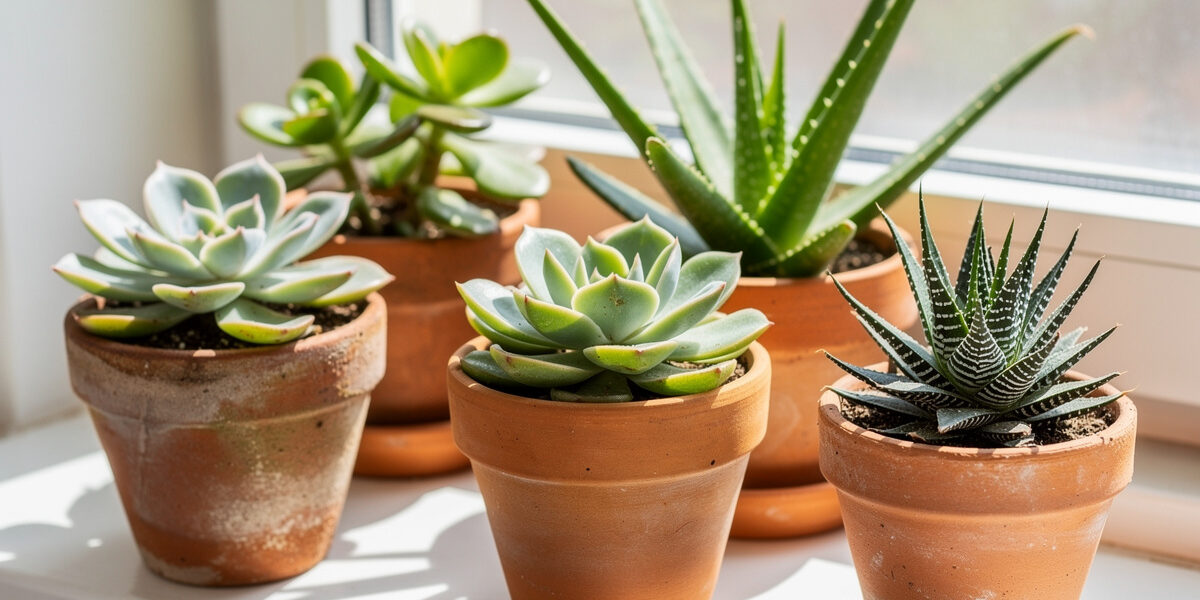
Get the soil right and a succulent becomes nearly impossible to kill; get it wrong and it rots from the roots up. The most common cause of succulent death is root rot from soil that stays wet too long. Unlike tropical plants that evolved with constant moisture, succulents store water in their fleshy leaves and stems, so their roots never developed tolerance for waterlogged conditions. This guide provides specific soil formulas, drainage testing methods, and repotting techniques that keep succulents thriving for decades.
As an Amazon Associate I earn from qualifying purchases.
Why Succulents Need Special Soil
Succulents evolved in semi-arid environments with infrequent rainfall and fast-draining soils. Their roots are fine and shallow, designed to absorb water quickly during rare rain events and then dry out completely. When planted in standard potting soil, these roots remain continuously moist, providing perfect conditions for the fungal growth that destroys root tissue — West Virginia University Extension flags overwatering and poor drainage as the most common way to kill a succulent.
The critical difference between succulent soil and regular potting soil is mineral content. Succulent soil should be 50-70% mineral materials like coarse sand, pumice, or perlite. This creates a matrix where water flows through instantly, and air pockets remain even after watering. Indoor plant soil requires similar fast-draining characteristics for tropical epiphytes, but succulents need even more aggressive drainage.
The Ideal Succulent Soil Recipe
Commercial succulent mixes vary dramatically in quality. The best homemade succulent soil combines: 50% coarse sand or poultry grit (3-5mm grade), 25% potting soil, and 25% perlite or pumice. This creates a fast-draining, low-organic environment that mimics desert conditions.
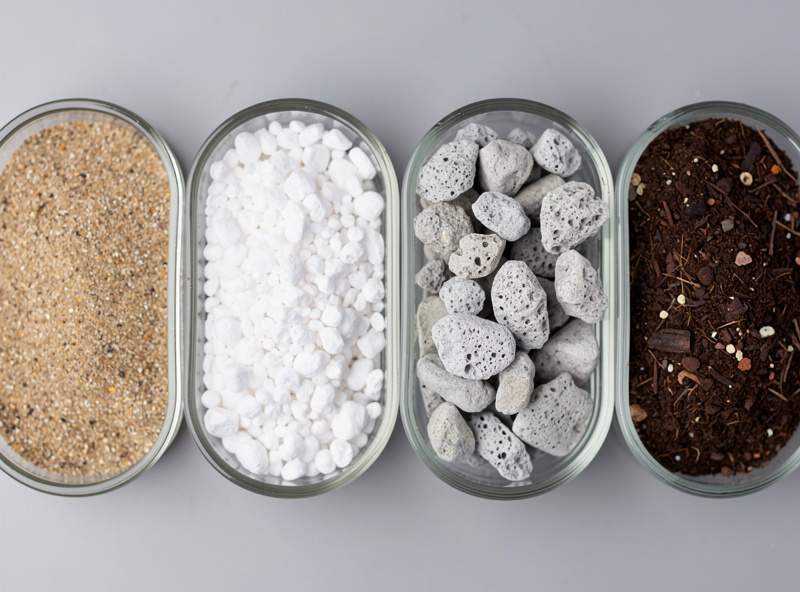
Coarse sand provides weight and drainage while remaining inexpensive. Avoid fine play sand, which packs tightly and defeats the purpose. Poultry grit (crushed granite) works as well as sand and adds mineral variety. Perlite provides additional air space and prevents any remaining compaction. Pumice is more durable than perlite but costs more.
Grit Types for Succulents
Different minerals provide different benefits. Coarse sand is affordable and effective but can compact over time. Poultry grit provides angular edges that create better air pockets than rounded sand grains. Pumice is lightweight, porous, and long-lasting, making it ideal for valuable specimen plants. Calcined clay (like Turface) absorbs moisture and provides slow-release minerals.
For a mixed collection, prepare multiple bags of soil with different mineral ratios: 50% mineral for standard succulents, 70% mineral for extremely drought-tolerant species like lithops, and 40% mineral for semi-succulents that tolerate more moisture like some aloes.
| Grit Type | Drainage | Durability | Cost | Best Use |
|---|---|---|---|---|
| Coarse Sand | Fast | High | Low | Standard succulents |
| Poultry Grit | Very Fast | High | Medium | All succulents |
| Pumice | Fast | Very High | High | Specimen plants |
| Perlite | Fast | Medium | Low | Mixed collections |
Not Every Succulent Wants the Same Mix
The single recipe above covers the classic windowsill rosettes — echeveria, sempervivum, most sedums — but “succulent” spans plants from at least a dozen unrelated families, and treating them identically is how I lost my first haworthia. It sat in the same 50% grit mix as my echeverias and slowly starved, because haworthia and gasteria are shade-floor plants with thicker roots that appreciate a touch more organic matter and a little more moisture between dry-downs. They get my 40% mineral blend now and have been steadily offsetting ever since.
At the other extreme sit the true desert specialists. Lithops and other living stones want the leanest mix I make — around 70-80% mineral — and essentially no water at all during their split-and-renew cycle. Most globular cacti sit close behind at 60-70% mineral. And then there is the trap category: holiday cacti. A Schlumbergera looks like a desert plant but is an epiphyte from Brazilian forest branches, and it wants a moisture-retentive, organic-rich mix closer to orchid conditions than to anything else in this article. Clemson’s indoor cacti factsheet draws exactly this line between desert and epiphytic types. My rule when a new plant arrives: identify the genus before mixing the soil, not after the leaves start telling me I guessed wrong.
Testing Soil Drainage
Before planting any succulent, test your soil drainage. Fill a pot with the intended mix, water thoroughly, and time how long until water stops dripping from the bottom. For succulents, drainage should be nearly immediate, definitely under 30 seconds. If water pools on the surface or takes minutes to flow through, add more coarse sand or perlite.
This simple test accounts for your specific pot shape, humidity, and watering habits better than any generic recommendation. Container gardening requires this kind of adjustment based on actual conditions rather than formula labels — and if you are tempted to dig soil from outside instead of mixing your own, my potting soil vs garden soil comparison explains why that ends badly in any pot, let alone a succulent’s.
Repotting Succulents
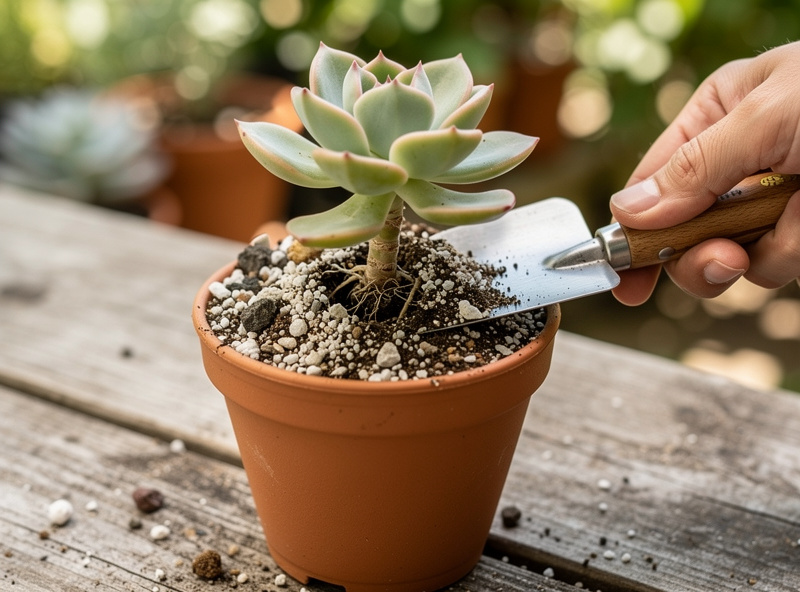
Succulents need repotting every 2-3 years as soil degrades and roots expand. Choose pots only slightly larger than the current root ball. Terra cotta pots are ideal because they breathe, helping soil dry faster. Always use pots with drainage holes at least 1/2 inch in diameter.
Remove the plant gently and inspect roots. Trim any brown, mushy, or smelly roots with clean scissors. Allow cuts to callous for 24 hours before replanting to prevent fungal infection. Add fresh soil to the pot, place the plant at the same depth it grew previously, and resist watering for 5-7 days to allow roots to settle.
Watering After Repotting
The biggest mistake after repotting succulents is watering immediately. Newly transplanted succulents need time for damaged roots to heal before encountering moisture. Wait 5-7 days after repotting before the first watering, then water deeply until it flows from drainage holes. Do not water again until the soil is completely dry and the plant shows slight wrinkling.
Succulents communicate water needs through their leaves. Well-hydrated succulents have firm, plump leaves. When they need water, leaves become slightly soft and may show minor wrinkles. Unlike tropical houseplants that wilt dramatically when thirsty, succulents show subtle signs that require attentive observation.
Propagation Soil: Leaves and Cuttings Want It Even Leaner
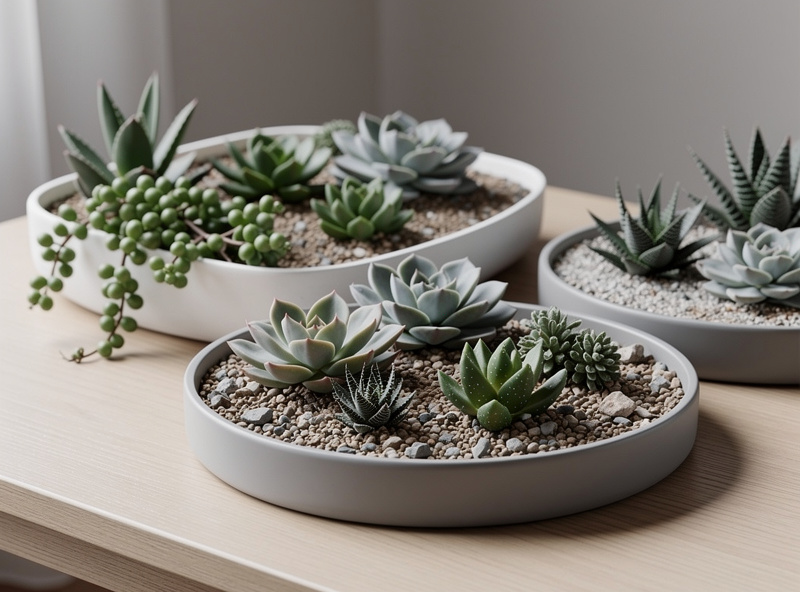
Half my collection came free from leaves and offsets, and propagation is where succulent soil rules get taken to their extreme. A detached leaf or fresh cutting has no roots to rot, but the wound is an open door for fungus, so the sequence matters more than the mix: let the cut end dry and callous for a few days before it touches soil at all. Illinois Extension’s propagation guide puts that callousing step at anywhere from a couple of days for thin leaves to longer for thick cactus pads, and skipping it is the main reason leaf propagation fails.
My propagation tray runs a leaner, finer version of the standard recipe — roughly 70% fine grit and perlite over 30% sieved potting soil — because new roots are hair-thin and push more easily through fine, open material. Leaves lie on top of the mix, not buried, and get a light misting every few days once roots appear; cuttings stand upright in barely-damp mix and wait. Patience is the real ingredient: through a Nordic winter a leaf can sit for six weeks before showing roots, and the worst thing you can do in that window is water it into rotting. I start mine in spring under the grow-light shelf instead, where the extra light halves the sulking time.
Feeding a Plant That Lives in Gravel
A mix that is two-thirds stone holds very little nutrition, and people conclude from the plants’ survival that succulents need none at all. They need little, not none. Extension guidance is consistent on the pattern: a low-nitrogen fertilizer at half the label rate, applied only during the spring and summer growing months, and nothing at all through winter dormancy. In my kitchen that translates to two or three feedings a year — one when the light returns properly in April, one in midsummer — using a quarter-to-half-strength balanced liquid feed in the watering can. Overfeeding shows up fast in succulents as soft, stretched, blistered growth that ruins the compact form; underfeeding shows up slowly as stalled growth and washed-out colour. Given how asymmetric those failure modes are, I always round the dose down.
Succulent Soil Mix for a Nordic Windowsill
Succulents on a Nordic windowsill face a problem the desert never posed: the dry winter air from radiators pulls moisture out of the soil faster than the plants can use it, yet the low winter light means the plants are barely growing, so overwatering is still the number one killer. The mix I run is equal parts coarse sand, perlite, and commercial cactus mix, and the plants get watered only every two to three weeks through the dark months. The lean mix and infrequent watering keep the roots dry enough that rot never sets in, and the plants make it through the long winter without etiolating or collapsing.
The counterintuitive part is that the cold windowsill is an asset, not a problem. Clemson’s guidance puts ideal winter temperatures for dormant cacti at a cool 45-55°F (roughly 7-13°C), and the microclimate between the glass and the curtain of a Swedish window in January sits close to that range for free. A cool, barely-watered succulent hunkers down and holds its shape; a warm one by the radiator keeps trying to grow in four hours of grey daylight and stretches into a pale, leaning ghost of itself. So my succulents winter on the coldest sill in the apartment while the tropical plants get the warm spots — the one arrangement where Nordic winter actually mimics the desert’s cool, dry rest period instead of fighting it. The only caution is contact frost: a leaf pressed against freezing glass on a -15°C night turns translucent and collapses, so everything sits a few centimetres back from the pane. Come March, watering resumes gradually, and the plants wake up compact and unscarred while the ones that spent winter warm and wet — the ones I used to keep — needed beheading and restarting every spring.
Signs Your Succulent Soil Is Wrong
Succulent leaves that turn translucent and mushy are overwatered, and in almost every case the real culprit is soil holding too much moisture rather than how often you water. The test is simple: water the pot, wait a couple of days, and feel the soil down at the drainage hole. If it’s still wet 48 hours after watering, the mix retains too much moisture and needs more coarse sand or perlite before it will ever be safe for a succulent.
Frequently Asked Questions
Can I use regular potting soil for succulents?
Regular potting soil retains too much moisture for succulents and causes root rot within days. Succulent soil must be 50-70% mineral materials like coarse sand, pumice, or perlite. Only extremely drought-tolerant succulents survive in standard potting soil.
What is the best succulent soil recipe?
Mix 50% coarse sand or poultry grit, 25% potting soil, and 25% perlite or pumice. This creates fast-draining conditions that mimic desert environments. Avoid fine sand, which packs and retains too much moisture.
How often should I water succulents in well-draining soil?
Water only when the soil is completely dry and the plant shows slight wrinkles or leaf softening. In summer, this might be weekly. In winter, it might be monthly. Overwatering kills more succulents than underwatering.
Do succulents need special pots?
Terra cotta pots are ideal because they breathe and help soil dry faster. All succulent pots must have drainage holes at least 1/2 inch diameter. Decorative pots without holes trap water and guarantee root rot.
Why are my succulent leaves falling off?
Leaf drop can indicate overwatering (soft mushy leaves), underwatering (thin crispy leaves), or normal aging (lower leaves only). Assess soil moisture and adjust watering accordingly. If the base is mushy, the plant may have root rot.
How do I test if my succulent soil drains fast enough?
Water the soil and time how long until water stops dripping. For succulents, drainage should be nearly immediate, definitely under 30 seconds. If slower, add more coarse sand or perlite to increase mineral content.
Can I use cactus soil for succulents?
Most commercial cactus soil is acceptable but often still too organic. Look for cactus soil with added perlite or coarse sand, or improve it by mixing 50% cactus soil with 50% additional perlite or coarse sand.