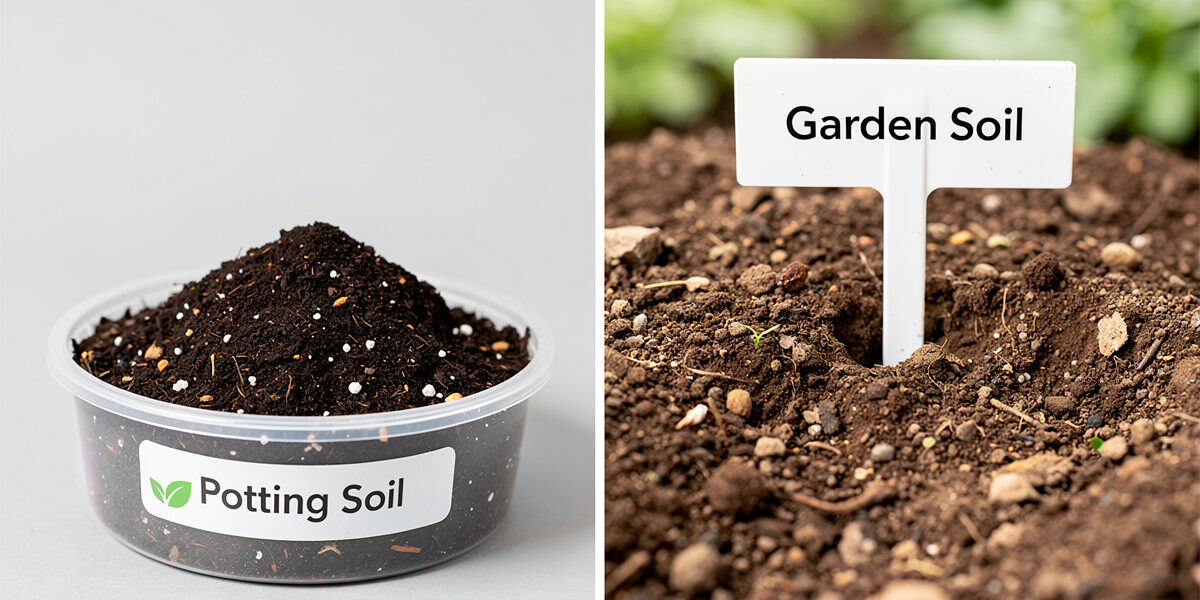
Choosing between potting soil and garden soil determines whether your container plants thrive or struggle — garden soil packed into a pot is one of the fastest routes to the root rot that kills container plants. These two soil types are not interchangeable. Potting soil is engineered for containers, while garden soil is meant for in-ground use. This guide explains when to use each and how to amend either for specific growing situations.
As an Amazon Associate I earn from qualifying purchases.
What Is Potting Soil?
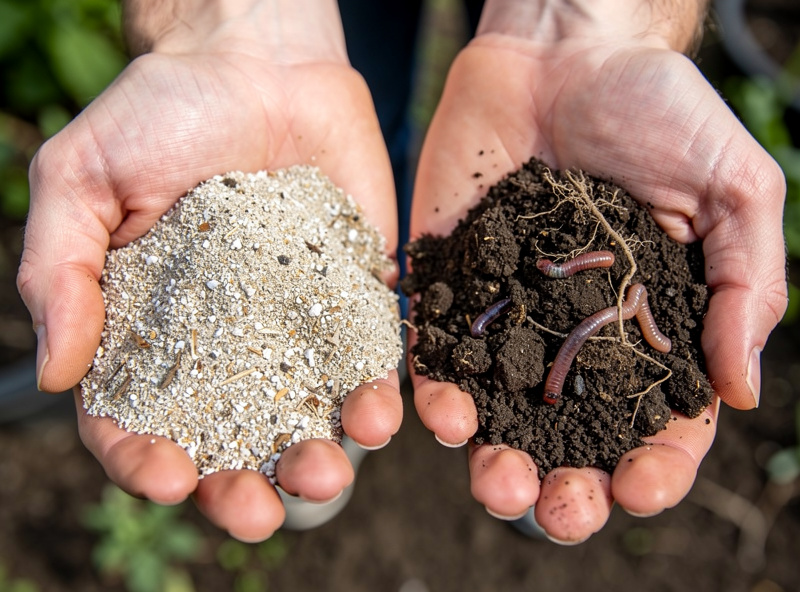
Potting soil is a soilless growing medium specifically formulated for container plants. It contains no actual soil, instead combining peat moss or coco coir, perlite or pumice, and compost or worm castings. This sterile, lightweight mixture provides drainage, aeration, and nutrition in proportions optimized for confined root systems.
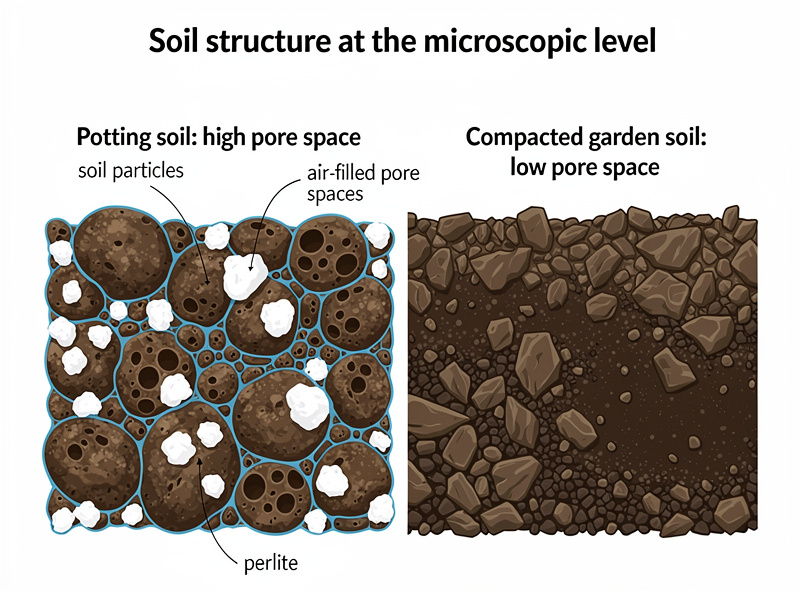
The perlite content creates air pockets that roots need for oxygen. Standard potting soil contains 10-30% perlite, while premium mixes may contain up to 50%. Indoor plant potting mixes typically have even higher perlite content because indoor evaporation rates are lower than outdoors.
Potting soil is sterile, meaning it contains no weed seeds, pathogens, or harmful microorganisms. This prevents soil-borne diseases like Fusarium wilt and Verticillium that persist in garden soil. Sterility also means potting soil lacks beneficial microorganisms until you add them through compost or amendments.
What Is Garden Soil?
Garden soil is native topsoil that has been amended with compost and other organic matter. It contains the full ecosystem of microorganisms, fungi, and invertebrates that support plant health in natural conditions. Garden soil connects with the underlying earth, providing deeper root exploration and natural moisture regulation through capillary action.
The composition of garden soil varies dramatically by location. Clay soils dominate in areas with poor drainage. Sandy soils prevail in coastal regions. Loam, the ideal balance of sand, silt, and clay, develops over centuries in undisturbed areas with balanced vegetation. Understanding your specific soil type is the first step to improving it.
Garden soil harbors beneficial organisms that potting soil lacks. Mycorrhizal fungi form symbiotic relationships with 90% of plant species, extending root systems and improving nutrient uptake. Earthworms aerate soil and create castings rich in nitrogen, phosphorus, and potassium. These organisms take years to establish in potting soil but are naturally present in healthy garden soil.
Key Differences Between Potting Soil and Garden Soil
The critical differences come down to five factors: drainage, weight, sterility, nutrients, and ecosystem.
Drainage: Potting soil drains far faster than garden soil when confined to containers. Garden soil in containers becomes waterlogged within days because it lacks the perlite and coarse materials that create fast drainage channels.
Weight: A soilless potting mix is dramatically lighter than the same volume of mineral soil — a sack of coir-perlite mix lifts with one hand, while the equivalent volume of moist garden soil is a two-person job. For rooftop gardens, balconies, or elevated beds, that difference is not a convenience, it is a structural constraint.
Sterility: Potting soil is sterile and disease-free. Garden soil contains both beneficial and harmful organisms, requiring careful management to prevent disease buildup.
| Property | Potting Soil | Garden Soil |
|---|---|---|
| Weight | Light, fluffy, soilless | Heavy mineral fraction, heavier wet |
| Drainage in containers | Fast (under 1 min) | Slow (days) |
| Sterility | Sterile | Contains organisms |
| Nutrient availability | Immediate | Slow-release |
| Reuse | Single season | Years with care |
Reading the Bag: What the Labels Actually Mean
The garden centre shelf makes this whole decision harder than it needs to be, because the product names sound interchangeable and are not. After years of buying (and mis-buying) these bags, here is how I decode them. “Topsoil” is the cheapest and crudest — screened mineral soil of wildly varying quality, meant for filling holes and levelling ground, never for pots. “Garden soil” is topsoil blended with some organic matter, intended to be dug into in-ground beds as an amendment; the bag rarely says so plainly, but it is a soil improver, not a growing medium. “Raised bed mix” sits in between — heavier than potting mix, lighter than soil, designed for large open-bottomed volumes. “Potting mix” or “potting soil” is the only one engineered to be the entire root environment in a closed container.
The reason the distinction matters is physics, not marketing. As University of Maryland Extension explains in its growing-media guide, containerized roots depend on a small volume of medium where water must push air out of the pore spaces and then drain away fast enough for fresh air to return — if it cannot, roots suffocate. Bagged garden soil has pore structure suited to open ground, where gravity and depth do the draining. Sealed into a pot, that structure fails. So my shorthand at the shelf: if the plant’s roots will be enclosed, only the word “potting” will do.
The Peat Question: What Actually Fills the Bag
Most potting mixes are built on one of two backbones — peat moss or coco coir — and having run both side by side in identical containers for several seasons, I have opinions. Peat is the traditional base: it holds water beautifully and is slightly acidic, which suits most vegetables once limed. Its weaknesses are practical and environmental. Practically, peat is hydrophobic when it dries out completely — water beads off the surface and runs down the pot walls while the root ball stays bone dry, a miserable failure mode on a hot balcony. Environmentally, peat is dug from bogs that took centuries to form, which is why several countries are phasing out peat in hobby composts.
Coir — processed coconut husk — rewets easily even from dead-dry, resists compaction noticeably better across a season of daily watering, and comes as compressed bricks that store flat, which matters in an apartment with no shed. Its quirks: it holds potassium and can carry salt residues, so cheap unwashed coir sometimes needs a rinse, and its near-neutral pH means acid-loving plants need adjusting the other way. My verdict after running both: coir for containers I water daily, peat-based bagged mix only when I need its lower price for big spring volumes — and every year the coir share of my balcony grows.
When to Use Potting Soil
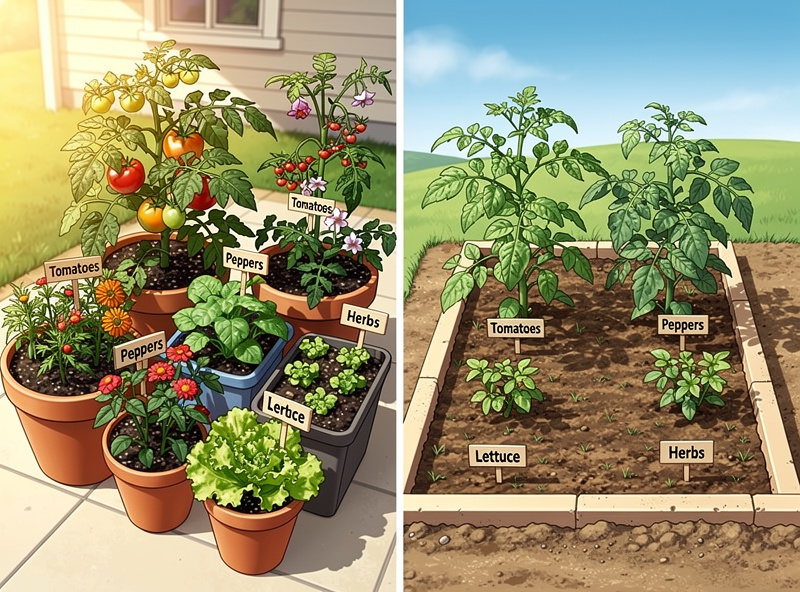
Use potting soil for all container gardening, raised beds, indoor plants, seed starting, and anywhere plants grow above ground level. Containers require the fast drainage and lightweight properties that only potting soil provides — Illinois Extension is blunt about it: never use garden soil by itself in a container, because drainage and aeration are severely impeded no matter how well it grows in the ground. Raised beds work best with potting soil or specially formulated raised bed soil, not raw garden soil.
For raised beds, Mel Mix or similar soilless combinations outperform garden soil because raised beds drain faster than ground-level soil. Raised bed soil formulas balance drainage with moisture retention to support intensive planting.
When to Use Garden Soil
Use garden soil for in-ground planting, filling raised beds if you have excellent native soil, and areas where you are building new beds over multiple seasons. Garden soil benefits from the capillary connection to underlying earth, which provides moisture during dry spells and allows roots to explore deeper soil profiles.
Amend garden soil with 2-3 inches of compost annually to maintain organic matter levels above 5%. This supports the beneficial organisms that make garden soil superior to potting soil for in-ground growing. Composting and cover cropping rebuild garden soil faster than waiting for natural processes.
One northern-specific note: much of Scandinavia gardens on heavy glacial clay or thin, stony moraine, and neither is the loam the seed-packet instructions imagine. If your in-ground soil forms a shiny ribbon when you squeeze a moist handful, patience beats products — annual compost additions improve clay structure steadily over several seasons, while a single season of tilling sand into it risks creating something closer to concrete. That slow timeline is, honestly, half the reason my serious growing happens in containers and raised beds instead: a mixed medium is right on day one, while the ground takes years to earn the same trust.
Can You Mix Potting Soil and Garden Soil?
Mixing potting soil and garden soil is possible but not always beneficial. For containers, never add garden soil because it compacts and destroys drainage. For in-ground amendment, potting soil adds expense without benefit since soil organisms and natural drainage handle the job.
The exception is when establishing new raised beds over poor native soil. Some gardeners add 10-20% garden soil to potting mix to introduce beneficial microorganisms. However, quality potting soil already contains all necessary components for plant health, making garden soil unnecessary.
Why Garden Soil Kills Container Plants
Garden soil in a container turns into a brick within a month of daily watering. The clay particles settle, the drainage channels collapse, and the root zone goes anaerobic. My first season of container tomatoes in garden soil produced four stunted green marbles on a plant that looked like it had survived a war. Potting mix, engineered with peat or coir and perlite, holds its structure through an entire season of daily watering. The difference is visible after two weeks: the garden-soil pot forms a hard crust on top and water pools on the surface, while the potting-mix pot drinks the water immediately and the soil stays crumbly to the touch.
Seed Starting: Where the Wrong Choice Hurts Most
If there is one place the potting-versus-garden-soil decision is absolutely unforgiving, it is the seed tray. Seedlings are the most vulnerable thing you will ever grow: a stem the width of a thread, no energy reserves, and no resistance to the damping-off fungi that live in every gram of garden soil. Sow into garden soil and you can watch a full tray of healthy seedlings topple at the soil line in forty-eight hours — I did exactly that with my first spring of kale starts, and the speed of the collapse is what converts people to sterile media forever.
Under my grow-light shelf every seed now starts in a fine, sterile seed-starting mix — essentially a sifted, low-nutrient potting mix — and moves up to richer container mix only after the first true leaves appear. The sterile start costs almost nothing because a small bag sows hundreds of cells, and in a short Nordic season where every indoor start in March is irreplaceable, losing a tray does not mean resowing, it means losing three weeks you cannot get back before the last frost. Garden soil has real virtues in the ground; a seed tray exposes every one of its vices at once.
Frequently Asked Questions
Can I use garden soil in containers?
No, garden soil should never be used alone in containers. It compacts when confined, reducing oxygen and creating poor drainage that leads to root rot. Use potting soil specifically formulated for containers, or create your own mix with 2 parts peat moss or coco coir, 1 part perlite, and 1 part compost.
Can I use potting soil in my garden?
Yes, but it is unnecessarily expensive for in-ground use. Potting soil provides excellent results when used as a soil amendment at 20-30% volume, but pure potting soil eliminates the beneficial organisms and capillary action that make garden soil superior for in-ground growing.
What is the difference between potting soil and garden soil?
Potting soil is a soilless, sterile, lightweight mix containing peat moss, perlite, and compost designed for containers. Garden soil is native topsoil amended with organic matter, containing microorganisms and connected to underlying earth for natural moisture regulation.
Why does potting soil drain faster than garden soil in containers?
Potting soil contains 10-50% perlite, creating air pockets that allow water to flow through instantly. Garden soil has no perlite and compacts in containers, filling pore spaces with water that cannot drain.
Which is better for raised beds, potting soil or garden soil?
Use potting soil or Mel Mix formula in raised beds for best results. Mel Mix combines equal parts peat moss, vermiculite, and compost, creating optimal drainage and nutrition for raised bed vegetables.
How do I improve clay garden soil?
Add 2-3 inches of coarse sand and 2-3 inches of compost annually. Gypsum loosens clay without changing pH. Within 2-3 seasons, clay soil becomes workable and drains properly.
Can I reuse potting soil from last year?
Reuse potting soil for the same plant type if the plant was healthy. Add 25% fresh compost and 10% perlite to replenish nutrients and restore drainage. Discard soil from plants that died of disease.