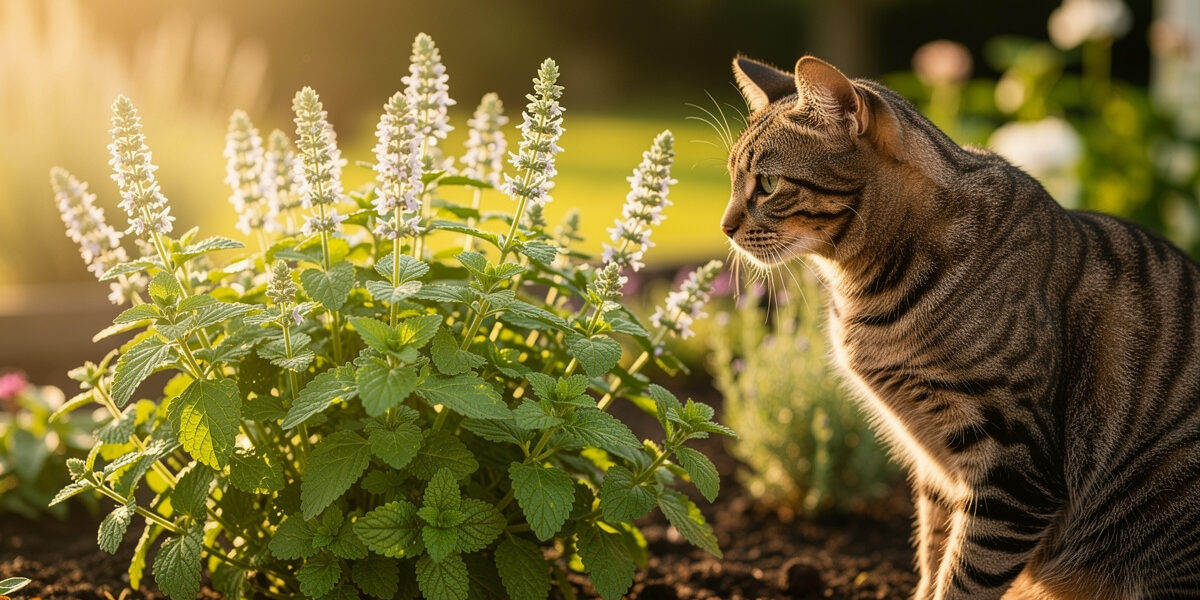
Catnip is about as foolproof as herbs get, which is exactly why I like it: it’s a tough perennial that comes back every spring even after a hard Nordic winter, shrugs off poor soil, and asks almost nothing of you once it’s in. One plant gives you enough fresh and dried leaf to keep a cat happy all year — and as a bonus it’s a genuinely effective mosquito repellent (lab studies have found its active compound, nepetalactone, as much as ten times more effective than DEET against Aedes aegypti). Here’s how I grow it, how to stop it taking over, and how to get the most out of it for both cats and people.
A quick note: some links below are affiliate links — if you buy through them I may earn a small commission at no extra cost to you. I only point to things I’d use myself. Details on my disclaimer page.
Catnip Varieties Worth Growing
Common catnip (Nepeta cataria) is the one that drives cats wild — bushy, a little sprawling, to about 60–90 cm, with the highest nepetalactone of the lot. Plant this if cat enrichment is the goal, and grab true catnip seed rather than ornamental catmint. Lemon catnip (‘Citriodora’) is a citrus-scented version cats still enjoy that makes a nicer tea for us. And don’t confuse either with catmint (Nepeta x faassenii) — it’s prettier in a border with neat blue-purple flowers, but its nepetalactone is much lower, so the cat response is weak. Showy border plant: catmint. Potent cat herb: true catnip.
When and Where to Plant
Plant in spring after the last frost, or in early autumn at least six weeks before the first. Catnip wants full sun but copes with partial shade (4–6 hours), making it more forgiving than lavender or the other Mediterranean herbs. It grows in almost any soil at pH 6.0–7.5 and — usefully — makes more aromatic oil in moderately poor, well-drained ground than in rich beds. Over-feed it and you get tall, floppy, weak-scented plants, so keep it lean.
Pick the spot carefully, because catnip self-seeds prolifically and spreads by runners. The simplest answer, and the one I use, is a pot — a container ends the spreading question entirely. More on containment below, and on pots in my container gardening guide.
Growing Catnip From Seed
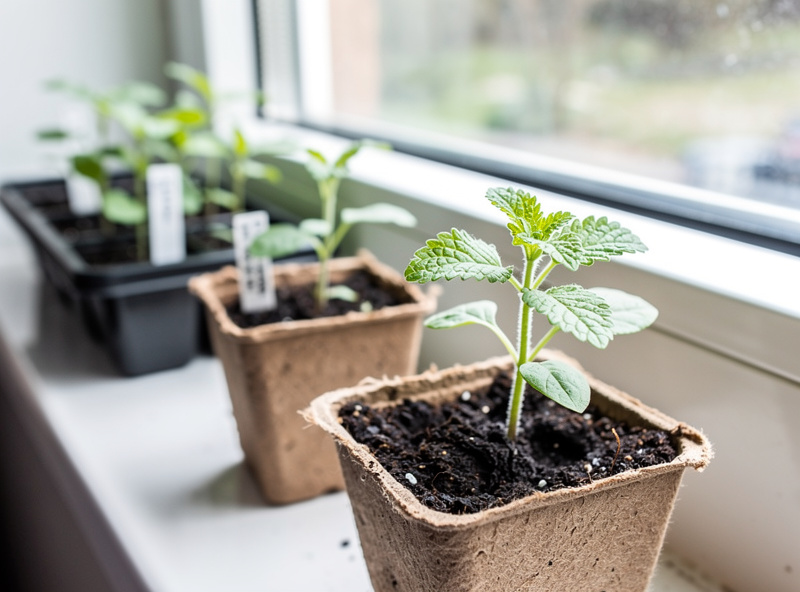
Seeds germinate in 7–14 days at around 15–21°C (60–70°F). Start indoors 6–8 weeks before your last frost, and surface-sow — catnip needs light to germinate, so press the seed gently onto moist mix without burying it. Mist daily until it’s up. Seedlings are tiny for the first couple of weeks then take off once the true leaves appear; harden off and plant out 45–60 cm apart after frost. You can also direct-sow outdoors once it’s warm. For the seed-starting detail, see my indoor seed starting guide.
Planting Transplants
Nursery plants or divisions are the fastest route — plant at the same depth they grew, 45–60 cm apart for a border or 30 cm for a dense patch. Water deeply at planting and weekly for the first month; after that catnip is seriously drought-tolerant and only needs water in long dry spells. Err dry — overwatering gives weak, disease-prone growth. One warning if you have outdoor cats: cage new transplants with wire for the first few weeks, because cats will roll on and flatten young plants before they’re tough enough to take it. Once a plant is 20–25 cm tall and rooted in, it bounces back from any amount of feline enthusiasm.
Containing the Spread
Catnip travels by both seed and underground runners, so containment matters unless you want it everywhere. Two things do it. Deadhead every flower spike before the seed matures — cut as the flowers fade — and you’ve stopped about 90% of the spread. For the runners, sink a bottomless pot or rigid barrier about 30 cm into the ground, or simplest of all, grow it in a large freestanding pot on the patio, which ends both seed and runner spread for good. The pot is how I grow mine.
Harvesting for Maximum Potency
Harvest just as the flower buds begin to open, before full bloom — that’s peak nepetalactone, noticeably stronger than leaf taken before or after flowering. Cut whole stems 10–15 cm above the ground and the plant reflushes within a month or so, giving two or three harvests a season. Dry it by hanging small bundles upside down somewhere dark, warm, and airy for about a week; when it crumbles easily and smells strongly minty, strip the leaf and flower and store in sealed glass jars away from light. It keeps its kick for 6–12 months.

Using Catnip for Cat Enrichment
Only about half to two-thirds of cats respond to nepetalactone — the trait is genetic, so roughly half simply lack the receptor and won’t react no matter how potent the catnip. If yours is one of the responders, sprinkle a pinch of dried leaf on a scratching post, stuff it into a refillable catnip toy, or just scatter it on the floor. The high lasts 5–15 minutes, then there’s a 30–60 minute reset where more catnip does nothing — that’s normal, not habituation.
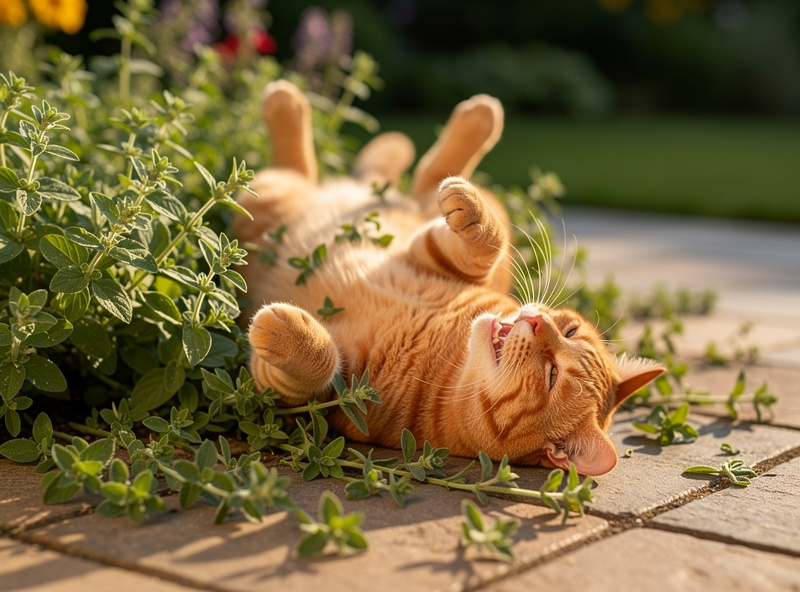
Fresh leaf straight from the plant works too — many people keep a cat-accessible patch and let the cat self-serve (you’ll need three or four mature plants so it survives the attention). And if your cat is one of the non-responders, don’t give up on enrichment: silvervine triggers a response in many cats that ignore catnip entirely, and it’s well worth trying.
Catnip as a Mosquito Repellent
The mosquito claim is real and sourced: research in the Journal of Medical Entomology found catnip oil repelled Aedes aegypti mosquitoes around ten times more effectively than DEET at equivalent concentrations, which makes it one of the most potent botanical repellents known. Plant it near seating, doorways, and patios; the effect is strongest when the leaves are bruised, so brushing past or crushing a leaf releases the oils. Rubbing fresh leaf on skin gives short personal protection (30–45 minutes). It pairs naturally with lavender, which deters mosquitoes through different compounds.
Companion Plants
Catnip sits happily with other tough perennial herbs that like the same lean, well-drained conditions — lavender, sage, oregano, creeping thyme as a groundcover beneath it, and bee balm for pollinators. Keep a buffer of about 60 cm between catnip and delicate seedlings, since visiting cats may flatten neighbours mid-roll; a row of comfrey makes a good barrier between a catnip patch and the veg beds.
Common Problems
Flea beetles pepper spring leaves with tiny holes — cosmetic only, and a floating row cover over young plants stops it if it bothers you. Powdery mildew shows as white patches in humid, still air; thin crowded stems for airflow and don’t water overhead. The biggest real problem is simply cat damage to young plants — cage them until established, and by the second year the plant regenerates faster than any cat can wreck it.
Frequently Asked Questions
Is catnip safe for cats?
Yes. Catnip is completely non-toxic and non-addictive for cats. The behavioral response lasts 5 to 15 minutes followed by a natural refractory period. Cats cannot overdose on catnip, and the ASPCA confirms it is safe.
Can humans drink catnip tea?
Yes. Catnip tea has a mild minty flavor and has been used for centuries as a gentle sedative and digestive aid. Steep 1 to 2 teaspoons of dried catnip in hot water for about 10 minutes. It is generally recognized as safe.
How do I stop catnip from spreading?
Deadhead all flower spikes before the seed matures to prevent self-seeding, and sink a bottomless pot about 30 cm deep around the plant to contain underground runners. Growing it in a freestanding container eliminates both seed and runner spread entirely.
Does catnip come back every year?
Yes. Catnip is a hardy perennial (USDA zones 3 to 9) that returns reliably each spring, even after a cold winter. Established plants live 3 to 5 years and self-seed freely, so new plants replace ageing ones unless you deadhead the flowers.
Why does my cat not react to catnip?
Roughly a third to a half of cats lack the genetic receptor for nepetalactone and show no response, and kittens under about 6 months rarely react. If your cat ignores catnip, try silvervine instead – it triggers a similar response in many cats that are immune to catnip.
Does catnip really repel mosquitoes?
Yes. Research published in the Journal of Medical Entomology found catnip oil repelled Aedes aegypti mosquitoes around ten times more effectively than DEET at equivalent concentrations. The effect is strongest when the leaves are crushed, so plant it near seating areas and brush against it.