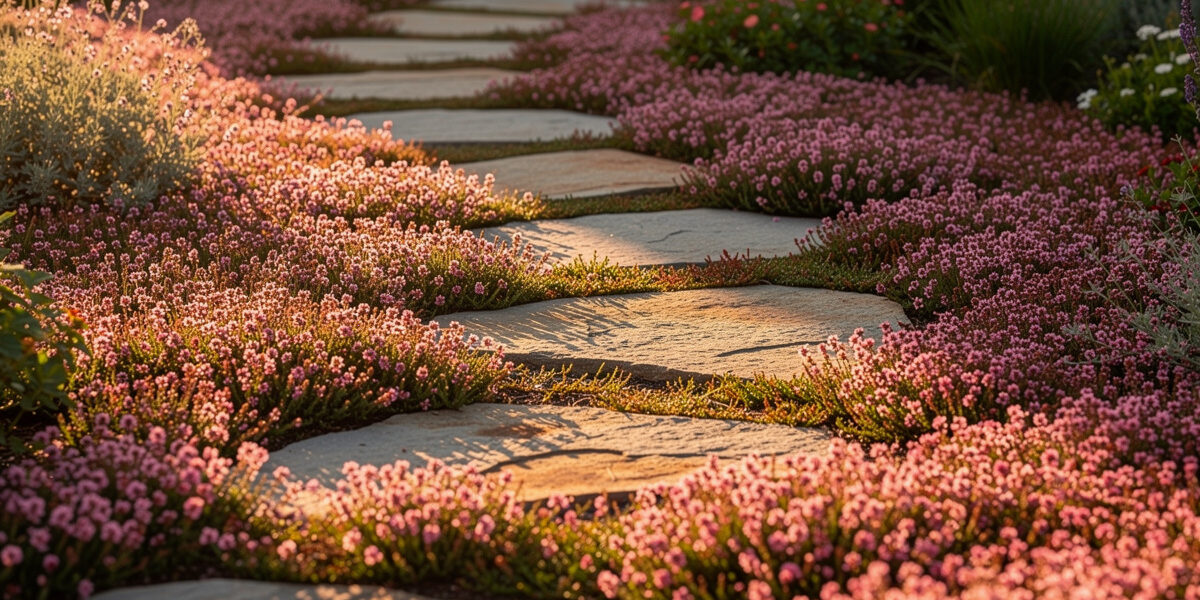
Creeping thyme is one of the toughest, most rewarding plants I grow — a hardy, drought-shrugging groundcover that turns bare ground, stepping-stone gaps, and dry slopes into a fragrant mat barely 3 cm tall, covered in pink, purple, or white flowers through high summer and humming with bees. It survives a hard Nordic winter without blinking, actually prefers poor, well-drained soil over rich, and once established it crowds out weeds and takes light foot traffic. Thymus serpyllum spreads 15–30 cm a year into a dense carpet with no mowing, ever. Here’s how I plant it for fast cover and keep it thriving.
A quick note: some links below are affiliate links — if you buy through them I may earn a small commission at no extra cost to you. I only point to things I’d use myself. Details on my disclaimer page.
Unlike traditional grass lawns that demand weekly mowing, fertilizing, and consistent watering, creeping thyme needs almost no maintenance once established. It thrives in the same full-sun, well-drained, lean-soil conditions that Mediterranean herbs prefer, making it an ideal ground cover companion for lavender, rosemary, and sage plantings. This guide covers species selection, site preparation, planting methods, spacing for fast coverage, and care through the first two seasons.
Creeping Thyme Species and Cultivar Selection
Three creeping thyme species dominate the ground cover market, and choosing the right one prevents the most common disappointment: expecting a flat carpet and getting a 6-inch mound instead. Thymus serpyllum (wild thyme) is the most widely available true creeping species, staying between 1 and 3 inches tall with a spreading habit.
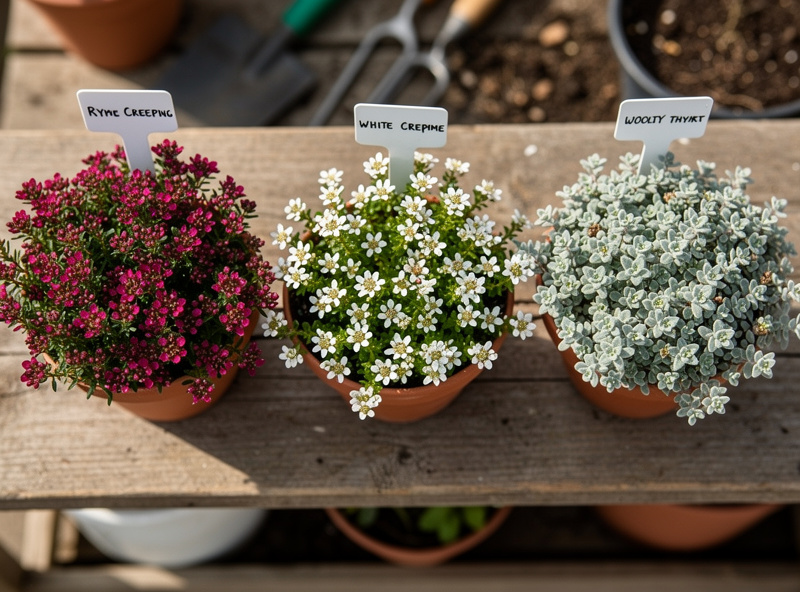
Red Creeping Thyme (T. serpyllum ‘Coccineus’) produces deep magenta-pink flowers and is the most popular cultivar for pathway borders and stepping stone infill. It reaches 2 to 3 inches tall and spreads vigorously to form a solid mat within 2 growing seasons from plants spaced 8 inches apart.
Elfin Thyme (T. serpyllum ‘Elfin’) is the flattest cultivar at just 1 to 2 inches, ideal for between stepping stones where even 3 inches of height would be noticeable. It spreads more slowly than Coccineus but produces an extremely tight, moss-like mat. White Creeping Thyme (T. serpyllum ‘Albus’) offers white flowers for contrast in mixed thyme plantings.
Woolly Thyme (T. pseudolanuginosus) is often sold as creeping thyme but differs significantly. Its fuzzy gray-green leaves create a beautiful texture, but it tolerates less foot traffic and does not flower as heavily. Use woolly thyme for ornamental areas without foot traffic and T. serpyllum cultivars for walkable ground cover.
Where to Plant Creeping Thyme
Creeping thyme needs at least 6 hours of direct sunlight daily and well-drained soil. It will not survive in shade or waterlogged conditions. The ideal locations include gaps between stepping stones or pavers, borders along gravel paths, slopes and banks prone to erosion, rock garden pockets, and edges of raised beds.
Avoid planting creeping thyme in areas that receive regular irrigation from adjacent lawn sprinklers or near downspouts where water collects. The combination of constant moisture and dense foliage mat creates ideal conditions for root rot and fungal diseases. If your intended site stays wet after rain for more than a few hours, either improve drainage with added grit or choose a different location.
Creeping thyme handles light to moderate foot traffic surprisingly well. Walking across an established thyme mat releases the aromatic oils and creates a pleasant fragrance experience. However, it cannot withstand the concentrated daily traffic of a primary walkway used dozens of times per day. Position it as infill between pavers where occasional stepping occurs, not as a high-traffic pathway replacement.
Soil Preparation for Creeping Thyme
Creeping thyme prefers lean, gravelly, well-drained soil with a pH between 6.0 and 8.0. Rich garden soil with heavy organic matter produces tall, floppy growth rather than the tight, carpet-like mat that makes creeping thyme attractive. If your soil is fertile, do not add compost or fertilizer before planting.
For clay soil or any site that holds water after rain, dig out the top 4 to 6 inches and replace with a 50/50 mix of coarse sand and native soil. Adding a 1-inch gravel sub-layer beneath this mix creates a drainage buffer that prevents root-zone saturation during extended wet periods.
For planting between pavers or stepping stones, sweep out any compacted soil or debris from the joints. Fill joints with a mix of 70% coarse sand and 30% fine compost. This provides just enough nutrition for establishment while maintaining the drainage creeping thyme demands. The right soil for herbs applies the same drainage-first principle.
How to Plant Creeping Thyme From Transplants
Nursery transplants in 2-inch or 4-inch pots establish the fastest and most reliably. Plant in spring after the last frost date when soil temperatures reach 60F. Fall planting works in zones 7 and warmer but carries higher winter kill risk in northern zones because roots have less time to establish.
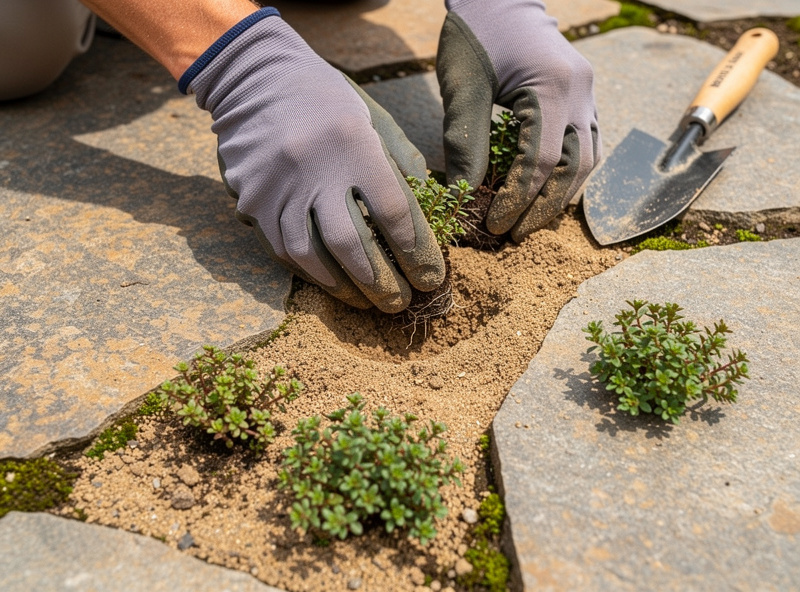
Dig holes slightly larger than the root ball. Set each plant so the crown is level with or slightly above the surrounding soil. Press the soil firmly around the roots to eliminate air pockets. Water deeply immediately after planting and apply a thin layer of fine horticultural grit around each plant to suppress weeds during establishment.
For large-area coverage, buying flats of 2-inch plugs is more cost-effective than 4-inch pots. A flat of 50 plugs costs $25 to $40 and covers approximately 25 to 50 square feet depending on spacing. Larger 4-inch pots run $3 to $5 each but establish faster and fill in with fewer plants.
Spacing for Fast Ground Coverage
Space creeping thyme transplants 6 to 12 inches apart depending on how quickly you want full coverage. At 6-inch spacing, expect a solid mat within one growing season. At 12-inch spacing, full coverage takes 2 growing seasons. The trade-off is cost: tighter spacing requires roughly 4 times more plants per square foot.
For a 100 square foot area, you need approximately 400 plants at 6-inch spacing or 100 plants at 12-inch spacing. The 12-inch spacing is the most practical balance of cost and coverage time for most gardeners. During the gap period before plants fill in, maintain gravel mulch between plants to suppress weeds.
Between stepping stones, plant one 2-inch plug per 6-inch gap, centered in the joint. For larger gaps between flagstones, plant 2 to 3 plugs per gap spaced evenly. The thyme spreads along the stone edges and fills the joint completely within one season in most cases.
Growing Creeping Thyme From Seed
Seed is the cheapest option for large areas but the slowest to establish. Creeping thyme seeds need light to germinate, so they must be surface-sown and pressed into the soil surface without covering. Germination takes 14 to 28 days at soil temperatures of 65 to 70F.
Start seeds indoors 6 to 8 weeks before the last frost date. Surface-sow on sterile seed-starting mix, mist with water, and cover trays with clear plastic to maintain humidity. Place under grow lights providing 12 to 16 hours of light daily. Seedlings are tiny and slow-growing for the first month. Our seed starting guide covers indoor propagation fundamentals.
Direct sowing outdoors is possible in spring after frost danger passes. Scatter seed on prepared soil, press with a board or roller, and keep moist for 3 to 4 weeks until germination. Direct-sown creeping thyme reaches ground cover density in its second year. Expect spotty results compared to transplants because seeds wash away in rain and seedlings cannot compete with established weeds.
First-Year Watering and Care
Water newly planted creeping thyme deeply twice per week for the first month. Reduce to once per week for months 2 and 3. After the first growing season, established creeping thyme needs supplemental water only during extended drought lasting 3 or more weeks.
Weed thoroughly around young plants during the first season. Once the thyme mat closes and forms a dense carpet, it suppresses most weeds on its own. Hand-pull any weeds that emerge through the mat rather than using herbicides, which can damage the thyme.
Do not fertilize creeping thyme. Fertilizer, especially nitrogen, produces loose, leggy growth that lifts off the ground and loses the tight mat character that makes creeping thyme valuable as ground cover. The lean-soil approach produces the densest, most fragrant, most attractive growth.
Pruning and Maintenance After Establishment
After flowering ends in late summer, trim creeping thyme back lightly with hedge shears or a string trimmer set to the lowest height. This removes spent flower stems, promotes fresh basal growth, and keeps the mat dense and tight. The trimming mimics the grazing pressure that keeps wild thyme low in its native Mediterranean meadow habitat.
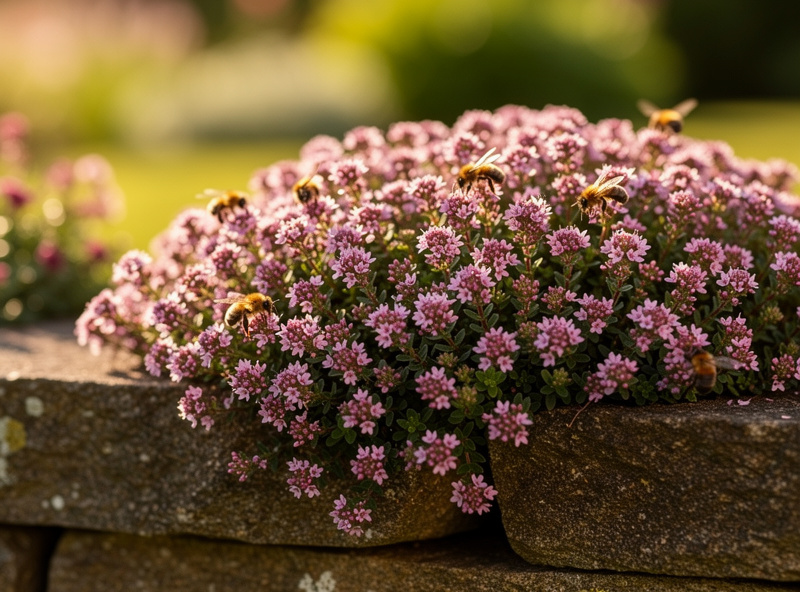
In early spring, remove any dead or brown patches by cutting back to green growth. Small dead spots from winter damage usually fill in naturally by midsummer as surrounding thyme spreads into the gap. Large dead patches (over 12 inches across) may need replanting with fresh plugs.
Creeping thyme is extremely long-lived when established in proper conditions. Expect 10 to 15 years of ground cover from a single planting. Over time, the center of very old plantings may thin out. Divide and replant sections every 3 to 4 years to maintain uniform density across the entire mat.
Companion Planting with Creeping Thyme
Creeping thyme works as an understory ground cover beneath taller upright herbs and perennials. The classic combination is creeping thyme around the base of English lavender plants, where the thyme covers bare soil, suppresses weeds, and creates a graduated height transition from ground level to the lavender mounds above.
Other excellent companions include upright rosemary, ornamental alliums, dwarf iris, sedum, and rock garden plants like sempervivum. Avoid pairing creeping thyme with moisture-loving plants or aggressive spreaders like mint that would either overwater the thyme or smother it. Comfrey grows nearby successfully in slightly richer soil patches, with the thyme serving as the dividing ground cover between planting zones.
Common Problems with Creeping Thyme
Crown rot from overwatering or poor drainage is the primary killer. Symptoms include browning patches that spread outward through the mat, soft stems at soil level, and a musty smell. Improve drainage and reduce watering immediately. Cut out and remove affected sections to prevent spread.
Spider mites occasionally infest creeping thyme during hot, dry summers. Fine webbing on leaf tips and stippled yellow foliage are telltale signs. A strong water spray from a garden hose dislodges mites effectively. Severe infestations respond to insecticidal soap applied in the evening when temperatures drop below 85F.
Rabbit and deer damage is possible but rare because the aromatic oils deter most browsers. If rabbits nibble young transplants before establishment, use temporary chicken wire cloches until plants are large enough to withstand grazing. Established creeping thyme recovers from light browsing within 2 to 3 weeks.
Frequently Asked Questions
Can you walk on creeping thyme?
Yes. Creeping thyme tolerates light to moderate foot traffic. Walking on it releases aromatic oils. However, it cannot handle heavy daily traffic like a primary pathway. Use it as infill between stepping stones.
How fast does creeping thyme spread?
Creeping thyme spreads 6 to 12 inches per year depending on variety and conditions. Plants spaced 12 inches apart form a solid mat within 2 growing seasons. Tighter 6-inch spacing fills in within one season.
Does creeping thyme come back every year?
Yes. Creeping thyme is a hardy perennial surviving winters in USDA zones 4 through 9. Established plants return reliably for 10 to 15 years with minimal care. Small winter-damaged patches fill in naturally by midsummer.
Will creeping thyme choke out weeds?
Established creeping thyme suppresses most weeds by forming a dense mat that blocks light from reaching weed seeds. During the first season before full coverage, manual weeding is still necessary around young plants.
Does creeping thyme need full sun?
Yes. Creeping thyme requires at least 6 hours of direct sunlight daily. In partial shade it produces thin, leggy growth that does not form the dense mat ground cover gardeners expect. Full sun produces the tightest growth.
Is creeping thyme edible?
Yes. Thymus serpyllum is edible with a milder flavor than culinary thyme. The tiny leaves and flowers can garnish salads and drinks. However, most gardeners grow it primarily as ornamental ground cover rather than for cooking.