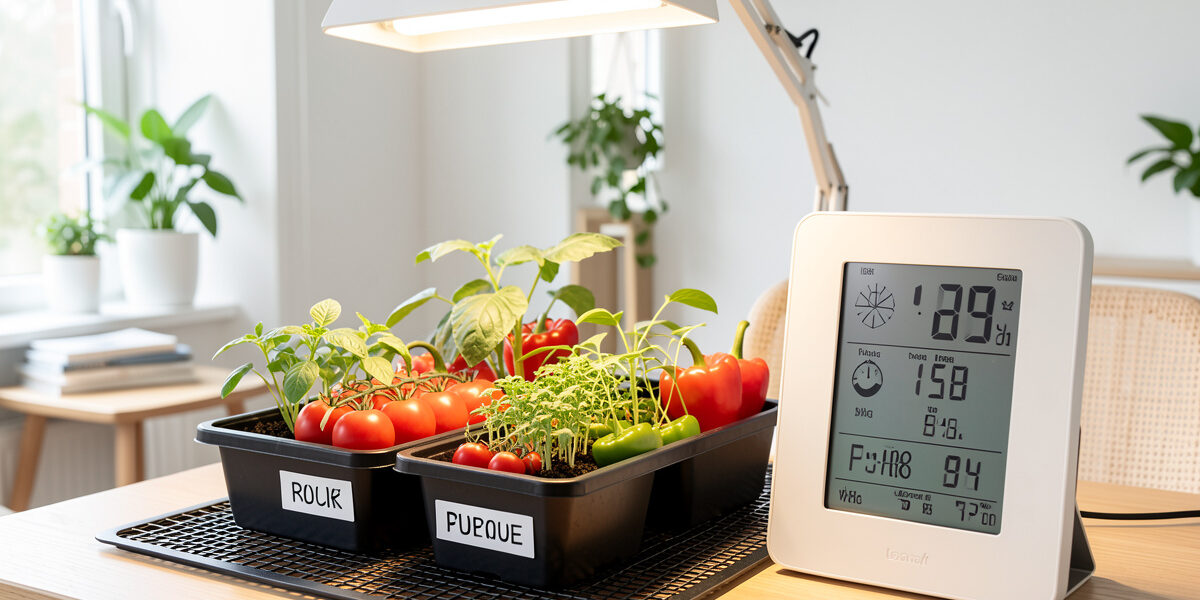
The seedling heat mat temperature that works is crop-specific, not a single number: tomatoes germinate best with the soil around 24–27 °C, peppers and aubergine at 27–29 °C, brassicas at 18–24 °C, and lettuce and spinach cool at 15–20 °C, where a mat can actually hurt them. The mat’s job is to hit the target for the crop you are sowing; the thermostat’s job is to hold it. Set one number for everything and half your flat sits on its hands.
These are the numbers I actually dial in, sowing after sowing, through a Nordic winter where the room never gives the heat-lovers what they want on its own. Germination temperature is the single biggest lever on how fast and how evenly seeds come up — get it right and a pepper is through in five days, get it wrong and it takes three ragged weeks or refuses entirely. Below is my crop-by-crop table, how I group crops so I am not running six mats, and how I verify the soil is really at the number rather than trusting the dial.
What Temperature Should a Seedling Heat Mat Be Set To?
Set the mat to the germination optimum of the crop, measured in the soil, not the air. For a mixed warm-season flat I set the thermostat to about 25 °C, which suits tomatoes well and is close enough for peppers to fire fast. For peppers and aubergine alone I nudge it to 27–28 °C. For brassicas and most vegetables, 20–22 °C is plenty. And for cool-season greens, I take them off the mat entirely.
The key idea beginners miss is that the number is a soil target, not a room target. A bare mat lifts soil roughly 5–10 °C above ambient, so in an 18 °C room a mat might land the soil around 25 °C — fine for tomatoes, a touch cool for peppers. But without a thermostat you are guessing, and a warm room can push the same mat past 32 °C, where germination drops off a cliff. That is why the controller matters more than the mat, a point I make in full in best seedling heat mat, and why the first question is whether the crop even needs a mat, covered in do you need a heat mat for seeds.
Seedling Heat Mat Temperatures by Crop
Here are the germination soil-temperature ranges I work to, crop by crop. These line up closely with the germination-temperature data published by university horticulture programs — the Royal Horticultural Society’s seed-sowing guidance and cold-climate extension charts land in the same ranges — so treat them as well-established, not my invention.
| Crop | Optimal soil temp (°C) | Optimal soil temp (°F) | Heat mat? |
|---|---|---|---|
| Pepper & chilli | 27–29 | 80–85 | Yes — biggest benefit |
| Aubergine | 27–29 | 80–85 | Yes |
| Cucumber | 27–32 | 80–90 | Yes |
| Squash & pumpkin | 27–32 | 80–90 | Yes |
| Tomato | 24–27 | 75–80 | Yes |
| Basil | 21–27 | 70–80 | Helpful |
| Brassicas (kale, cabbage, pak choi) | 18–24 | 65–75 | Optional |
| Onion & leek | 18–24 | 65–75 | Optional |
| Lettuce | 15–20 | 60–68 | No — can stall it |
| Spinach | 10–20 | 50–68 | No — prefers cool |
Read the right-hand column and the pattern is clear: the mat is for the warm-season block at the top, optional in the middle, and a mistake at the bottom. Lettuce and spinach germinate best cool and can enter thermo-dormancy when a mat pushes them above roughly 25 °C — the warmth tells the seed it is midsummer and it refuses. I lost a flat of lettuce this way before I understood it, which is exactly why the greens now germinate on a plain shelf.
How I Group Crops So I Am Not Running Six Mats
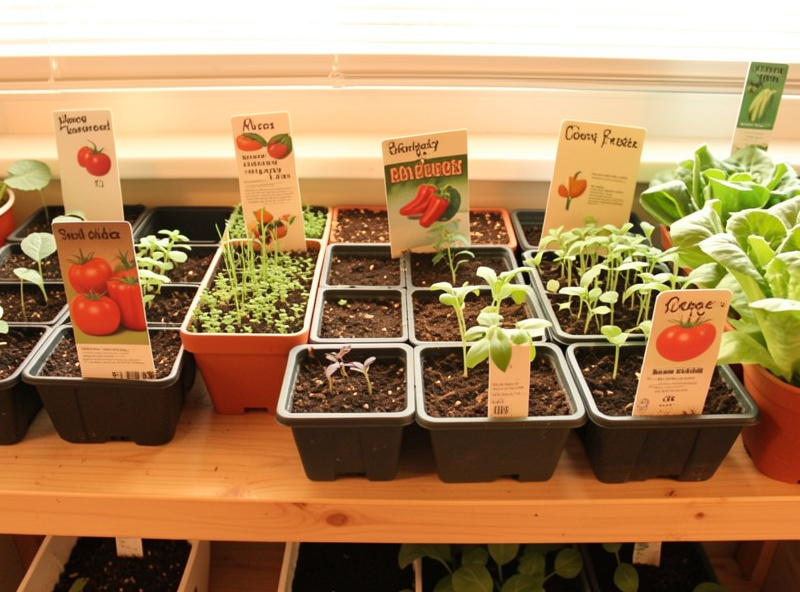
I sow in temperature groups, not crop by crop, so one mat and one setpoint serve a whole flat. The heat-lovers — peppers, aubergine, cucurbits — go together on the mat at around 27–28 °C. Tomatoes and basil, which are happy a little cooler, go together at about 24–25 °C, and I will run them on the same mat as the heat-lovers if I only have one, accepting the peppers are a touch cool rather than cooking the tomatoes. The brassicas and alliums germinate off the mat at room temperature, and the cool-season greens go on a separate shelf entirely.
This grouping is why a single-tray mat is usually enough for an apartment grower: you only need heat during the germination window, so you germinate one temperature group, move it off to the light, and load the next. Timing the groups also matters in a short Nordic season — the slow, warm crops go under the mat first, weeks before the fast greens, because they need the longest head start. I lay out that whole schedule in my seed-starting equipment list, and the crop-specific walkthroughs for starting peppers from seed indoors and starting tomato seeds indoors both build on these temperatures.
Why Soil Temperature, Not Air Temperature, Is What Counts
Seeds respond to the temperature of the medium around them, and that can be very different from the room. A warm room with a cold windowsill can leave the soil in a tray several degrees below the air, and a mat with the probe taped to its surface can read hot while the soil the seeds sit in is cooler. Measuring the wrong thing is how growers convince themselves they are at 25 °C while their peppers germinate as if it were 18.
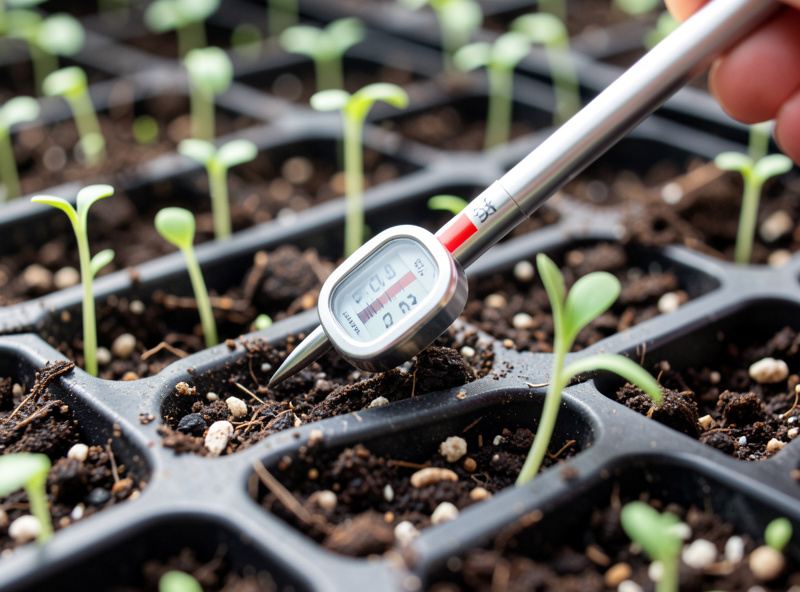
So I push the thermostat probe, or a separate soil thermometer, into the medium of a representative middle cell — the same depth the seed sits — and set the number by that reading. It is a two-minute habit that removes all the guesswork. A cheap soil thermometer pays for itself the first sowing; an Amazon search for a soil thermometer turns up plenty of simple probe models. Verify once at the start of a sowing and you will trust your setup for the rest of the season.
As an Amazon Associate I earn from qualifying purchases.
What Happens When the Temperature Is Wrong
Too cold and seeds germinate slowly or rot; too hot and they either fail to germinate or come up weak. Cold, wet medium is the classic killer up north — a pepper sitting at 15 °C for three weeks is far more likely to rot than sprout, because the seed is metabolising slowly while soil fungi are not. That slow, uneven emergence is where damping-off gets its foothold. On the other end, above roughly 32 °C germination rates fall sharply for most crops, and I have cooked a tray of peppers with a thermostat-less mat in a warm room — perfect seed, ruined by heat.
The temperature also drives evenness, not just speed. At the optimum, a tray comes up together in a tight window, which makes everything downstream easier — one light height, one watering schedule, one hardening-off date. Sown too cold, the tray straggles up over two or three weeks and you are managing seedlings at wildly different stages in the same flat. Once the crop is up, the mat comes off — its job ends at germination, and warm wet soil under seedlings only invites rot. From there it is light and airflow that matter, which I cover in the wider seed starting in small spaces guide. What I would do starting today: buy a soil thermometer, group your crops by their germination optimum, set the mat to the soil target of the group, and pull the tray off heat the moment it is up. Hit the number in the medium and germination stops being a gamble.
Adjusting the Mat for a Cold Room Versus a Warm One
The same setpoint behaves differently depending on your room, and a thermostat is what makes that a non-issue. In my cool February shelf room at 18 °C, the mat runs most of the time to hold soil at 25 °C, cycling on and off gently. Move that same tray to a warm 23 °C room and the mat barely comes on, because the room is already doing most of the work — and a bare, thermostat-less mat in that warm room would sail straight past the target and start cooking the seed.
This is the practical case for the controller in a Nordic apartment specifically. Winter rooms swing: the heating cycles, a cold snap drops the sill temperature, a sunny afternoon warms the shelf. A fixed-output mat cannot respond to any of that, so the soil temperature wanders with the room. A thermostat pins the number regardless — the mat works harder on a cold night and eases off on a warm afternoon, and the seeds never notice the difference. Without one, my honest advice is to run the mat only in a reliably cool room and to check the soil temperature by hand daily, moving the tray off heat if it climbs too high.
One more adjustment worth knowing: a humidity dome raises the soil surface temperature a little on top of the mat, so a dome-plus-mat setup runs a degree or two warmer than the mat alone. I account for that by setting the mat at the lower end of a crop’s range when a dome is on, then confirming with the probe. Small margins, but at the edge of a crop’s tolerance — peppers near 29 °C, lettuce near its dormancy threshold — a degree or two is the difference between a full flat and a patchy one.
What temperature should a seedling heat mat be set to?
Set it to the germination optimum of the crop, measured in the soil. About 24 to 27 degrees Celsius suits tomatoes, 27 to 29 degrees suits peppers and aubergine, and 18 to 24 degrees suits brassicas. Cool-season greens like lettuce germinate best at 15 to 20 degrees and should come off the mat.
Is 30 degrees too hot for germinating seeds?
For most crops, yes, it is at the upper edge or beyond. Cucumbers and squash tolerate up to about 32 degrees, but tomatoes, peppers, and most vegetables germinate best below 29 degrees, and germination rates fall sharply above 32 degrees. Without a thermostat, a mat can easily push soil that high in a warm room.
Why won’t my seeds germinate on the heat mat?
The most common causes are the wrong temperature for the crop or measuring the mat surface instead of the soil. A mat probe taped to the surface can read hot while the soil is cooler, and cool-season greens like lettuce actively stall above 25 degrees. Push the probe into a representative cell and set the number by the soil reading.
Do tomatoes and peppers need different heat mat temperatures?
Slightly. Tomatoes germinate best around 24 to 27 degrees Celsius and peppers a little warmer at 27 to 29 degrees. If you only have one mat, setting it around 25 to 26 degrees germinates both acceptably, with peppers running a touch cool rather than cooking the tomatoes.
Should I measure soil or air temperature for seed starting?
Soil temperature. Seeds respond to the temperature of the medium around them, which can be several degrees different from the room, especially on a cold windowsill. Use a soil thermometer or the thermostat probe pushed into a representative cell at seed depth.