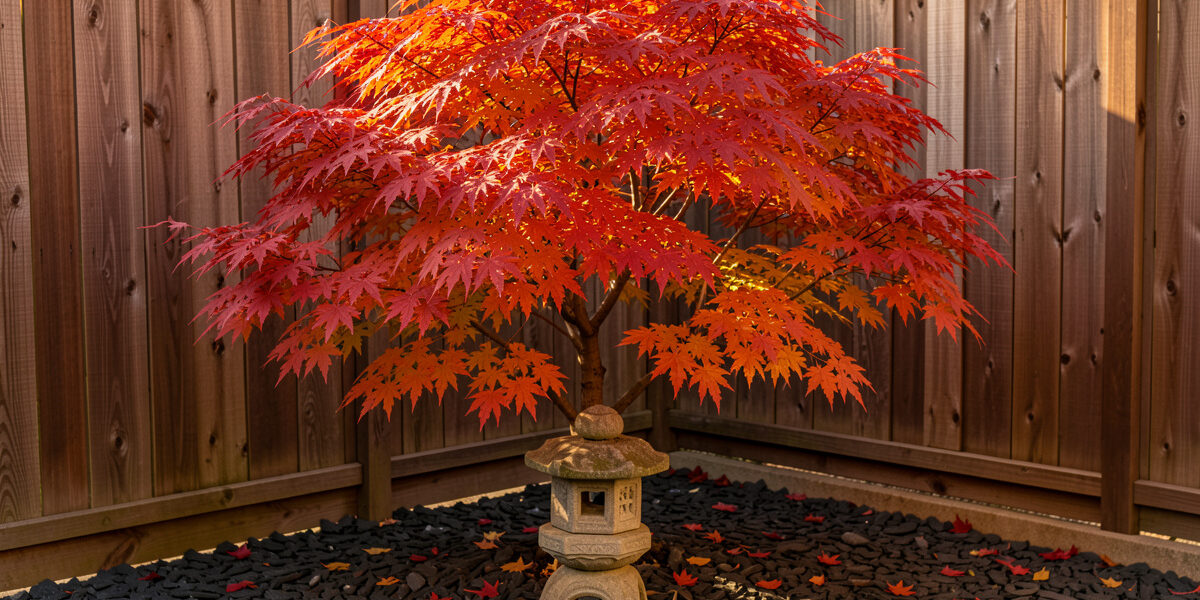
If I could grow only one ornamental tree in a small space, it would be a Japanese maple. Acers are slow, refined, fiery in autumn — and, crucially for someone like me, they’re hardy through a cold winter and take beautifully to a pot, which makes them the perfect tree for a balcony or a tiny plot where you can’t dig a planting hole at all. This guide covers eight of the best compact varieties and exactly how I’d grow them, with the container care and winter protection that matter most in a cold climate. For the wider list, see my 15 best trees for small gardens and the complete small garden trees and shrubs guide.
As an Amazon Associate I earn from qualifying purchases.
Why Japanese Maples Excel in Small Gardens
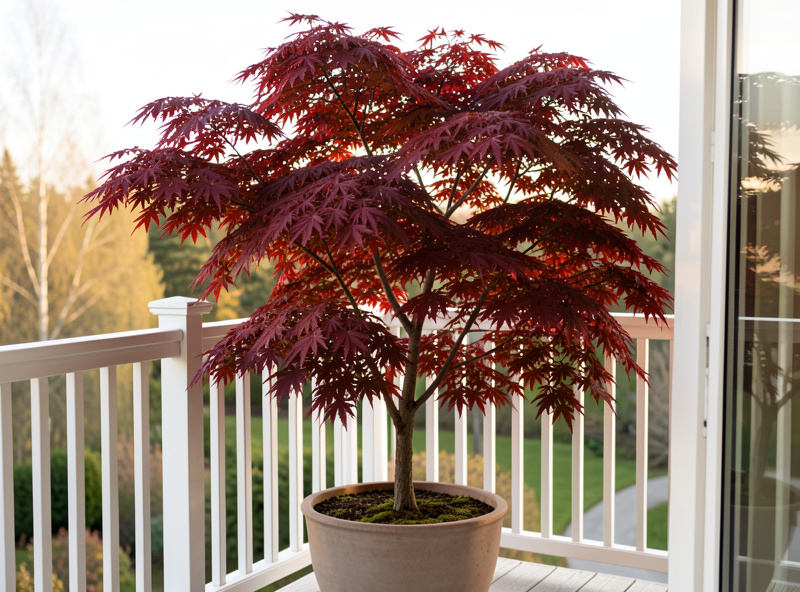
Acers earn their place several ways at once. They’re slow — usually just 15–30 cm a year — so they never overrun a small space and you can place one precisely without fear. Their branching is beautiful even bare, giving winter structure when the garden is otherwise asleep. The colour range within Acer palmatum covers everything from deep burgundy to cool green to coral bark. And best of all for an apartment gardener, they thrive in containers — their fibrous roots cope happily with a pot, so you can grow one on a patio, balcony, or by a doorway. They also take partial shade better than most trees, which makes them ideal for brightening a shaded corner. A young Japanese maple is a genuinely good first tree.
Eight Top Acer Varieties for Compact Gardens
Bloodgood
Upright to 3–3.5 m, deep burgundy foliage that holds all summer, then scarlet in autumn. Tolerates more sun than most reds — the versatile all-rounder and the variety I would start with if I could only have one. It is widely available, unfussy about conditions, and the broad palmate leaves give a classic Japanese maple silhouette even from a distance.
Crimson Queen (dissectum)
A weeping lace-leaf staying 2–2.5 m. Finely cut leaves open red, deepen to maroon, finish vivid crimson. The cascading shape makes a perfect focal point — and a stunning container specimen. I grow one on my balcony in a 60 cm pot and it stops visitors mid-sentence; the dissected leaves look almost like coral underwater when backlit by afternoon sun.
Skeeters Broom
Compact and upright, under 2 m, so ideal for the smallest gardens or a pot. Green spring leaves turn red-orange in autumn; dense and bushy, needing almost no pruning.
Viridis
A green lace-leaf weeper turning golden in autumn, 2–2.5 m. Takes more sun than the reds without scorching, and its delicate texture sets off bolder-leaved neighbours.
Sango Kaku (Coral Bark)
Grown for winter: its coral-red bark glows in low winter sun, a real gift in a cold climate when little else gives colour. Yellow-green leaves turn apricot-gold in autumn. Larger over time (to 4.5 m+), but slow.
Orangeola
A lace-leaf weeper, 2–2.5 m, that runs through orange-red, bronze-green, then fiery autumn orange-red — months of changing colour from one tree.
Seiryu
The rare upright green dissectum, 3–4.5 m, with lacy foliage on upright branches and bright golden autumn colour. Lovely fine texture in a mixed planting.
Shaina
Compact red, under 2 m, dense and rounded, bright red spring growth holding into summer then crimson in autumn. A natural for containers or the front of a border.
Growing Japanese Maples — Especially in Pots
Light: morning sun with afternoon shade suits most, and in a cool climate they handle more sun than they would in the heat. The real enemy here isn’t sun, it’s wind — a windy spot causes the leaf scorch (brown, crispy edges) people blame on sun. The RHS notes that acer leaf scorch is driven by wind and drought, the leaves losing water faster than the roots can replace it, not by sunlight itself. Site them with shelter.
Soil: rich, well-drained, slightly acidic. In a container that’s easy to give them — use a quality mix with added grit, and feed with an ericaceous (acid) feed in spring to keep the colour strong. In the ground, work in compost and grit, and never plant into a wet, heavy clay pocket — acers hate waterlogged roots.
Containers: this is how I grow most of these and it is also the safest route in a cold climate, because you can move the whole tree under cover when a hard freeze threatens. A 45 cm pot is the practical minimum, but if you have the space and budget for a 60 cm large planter the tree will be visibly healthier and need less frequent watering. Pot on every two or three years, and water more often than you would an in-ground tree, because pots dry fast and drought stress shows instantly as scorched leaves. Mulch the surface to hold moisture.
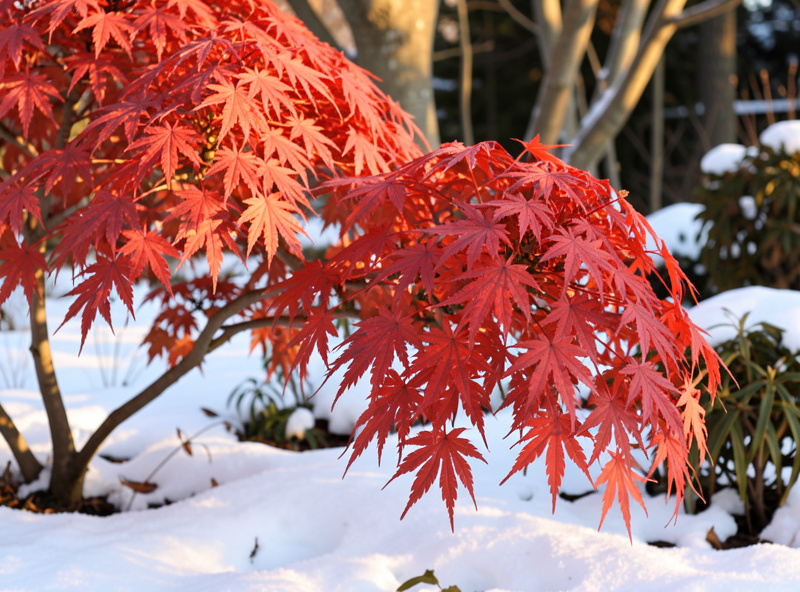
Winter protection: hardy as they are, a maple in a pot is more exposed than one in the ground because the rootball can freeze solid. In a hard winter, move pots to a sheltered spot against the house, wrap the container, or throw a frost fleece over the whole tree if a late frost threatens after the buds have broken — that late-frost hit on tender new leaves is the one real risk up north.
Colour Through the Year
Spring: new leaves open red, pink, or bright green — the first colour of the season. Summer: steady colour, reds deepening to burgundy, greens staying cool. Autumn: the grand finale, weeks of red, orange, and gold. Winter: elegant bare branches, and on Sango Kaku, that glowing coral bark.
Care and Maintenance
Pruning: minimal — take out dead or crossing branches in late winter and lightly thin for airflow; heavy pruning forces coarse regrowth that ruins the fine habit. Feeding: a little slow-release or ericaceous feed in early spring; don’t overfeed, as soft growth is weak and pest-prone. Mulch year-round, kept off the trunk. Watch for: aphids on new growth (a water jet or insecticidal soap handles them), leaf scorch (wind/drought — improve shelter and watering), and verticillium wilt (ensure sharp drainage — there’s no cure once it strikes).
Common Japanese Maple Problems and How I Fix Them
Leaf scorch (brown crispy edges): Almost always wind or drought, not sun. Move the pot to a sheltered spot, water deeply, and the next flush of leaves will come through clean. The damaged leaves will not recover, but the tree will. In a cold climate, scorch is most common in late spring when drying winds hit new foliage before the roots are fully active.
Green reversion on red varieties: Some red cultivars throw the occasional green shoot. Cut it out the moment you see it — the green growth is more vigorous than the red and will take over if left. I check mine every fortnight through the growing season.
Verticillium wilt: Sudden branch dieback on one side of the tree, with dark staining visible when you cut into the wood. There is no reliable cure — the best defence is excellent drainage from day one. Never plant an acer where a previous maple or other susceptible tree (smoke bush, catalpa) has died, as the pathogen persists in soil for years.
Late frost on new leaves: This is the one that catches northern growers. Buds break in a warm spell, then a frost at -3°C blackens every new leaf. The tree usually re-foliates but loses weeks of the growing season. I keep a piece of horticultural fleece near the door from late March onward — if a frost warning hits, 30 seconds to throw it over the tree saves the entire spring display.
Design Ideas
Container stars by a door or seat — a single Crimson Queen in a handsome pot by the front entrance gives more curb appeal than a whole border of bedding annuals, and it gets better every year. Mixed borders — reds against gold or chartreuse, greens to cool a hot scheme, moved into the spotlight in autumn. Beside water, where a weeping form mirrors the movement. In a quiet Japanese-style corner with moss, stone, and a little evergreen. Pair one with a crab apple or a weeping tree for a longer season of interest, and if you’re new to it all, start with my how to start a garden guide.
How to Choose Your First Acer
With eight strong candidates the choice can stall, so here is how I would actually narrow it. If you want one tree that simply works and forgives beginner mistakes, buy Bloodgood — it is upright, sun-tolerant for a red, widely stocked, and hard to kill. If the tree is going in a pot as a doorway or balcony centrepiece and you want the cascading, sculptural look, Crimson Queen is the one people photograph. If your space is genuinely tiny, Skeeters Broom or Shaina stay under two metres and need almost no pruning. And if the point is winter interest in a dark northern garden, Sango Kaku’s coral bark earns its slightly larger eventual size. Green lace-leaf forms like Viridis and Seiryu are the ones I reach for to cool down a hot border rather than to be the star. Match the variety to the job first, then the colour — a red maple planted purely for the colour in the wrong spot just scorches and sulks.
Overwintering an Acer in a Pot Up North
A Japanese maple on a balcony through a Nordic winter is really a test of container size and wind protection. The pot needs to be reasonably large — a small pot freezes solid to the core in an afternoon, so go up in size to buffer the roots — and it sits against the building wall where the radiant heat leaking through the apartment envelope keeps the root zone a few degrees warmer than the open air. A gravel or bark mulch over the surface stops ice forming directly on the trunk base, and once the tree is dormant the cold itself is rarely the killer; the two things that actually catch these trees up here are the rootball freezing dry in a windy pot and a late spring frost hitting new leaves after the buds have already broken. Keep a fleece by the door from late March and both risks are cheap to manage.
Frequently Asked Questions
What are the best acer trees for small gardens?
Compact Acer palmatum (Japanese maple) varieties are ideal: Bloodgood and Shaina for red, Crimson Queen and Orangeola for weeping lace-leaf forms, Viridis and Seiryu for green, and Sango Kaku for coral winter bark. Most stay under 3 metres and several are perfect for containers.
Do acer trees need full sun?
Most prefer morning sun with afternoon shade. In a cool climate they tolerate more sun, but the real cause of scorched leaves is usually wind rather than sun, so shelter matters more than shade. Red varieties do need some sun to keep their deep colour.
How big do Japanese maples get?
It depends on the variety. Dwarf weepers like Crimson Queen stay around 2-2.5 metres, compact uprights like Skeeters Broom and Shaina under 2 metres, while Bloodgood and Sango Kaku reach 3-4.5 metres slowly over many years. All are slow-growing, so they stay small for a long time.
What soil do acer trees prefer?
Moist but well-drained, slightly acidic soil rich in organic matter. They hate waterlogged ground and heavy clay. In containers, use a quality mix with added grit and feed with an ericaceous (acid) fertiliser in spring to keep colour strong.
Are Japanese maples hardy enough to survive a cold winter in a pot?
Yes, Japanese maples are hardy, but a tree in a pot is more exposed than one in the ground because the rootball can freeze. In a hard winter, move pots to a sheltered spot, wrap the container for insulation, and protect tender new spring growth from late frosts with a fleece. They come through cold winters reliably with that bit of care.