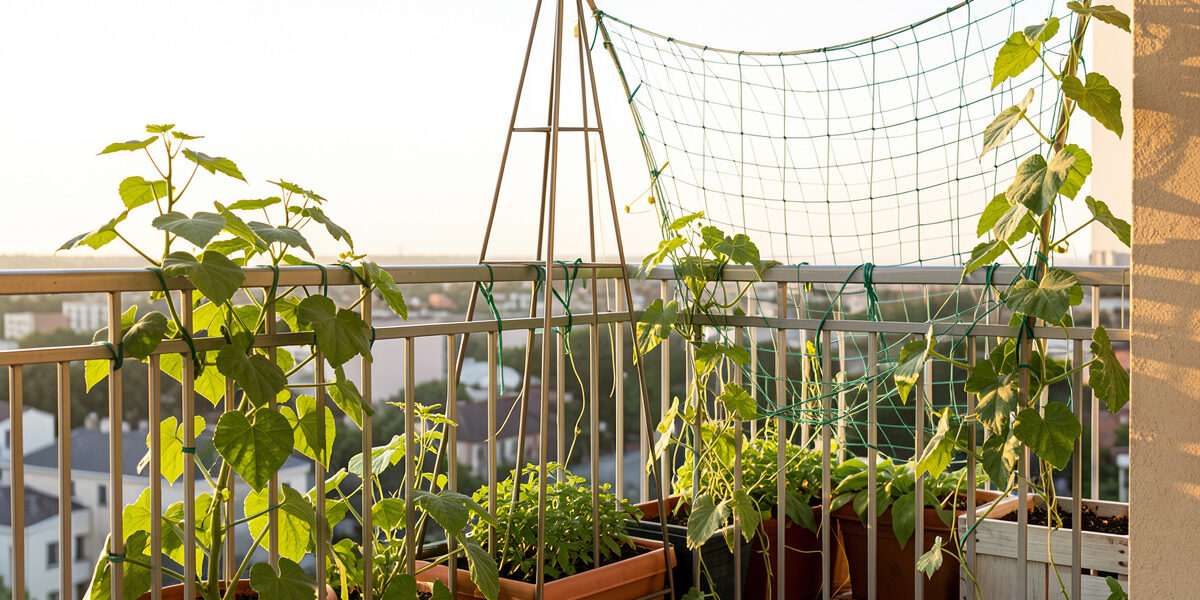
The best trellis for a balcony container garden is the one matched to both your crop’s weight and your railing: pea-and-bean netting for light twiners, a rigid steel obelisk or zip-tied mesh panel for heavy fruiting climbers, and in every case anchored to the rail, not just stuck in the pot. A loaded vine in an August gust pulls with surprising force.
I’ve run just about every support a balcony allows up against real Swedish wind — flimsy bamboo wigwams that levered themselves out of the soil, netting that worked perfectly for years, and a cattle panel I’d never go back from for squash. This guide is how I choose between them now: by the mature weight of the plant, by how the climber actually grips, and by whether the structure can be tied to something solid. Get those three right and the trellis disappears into the background; get them wrong and you spend the summer propping things up.
Why a Balcony Trellis Has to Be Anchored to the Railing
On a balcony the trellis’s real job is resisting wind, not just holding the plant up, so it must be tied to the railing or a fixed point — never relying on the pot alone, because a leafy climber acts like a sail and a single gust can tip a 15-litre pot. This is the mistake that wrecks more balcony climbers than any pest.
The physics are simple and unforgiving: a 2-metre wall of cucumber leaves catches wind like a sheet, and all that force levers against the base of the support. If the only thing holding the support is friction in a pot of loose container mix, the whole thing pivots and goes over — usually at night, usually fully loaded, usually two floors up. My fix is non-negotiable now: every support gets lashed at the top to the railing with soft tie or coated wire, so the rail takes the wind load and the pot just holds soil. On an exposed high balcony I’ll even trade the brightest corner for a sheltered one rather than fight a gale. The climbing vegetables guide covers the wider strategy, but anchoring is the one rule I’d never break.
Netting and Twine: Best for Peas and Beans
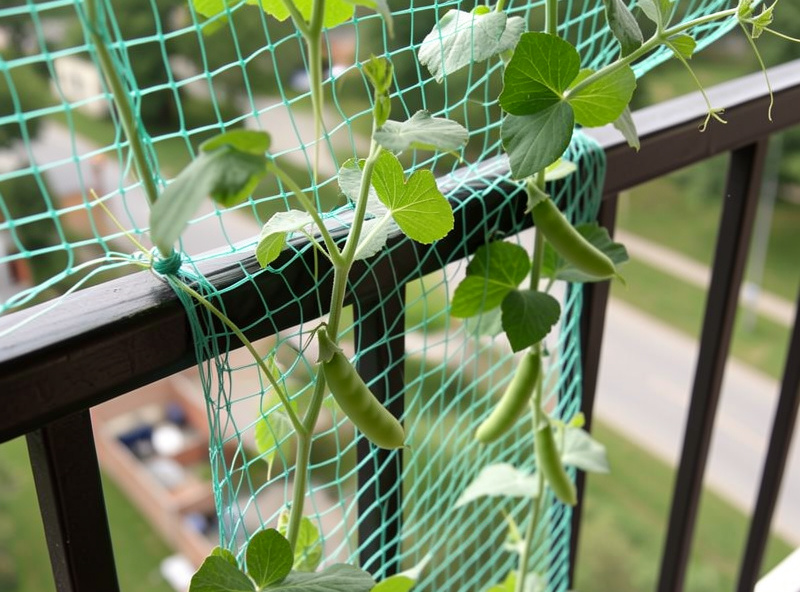
Pea-and-bean netting is the cheapest, lightest, and most effective support for twining climbers, which grip it themselves and need nothing rigid — a panel of plastic or jute mesh run from the railing to the pot rim carries a full crop of beans or peas with no frame at all. It’s the support I reach for first.
Peas climb with tendrils and beans twine around anything thin, so both self-attach to mesh the moment they’re tall enough; I just tuck the first few tips through and they take over — the RHS notes the same self-twining habit when it recommends netting or canes for runner beans. I prefer a 15 cm or wider square mesh so my hand fits through to pick, and I run it vertically with the top edge zip-tied to the railing and the bottom anchored to the pot or a low cross-bar so it stays taut. Jute or cotton netting is lovely because it composts at season’s end with the spent vines, but it sags under a heavy runner-bean crop, so for the heaviest beans I use a sturdier reusable plastic mesh. Either way it weighs nothing, packs flat over winter, and costs a fraction of a rigid frame.
Obelisks and A-Frames: For Cucumbers and Mixed Pots
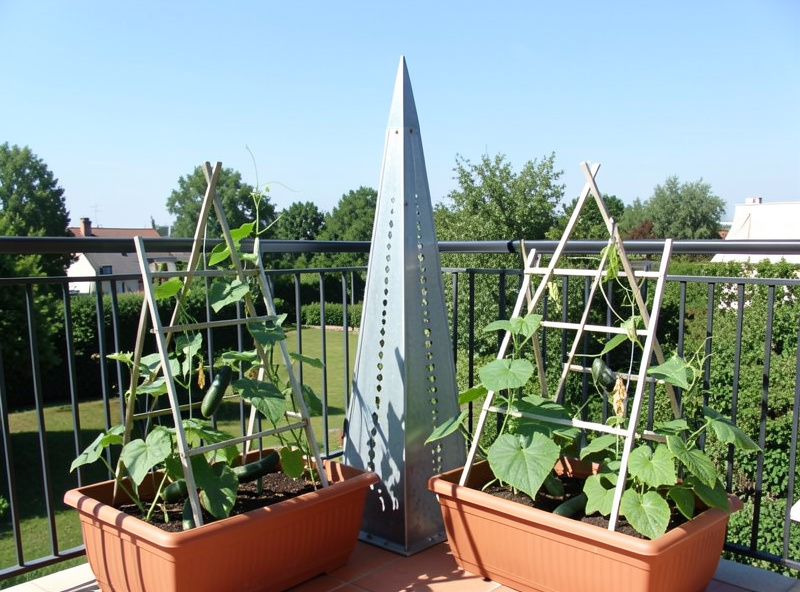
A rigid steel obelisk or a two-pot A-frame is the right call for cucumbers and any climber heavy enough to drag netting out of shape, giving a self-supporting structure that handles 20 kilos of wet vine without flexing. These are the supports that justify their cost over several seasons.
Cucumbers grip with tendrils like peas but get far heavier, and a loaded vine will bow flimsy mesh into a hammock — so I give them either a coated-steel obelisk sized to the pot or, better, an A-frame straddling two containers so the weight shares across the structure and the whole footprint resists tipping. The A-frame is my favourite for a mixed planting: cucumbers up one face, beans up the other, and the angle makes picking easy. Metal obelisks last for years and fold or knock down for storage; the only thing to watch is height, because a 1.8-metre obelisk on a high balcony is itself a sail, so it still gets tied to the rail. For training cucumbers up an obelisk specifically, see the detailed growing cucumbers vertically walkthrough.
Mesh and Cattle Panels: The Heavyweight Choice for Squash
For squash and the heaviest climbers, a section of rigid steel mesh or cattle panel zip-tied to the railing is the strongest support a balcony can take, carrying fruiting squash vines that would crush anything lighter. It’s overkill for beans but exactly right when the fruit gets heavy.
Climbing squash and courgette produce fruit that hangs with real weight, and the vine itself is thick and woody compared to a bean — so the support has to be genuinely rigid. A cut section of galvanised mesh panel or a length of reinforcing mesh, zip-tied flat against the railing or bent into a low arch, gives the vine somewhere solid to climb and lets me sling heavy fruit in a soft net if it needs supporting. It’s the least pretty option and the most permanent, but for the one season I grew a climbing squash properly it was the difference between a crop and a collapsed mess. Match it to a 25-litre-plus pot, because a support that strong is wasted under a starved plant — the right container soil matters as much as the trellis under a heavy feeder like squash.
No-Drill and Freestanding Options for Renters
Renters who can’t drill into walls can still anchor a trellis using freestanding A-frames, railing-clamp brackets, and tension between two heavy pots, all of which resist wind without a single fixing. A lease is no reason to grow climbers badly.
My whole balcony is no-drill, so everything I use leans on the railing or stands on its own. Railing-clamp brackets grip the top rail and hold a panel or net without tools; an A-frame is self-standing by design; and a wide mesh strung between two heavy, well-spaced pots makes a freestanding wall that the pots’ own weight keeps upright. The trick is using the weight you already have — a pair of full 20-litre pots is plenty of ballast for a netting wall between them. For more freestanding ideas, the vertical gardening guide and the vertical vegetable garden guide cover the no-fix approaches in depth, and the fabric grow bags I use keep the ballast pots light enough to move.
Trellis Types Compared
Here’s how the main options stack up by what they carry, what they cost, and which crop they suit — the quick reference I’d have wanted before buying anything.
| Trellis type | Carries | Best crop | Storage | Anchoring |
|---|---|---|---|---|
| Pea-and-bean netting | Light | Peas, beans | Packs flat | Tie top to rail |
| Steel obelisk | Medium-heavy | Cucumbers, beans | Knocks down | Tie to rail (it’s tall) |
| Two-pot A-frame | Heavy | Cucumbers, mixed | Folds | Self-stable, share weight |
| Mesh / cattle panel | Very heavy | Squash | Permanent | Zip-tie to rail |
| Railing-clamp bracket | Light-medium | Renters, any net | Reusable | Clamps to rail, no drill |
Frequently Asked Questions
What is the best trellis for a balcony container garden?
Match the trellis to the crop: pea-and-bean netting for light twiners, a rigid steel obelisk or two-pot A-frame for cucumbers, and a mesh panel for heavy squash. In every case anchor the top to the railing, because a leafy vine catches wind like a sail.
How do you anchor a trellis on a balcony without drilling?
Use railing-clamp brackets that grip the top rail, a self-standing A-frame, or netting strung between two heavy pots whose weight keeps it upright. A pair of full 20-litre pots is enough ballast for a freestanding netting wall, with no fixings needed.
How tall should a balcony trellis be?
Most balcony climbers want a 1.5 to 2-metre support, which suits beans, peas, and cucumbers. Taller is rarely worth it because a tall trellis becomes a sail in wind, so keep it within reach for picking and always tie the top to the railing.
Can netting hold up climbing beans and cucumbers?
Netting is ideal for peas and beans, which grip it themselves and weigh little. Cucumbers get heavier and can bow soft mesh into a hammock, so use a sturdier reusable plastic net or step up to a steel obelisk or A-frame for a full cucumber crop.
What is the strongest trellis for growing squash in pots?
A section of rigid steel mesh or cattle panel zip-tied to the railing is the strongest balcony support. Climbing squash produces heavy fruit on thick vines, so it needs a genuinely rigid frame paired with a 25-litre-plus container to feed the plant.
Should a balcony trellis go in the pot or against the wall?
Put the support in or beside the pot but tie its top to the railing or wall. Relying on the pot alone lets wind lever the whole thing over. Anchoring to a fixed point lets the rail take the wind load while the pot just holds soil.
As an Amazon Associate I earn from qualifying purchases. The support links below are gear I’d actually use on a balcony.
If you’re buying rather than improvising, the three I keep coming back to are a roll of pea-and-bean trellis netting for the twiners, a coated steel garden obelisk for cucumbers, and a set of no-drill railing brackets for renters.