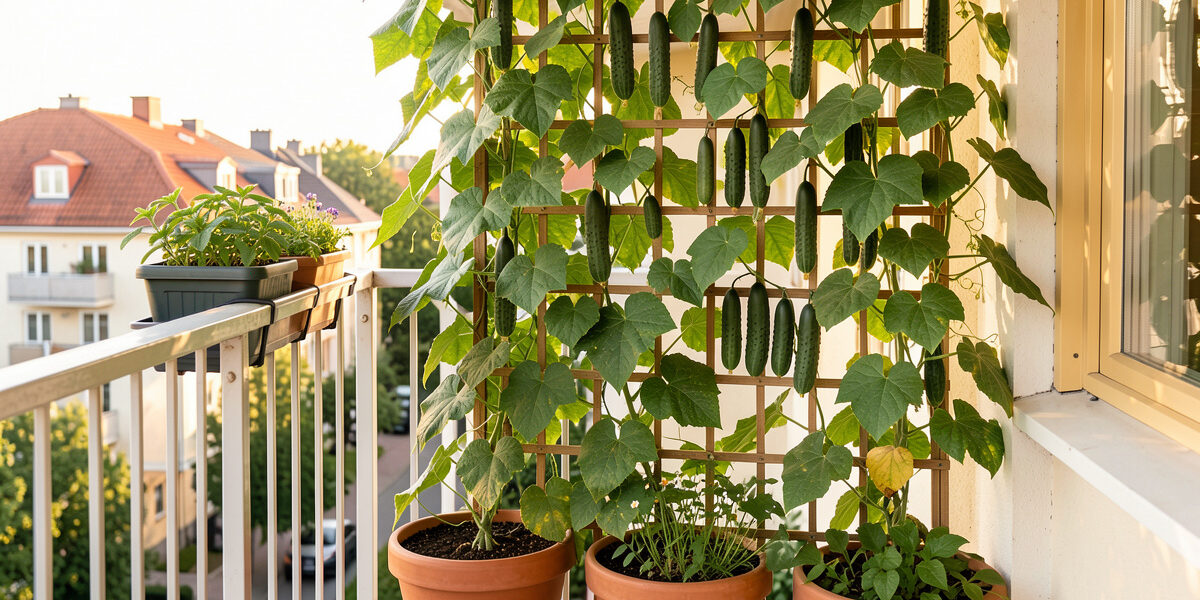
Climbing vegetables are the single best way to multiply a balcony’s harvest without taking more floor: cucumbers, beans, peas, and compact squash all climb a trellis, turning a 1-square-metre rail into roughly 2 metres of productive growing wall. The whole game comes down to a support that won’t tip, a deep enough container, and crops that actually want to climb.
After years of running climbers up every kind of support I could fit on a Swedish balcony, I’ve made every mistake there is — and this is the guide I wish I’d had when I first lashed a sad bamboo wigwam to my railing and watched a runner bean snap it off in the first August gust. Below I’ll walk through which climbing crops are worth your limited space, how to anchor a trellis that survives wind on a high balcony, the container depth each crop needs, and how to keep a vertical wall of leaves watered when the top dries out twice as fast as the bottom.
Every climber here links to its own detailed guide, so you can read the overview and then go as deep as you like on the one crop you actually want to grow.
Why Grow Vegetables Vertically on a Balcony?
Growing up instead of out is the highest-leverage move in small-space food growing: a single 30 cm pot footprint can carry a 2-metre cucumber vine, so you get the yield of a sprawling plant from the floor space of a bucket. On a balcony where every pot competes for the same metre of rail, that ratio is everything.
There’s more to it than floor space, though. Climbers held off the ground get far better airflow, which on my balcony has been the difference between a clean crop and a mildew write-off — powdery mildew on cucurbits loves the stagnant, humid air that pools around a plant flopping on the deck. Vertical growth also keeps the fruit clean and visible, so you actually find and pick the courgette before it turns into a marrow, and it puts the leaves where they catch the low, side-angled light that a Nordic summer hands you instead of overhead sun. The one trade-off: a leafy wall acts like a sail, so wind and watering both get harder, and the rest of this guide is mostly about solving those two problems.
The light point deserves a second sentence because it’s the part US and UK container advice gets wrong for us. Down south, the sun is more or less overhead at midday and a sprawling plant catches plenty; up here, even in high summer the sun tracks low and comes in from the side, so a flat, horizontal plant on the deck shades its own lower leaves while the productive vertical surface — the side of the plant facing the light — is exactly what a trellis exposes. Growing climbers up isn’t just a space trick in a Nordic climate, it’s how you present the most leaf area to the kind of light you actually get. That’s the same logic behind my indoor strawberry rig and the rest of the balcony: orient the productive surface toward the light you have, not the light the gardening books assume.
Which Climbing Crops Are Worth Your Balcony Space?
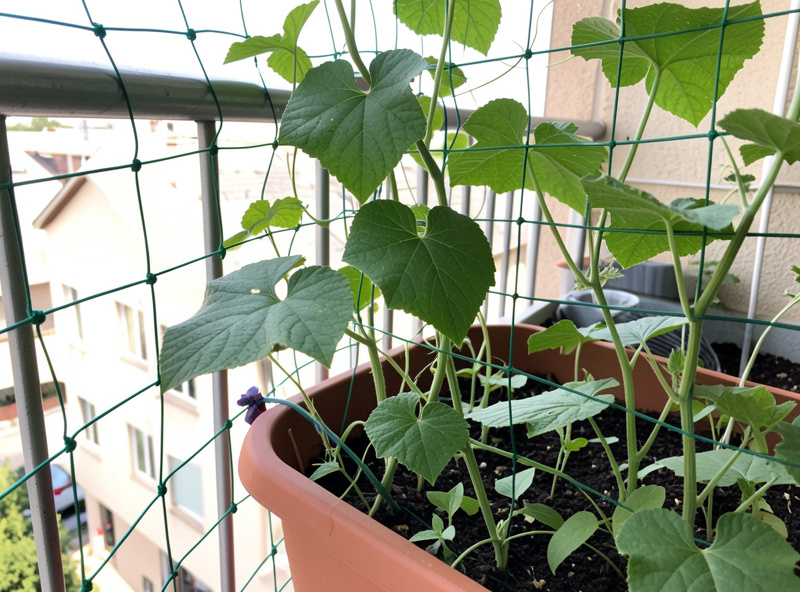
The best balcony climbers are bush-to-pole transitional crops that produce heavily in a small footprint: pole beans, peas, cucumbers, and compact climbing squash give you the most food per pot, while ornamental climbers fill the gaps that aren’t deep enough for a vegetable. Not everything that vines is worth the room.
I rank climbers by yield-per-litre-of-soil, because soil volume is the real constraint on a balcony, not floor area. Pole beans win outright — a single 15-litre pot of climbing beans will out-crop three pots of bush beans and keep cropping for two months if you pick daily. Peas are the early-season opener, cropping before the beans even flower, and they tolerate the cool, half-lit spring a Nordic balcony actually offers. Cucumbers are the diva: huge yield, but thirsty and hungry, needing the biggest container of the group. Compact climbing courgette and small winter squash work if — and only if — you give them a 25-litre-plus pot and a serious trellis, because the fruit gets heavy. For the shallow planters and railing boxes that won’t take a vegetable, I lean on climbing nasturtium and sweet peas, which earn their keep by pulling in the pollinators the cucumbers and squash depend on.
Variety choice matters as much as the crop itself, and this is where the short Nordic season bites. For beans I stick to climbing French beans and a reliable runner — they crop earlier and more forgivingly than the dramatic dried-bean varieties that need a long hot autumn we don’t get. For cucumbers I grow the smaller, thinner-skinned types bred for greenhouses and cool climates rather than the big ridge cucumbers, because they set fruit at lower temperatures and don’t sulk through a cool July. With squash I’ll only attempt the genuinely compact climbing courgettes and the smallest winter squash, never a sprawling pumpkin — there simply isn’t enough heat or season to ripen a big squash on a balcony this far north, and pretending otherwise is how you spend a whole summer on a plant that gives you nothing. The honest rule is to grow the reliable, quick, cool-tolerant version of every climber and leave the showstoppers to gardeners with a longer season and a polytunnel.
| Climbing crop | Min. container size | Support type | Season (Nordic) | Yield per pot |
|---|---|---|---|---|
| Pole / runner beans | 15 L (30 cm deep) | Wigwam or netting | Sow late May, crop Jul–Sep | Very high |
| Peas | 10 L (25 cm deep) | Netting or twiggy sticks | Sow Apr, crop Jun–Jul | Moderate |
| Cucumbers | 20 L (30 cm deep) | String, mesh, or A-frame | Plant out Jun, crop Jul–Sep | High |
| Climbing courgette / small squash | 25 L+ (35 cm deep) | Strong cattle-panel or obelisk | Plant out Jun, crop Aug–Sep | High but bulky |
| Nasturtium (climbing) | 5 L (20 cm deep) | Trellis or twine | Sow May, flower Jun–Oct | Edible flowers + pollinators |
| Sweet pea (ornamental) | 7 L (25 cm deep) | Netting or obelisk | Sow Apr, flower Jun–Aug | Cut flowers + pollinators |
How Do You Choose a Trellis That Won’t Tip Over?
A balcony trellis fails for one of two reasons — it’s too flimsy for the crop or it’s not anchored against wind — so match the structure’s strength to the mature plant’s weight and tie the whole thing to the railing, never just into the pot. A loaded cucumber vine in an August gust generates real leverage.
I sort supports by how much wind-loaded weight they carry. Netting and twine are perfect for peas and beans, which grip with tendrils and twiners and don’t need anything rigid; I run a panel of pea-and-bean netting from the railing down to the pot rim and let them self-cling. Cucumbers do well on the same netting or on a string dropped from above and trained, but they get heavy enough that the support has to be tied off at the top. For squash and anything fruiting heavy, you need something rigid — a steel obelisk, a section of cattle/mesh panel zip-tied to the railing, or a stout A-frame straddling two pots so the weight shares across the structure. Whatever you pick, the golden rule on a high balcony is that the support’s job is the wind, not just the plant: I always lash the top of every trellis to the railing with soft tie or coated wire so the pot isn’t the only thing stopping a gust from launching the lot. For the full breakdown of types, heights, and anchoring, see my dedicated best trellis for a balcony container garden guide and the vertical trellis ideas for balconies roundup.
What Container Depth Does Each Climber Need?
Climbing crops are deep-rooted relative to their footprint, so the rule on a balcony is depth over width: aim for at least 25–30 cm of soil depth for beans and cucumbers and 35 cm for squash, because a vine that has to support metres of top growth needs the root volume to back it up. Shallow pots are the number-one cause of stalled, yellowing climbers.
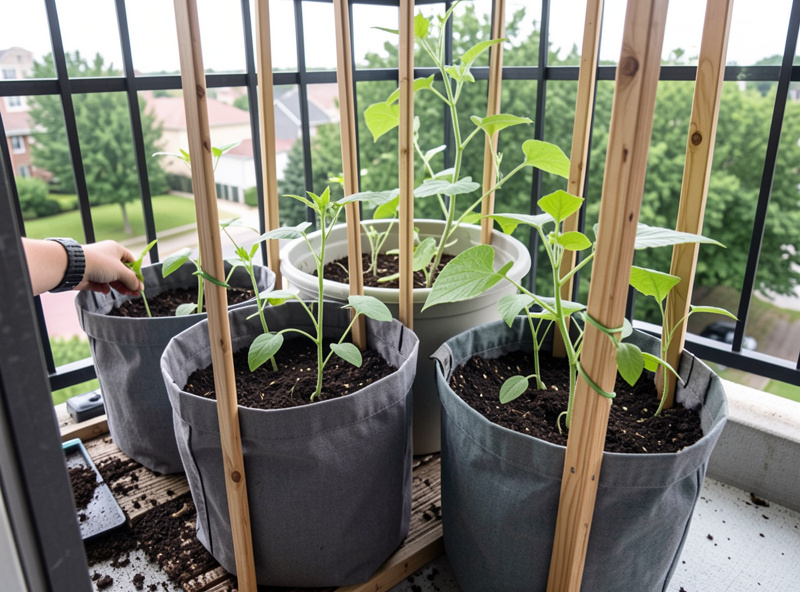
In my setup the climbers live in the deepest containers I own. Cucumbers and squash go in 20–25-litre fabric grow bags or deep plastic tubs — I prefer fabric grow bags for these because the air-pruned roots and extra drainage suit thirsty cucurbits, and they’re light enough not to overload the balcony when wet. Beans and peas are slightly less demanding and crop happily in 10–15-litre pots or a deep railing box. The constraint nobody mentions in US container advice is weight: a 25-litre pot of wet soil is heavy, and a balcony has a load limit, so I keep the biggest pots near the load-bearing wall, not out on the cantilevered edge. Fill with a real container mix — not bagged “potting soil,” which compacts and drowns roots — and check my notes on the right soil for container vegetables before you fill anything. For the whole approach to growing food on a rail, the container gardening complete guide and the balcony vegetable garden overview cover the fundamentals.
How Do You Water a Vertical Wall of Climbing Plants?
The problem with climbers is that the top of the wall dries out twice as fast as the base, so water deeply and consistently at the root and never trust a quick splash — a fruiting cucumber in a 20-litre pot can drink a full litre or more a day in a Nordic July heat spell. Inconsistent watering is what splits beans and turns cucumbers bitter.
Climbers are the crops where I lean hardest on self-watering containers — the same 3D-printed reservoir inserts I print for the rest of the balcony — because they buffer the daily swing that stresses cucumbers most. A reservoir in the base lets the plant draw what it needs and cuts my watering on the climbers to roughly every second day even in heat, instead of the twice-daily marathon a bare pot demands. If you’re hand-watering, do it at the soil and do it slowly until it runs from the drainage holes; a fast splash wets the top inch and runs off. Learn to read the plant, too — climbers wilt at midday and recover by evening when they’re fine, but a vine still flagging at dusk is genuinely dry. My guides on how to water a container garden and the signs of overwatering cover the whole balance, because drowning a climber in a pot with poor drainage is just as deadly as letting it dry out.
Feeding and Pollination: The Two Things Beginners Miss
Climbing crops are heavy feeders that exhaust a pot’s nutrients in weeks, and fruiting climbers need pollinators to set, so you have to feed through the crop and make sure bees can reach the flowers — an un-pollinated courgette aborts as a finger-sized, yellowing dud. These two issues account for most “the plant grew but didn’t crop” failures on a balcony.
For feeding, I top-dress with worm castings at planting and switch to a high-potassium liquid feed once the first flowers open, every 7–10 days through the cropping window; potassium drives fruit, where too much nitrogen just gives you a jungle of leaves and no beans. Pollination is the sneaky one up high: a balcony two floors up gets fewer visiting insects, so I plant climbing nasturtium and a pot of flowers among the crops specifically to pull bees in, and on still days I hand-pollinate squash and cucumbers with a soft brush, moving pollen from the male flowers (plain stem) to the females (tiny fruit behind the bloom) — the same transfer the RHS recommends when courgettes set poorly in cool or insect-poor conditions. It takes thirty seconds and turns a frustrating non-crop into a glut. The same logic carries over from how I handle feeding fruiting crops like tomatoes in containers.
The Climbing Crops, One by One
Each climber has its own quirks — beans want warmth before they germinate, peas want the opposite, cucumbers want a windless warm corner, and squash wants more pot than you think. I’ve written a full guide for each so you can go straight to the crop you want to grow.
Start with growing climbing beans in pots for the most reliable, highest-yield balcony climber there is. For an early crop before the beans get going, growing peas on a balcony in pots covers the cool-season opener. Growing cucumbers in containers on a balcony is the deep dive on variety, pot size, and care for the thirstiest climber — and if you want the trellising and training detail specifically, I cover that separately in growing cucumbers vertically. Growing squash in small spaces and containers handles the heavyweight, and the best climbing plants for small balconies rounds up the ornamental and edible climbers for the spaces a vegetable won’t fit. For the wider context, the vertical gardening guide and vertical vegetable garden pages cover growing-up as a whole-balcony strategy.
Where to Put Climbers on a Balcony for the Most Light
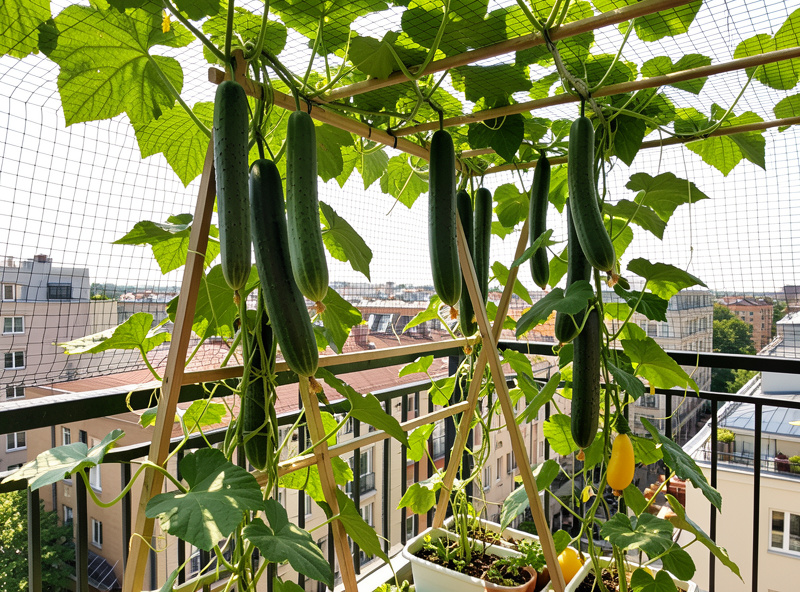
Position climbers against the brightest, most sheltered face of the balcony and let them screen everything behind, because a vertical wall of leaves casts a long shadow — a 2-metre cucumber vine will shade a metre of deck behind it for most of the afternoon. On a Nordic balcony where usable light is already scarce, where you put the wall decides what else can grow.
I treat the climbing wall as the south or west backdrop and step the shorter, shade-tolerant crops down in front of it — leaf lettuce and herbs are happy in the part-shade the climbers throw, so nothing’s wasted. The other half of positioning is wind: the brightest corner on a high balcony is often the most exposed, and that’s exactly where a loaded trellis is most at risk, so I’ll trade a little light for a sheltered corner if the choice is between a slightly shadier crop and a vine on the pavement two floors down. Reflected light helps more than people expect up north too — a pale wall behind the climbers bounces the low side-angled sun back into the canopy, and on my balcony that bounce is worth as much as an hour of direct sun in the shoulder seasons. If light is your real constraint, my notes on grow lights for vegetables cover supplementing it, though climbers are summer crops that mostly want the real thing.
Setting Up a Climbing-Crop Wall, Step by Step
Build the support before you plant, anchor it to the railing, then plant into a deep pot at its base and train the young vine on within its first week — climbers that aren’t given something to grip early will sprawl and sulk, and retro-fitting a trellis around an established tangle is miserable. The order matters more than the gear.
My routine each spring is the same. First I fix the support: net, obelisk, or panel tied at the top to the rail and seated firmly at the base, sized to the crop from the table above. Then I fill the deepest pot I have for that crop with fresh container mix and a handful of worm castings, and only then do I plant — beans and squash direct-sown or planted out after the frost window, peas earlier into the cool spring, cucumbers as sturdy young plants once nights are reliably warm. Within the first week I start training: tucking pea and bean tips through the netting and tying cucumbers loosely to their string with soft twine, redirecting anything heading the wrong way. After that it’s a two-minute job every few days — tuck, tie, and pinch out the odd wayward side-shoot — and the wall more or less builds itself up the support. The single biggest time-saver I’ve found is doing the support and the pollinator-flower planting in the same session so the bees arrive as the flowers do. For renters who can’t drill, the vertical vegetable garden and small-space garden ideas guides cover freestanding, no-fix supports that lean on the railing instead.
The Mistakes I Made So You Don’t Have To
Most climbing-crop failures on a balcony trace to four errors: a support too weak for the mature plant, a pot too shallow, watering that swings between flood and drought, and skipping pollination. I’ve made all four, and fixing them is what turned my balcony from a tangle into a working food wall.
My worst was the bamboo-wigwam runner bean I mentioned — the structure was never the problem, it was that I’d pushed the canes into 12 cm of loose container mix and tied nothing to the railing, so a loaded plant in wind simply levered the whole thing out of the pot. The fix was lashing the top of every support to the rail. The second was planting cucumbers in a 10-litre pot to “save space” and then wondering why they stalled at half height, yellow and bitter; cucurbits punish a small pot fast. Third was hand-watering on a schedule instead of by feel, splitting beans every time a hot spell hit a dry pot — self-watering inserts fixed that. And the quiet one was waiting all summer for squash that never came, because nothing was pollinating two floors up until I started brushing the flowers myself. None of these are hard once you know them, which is the whole point of growing the same crops year after year through the same short Nordic season — you stop repeating the mistakes.
Frequently Asked Questions
What is the best climbing vegetable for a small balcony?
Pole or runner beans are the best balcony climber: a single 15-litre pot out-crops three bush-bean pots and keeps producing for two months if you pick daily. They climb netting easily and need no rigid support, making them the highest yield per pot.
How deep does a container need to be for climbing vegetables?
Aim for at least 25-30 cm of soil depth for beans and cucumbers and 35 cm for squash. Climbing crops are deep-rooted relative to their footprint and need the root volume to support metres of top growth, so depth matters more than pot width.
How do you stop a balcony trellis from blowing over?
Lash the top of the trellis to the railing with soft tie or coated wire, never rely on the pot alone. A loaded vine acts like a sail in wind, so the support must be anchored to a fixed point, and the structure must match the mature plant’s weight.
Can you grow cucumbers and squash up a trellis on a balcony?
Yes. Cucumbers grow well on netting or string in a 20-litre pot, and compact climbing squash works in a 25-litre-plus container on a rigid obelisk or cattle panel. Both are heavy feeders, need hand-pollination on still high balconies, and drink a litre or more a day in heat.
Why are my climbing vegetables growing but not fruiting?
The two usual causes are too much nitrogen, which gives leaves not fruit, and a lack of pollinators on a high balcony. Switch to a high-potassium feed once flowers open and hand-pollinate squash and cucumbers with a soft brush on still days to set fruit.