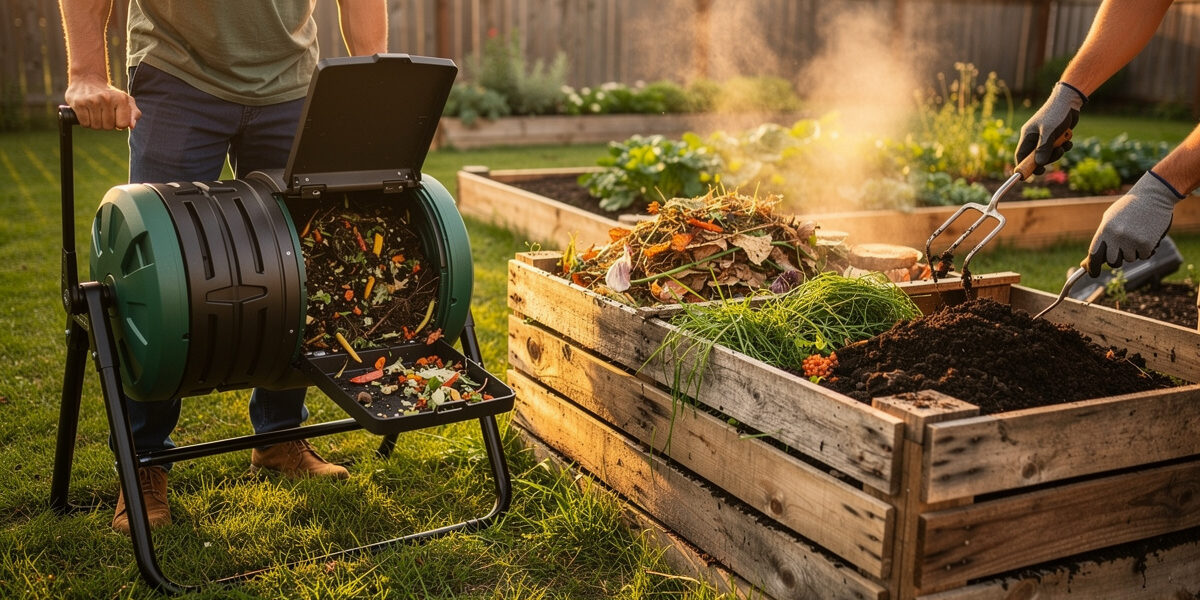
A compost tumbler finishes a 60-gallon batch in 6 to 8 weeks with daily cranking; an open pile of the same volume takes 8 to 12 weeks with weekly turning. On my balcony, the tumbler wins every time — it stays sealed against the pests that visit the container garden, takes 15 seconds to crank instead of 15 minutes with a pitchfork, and produces finished compost that goes directly into the raised beds. If I had a half-acre yard and seasonal leaf drops, I would switch to a pile for the capacity. The right choice depends on your space.
This is one of the most consequential decisions in starting a backyard composting setup, because each method demands a different daily routine, different inputs, and different physical effort. Most beginners either pick the wrong tool for their yard or buy both and end up using neither well. The honest comparison: tumblers fit small-to-medium yards with regular waste flow; piles fit large yards with bursts of seasonal yard waste.
As an Amazon Associate I earn from qualifying purchases.
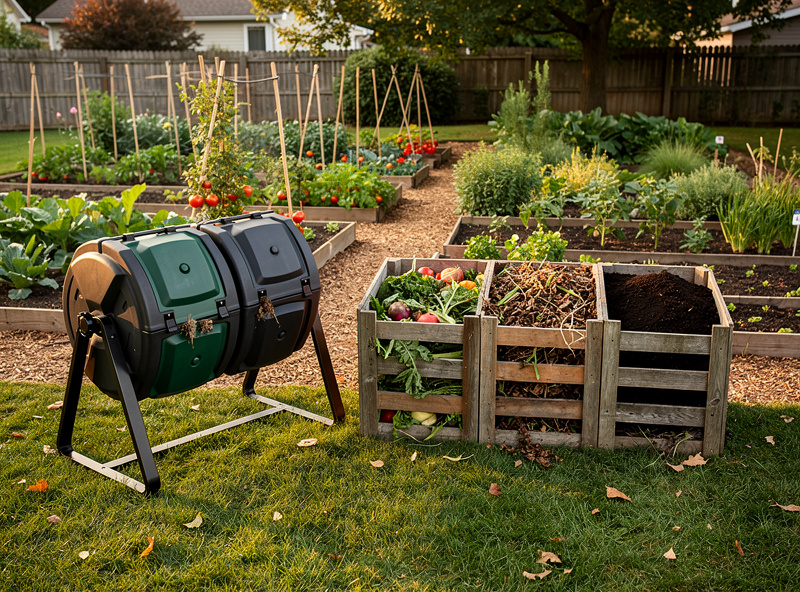
Quick Decision Framework
Two questions decide between tumbler and pile for almost every household:
1. Do you have rodents, raccoons, or wildlife pressure? If yes, tumbler. Open piles in rodent-active areas become rat infrastructure within a season. A sealed dual-chamber tumbler exists to solve exactly this problem.
2. How much weekly compostable waste do you generate? Under 5 gallons per week → tumbler is right-sized. Over 10 gallons per week → tumbler will overflow within 2 to 3 weeks; an open pile is the only system with enough throughput. Between 5 and 10 gallons → either works, but a tumbler is simpler.
Households with under 1,000 sq ft of yard, no chickens or rabbits, and primarily kitchen scraps fit tumblers cleanly. Households with mature trees, an active vegetable garden, and seasonal yard cleanup almost always need an open pile (or at minimum, a holding bin to stage material until tumbler space opens).
How a Compost Tumbler Works
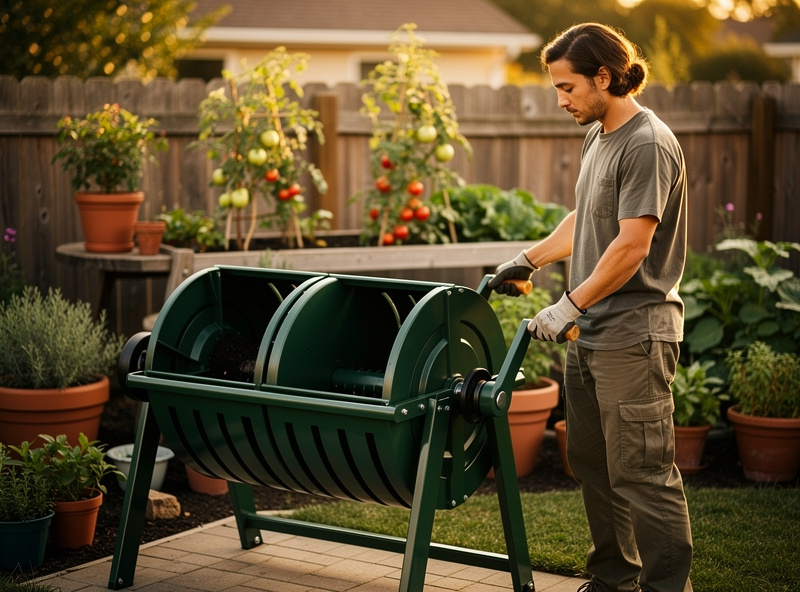
A compost tumbler is a sealed plastic or metal drum on a frame, with a crank handle or rotating axle that lets you spin the chamber to mix contents. The mixing replaces the pitchfork-turning that an open pile requires for oxygen exchange. Sealed walls block pests, contain odors during active fermentation, and retain heat better than equivalent-volume open piles in cold weather. Oregon State University Extension notes tumblers are popular precisely because they keep animal pests like rodents out, and recommends turning the drum daily (or at least several times a week) and, ideally, running two — one accumulating debris while the other actively composts.
Two tumbler designs dominate the market:
- Horizontal-axis tumbler with crank handle. The chamber rotates around a horizontal pole on a stand. Easy cranking, even with full-load capacity. Most common type, 60 to 80-gallon range. Best general-purpose choice.
- Vertical-axis tumbler (less common). Chamber rotates on a vertical axis. Footprint is smaller but turning is harder when full. Generally inferior to horizontal-axis units.
The dual-chamber feature is non-negotiable for serious users. Single-chamber tumblers force you to either stop adding material to let the batch finish (which means food scraps pile up elsewhere) or constantly mix fresh material with almost-finished compost (resetting the decomposition clock). Two chambers solve this entirely: fill one, finish the other, alternate.
How an Open Compost Pile Works
An open pile is exactly what it sounds like — a free-standing heap of organic material at minimum 3×3×3 feet, built either contained in a wooden three-bin system, ringed by hardware cloth, or simply stacked on the ground. The minimum size is set by the heat-retention physics: smaller piles bleed heat to surrounding air faster than microbes can produce it, so they never reach thermophilic decomposition.
Three open-pile structures cover the range of yard situations:
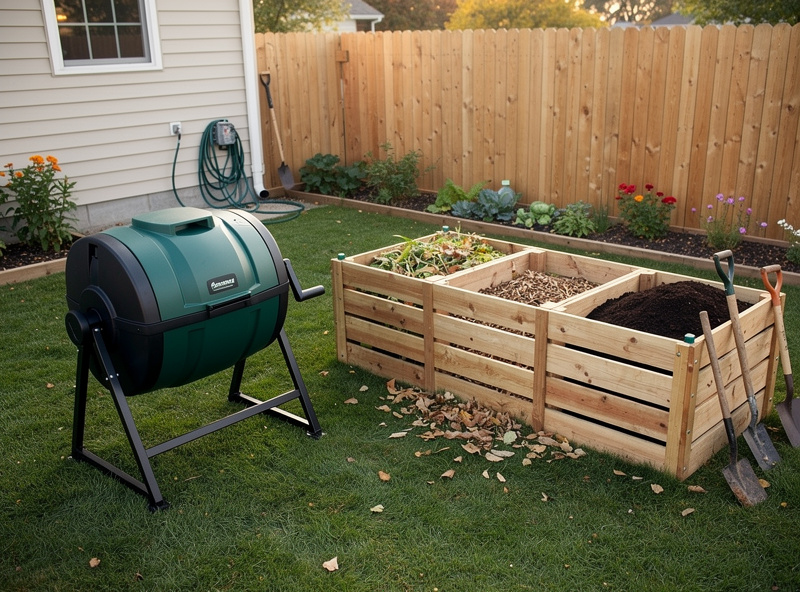
- Wooden three-bin system. Three side-by-side wooden bins, each roughly 3×3×3 ft. New material in bin 1, mid-decomposition in bin 2, finishing in bin 3. Move material between bins as it progresses. Best for households with consistent yard waste and 50+ sq ft to dedicate.
- Hardware-cloth ring (Geobin or DIY). A 3-foot-diameter ring of welded wire forming a vertical cylinder. Material loads from the top; the ring lifts off for harvest. Cheaper than wood and excellent airflow.
- Free-standing pile (no container). Just a heap on the ground. Works in rural yards with no neighbors but loses to rain compaction and wildlife scattering. Not recommended in suburbs.
All open piles need to start as a single critical-mass build, not gradually layered over weeks. Stockpile material in a holding bin until you can build a 3×3×3 pile in one day. Otherwise the pile never reaches thermophilic temperature and you are effectively cold composting whether you intended to or not. The hot vs cold composting guide covers the temperature dynamics in detail.
Direct Comparison Table
| Factor | Compost Tumbler | Open Pile |
|---|---|---|
| Capacity (single batch) | 30–80 gallons | 200+ gallons (3×3×3 ft) |
| Time to finish | 6–8 weeks | 8–12 weeks (hot) or 9–12 months (cold) |
| Setup cost | 80–250 dollars | 0–150 dollars (DIY) or 80–250 dollars (kit) |
| Daily effort | 30 seconds (crank handle) | None (turn weekly with pitchfork) |
| Pest exclusion | Excellent (sealed) | Poor to moderate |
| Smell control | Excellent | Moderate (depends on greens management) |
| Adds to gradually | Yes (single chamber) or No (dual) | No — single build is best |
| Heat retention | Good in cold weather | Excellent at 3×3×3 size |
| Aerobic conditions | Maintained by tumbling | Maintained by turning |
| Capacity for yard waste | Limited — fills in 2–3 weeks | Excellent — fills proportionally to yard |
| Weed seed kill | Limited — temps rarely exceed 130°F | Yes if hot pile reaches 140°F+ |
| Visual neutrality | High — blends into corners | Variable — depends on container |
| Best yard size | Under 1,000 sq ft | 1,500+ sq ft |
Note the asymmetry on capacity vs pest exclusion. Tumblers cap out around 80 gallons — fine for a household generating 5 gallons of waste per week, undersized for serious yard waste output. Open piles handle 10x the volume but require active pest management or wildlife-prone food scraps go to bokashi instead.
When a Tumbler Is the Right Choice
Tumblers earn their place in three specific situations:
1. Suburban yards with rodent or raccoon pressure. Sealed tumblers entirely exclude pest access. An open pile in this environment becomes a rodent feeding station within weeks regardless of how diligently you bury food scraps.
2. Households with consistent moderate output. 3 to 8 gallons of compostable waste per week — kitchen scraps plus light yard trimmings — fits a 60 to 80-gallon dual-chamber tumbler perfectly. The 6 to 8-week cycle aligns with the time it takes to fill the second chamber.
3. Cold-climate winters. Insulated tumblers retain enough heat to continue decomposing in winter temperatures down to 35°F. Open piles below this size and temperature freeze and pause.
Tumblers are the wrong choice when you generate more than 10 gallons of waste per week, or when you are trying to compost large volumes of yard waste like fall leaves and grass clippings. The tumbler will overflow within 2 to 3 weeks of fall and you will end up bagging excess material for trash anyway. The compost bin for small space guide covers tumblers in tight-yard scenarios.
When an Open Pile Is the Right Choice
Open piles win in five situations:
- Large yards with significant yard waste. Over 10 gallons per week of plant material is too much for any tumbler. Open piles scale to whatever volume your yard produces.
- Hot composting for weed-seed kill. Only 3×3×3+ piles reach the sustained 140°F+ that kills weed seeds. Tumblers occasionally reach 130°F but rarely sustain it for the 3 days required.
- Rural settings with low pest pressure. If rodents and raccoons are not a concern, the tumbler’s pest-exclusion advantage is moot. Open piles cost less and produce more.
- Households with chickens, rabbits, or backyard livestock. Manure-heavy compost benefits from the airflow of an open pile. Sealed tumblers go anaerobic faster with high-nitrogen manure inputs.
- Long-term gardening at scale. A 4-bin pile system produces 200 to 400 gallons of finished compost per year, enough for 50+ square feet of vegetable beds. Tumblers max out at roughly 80 gallons of finished compost per year.
Open piles are the wrong choice when wildlife pressure is high, neighbors are close enough to complain, or your weekly output cannot reach the 27-cubic-foot critical mass needed for hot composting.
The Hybrid Setup Most Serious Composters End Up With
Within 2 years, most committed composters operate both systems in parallel. The reason: each handles waste streams the other cannot.
The tumbler takes weekly kitchen scraps and produces continuous moderate output for top-dressing established beds. Pest-exclusion and ease of maintenance make it the daily-use system.
The open pile fires once or twice per year for spring yard cleanup and fall leaf processing. It produces the bulk compost that feeds new bed construction, mulch needs, and seasonal soil amendments.
Combined annual output: 200 to 500 gallons of finished compost from a 1,500 sq ft suburban yard. That covers a 50 sq ft vegetable garden, two raised beds, and seasonal mulching of perennials with no purchased amendment.
Specific Problems by Method
Each method has distinct failure modes worth knowing:
Tumbler-specific problems. Wet mass forming a single rotating clump (fix: add coarse browns); chamber so heavy you cannot turn it (fix: empty 25%, restart smaller); axle bearings seizing (fix: check for trapped material, lubricate annually).
Pile-specific problems. Pile too small to heat (fix: stockpile material, build all at once at minimum 3×3×3); rats burrowing in from below (fix: hardware-cloth base layer); compaction in heavy rain causing anaerobic conditions (fix: cover with tarp during heavy rain, add coarse browns).
The C:N ratio rules apply equally to both — see the compost carbon to nitrogen ratio guide for the math that prevents the most common decomposition failures regardless of container.
After running both systems side by side, the tumbler does 90% of my household’s composting work. The open pile handles seasonal yard waste and overflow. If I were buying just one for a typical suburban yard under 2,000 square feet, I would pick a dual-chamber tumbler — the pest exclusion and turn speed outweigh the capacity advantage of an open pile for anyone producing under 4 gallons of waste per week.
Related Reading
- Home Composting: The Complete Beginner Guide — pillar guide covering all five methods
- Hot vs Cold Composting — when method choice depends on temperature targets
- Compost Bin for Small Space — tumblers for apartments and tight yards
- Compost Carbon to Nitrogen Ratio — applies to both tumblers and piles
- What Not to Compost — keep both systems healthy
Frequently Asked Questions
Is a tumbler better than a compost pile?
Neither is universally better. Tumblers win on pest exclusion, ease of turning, and even moisture for households generating 3 to 8 gallons of waste per week. Piles win on capacity, weed-seed kill, and total annual output for households with significant yard waste. Choose based on weekly volume.
How long does compost take in a tumbler?
6 to 8 weeks per chamber for a properly loaded dual-chamber tumbler. Single-chamber tumblers technically take 8 to 10 weeks because adding fresh material resets parts of the decomposition. Daily cranking and balanced C:N inputs are required to hit the 6-week mark.
Can a tumbler reach hot composting temperatures?
Occasionally. Insulated 60 to 80-gallon tumblers can reach 130 degrees Fahrenheit for 1 to 3 days, but rarely sustain the 140-degree-plus temperatures needed for weed-seed kill. For reliable hot composting, only an open 3 by 3 by 3 pile or larger consistently delivers thermophilic conditions.
Do tumblers attract rats?
No. Sealed dual-chamber tumblers exclude rodent access entirely. This is the primary reason to choose a tumbler over an open pile in suburban or urban backyards with rodent pressure. Open piles in rodent-active areas become infrastructure for rats within a season.
Can I compost yard waste in a tumbler?
Limited. A 60 to 80-gallon tumbler holds roughly 2 to 3 weeks of fall leaves from a single mature tree, then overflows. For yards with significant seasonal yard waste — leaves, grass clippings, garden cleanup — an open pile or three-bin system handles 10 times the throughput.
How often do you turn a compost tumbler?
Daily for the first 2 weeks of an active batch, then every 2 to 3 days through finishing. Each turn is 5 full revolutions. Less frequent turning slows decomposition. More frequent turning does not speed it up beyond a point — once a day is the practical maximum.
Why is my compost tumbler so heavy I can’t turn it?
Either too full (more than 75 percent capacity) or too wet (waterlogged from greens or rain). Stop adding material, drain the chamber if it has a spigot, and add 2 cups of dry browns. After 2 to 3 days the moisture redistributes and turning becomes manageable. Going forward keep the chamber under 75 percent full.