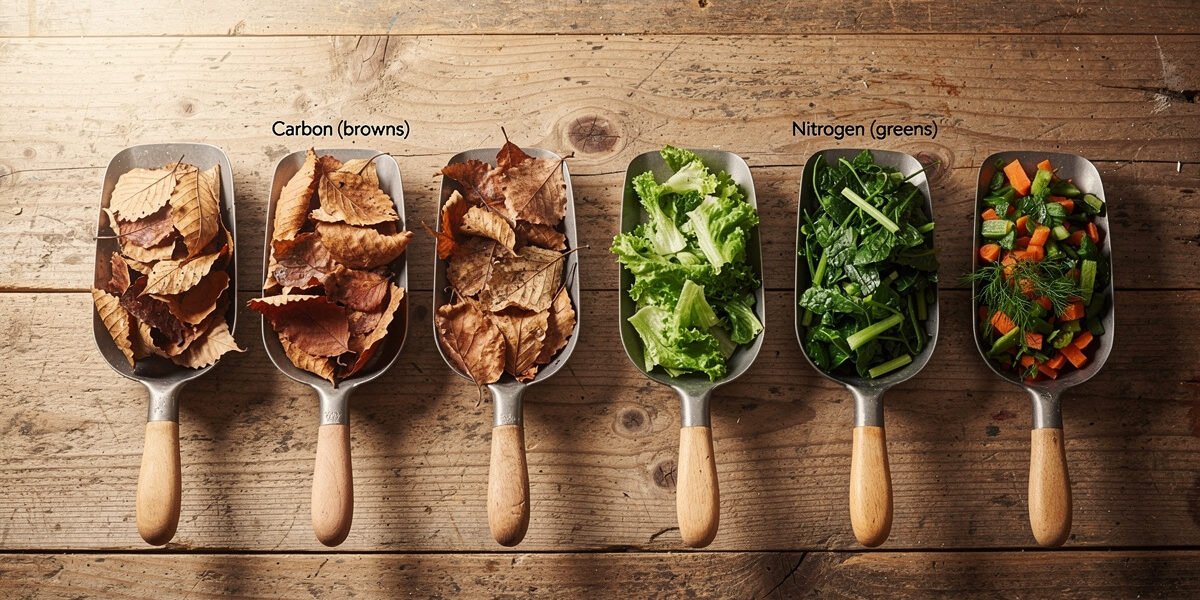
The ideal compost carbon to nitrogen ratio is 30:1 by weight — 30 parts carbon (browns) to 1 part nitrogen (greens). At this ratio, microbes multiply at maximum rate, the pile heats to 130-160°F within 72 hours, and decomposition finishes in 8 to 12 weeks. Drift below 20:1 and the pile smells like ammonia. Drift above 40:1 and the pile sits cold and inert for months. Almost every backyard composting failure traces back to a wrong C:N ratio.
The good news: you do not need a scale or a chemistry kit. Composters estimate C:N by volume — roughly 2 to 3 parts browns to 1 part greens by sight — and adjust based on smell, temperature, and pile behavior. This guide explains the math, shows the C:N values for every common composting input, and gives a same-day diagnostic to fix any pile that has drifted out of range.
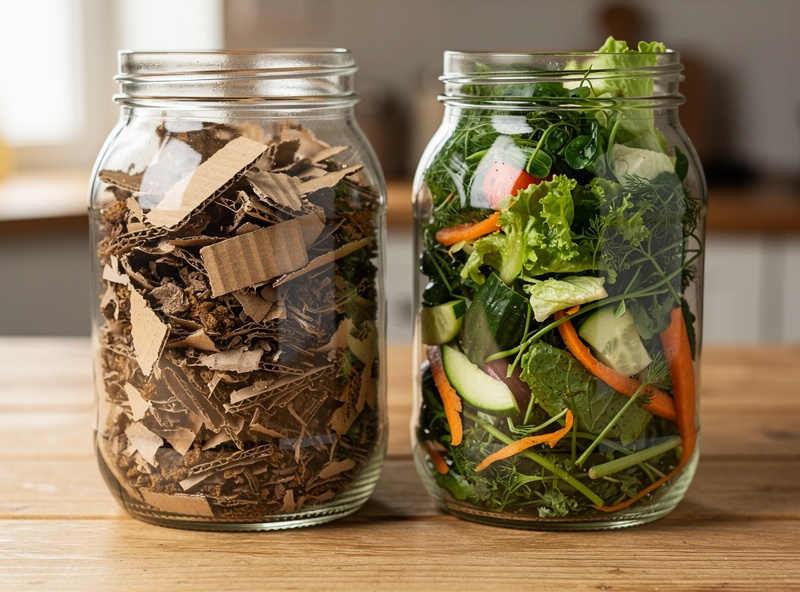
The carbon-to-nitrogen ratio is the one number that decides whether your compost cooks down in a couple of months or just sits there sulking — but honestly, I’ve never weighed a thing. After a while you go by feel and smell: ammonia means too much green, no heat means too much brown. A cheap compost thermometer takes the guesswork out, because the ratio shows up directly as heat. Here’s what 30:1 actually means, the C:N values of everything you’ll throw in, and how to read and fix a pile in thirty seconds. For the full method, see my how to make compost for vegetables guide.
As an Amazon Associate I earn from qualifying purchases.
Why 30:1 Specifically
Compost microbes are roughly 30% carbon and 5% nitrogen by dry weight. To build their bodies and reproduce, they need 30 carbon atoms for every nitrogen atom they consume — the ratio of their own composition. Feed them a substrate that matches this ratio and they convert organic matter to humus at maximum efficiency. Feed them an unbalanced substrate and the limiting nutrient dictates the rate.
LSU AgCenter puts the best blend for composting at about 25 to 30 parts carbon to 1 part nitrogen — the point where microbes have the most balanced environment to reproduce. Push the ratio too low and excess nitrogen is lost as ammonia; push it too high and decomposition slows to a crawl for want of nitrogen. In practice, at 30:1 a 3×3×3 ft pile reaches 140°F within 72 hours and sustains it for a couple of weeks, while a carbon-heavy 50:1 pile may never break 100°F.
The 30:1 target is for the entire pile, not each input. You blend high-carbon and high-nitrogen ingredients to average out at 30:1 in aggregate. Coffee grounds (20:1) blended with cardboard (350:1) at the right ratio averages out near 30:1 — both can go into the same pile.
C:N Values for Common Compost Inputs
| Material | Type | C:N Ratio | Moisture | Notes |
|---|---|---|---|---|
| Fresh grass clippings | Green | 17:1 | High | Compacts fast — mix with browns |
| Vegetable scraps | Green | 15–25:1 | High | Cut to 1-inch pieces |
| Coffee grounds | Green | 20:1 | Medium | Filter is brown — keep them together |
| Chicken manure | Green | 10:1 | Variable | Very hot — use sparingly |
| Cow or horse manure | Green | 20:1 | Medium | Aged manure preferred |
| Rabbit manure | Green | 12:1 | Low | Cold-applies safely too |
| Eggshells | Neutral | — | Low | Calcium source, negligible C:N effect |
| Fresh garden weeds | Green | 20:1 | High | Hot pile only if seeded |
| Dry autumn leaves | Brown | 50:1 | Low | Most accessible brown for most yards |
| Pine needles | Brown | 60:1 | Low | Mildly acidic — moderate amounts |
| Straw | Brown | 75:1 | Low | Excellent structure for airflow |
| Hay (dried grass) | Brown | 30:1 | Low | On the line — varies with cut date |
| Cardboard, shredded | Brown | 350:1 | Low | Soak first or it absorbs all moisture |
| Newspaper, shredded | Brown | 175:1 | Low | No glossy or color print |
| Wood chips | Brown | 400:1 | Low | Slow — best for paths or outer pile layers |
| Sawdust (untreated) | Brown | 500:1 | Low | Use sparingly — locks up nitrogen |
Memorize three numbers: grass clippings 17:1 (high N), vegetable scraps 20:1 (high N), dry leaves 50:1 (high C). Most household compost piles run heavy on these three inputs, and knowing roughly where each falls lets you balance by feel without consulting a chart.
Estimating Without a Scale
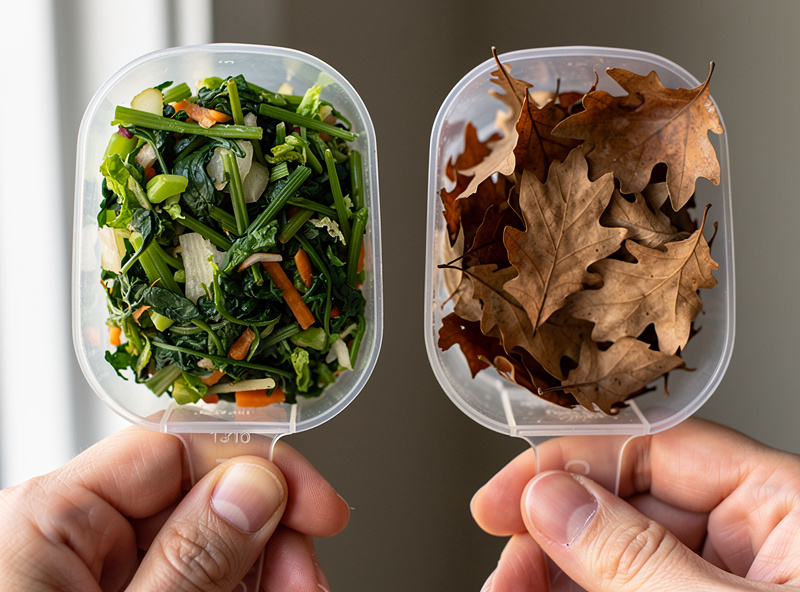
Backyard composters do not measure C:N with chemistry tools. The volume rule of thumb that approximates 30:1 in most pile builds is 2 to 3 parts browns to 1 part greens by volume. This works because greens are denser and wetter than browns — equal volumes of browns and greens contain very different masses, but the volume rule corrects for it.
Two practical adjustments to the volume rule:
- If your greens are mostly grass clippings (17:1, very high N): use 3 parts browns to 1 part greens.
- If your greens are vegetable scraps and coffee grounds (20–25:1, moderately high N): 2 parts browns to 1 part greens.
- If your browns are mostly cardboard or sawdust (350–500:1, very high C): blend with leaves first or you starve the pile of nitrogen.
The volume rule gets you within 20% of the 30:1 target — close enough that microbes thrive. Fine-tune by reading the pile’s behavior, not by recalculating math.
Diagnosing C:N Drift in 30 Seconds
The pile tells you what is wrong before you measure anything. Three sensory signals diagnose C:N drift:
Ammonia smell + pile won’t heat above 110°F. Diagnosis: too much nitrogen, C:N below 20:1. The microbes are converting excess nitrogen to ammonia gas instead of building their bodies. Fix: add 2 to 3 buckets of dry leaves, shredded cardboard, or straw and turn the pile thoroughly. Smell clears within 24 hours.
Pile sits cold + dry-looking + no decomposition after 2 weeks. Diagnosis: too much carbon, C:N above 40:1. Microbes have run out of nitrogen and stopped multiplying. Fix: add 1 to 2 buckets of fresh grass clippings, coffee grounds, or vegetable scraps, water to wrung-sponge moisture, and turn. Pile heats up within 72 hours if the pile is also at the 3×3×3 critical mass.
Pile smells like rotten eggs + slimy texture. Diagnosis: anaerobic conditions, often from too many wet greens compacting. Not a pure C:N problem but related. Fix: add coarse browns (straw, shredded cardboard) to restore airflow, turn thoroughly, ensure moisture is wrung-sponge level not dripping wet. The hot vs cold composting guide covers more troubleshooting for active piles.
Three Extreme C:N Mistakes
Beyond ordinary drift, three patterns of C:N mistake show up repeatedly in beginner piles:
Pure grass clipping piles. A pile of nothing but lawn clippings is 17:1 — way below the 25:1 floor. It compacts into a slimy, ammonia-soaked mat that goes anaerobic within days. Always blend grass clippings with at least equal volume of dry leaves, straw, or shredded cardboard. Best practice: store fresh clippings 24 hours to wilt before adding to a pile.
Sawdust-heavy piles. Sawdust at 500:1 is the most carbon-heavy material commonly available. A pile dominated by sawdust will not decompose meaningfully for years. Use sawdust as a thin top dressing for odor control or in tiny amounts as a moisture-absorbing additive — never as a primary brown.
All-cardboard browns with high-nitrogen greens. Cardboard at 350:1 absorbs water aggressively and locks up surrounding nitrogen during initial decomposition. A pile that is 2 parts cardboard to 1 part vegetable scraps drifts toward 80:1 average even though the volume ratio looks correct. Mix cardboard with leaves (50:1) so the average brown stays under 200:1.
When Precision Matters
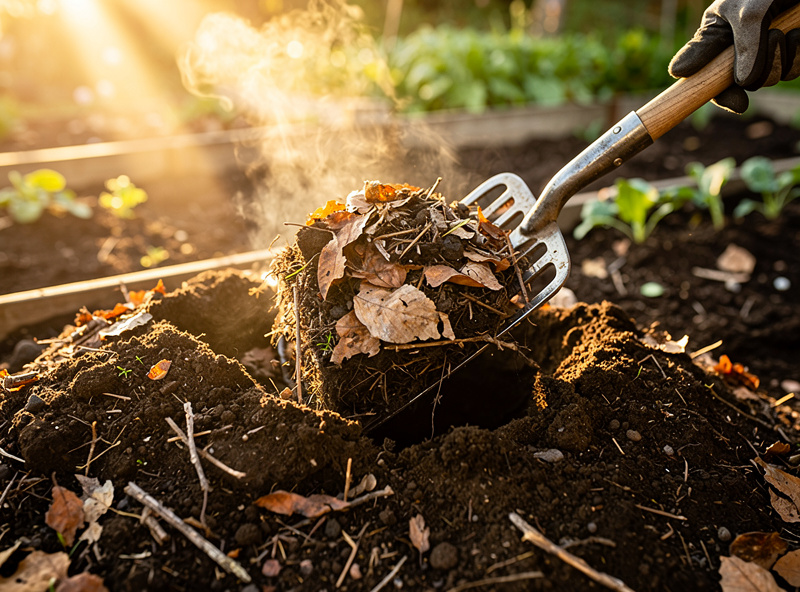
Most home composters can ignore C:N math entirely and rely on volume estimates. Precision becomes useful in two situations:
First, when you are scaling up to a 1-yard or larger hot pile and want it to peak at 160°F reliably. The fastest pile heat-up requires 28:1 to 32:1 C:N exactly, which means weighing inputs. A digital kitchen scale and the C:N table above is enough to land within range.
Second, when you are composting an unusual feedstock — coffee shop coffee grounds in bulk (20:1, very wet), spent brewery grain (12:1, very nitrogen-heavy), or bulk cardboard from a workshop (350:1). At volume, eyeballing fails and you need to calculate C:N by mass.
The formula: (Mass A × C:N A + Mass B × C:N B + …) ÷ Total Mass = Pile Average C:N. Aim for 30:1. For a 50-pound batch with 30 lb dry leaves (50:1) and 20 lb vegetable scraps (20:1): (30 × 50 + 20 × 20) ÷ 50 = 38:1 — slightly carbon-heavy but workable. Add 5 lb coffee grounds (20:1) to drop the average to 33:1.
The 30:1 C:N ratio is not a recipe you measure — it is a pattern you learn to read by smell and temperature. The compost thermometer I use — a Reotemp 20-inch probe — tells me everything I need to know in five seconds. If the pile reads below 100°F, it needs greens. If it smells like ammonia, it needs browns. After a season of tuning piles by C:N, the ratio becomes automatic — you will know by nose whether you are at 20:1 or 40:1 before the thermometer ever goes in.
Related Reading
- Home Composting: The Complete Beginner Guide — pillar guide covering all five methods
- Hot vs Cold Composting — when method choice depends on C:N control
- Vermicomposting for Beginners — worm bins handle different C:N ranges
- Compost Bin for Small Space — how container choice affects C:N management
- Soil and Compost: Complete Guide for Gardeners — broader soil context
Dialing In C:N on a Balcony
Carbon-to-nitrogen ratios are harder to dial in on a balcony than the extension-service charts suggest, because the material stream is so limited. My kitchen scraps are almost all nitrogen — food waste, coffee grounds, peelings — and the browns I have on hand are mostly cardboard and shredded paper, which break down slowly. The fix that has worked for me is planning ahead: I keep a bag of autumn leaves in the storage closet specifically for the compost, and a handful of dried leaves tucked between every layer of kitchen scraps is enough to keep the ratio in the zone where the pile heats up instead of turning into a stinking anaerobic mess. Up north, where you cannot always nip outside for a fresh armful of browns in February, that stockpiled bag of leaves is the single most useful thing on the balcony.
Frequently Asked Questions
What is the ideal compost C:N ratio?
30 parts carbon to 1 part nitrogen by weight is ideal. This matches the elemental composition of compost microbes themselves, so they reproduce at maximum rate. The acceptable working range is 25:1 to 35:1. Below 20:1 the pile smells like ammonia. Above 40:1 it sits cold.
How do I measure C:N without a scale?
Use a volume rule of thumb: 2 to 3 parts browns (dry leaves, cardboard, straw) to 1 part greens (food scraps, grass clippings, coffee grounds) by volume. Adjust toward 3 parts browns when greens are mostly grass clippings; toward 2 parts when greens are mostly vegetable scraps.
Are coffee grounds a green or a brown?
Green. Despite the brown color, coffee grounds have a C:N of about 20:1 — solidly in the green (high-nitrogen) category. The paper filter is brown at about 175:1, so used coffee filters and grounds together approximate 25:1 — close to the ideal target.
Can I add too many leaves to compost?
Yes. Dry leaves are 50:1 — already carbon-heavy. A pile that is 80% leaves will run at 80:1 average and never heat up. Balance leaves with at least 25% by volume of greens like coffee grounds, vegetable scraps, or grass clippings to bring the pile into thermophilic range.
How does C:N affect compost pile temperature?
At 25:1 to 30:1, a critical-mass pile reaches 140 degrees Fahrenheit in 72 hours. At 40:1, it may peak at 110 degrees and stall. At 60:1, it does not heat above ambient. Below 20:1, it heats once but goes anaerobic and stinks within days.
What is the C:N of finished compost?
Finished compost has a C:N ratio of about 10:1 to 15:1 — much lower than the starting material because microbes have consumed carbon as energy and exhaled it as carbon dioxide. This stable ratio is what makes finished compost a slow-release soil amendment.
Does C:N matter for cold composting?
Less than for hot composting. Cold piles decompose at any C:N in the 20:1 to 100:1 range — they just take longer at the extremes. The 30:1 target still produces faster results, but cold composting is forgiving of imprecise mixing because there is no thermophilic threshold to hit.