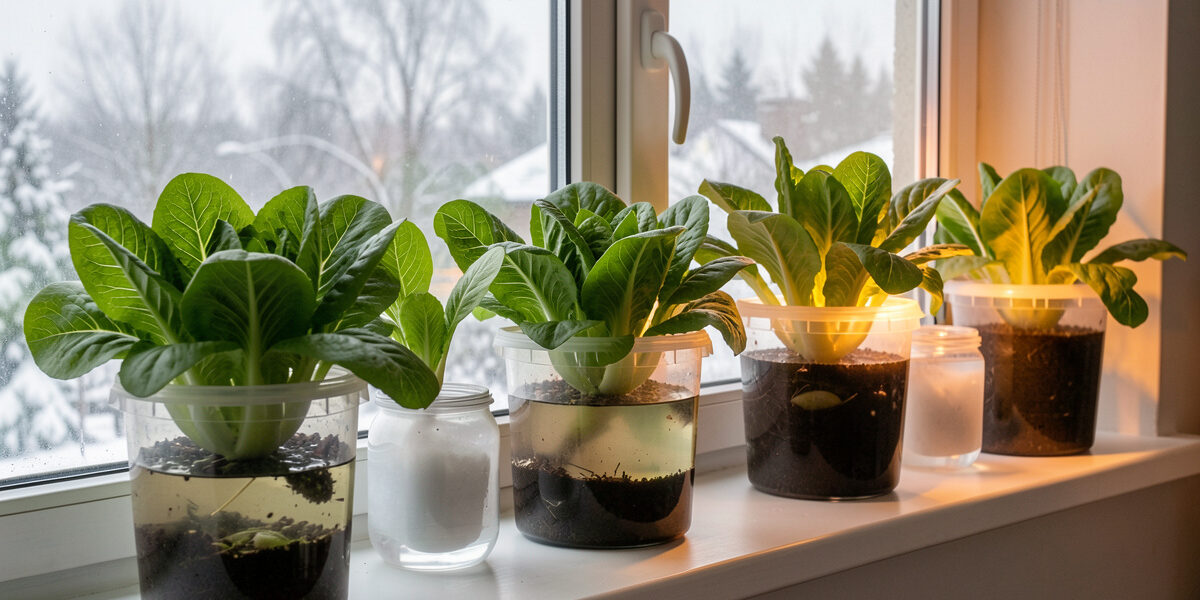
Lettuce is the crop the Kratky method was practically designed for: it is shallow-rooted, fast, low-feeding, and finishes in four to six weeks — well before a correctly sized reservoir runs dry. Suspend a seedling in a net cup over a litre or two of nutrient water, put it under light, and you get a full head with no pump, no timer, and no daily watering. Through a dark Swedish winter it is the single most reliable food I grow.
I say that having killed my share of early heads. My first winter lettuce went pale and stalled at the two-true-leaf stage and sat there sulking for three weeks while I blamed everything except the real cause. Once I sorted the light and the pH, the same setup gave me butterhead I was cutting for salad in February, which is a genuinely strange thing to carry from a windowsill in a country that barely sees the sun that month. This is exactly how I do it now, and the mistakes I would save you.
Why Is Lettuce the Best Crop for the Kratky Method?
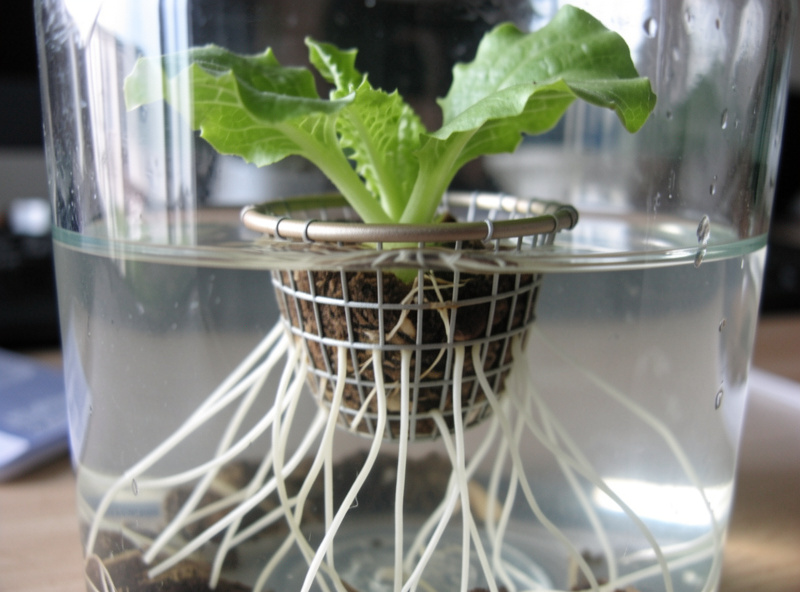
Lettuce suits passive hydroponics because it is a low-demand leafy crop with no fruiting phase, so a single charge of nutrient solution carries it all the way to harvest. It roots fast, tolerates a wide pH window, and its shallow root system is perfectly happy splitting into submerged feeder roots and an air-breathing upper mass — the exact behaviour the Kratky method relies on.
Compare that to a tomato, which wants a huge reservoir and mid-grow refills, and you can see why every passive-hydroponics tutorial starts with lettuce. It forgives beginners. If your solution drifts a little or your light is imperfect, lettuce slows down rather than dying outright, which gives you time to notice and fix the problem. That forgiveness is why I still start every new grower — and every new cultivar test on my own shelf — with a head of leaf lettuce before anything fussier. The method itself is laid out in the Kratky method for beginners guide; this article is the crop-specific playbook.
Which Lettuce Varieties Grow Best in Passive Hydroponics?
Loose-leaf and butterhead types are the winners: they are quick, compact, and forgiving of low winter light. Loose-leaf varieties like ‘Black Seeded Simpson’ and the Salanova types give you cut-and-come-again harvests, while butterheads such as ‘Rex’ form tidy hearts that suit a small reservoir. Crisphead (iceberg) types are slower and hungrier and I leave them for the summer balcony.
My winter shelf leans on loose-leaf because it starts giving me leaves to pick early, long before it forms a full head — important when daylight is short and growth is slow. ‘Rex’ is my go-to butterhead because it stays sweet and does not bolt at the first sign of warmth from the grow light, which cheaper seed-rack butterheads will do. I avoid the dramatic red romaines indoors in deep winter; they colour up beautifully in strong light but look muddy and grow slowly under a bar during the darkest weeks. Match the cultivar to your light, not to the pretty picture on the seed packet.
How Do You Start Lettuce Seeds for a Kratky Setup?
You germinate the seed in a small starter plug — a rockwool cube or coir plug — kept damp until the first roots poke through, then transfer the whole plug into a net cup and set it over your reservoir. Lettuce germinates in a few days at room temperature and does not need to be buried; it actually germinates better with a little light, so I press seeds barely into the surface of a moist cube.
I start mine on the same shelf as my microgreens, under the LED bar, because a warm bright start prevents the leggy, stretched seedlings that never recover. Leggy is the enemy here: a seedling that stretches for light in its first week makes a floppy, weak plant that flops out of the net cup later. If you are new to starting seeds under lights, the same principles I use for keeping microgreen seedlings stocky apply exactly to lettuce — bright light, close to the plant, from the moment the first leaf shows. The choice between rockwool, clay pebbles, and coir for that starter plug is worth getting right, and I compare all three in rockwool vs clay pebbles vs coir plugs.
How Much Light Does Kratky Lettuce Need in Winter?
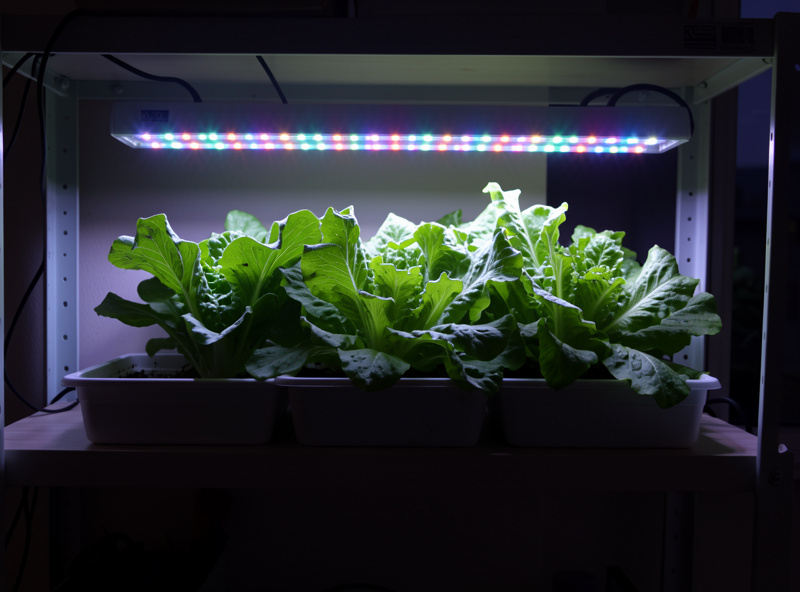
Lettuce needs bright light for 12–16 hours a day to form a proper head indoors, and in a Nordic winter that has to come from a grow light — the window alone will not do it. Lettuce is a lower-light crop than fruiting vegetables, which is part of why it works up here, but “lower light” still means far more than a December windowsill provides at these latitudes.
Under my full-spectrum LED bar I run the lettuce shelf on a long photoperiod, and the difference between that and window-only growing is night and day — literally. Window-only lettuce in January stretches, pales, and never hearts up; the same seed under the bar packs tight and stays deep green. Two variables matter beyond just hours: intensity and distance. Too far from the light and the plant stretches; too close and tender lettuce can scorch. I keep the bar at the height covered in grow light distance from plants, and I settled my daily run time using the logic in how many hours of grow light per day. Get the light right and lettuce is almost impossible to fail; get it wrong and no nutrient recipe will save you.
How Long Does Kratky Lettuce Take to Harvest?
Loose-leaf lettuce is ready to start picking leaves in about three to four weeks and a full head in four to six, while butterhead takes six to eight — add a week or two in the darkest part of winter when growth slows. You are not waiting on the reservoir; you are waiting on light and warmth, which is why the same setup harvests faster in March than in December.
The beauty of loose-leaf is that you do not have to wait for a finished head. I harvest the outer leaves as cut-and-come-again, taking the biggest few from each plant and letting the centre keep growing, which stretches one planting across several weeks of salads. For a full butterhead I lift the whole plant once it has formed a heart and before it shows any sign of bolting — a lettuce that starts stretching tall and going bitter has decided it is summer, and no amount of hoping reverses that. When the reservoir is nearly empty and the head is full, that is your cue to cut.
What Goes Wrong With Kratky Lettuce, and How Do You Fix It?
The three failures I see most are pale stalled seedlings (a light or pH problem), slimy brown roots (drowning, from over-filling), and bitter bolting plants (too warm, too old, or too little light). None of them are mysterious once you have seen each one, and all three are preventable at setup.
My own worst mistake was topping the reservoir up like a houseplant during that first winter — I kept the water line high “to be safe,” which meant the roots never got their air gap and the whole base of the plant went soft and translucent, with that sharp sour smell of anaerobic rot that you never forget once you have knelt over a jar and caught it. The fix was simply to stop: fill once so the solution kisses the net cup, then leave it and let the level fall. Pale, stalled plants almost always mean too little light or a pH out of range — check the light first because it is the more common culprit in winter, then reach for a pH pen. Bolting is a warmth-and-age problem; harvest before it and choose slow-bolt cultivars like ‘Rex’. If the water itself turns green, that is algae, and it wants its own fix, covered in the algae in a hydroponic reservoir guide.
Can You Grow Lettuce This Way All Winter?
Yes — a rolling succession of jars is what turns Kratky lettuce from a novelty into an actual winter salad supply. Because a single reservoir does one grow, continuous harvest comes from staggering plantings, not from squeezing extra crops out of tired solution. I start a new plug every week or two so there is always a head at cutting size behind the one I am eating.
This is the same succession-sowing logic that keeps my microgreen trays and sprouting jars producing without gaps, just slowed down to lettuce’s pace. Four small jars started two weeks apart will feed one person salad indefinitely through the dark months, using nothing but nutrient concentrate and the light you were probably running anyway. That is the whole promise of passive hydroponics up north: fresh green leaves in the depth of a Nordic winter, from a shelf, with less effort than keeping a houseplant alive. Kratky lettuce is where I would have every new grower start.
For the research-minded, Bernard Kratky’s non-circulating method was developed and published through the University of Hawaii’s College of Tropical Agriculture and Human Resources, and the wider science of growing leafy greens under controlled light is documented by Cornell’s Controlled Environment Agriculture program — both are worth reading once you are hooked.
Keep Building
- The Kratky Method for Beginners: Passive Hydroponics
- Rockwool vs Clay Pebbles vs Coir Plugs for Hydroponic Starts
- How Many Hours of Grow Light Per Day
- Algae in a Hydroponic Reservoir and How to Block Light
How long does lettuce take to grow with the Kratky method?
Loose-leaf lettuce is ready to start picking leaves in about three to four weeks and a full head in four to six weeks. Butterhead takes six to eight weeks. Growth slows in the darkest part of winter, so add a week or two when daylight is shortest.
What is the best lettuce variety for Kratky hydroponics?
Loose-leaf types like Black Seeded Simpson and Salanova, and butterheads like Rex, are the best choices. They are fast, compact, and forgiving of low winter light. Slow, hungry crisphead types such as iceberg are better left for summer growing.
Why is my Kratky lettuce not growing?
The most common causes are too little light and pH drift. In a Nordic winter a windowsill alone is not bright enough, so lettuce stalls and pales without a grow light. If light is adequate, check that the nutrient solution pH is in the high fives to low sixes.
Do you need to change the water for Kratky lettuce?
No. In the single-charge Kratky method you fill the reservoir once and let the plant drink it down to harvest. Lettuce finishes before a correctly sized reservoir runs dry, so there is no need to change or top up the water during the grow.
How much light does hydroponic lettuce need?
Lettuce needs bright light for roughly 12 to 16 hours a day to form a proper head indoors. It is a lower-light crop than fruiting vegetables, but in a dark Nordic winter that light still has to come from a grow light rather than the window.