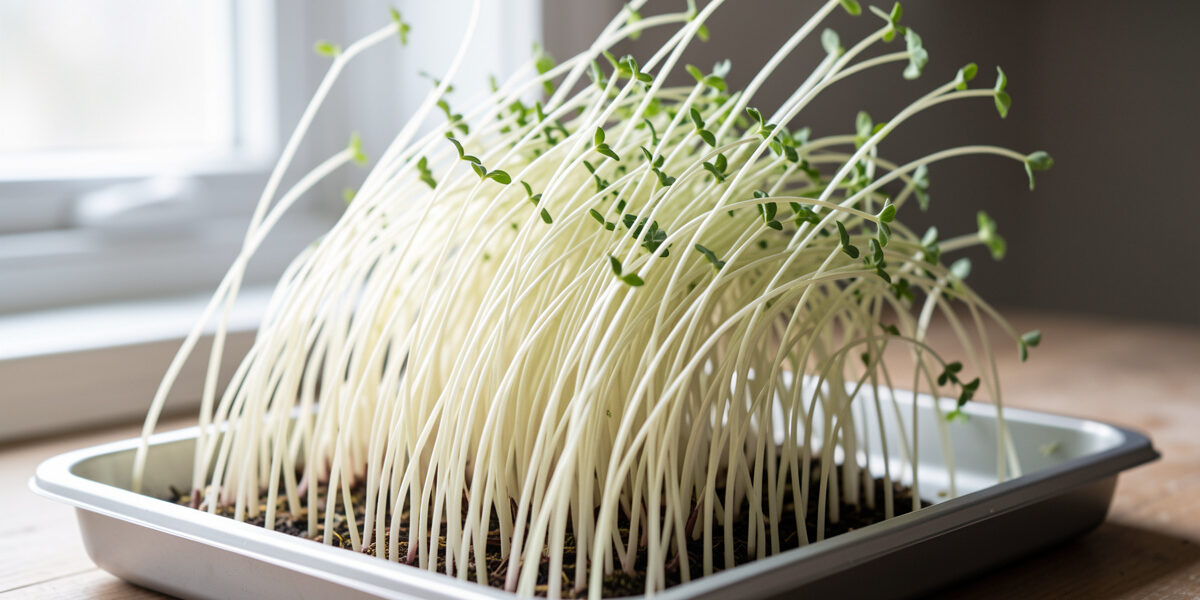
Leggy microgreens are stretching for light. When stems grow tall, thin, and pale and the tray leans or flops, the plants are burning energy on height because the light is too weak, too far away, or switched on too late after the blackout period. Bring a strong light down close to the canopy, uncover the tray on time, and run a small fan, and the next sowing comes up short, thick, and sturdy.
Legginess is the most common thing people “fix” wrong, because a little stretch is actually normal and useful, and panic makes them overcorrect. I’ve grown microgreens on my shelf through enough dark Nordic winters to have made every stretch mistake there is — blackout too long, bar hung too high, seedlings uncovered into the four hours of grey light a Swedish January window gives you. The good news is legginess is almost always cosmetic. You can still eat leggy microgreens; they’re just floppier and harder to cut clean. But if you want that dense, upright, market-stall look, it comes down to light, and light is the thing I’ve measured hardest.
What Makes Microgreens Grow Leggy?
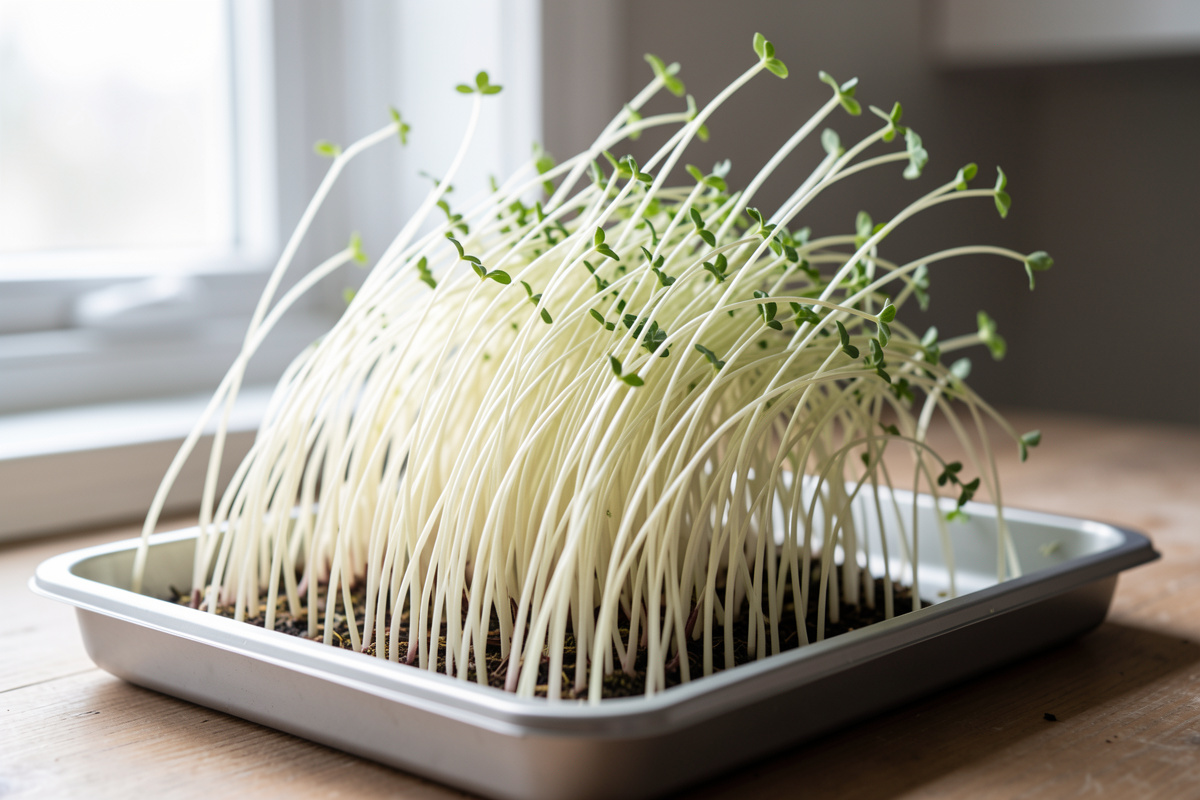
Microgreens grow leggy when they don’t get enough light intensity soon enough. A seedling’s default program is to stretch upward until it finds strong light, so weak light, a light source too far from the canopy, or a blackout period that runs too long all trigger the same elongated, pale, floppy growth. The stem invests in length instead of thickness, and once stretched it can’t un-stretch.
The mechanism is worth understanding because it tells you exactly what to change. In darkness or dim light, seedlings pour resources into vertical growth — it’s how a seed buried in soil reaches the surface. That’s why the blackout period produces long stems on purpose. But the plant is supposed to hit strong light and switch modes, thickening up and greening. If the light it hits is weak — a distant bar, a north window, a cheap panel that reads impressive on the wattage label but delivers little actual intensity at canopy height — the plant keeps stretching, hunting for a light level that never arrives.
Up here the winter light problem is brutal and it’s the reason I stopped trusting windowsills for microgreens years ago. A south window in Stockholm in January gives you maybe four hours of usable light, at an intensity that wouldn’t green up a bean sprout. Every US grow-guide that says “a sunny windowsill will do” was written by someone who has never tried to grow through a Nordic winter. This whole problem is one branch of my wider microgreens troubleshooting guide, and it’s the one where the Nordic-climate reality diverges hardest from the standard advice.
Is Some Stretch in Microgreens Normal?
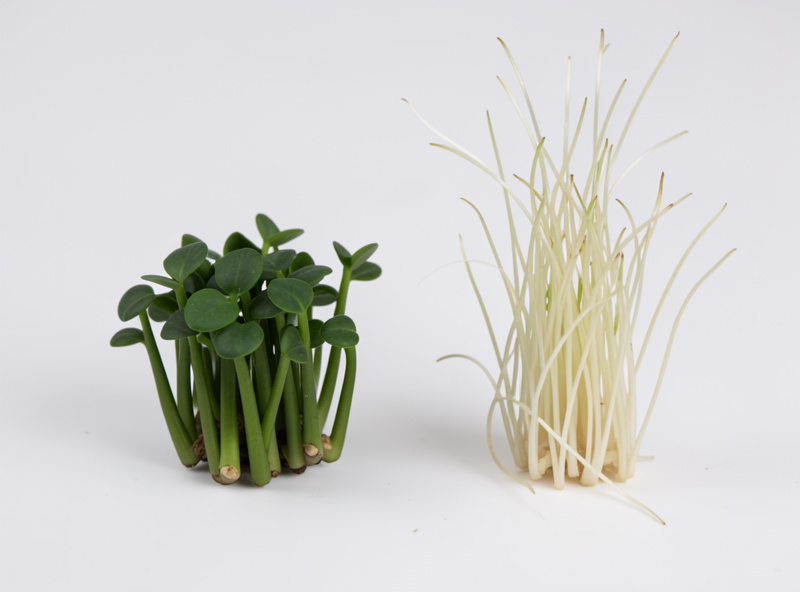
Yes — a controlled stretch during the blackout period is normal and even desirable. Those first days under a cover, you want the seedlings to reach and lengthen, which gives you taller harvestable stems on crops like pea, sunflower, and corn. The problem isn’t stretch itself; it’s stretch that continues after uncovering because the light that greets the plants is too weak to stop it.
This trips up beginners in both directions. Some panic at the pale, leaning growth under the blackout dome and rip the cover off on day two, ending up with short, uneven trays. Others leave the blackout on far too long, chasing length, and get spindly, etiolated stems that collapse. The blackout is a tool with a window: you keep it on until the crop has pushed up a uniform canopy that’s lifting the cover, then you uncover into strong light and the stretching stops. On my shelf that’s usually three to five days depending on the crop, and I judge it by the canopy pressing the lid, not by a fixed number.
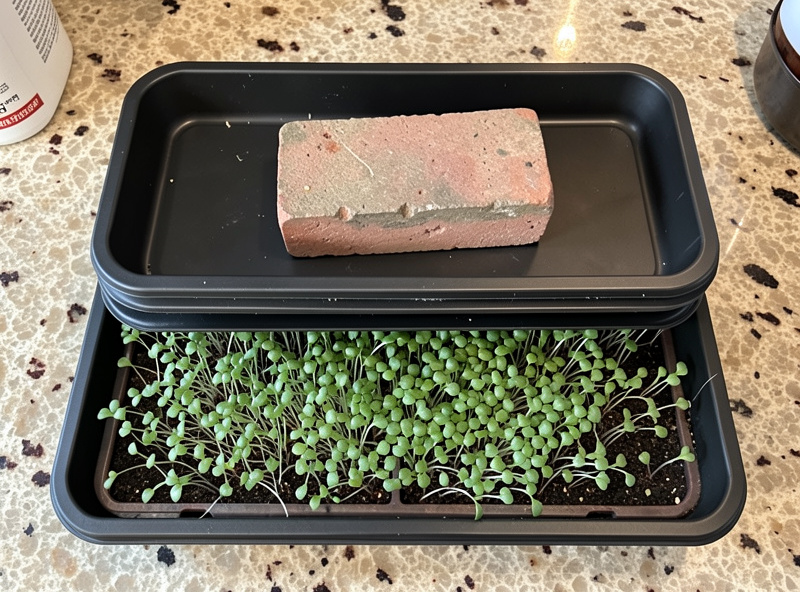
Weighting the tray during blackout actually helps here, counterintuitively. A weighted blackout tray — a second tray stacked on top with a brick in it — makes crops like pea and sunflower push against resistance, which builds thicker stems even as they lengthen. It’s the same trick that fixes uneven germination, doing double duty. When I skip the weight on sunflowers, I get a weaker, more sprawling stand.
How Close Should the Grow Light Be to Microgreens?
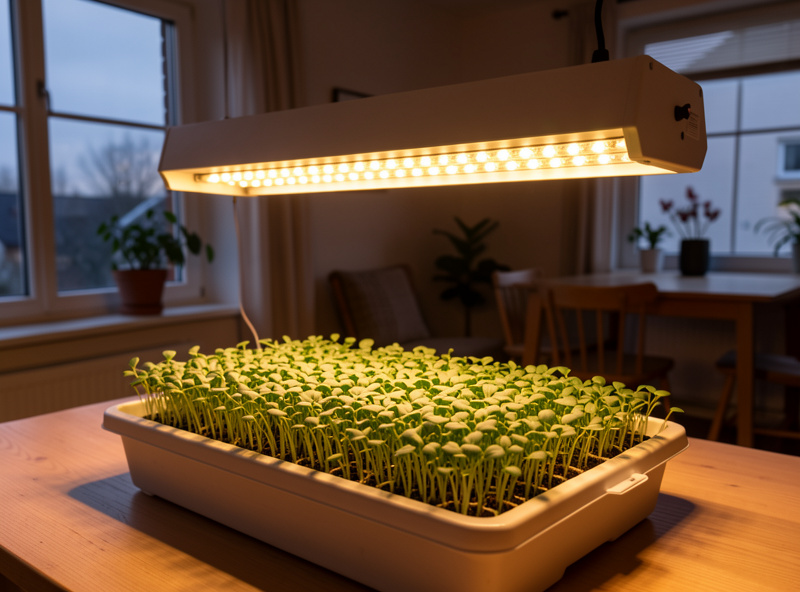
Close — often 15 to 25 cm above the canopy for a typical LED bar, far closer than most people hang it. Light intensity falls off with the square of the distance, so a bar at 50 cm delivers only a quarter of the intensity it gives at 25 cm. Getting a real light source down near the canopy is the single biggest fix for leggy microgreens, and it beats buying a more powerful light.
The inverse-square law is the thing nobody internalizes until they measure it. Double the distance, quarter the light. That’s why raising a modest bar closer to the plants often outperforms a bigger, brighter light hung high — you’re fighting geometry, not wattage. I treat my lights as a measured system rather than a number on a box; the details of what actually matters (spectrum and PPFD, not lumens or watts) are in my guide to grow lights for microgreens, and the broader case that expensive grow lights aren’t always worth it holds especially for microgreens, which need intensity and proximity more than premium features.
Watch the distance doesn’t flip into the opposite problem. Too close, especially with a hot or high-output light, can bleach or scorch tender microgreens. For most LED bars over microgreens there’s no meaningful heat, so close is safe, but if you’re running an older or higher-wattage fixture, watch for pale, crisped tips and back off a few centimeters. I aim for the closest distance that doesn’t stress the crop, then leave it there. A good adjustable-height full-spectrum LED grow bar makes dialing this in trivial. A peer-reviewed study on light intensity and photoperiod in Brassica microgreens backs this up: too little light drives the same elongation and pigment loss growers see as legginess on a windowsill.
As an Amazon Associate I earn from qualifying purchases.
How Do You Fix Microgreens That Are Already Leggy?
You can’t un-stretch a stem, but you can stop it getting worse and still get a decent harvest. Drop the light closer immediately, add a fan to thicken what growth remains, and plan to harvest a little earlier before the stems get any weaker. Leggy microgreens are fully edible — they’re just floppier — so a stretched tray is a lesson for next time, not a loss.
Here’s my triage for a tray I’ve caught mid-stretch. First, get the light right down on it — even mid-crop, stronger light slows further elongation and helps the plants green up. Second, turn on a fan. Air movement is the underrated stem-thickener; plants that feel a breeze lay down more supportive tissue, and the same fan is doing double duty against mold by drying the canopy. Third, adjust expectations — cut the tray a bit sooner rather than hoping the stems firm up, because they won’t magically thicken past a certain point.
The failure I keep coming back to is my second winter, when I hung a new bar high because the instructions warned about scorching, then wondered why every tray came up like pale spaghetti. I’d taken a rule meant for seedling transplants and misapplied it to microgreens, which want the light far closer. Lowering that bar 30 cm turned floppy trays into upright ones within a week. If your stems are so weak they collapse into a wet mat, though, check it isn’t damping off instead — legginess leans and flops but the stems stay intact, whereas damping off pinches them through at the soil line.
How Do You Prevent Leggy Microgreens Next Time?
Prevent legginess with four habits: run a real light close to the canopy, uncover from blackout on time, keep a fan on the shelf, and give the crop enough hours of light per day. Do those and stretch never gets past the useful, controlled kind. It’s a setup problem, not a crop problem, and once the setup is right it stays fixed.
The light-hours piece matters as much as intensity, especially up north. Microgreens do well on a long photoperiod — I run mine on a generous daily schedule and the extra hours help the plants build substance rather than race upward hunting for light that keeps switching off. A cheap timer takes the guesswork out; my thinking on photoperiods and run-cost is in how many hours of grow light per day. Consistency is the point — plants stretched by an erratic light schedule look just as leggy as ones under a weak light.
And start with crops that behave. Some microgreens are naturally more upright and forgiving than others; if you keep fighting floppy trays, my list of the easiest microgreens for beginners points you at the reliable ones. Get a sturdy crop, a close light, honest hours, and a fan, and legginess simply stops being a problem you think about. The University of Minnesota Extension microgreens growing guide is a solid non-commercial reference on light and spacing if you want to go deeper.
Why are my microgreens tall, thin, and falling over?
They are stretching for light. Tall, pale, floppy stems mean the light is too weak, too far from the canopy, or was switched on too late after blackout. Lower a strong light close to the plants, uncover on time, and add a small fan to thicken the stems.
Can you eat leggy microgreens?
Yes. Leggy microgreens are fully edible and taste the same as sturdy ones. They are just taller, paler, and floppier, which makes them harder to cut cleanly and quicker to wilt. Legginess is a cosmetic and handling issue, not a safety one.
How close should a grow light be to microgreens?
For a typical LED bar, roughly 15 to 25 cm above the canopy. Light intensity drops with the square of the distance, so getting the light close matters more than buying a brighter fixture. Watch for bleached tips with hotter lights and back off slightly if you see them.
Is some stretching in microgreens normal?
Yes. A controlled stretch during the blackout period is normal and gives you longer harvestable stems on peas and sunflowers. The problem is stretch that continues after uncovering because the light is too weak to stop it. Uncover into strong, close light on time.
Can I fix microgreens that are already leggy?
You cannot un-stretch a stem, but you can stop it getting worse. Lower the light immediately, add a fan to thicken remaining growth, and harvest a little earlier before the stems weaken further. Then fix the light setup for the next sowing.