Catching aphids, spider mites, and whiteflies in the first 48 hours is the difference between wiping a leaf and stripping a plant. A 1:1 macro lens — or a phone clip-on at roughly 10x — resolves a 1.2 mm whitefly and the silken webbing spider mites lay before any leaf curl appears. That is the entire game: see them while they are still a few colonies, not a population.
Most indoor gardeners only notice an infestation when leaves are already stippled, sticky, or wilting. By then, populations have doubled five or six times. This guide walks through the three pests that account for the majority of indoor and balcony-garden damage, what each looks like at 3-10x magnification, and the inspection cadence that keeps you ahead of them.
Why Early Macro Inspection Beats Reactive Treatment
Aphids reproduce parthenogenetically — a single founding female can become 600 descendants in a week at 26°C. Spider mites complete a full generation in 5-7 days at warm room temperatures. Whiteflies lay 200-400 eggs per female in a 30-day life. None of those numbers leave room for waiting until damage is visible.
A 5-minute weekly macro inspection costs almost nothing and catches every one of these pests during the founder-colony phase, when removal is mechanical (a cotton swab, a forceful water spray, an isopropyl wipe) instead of chemical. Once a population is established, you are committing to repeated insecticidal soap or neem applications and accepting some leaf loss. The core principle of integrated pest management holds here: how often you scout, not which spray you eventually reach for, is what decides the outcome.
Aphids: Pear-Shaped Bodies and Cornicles
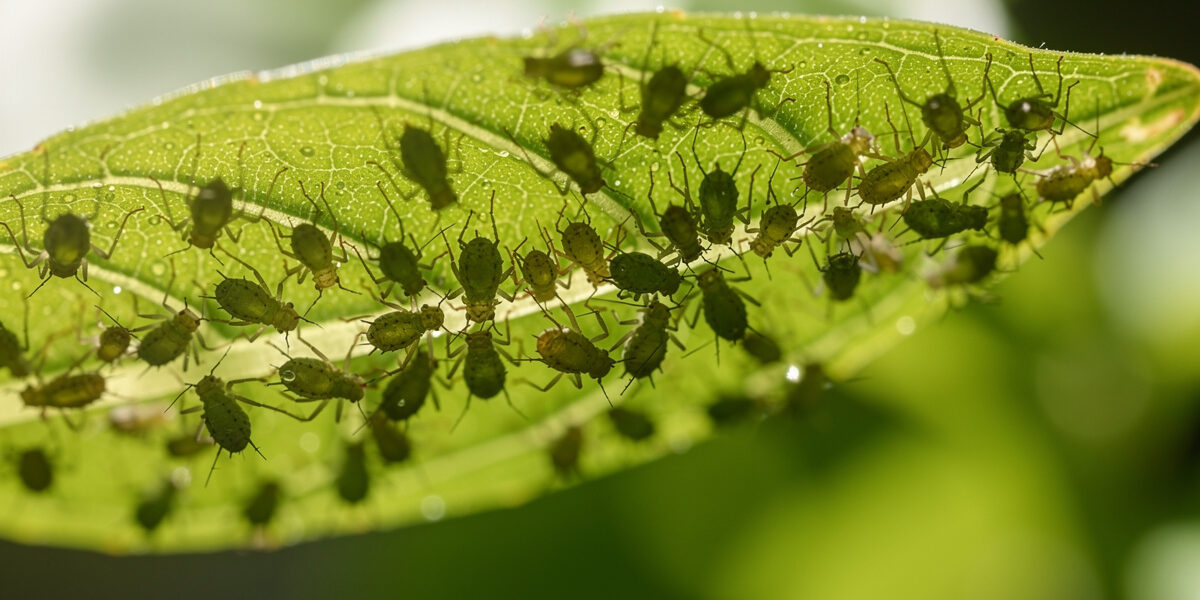
Aphids look like 1-3 mm pear-shaped insects with two short tubes — cornicles — projecting backward from the abdomen. Color varies by species and host: green on basil and lettuce, black on bean and nasturtium, pink on rose. At 3-5x macro you can clearly see the cornicles, which is the single most reliable identifier separating aphids from generic small green insects.
Where to look first: undersides of new growth, the tightest part of the leaf where it meets the stem, and any developing flower buds. Aphids cluster — finding one usually means finding 20 within a centimeter. Look also for ants. Ants farm aphids for honeydew, so a column of ants climbing a stem is an aphid indicator before you ever see the colony itself.
Damage signs at the macro scale: tiny puncture spots on the leaf surface, glossy honeydew sheen, and sooty mold (a black powdery coating) growing on top of the honeydew. A magnified leaf surface with these three together is conclusive.
Spider Mites: Look for the Webbing First
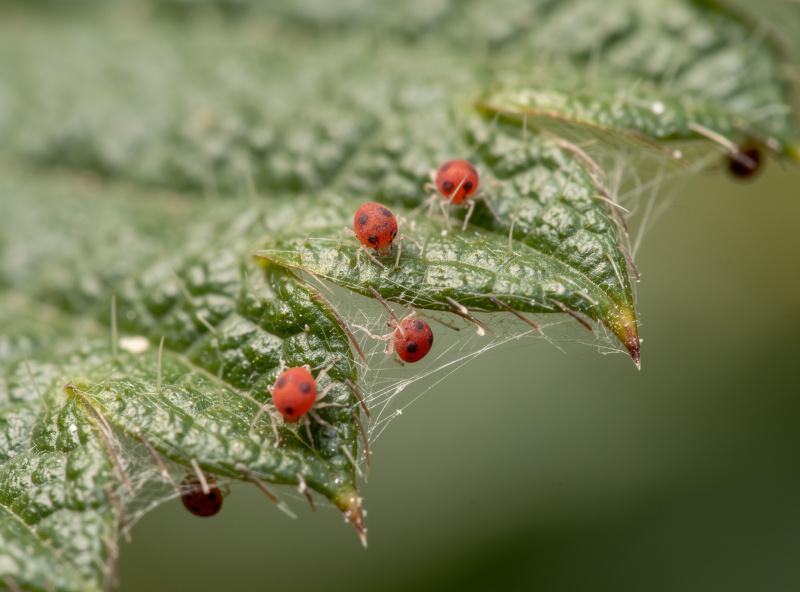
Two-spotted spider mites (Tetranychus urticae) are 0.4 mm — at the absolute bottom of what the human eye can resolve. You will almost always see their fine silk webbing before you see the mites themselves. The webbing appears at leaf-tip junctions, between leaflets, and along the leaf underside near the central vein.
At 5-10x macro the mites resolve as oval bodies with two darker patches on either side of the abdomen — the namesake “two spots” — moving slowly across the leaf underside. A red coloration usually means an older female; juveniles are paler tan-yellow. The University of California Statewide IPM Program’s identification photographs are the gold-standard reference if you want to match what you are seeing in the macro frame.
Damage signs: pale stippling on the upper leaf surface (the result of mites feeding from below), a generally dusty or bronzed leaf appearance, and in advanced cases, leaf yellowing and drop. Once webbing is heavy enough to be visible without magnification, the population is several thousand strong and chemical intervention is required.
Whiteflies: Disturb the Leaf and Watch
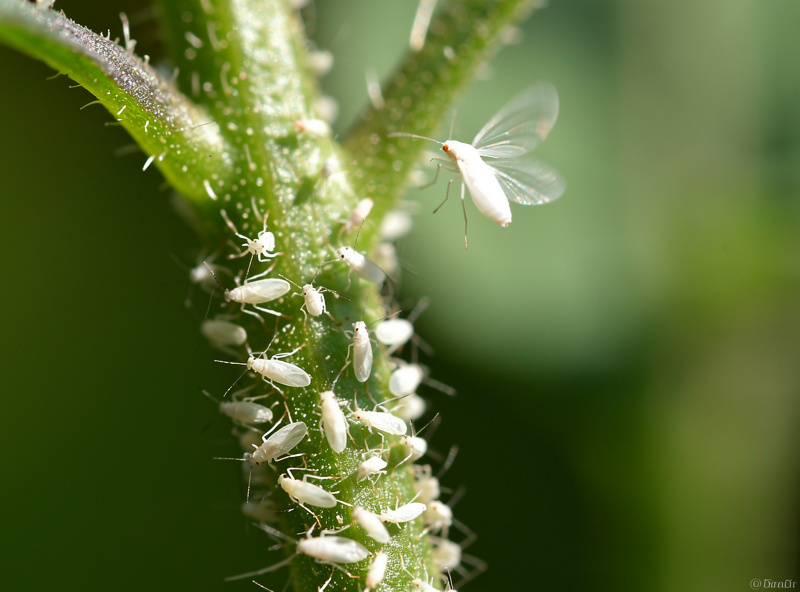
Whiteflies are 1-2 mm soft-bodied insects with powdery white wings held tent-shaped over their body. They cluster on the underside of leaves, particularly tomato, pepper, eggplant, and brassicas, and the most reliable identification method is behavioral: gently shake or brush the leaf and look for the cloud of small white insects that lifts off and resettles.
At macro scale, the wings show a slightly mealy texture rather than the smooth sheen of a fly. Eggs and nymphs appear as flat, oval, semi-transparent scales adhered to the leaf underside — these are easy to miss without magnification because they look more like leaf debris than insects. A clean scouting routine catches the egg stage on Tuesday and the adult cloud on Friday, which is exactly the kind of head-start you want.
Damage signs: yellowing leaves, sticky honeydew (same as aphids), and sooty mold. Heavy infestations cause stunted growth and, on tomatoes, irregular ripening. If you grow brassicas, whiteflies are the single most likely pest you will face indoors.
Camera, Lens, and Lighting: A Garden-Inspection Setup That Works
You do not need a high-end macro setup to identify these three pests. A modern smartphone with a clip-on macro lens (10-20x) resolves all three clearly. For more detailed work — schema-quality reference photos, distinguishing similar species — a dedicated macro lens on a mirrorless body is significantly faster and sharper.
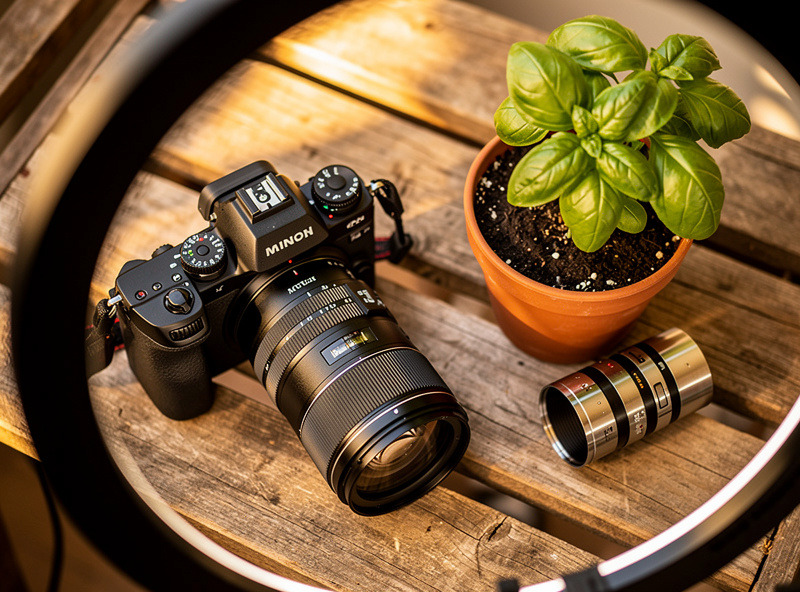
The full equipment-and-technique breakdown — focal length choice, working distance, aperture for depth of field, and focus stacking for full-pest-body sharpness — is covered on my sister site in the complete macro photography guide at LensLabHQ. The short version: a 90-105 mm macro at f/8-f/11 with a small LED ring light gives you both reach (no scaring whiteflies into flight) and the depth of field needed to keep an entire 2 mm aphid in focus.
Lighting matters more than most people think. Direct sunlight creates harsh shadows that hide pale eggs; a continuous LED ring or panel at 5000-5600 K reveals the cornicles, mite spots, and whitefly wing texture you are trying to see. A small reflector on the opposite side fills the shadow under curled leaves where pests hide.
The 5-Minute Weekly Inspection Workflow
This routine catches founder colonies of all three pests reliably, without becoming a chore:
- Day choice: Same day each week, ideally morning before pests are most active. Consistency matters more than the specific day.
- Plant rotation: Inspect every plant at least twice a month, susceptible plants (tomato, basil, pepper, brassica) every week.
- Macro pass: Photograph 3-5 leaves per plant — always the underside of new growth and one mature leaf — at 5-10x magnification. Save to a dated folder per plant.
- Disturb test: Gently brush the canopy and watch for whitefly liftoff. Two seconds per plant.
- Honeydew check: Touch a finger to a few leaves and check for stickiness — the fastest aphid/whitefly tell that requires no magnification.
- Tag and treat: Anything suspicious gets a same-day macro re-photo and a mechanical removal step (water spray, alcohol wipe, sticky trap placement).
For the dated photo workflow, pair this with the indoor-growing setup notes in the indoor herb garden setup guide and the fungus-gnat-specific identification approach in the fungus gnats complete guide — fungus gnats are the fourth common indoor pest and use a slightly different scouting method (yellow sticky cards rather than leaf inspection).
Pest Comparison Table: Identification at a Glance
| Pest | Size | Body Color | Where | Macro Tell | Damage Sign |
|---|---|---|---|---|---|
| Aphid | 1-3 mm | Green / black / pink | New growth, leaf nodes | Two cornicles on rear abdomen | Honeydew, sooty mold, ant column |
| Two-spotted spider mite | 0.4 mm | Tan to red | Leaf undersides, near veins | Two dark abdominal spots, fine webbing | Pale stippling above, bronzing |
| Whitefly | 1-2 mm | White (powdery wings) | Leaf undersides, brassicas/tomato | Mealy wing texture, lifts when disturbed | Yellowing, honeydew, sooty mold |
| Whitefly egg/nymph | 0.3 mm | Translucent yellow | Same leaves as adults | Flat oval scale stuck to leaf | Often missed without macro |
| Fungus gnat (for contrast) | 2-4 mm | Dark gray-black | Soil surface, flying low | Long legs, mosquito-like profile | See dedicated guide |
What to Do When You Find Them
Macro identification is half the workflow — the response is the other half. The treatment escalates by population size, not by pest species: insecticidal soap and a hard water spray work for all three at the founder-colony stage, neem oil and yellow sticky cards add coverage for established populations, and predatory insects (lacewings, lady beetles, Phytoseiulus persimilis for spider mites) are the right answer for outdoor and greenhouse infestations that have moved past 100+ individuals per plant.
Soil health drives susceptibility too. Plants under nitrogen stress, root-bound plants, and plants drying repeatedly between waterings all attract more pests. My soil and compost guide covers the foundation work that reduces infestation pressure independent of treatment, and the raised beds planning guide covers spacing decisions that let air move through the canopy — another underrated pest-pressure variable.
For deeper identification confidence, the University of California Statewide IPM Program photo library and the University of Kentucky aphid entomology fact sheet are the two free references most worth bookmarking. Both maintain side-by-side photographs of confusable species at the same magnifications you will be working at.
Frequently Asked Questions
What magnification do I need to identify garden pests?
5-10x magnification resolves all three common indoor pests. A smartphone with a clip-on macro lens (about 10x) is enough for aphids, spider mites, and whiteflies. Dedicated 1:1 macro lenses with extension tubes reach 1.5-2x magnification, which gives you sharper detail for distinguishing similar species.
How do I tell aphids from other tiny green insects?
Aphids have two short tubes called cornicles projecting backward from the abdomen. No other small garden insect has this exact feature. At 3-5x macro the cornicles are clearly visible. Aphids also cluster, so finding one almost always means finding 10-20 within a centimeter on the same leaf.
Why can I see spider mite webbing but not the mites?
Two-spotted spider mites are only 0.4 mm long, near the limit of human vision. Their silk webbing is far easier to see, especially at leaf-tip junctions and along the central vein on the underside. By the time webbing is visible without magnification, populations are several thousand strong and need active treatment.
How often should I macro-inspect my indoor plants?
Once weekly for susceptible plants like tomato, basil, pepper, and brassicas. Twice a month for everything else. Five minutes per inspection covers a 10-plant indoor garden — three to five leaf photographs per plant at 5-10x, plus the disturb-test for whiteflies. Catching founder colonies in week one prevents most damage.
Do I need a dedicated camera or is a phone enough?
A modern smartphone with a clip-on macro lens identifies all three pests reliably. Image quality is good enough for personal records and online identification questions. A dedicated mirrorless camera with a 90-105 mm macro lens delivers sharper detail, faster focus, and reference-quality photographs — useful if you want to track populations precisely or contribute to citizen-science databases.
What lighting works best for garden macro photography?
A continuous LED ring or panel at 5000-5600 K provides the even light needed to see pale aphid eggs and the fine texture on whitefly wings. Direct sunlight creates harsh shadows that hide nymphs and eggs in leaf curls. A small reflector opposite the main light fills shadow areas under curled leaves where pests typically hide.
Are macro photos useful for getting expert pest ID help?
Yes — clear macro photos are the single most useful thing you can attach when posting to extension service forums or plant-pathology subreddits. A 5-10x photo of the underside of an affected leaf, plus a wider context shot of the whole plant, lets entomologists ID the pest within minutes instead of guessing from text descriptions.