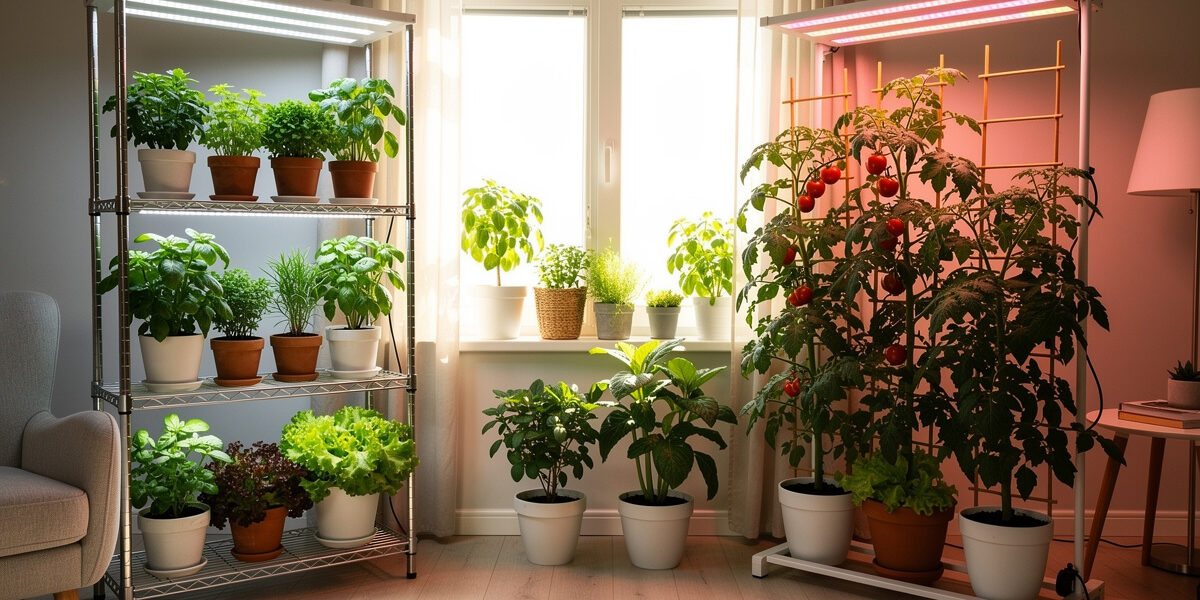
For about half the year, my windowsill is a decoration, not a light source. I garden indoors in Sweden, where winter daylight shrinks to eight or nine hours of low, grey sun and it’s dark by mid-afternoon. If I want microgreens in January or seedlings ready for spring, natural light simply isn’t an option — a grow light is the only thing standing between me and a shelf of pale, leggy disappointments. So the best light for growing plants indoors really depends on three things: what you’re growing, where, and how much of the year your own sky lets you down. This guide walks through every option, from free window light to LED panels, the way I’ve actually worked through them. Lighting is one part of a wider kit — see the full indoor gardening essentials — and your potting mix matters just as much.
As an Amazon Associate I earn from qualifying purchases.
Natural Light: The Free Option
Before you spend anything, take an honest look at the light you already have. Plenty of houseplants and even some vegetables grow fine on a well-placed windowsill — the trick is knowing which window.
Window Direction and Light Quality
| Window Direction | Light Intensity | Hours of Direct Sun | Best For |
|---|---|---|---|
| South-facing | High (400–800+ PPFD peak) | 6–8 hours | Tomatoes, peppers, herbs, most vegetables |
| East-facing | Moderate (200–400 PPFD peak) | 3–5 hours (morning) | Lettuce, herbs, houseplants |
| West-facing | Moderate (200–400 PPFD peak) | 3–5 hours (afternoon) | Herbs, leafy greens, some houseplants |
| North-facing | Low (50–150 PPFD) | 0–2 hours indirect | Low-light houseplants only |
The real problem with window light is consistency, and it’s the one I live with. At northern latitudes winter daylight drops to eight or nine hours, a heavy cloud deck can cut intensity dramatically, and if your window faces another building you lose more again. This is exactly why even people with good south-facing windows end up supplementing with LED grow lights through autumn and winter — and why, this far north, I treat artificial light as the default rather than the backup from October on. Iowa State Extension puts the underlying principle plainly: light is the most limiting growth factor indoors, and supplemental lighting is what removes that ceiling (important considerations for supplemental light).
How to Measure Your Natural Light
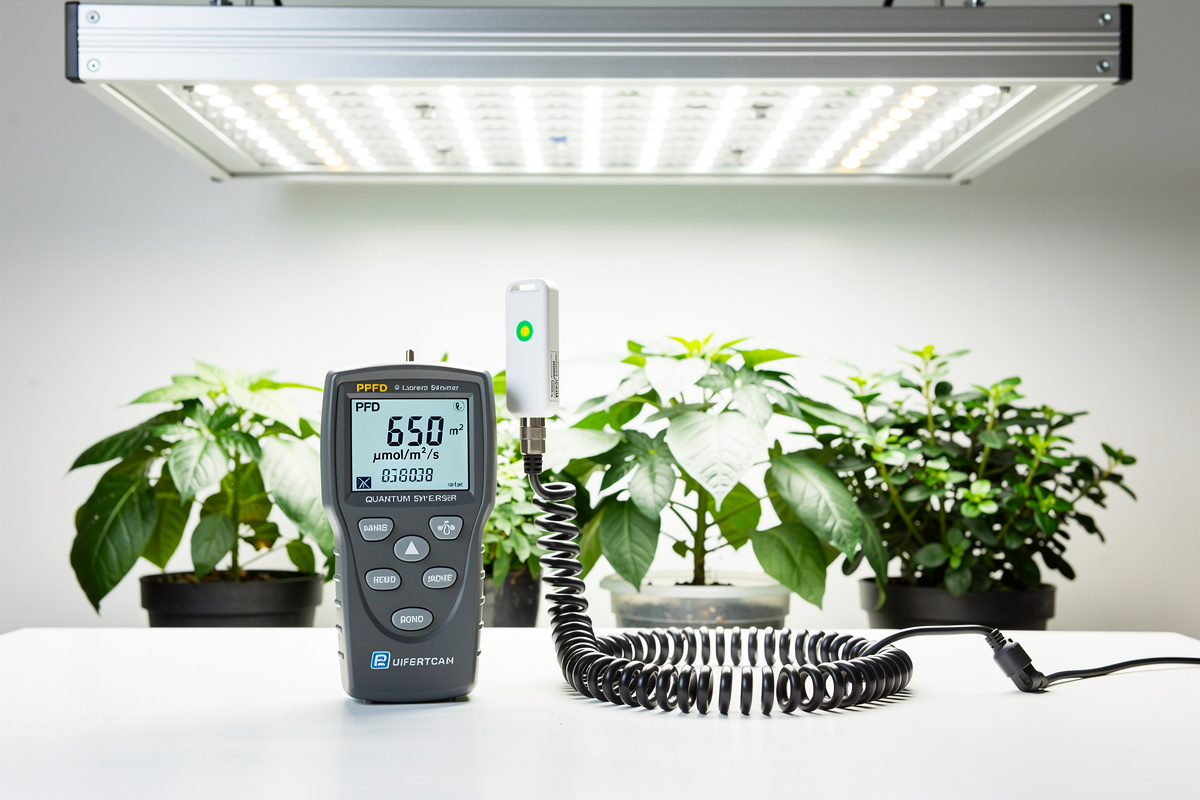
You don’t need to guess. A free phone app like “Photone” or a lux-meter app gets you close enough: hold the phone at plant height, sensor toward the window, and note the reading. Rough conversions from lux to PPFD:
- Sunlight: PPFD ≈ lux ÷ 54
- White LED: PPFD ≈ lux ÷ 65
- Fluorescent: PPFD ≈ lux ÷ 76
If your reading at plant level sits below about 5,000 lux (~90 PPFD sunlight equivalent), you need supplemental light for anything beyond a low-light houseplant. When I run this check on my brightest window in December, it fails — which tells you everything about why the lights go on.
Artificial Light Options, Ranked
When the window isn’t enough, here’s how the options stack up for a home grower, best to least practical.
1. Full Spectrum LED Panels (Best Overall)
A full-spectrum LED panel is what I’d buy first and what I’d tell anyone else to buy first. One fixture is efficient, lasts years, and does everything. A quality 100-watt panel covers roughly a 2×2 foot area and costs only a few dollars a month to run. The diodes to look for are Samsung LM301B or LM301H — they’re the efficiency benchmark, and a good full-spectrum LED panel will list the chip it uses. Best for: vegetables, herbs, seedlings, fruiting plants, and anyone who wants one light that handles the lot.
2. LED Light Bars and Strips (Best for Shelves)
If you grow on a wire shelving unit like I do, LED bars are the most space-efficient choice. They mount flush under a shelf so you keep the vertical room for the plants, and most daisy-chain so you can run several from one outlet. A pair of 20-watt bars lights a four-foot shelf of herbs or lettuce nicely. LED grow bars are my pick for a tiered seed-starting station. Best for: shelf setups, under-cabinet herb gardens, seed starting.
3. LED Grow Bulbs (Best Budget Entry)
Screw-in LED grow bulbs are the cheapest way in and fit any standard lamp socket. A single bulb realistically lights about a 1×1 foot area, so it’s for a pot or two, not a shelf — pair it with a clamp lamp over the plant. This is genuinely how I’d tell a nervous beginner to start: one LED grow bulb in a desk lamp, learn how plants respond, then scale up. Best for: supplementing 1–3 pots, a single houseplant, a tiny herb cluster.
4. T5 Fluorescent Tubes (Legacy Option)
T5 fixtures were the standard before LEDs got cheap, and they still work for seed starting and leafy greens. But they need new tubes every year or two, run hotter, and cost more to run. If you already own one, use it up — but I wouldn’t buy into fluorescent now. Best for: growers using up gear they already have.
5. CFL Spiral Bulbs (Minimal Use)
Compact fluorescents can keep a low-light houseplant alive but lack the punch for growing vegetables, and they produce less than half the usable light per watt of an LED. Cheap, but not worth it for anything serious.
Matching Light to the Plant
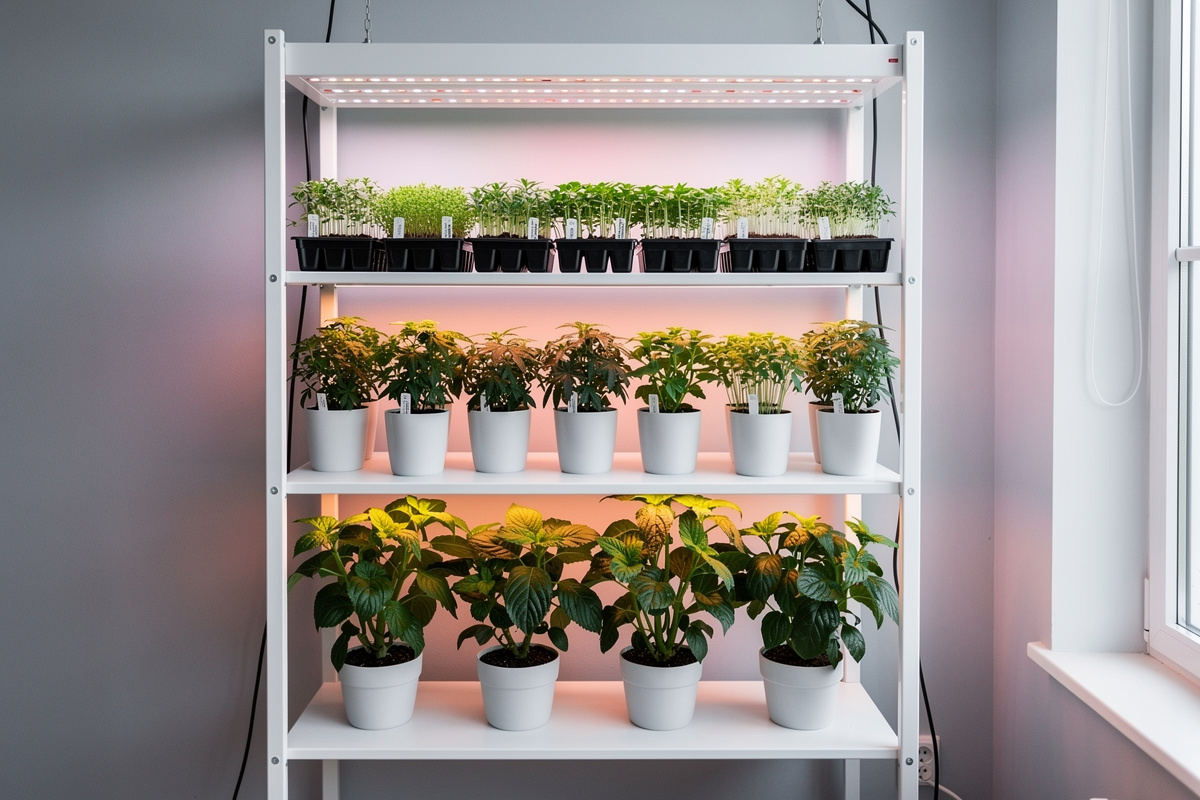
Different plants have very different appetites for light. The metric that ties it together is DLI — Daily Light Integral — the total photosynthetic light a plant gets over 24 hours, in mol/m²/day. Purdue Extension’s greenhouse guide is the clearest explainer of how DLI is measured and why it predicts growth better than wattage (Measuring Daily Light Integral in a Greenhouse).
| Category | Example Plants | Target DLI | Minimum PPFD | Recommended Setup |
|---|---|---|---|---|
| Low light | Pothos, snake plant, ZZ plant | 4–6 mol/day | 50–80 | LED bulb or east window |
| Medium light | Herbs, lettuce, spinach, microgreens | 8–14 mol/day | 100–250 | LED bar or small panel |
| High light | Tomatoes (see tomato grow light guide), peppers, strawberries | 20–30 mol/day | 300–600 | Full panel (150W+) |
| Very high light | Fruiting peppers and dwarf tomatoes at full production, flowering succulents | 30–45 mol/day | 600–1000 | Dual panel or commercial fixture |
The DLI Formula
DLI = PPFD × hours × 0.0036
For example, a panel giving 200 PPFD for 14 hours works out to 200 × 14 × 0.0036 = 10.08 mol/m²/day — perfect for herbs and leafy greens, and exactly the band my microgreens and lettuce live in. To reach the 20+ DLI that tomatoes and peppers want, you’d need around 400 PPFD for 14 hours. For pepper light needs by growth stage, see my grow lights for peppers guide.
Budget Guide: What to Spend
| Budget | What You Get | Coverage | Can Grow |
|---|---|---|---|
| $10–20 | Single LED grow bulb + clamp lamp | 1 sq ft | 1–2 herb pots, supplemental light |
| $30–50 | LED bar set or basic panel | 2–4 sq ft | Herbs, lettuce, seed starting |
| $60–100 | Quality panel with Samsung diodes | 4–6 sq ft | Full herb garden, leafy vegetables |
| $100–200 | Premium panel or dual-bar setup | 6–10 sq ft | Vegetables including fruiting crops |
| $200–400 | Multi-panel setup with timer | 10–16 sq ft | Year-round vegetable production |
The sweet spot for most home growers is the $60–100 range — one good panel that covers a standard wire shelf and grows everything from sprouts to peppers. That’s the bracket I’d steer almost everyone to. For the full from-scratch breakdown including soil and containers, see my urban gardening budget guide.
Setting Up for Success
Placement and Height
Hang the light directly above the plants, not off to one side — side-lighting makes everything lean and grow crooked. Start at the maker’s recommended height (usually 18–24 inches for seedlings, 12–18 for mature plants) and adjust over the first week based on how the plants respond.
Light Schedule — Use a Timer
This is the one accessory I’d insist on. A consistent photoperiod grows healthier plants than you flicking a switch when you remember, and through a dark winter you will forget. A cheap outlet timer or smart plug pays for itself in saved plants. Starting schedules:
- Seedlings: 16 hours on / 8 off
- Herbs and greens: 14 on / 10 off
- Flowering/fruiting crops: 12–14 on / 10–12 off
Combining Window Light and Grow Lights
If your plants catch 3–4 hours of direct window light, you only need to make up the rest artificially. Put the grow light opposite the window so the plants get light from both sides and lean less. This hybrid is what I run in the shoulder seasons — it trims the electricity bill while still hitting the DLI the plants need.
Signs Your Light Is Wrong
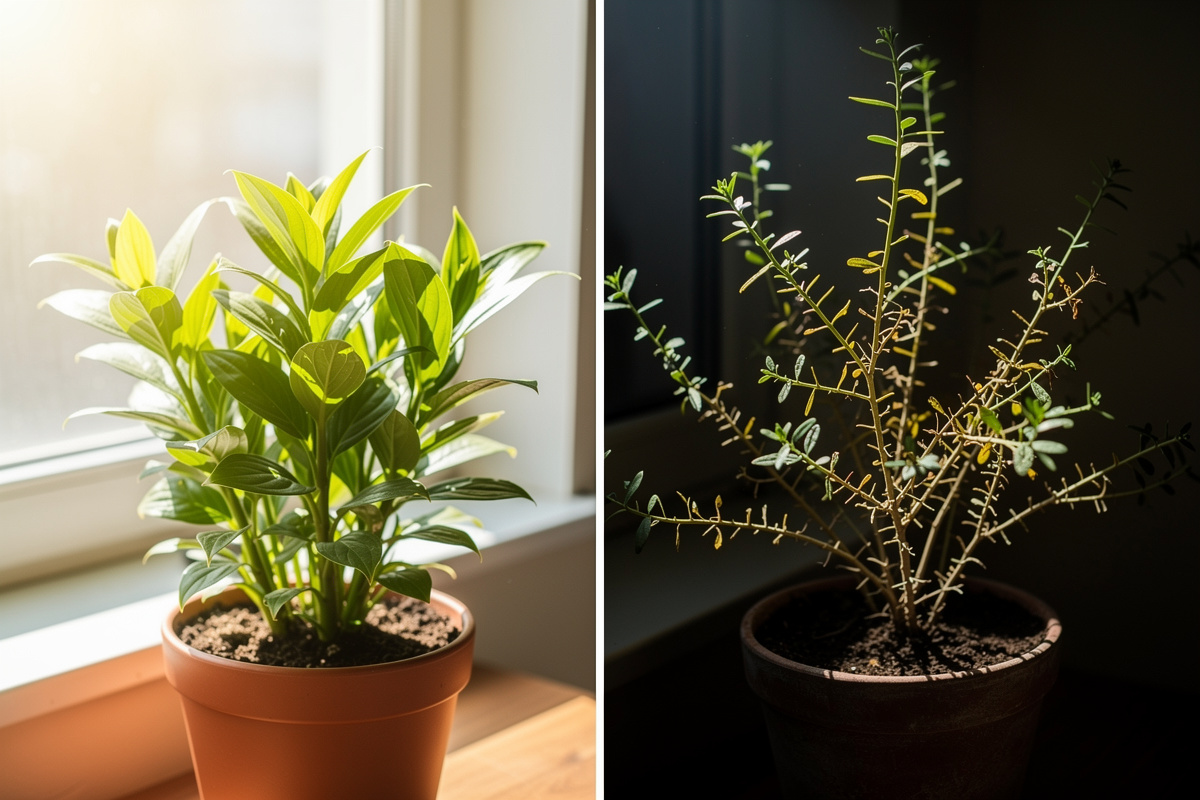
Not Enough Light
- Stems stretch thin and leggy (etiolation)
- Leaves turn pale or yellow
- Lower leaves drop
- Flowering plants won’t bloom
- Growth stalls in winter
Too Much Light
- Leaf edges scorch brown
- Bleached white patches on top leaves
- Leaves curl in or down
- Wilting despite enough water
Both are fixable by changing the light’s height or run-time. Move it 4–6 inches at a time and watch for 3–5 days before changing anything else. My indoor tomato guide has light-distance specifics for fruiting crops.
Energy Efficiency Tips
- Use reflective surfaces — white walls or a sheet of mylar bounce 10–25% more light onto the plants.
- Group plants tightly under the footprint so you’re not lighting empty shelf.
- Dim in late growth — leafy greens don’t need full intensity once established.
- Run during off-peak hours if your utility has time-of-use pricing.
- Match wattage to the job — a 100-watt panel over three herb pots is just an expensive electricity bill.
Heat Management Under Grow Lights
LEDs run far cooler than the old HID lights, but they still add some heat. A 100-watt panel can lift the temperature in a small enclosed space by a few degrees, which in a closed cabinet or tent can push past the comfort zone for leafy greens and make lettuce and spinach bolt. In an open room, ordinary ventilation handles it; an oscillating fan on low both moves the heat and strengthens the stems. In a tent, a small inline exhaust fan keeps things in check. Measure temperature at canopy level, not at the ceiling — the space right under the light is always the warmest, and it’s the number that matters.
An Upgrade Path That Works
Almost everyone starts small and scales up, and that’s the right way to do it:
- Months 1–3: a single LED bulb or gooseneck lamp on the windowsill — learn watering, positioning, and plant response with herbs.
- Months 3–6: a 100W panel on a wire shelf — add lettuce, spinach, and seed starting with steady harvests.
- Months 6–12: a second panel or a 200W board — bring in fruiting crops like peppers and compact tomatoes.
- Year 2+: a multi-shelf or tent setup with 400W+ — genuine year-round production that shows up on the grocery bill.
Each stage builds the skills for the next. Jump straight to a big rig without learning light positioning and watering under lights first and you’ll just buy expensive frustration. Start with lettuce, prove you can grow it well, then add complexity.
What is the best light for growing herbs indoors?
A full spectrum LED panel or LED light bar in the 20–40 watt range is ideal for herbs. Position it 12–18 inches above the plants and run it 12–14 hours daily. Herbs like basil, mint, and cilantro need moderate light (100–200 PPFD) and respond quickly to LED supplementation.
Can I use a desk lamp as a grow light?
A desk lamp with an ordinary LED bulb gives plants almost no usable light. But swap in a dedicated LED grow bulb (around $10–15 in E26/E27 size) and a desk lamp becomes a real grow light for one or two small pots.
How do I know if my plants are getting enough light indoors?
Watch for leggy stretched stems, pale leaves, slow growth, and dropping lower leaves. Use a free phone lux-meter app at plant level — most vegetables need at least about 10,000 lux (roughly 185 PPFD) for healthy growth.
Is natural sunlight better than grow lights for indoor plants?
Direct sun through a south window can beat most home grow lights for raw intensity, but it is inconsistent, especially in winter and at northern latitudes. Grow lights give controllable, consistent light regardless of the weather. Many growers, including me, use both.
Do plants need darkness or can I leave grow lights on 24/7?
Most plants need 6–10 hours of darkness daily for respiration and healthy growth, and running lights 24/7 can actually stress them and slow growth. The main exceptions are germinating seeds and some microgreens.
Related Articles
- LED Lights for Growing Plants Indoors: Complete Guide — the deep dive into LED spectrum, diodes, and setup
- Grow Lights for Tomatoes: Indoor Growing Guide — high-intensity lighting for indoor tomatoes
- Grow Lights for Peppers: Indoor Lighting Guide — LED recommendations for peppers
- Growing Plants from Seed Indoors — using lights to start seeds successfully
- Urban Gardening Equipment: Essential Tools — the complete gear list including lighting