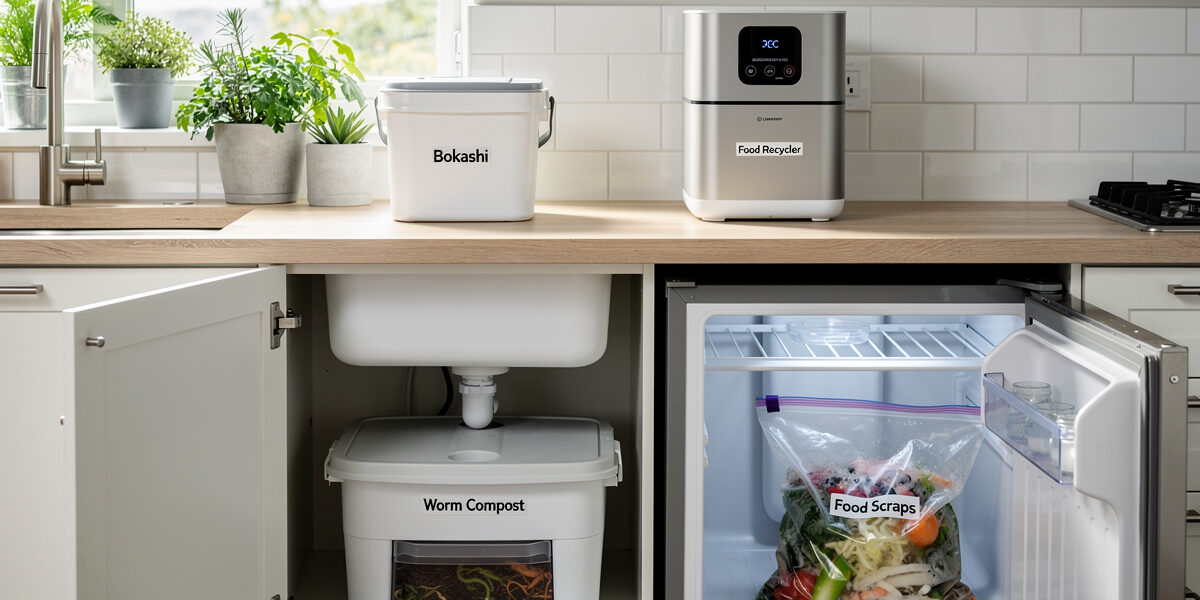
Apartment composting works in 4 methods I have tested in my own kitchen: a worm bin under the sink for daily vegetable scraps, bokashi buckets for meat and dairy, countertop electric composters for speed, and municipal drop-off for zero-hardware simplicity. The worm bin under my kitchen counter — a 10-gallon tote that cost 38 dollars to set up — processes half a pound of food per day and has never produced a single detectable odor in the three years it has been running. Most apartment dwellers can compost their entire food waste stream without touching outdoor soil.
The barrier is not space — a worm bin needs only 2 square feet of floor — but choosing the wrong method for the household. Vegetarian households mostly succeed with worm bins. Households with significant meat and dairy waste need bokashi or municipal drop-off. Households generating heavy food waste (over 5 lb per week) need either a larger system or a hybrid approach. This guide walks through the four working methods with realistic cost, capacity, and effort numbers.
As an Amazon Associate I earn from qualifying purchases.
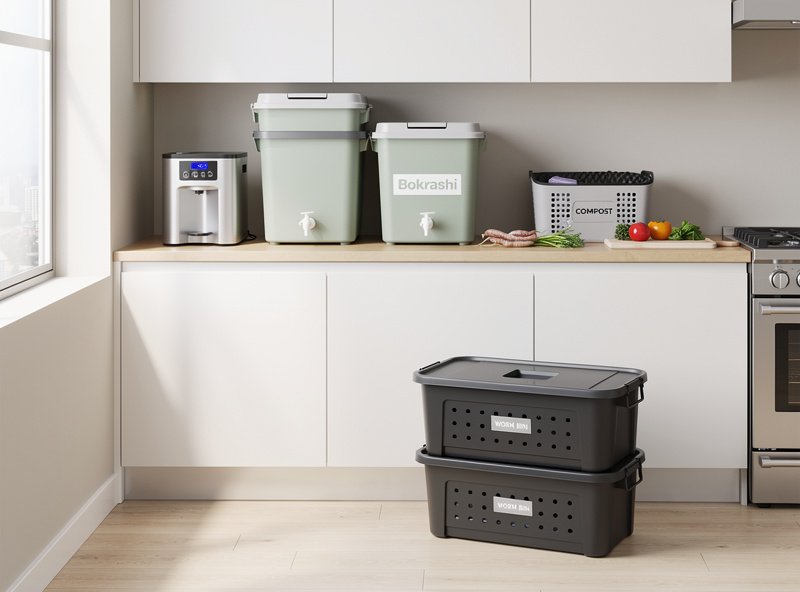
Why Apartment Composting Is Different
Three constraints separate apartment composting from backyard composting and force the methods that work:
1. No soil access. You cannot bury bokashi outdoors. You cannot top-dress a garden bed. The output of any apartment composting method must be either immediately usable on houseplants and container gardens, or transportable to someone who has soil — community gardens, friends with yards, or municipal compost programs.
2. Strict no-odor expectations. Even subtle smells are unacceptable in shared housing. The neighbor problem is the real reason most apartment composting attempts fail — not technical failure, but social failure. Sealed systems are mandatory.
3. Limited capacity. A 10-gallon worm bin maxes out at 0.5 lb of food per day. A bokashi pair maxes out at 5 lb per 2-week cycle. For families generating more than this, the system overflows and you end up freezing scraps or supplementing with municipal drop-off.
The good news: a single person or couple in an apartment generates 1 to 3 lb of compostable food waste per week — well within the capacity of a single small system. The wrong-system fit is the main failure mode, not capacity itself.
The 4 Apartment Composting Methods
Method 1: Under-sink worm bin (vermicomposting)
Capacity: 0.5 lb food per day for a 2-square-foot bin.
Setup cost: 38 dollars (DIY) to 130 dollars (Worm Factory 360).
Cycle time: First harvest in 3 to 4 months, then every 2 to 3 months.
Output: Worm castings, ready to use immediately on houseplants.
Best for: Vegetarian or low-meat households, plant lovers, anyone wanting immediate-use output.
The under-sink worm bin is the highest-impact apartment composting method by output value. Castings test 5 to 11x more nutrient-available than starting material, making them functionally a concentrated fertilizer for houseplants and container gardens. The US EPA’s indoor worm-bin guide recommends starting with a pound of red wigglers in a compact bin kept indoors so the worms neither freeze in winter nor overheat in summer — exactly the conditions a heated apartment provides year-round. Setup details and the full feeding workflow are in the vermicomposting for beginners guide.
The constraint: worms refuse meat, dairy, citrus in quantity, onions, and oils. A household generating these foods needs bokashi alongside or instead.
Method 2: Bokashi fermentation buckets
Capacity: 5 gallons of food per 2-week fermentation cycle, 10 gallons total with bucket pair rotation.
Setup cost: 50 to 90 dollars including 2-pound bran starter.
Cycle time: 2 weeks fermentation + 2 to 4 weeks soil-stage finishing = 4 to 6 weeks total.
Output: Pickled pre-compost requiring soil burial; finished compost after burial.
Best for: High-meat or high-dairy households, anyone wanting maximum waste capture.
Bokashi is the only home method that processes meat, fish, dairy, oils, citrus, onions, and cooked food. The trade-off is that fermented bokashi is not directly usable — it needs to finish in soil. Apartment dwellers without yard access use a 5-gallon "soil factory" bucket of garden soil for indoor finishing. Setup specifics are in the bokashi composting indoor guide.
The compounding advantage: bokashi paired with a worm bin processes a household’s entire food waste stream with no exclusions. The bokashi handles what worms refuse; the worm bin handles the high-volume vegetable scraps that bokashi would over-fill.
Method 3: Countertop electric composter
Capacity: 2 to 3 lb of food per cycle (most consumer units).
Setup cost: 400 to 800 dollars (Lomi, Vitamix Foodcycler, Reencle).
Cycle time: 4 to 9 hours per cycle.
Output: Dehydrated, ground food residue; not technically compost, requires further curing in soil.
Best for: Convenience-prioritizing households, no patience for fermentation timeframes.
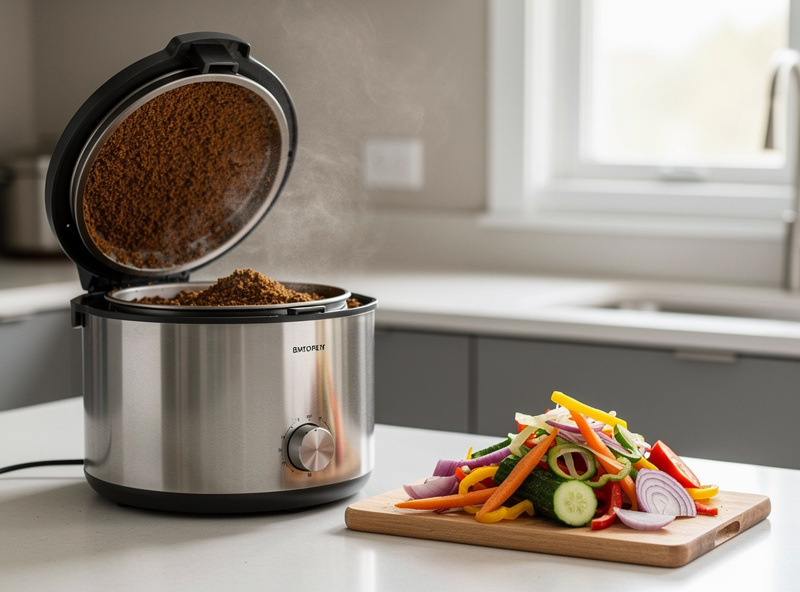
Electric composters are the marketing winner of the apartment composting category and the technical loser. They do not actually produce compost — they dehydrate food into a brown granulated residue that still needs to break down in soil to be usable. The 4-hour cycle marketed as "composting" is essentially a fast dehydrator with grinding.
That said, they have a niche: households with strong meat and dairy waste who want immediate volume reduction without bokashi’s fermentation routine, and who do not mind paying 400+ dollars and using 500 to 800 watts per cycle. The output works well as a soil amendment after a 2 to 4-week curing period in soil. As pure compost, electric composters underperform a 38-dollar DIY worm bin.
Method 4: Municipal compost drop-off
Capacity: Unlimited.
Setup cost: 0 dollars (or 5 to 10 dollars for a kitchen counter caddy with carbon filter).
Cycle time: Whenever you drop off — usually weekly.
Output: None retained — the city processes it.
Best for: Renters who do not want any equipment, dense urban areas with curbside or drop-off programs.
Many cities now offer either curbside compost pickup or designated drop-off points (community gardens, farmers markets, transfer stations). Storing scraps in a freezer bag eliminates odor entirely between drop-offs. This is the lowest-effort method and works at any household size.
The trade-off: you generate zero usable output yourself. For renters with houseplants or balcony gardens, this means buying bagged compost or worm castings to use indoors despite producing the raw material upstream. Worth it for the simplicity if you do not have plants to feed.
Method Comparison Table
| Method | Cost | Capacity/Week | Output Ready | Meat/Dairy? | Effort |
|---|---|---|---|---|---|
| Worm bin (DIY) | 38 dollars | 3.5 lb | 3–4 months | No | 5 min/week |
| Worm bin (kit) | 90–130 dollars | 3.5 lb | 3–4 months | No | 5 min/week |
| Bokashi pair | 50–90 dollars | 5 lb (per 2 weeks) | 4–6 weeks | Yes | 2 min/day |
| Electric composter | 400–800 dollars | 15 lb | 4 hours + 2–4 wk cure | Yes | 0–1 min/cycle |
| Municipal drop-off | 0–10 dollars | Unlimited | N/A | Yes | 10 min/week |
The math: a typical 2-person apartment generates 3 to 5 lb of compostable food waste per week. A worm bin handles 3.5 lb cleanly. A bokashi pair handles 5 lb. The electric composter has more capacity than most apartments need. Municipal drop-off is unlimited but produces no household-usable output.
The Two-System Apartment Setup
Most successful apartment composters end up running two methods in parallel within the first year. The pattern that works:
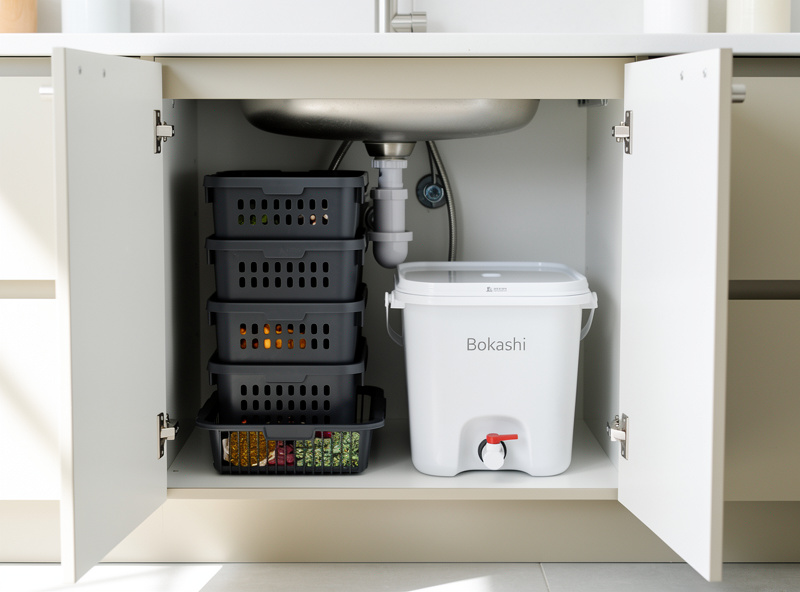
Worm bin + bokashi pair. The worm bin handles vegetable scraps, coffee grounds, fruit peels, and tea bags — high-volume but worm-safe inputs. The bokashi pair handles meat, dairy, oils, cooked leftovers, and citrus that the worms refuse. Combined, the two methods process 100% of a household’s food waste stream with zero exclusions.
Total cost: 90 to 200 dollars depending on setup choices. Total footprint: under-sink cabinet plus a corner of a pantry. Total monthly maintenance: 30 minutes including bin feeding, harvest, and bokashi-to-soil-factory transitions.
This setup outperforms a single-method approach by every measurable metric: capacity, food acceptance, output usability, and operational simplicity. The only reason not to run both is if you only generate vegetable scraps (worm bin alone is sufficient) or you only generate meat-heavy waste (bokashi alone is sufficient).
Apartment-Specific Problems
Three problems hit apartment composters more than backyard composters. Each has a clear fix:
Fruit fly outbreak. Cause: exposed food on the bin surface, often during a feeding rush. Fix: bury all food under 2 inches of bedding (worm bin) or bran (bokashi). Add a layer of dry shredded paper on top of worm bins. Cover bins with a damp cloth for one week to break the fly life cycle.
Neighbor smell complaints. Cause: usually a worm bin gone anaerobic from overfeeding or excess moisture. Fix: stop feeding for 2 weeks, add 2 cups of dry bedding, mix gently. Smell clears within 48 hours. A healthy bin smells faintly earthy, not sour or rotten.
Bin overflows during a busy week. Cause: cooking event, holiday meal, or seasonal influx exceeds bin capacity. Fix: freeze excess scraps in a freezer bag, gradually feed back over 2 to 3 weeks. Most apartments have spare freezer space for this. The freezer also kills any fruit fly eggs on incoming scraps.
What to Do With the Output in an Apartment
The most common question apartment composters ask after their first harvest: now what? Here are the practical destinations for indoor-produced compost and castings:
- Houseplants: 1 to 2 tablespoons of worm castings per 6-inch pot every 3 months. Specific application detail in the worm castings benefits guide.
- Balcony container gardens: Mix 20% castings into potting soil at planting. Top-dress with castings twice per growing season.
- Herb garden: Worm castings dramatically improve basil, parsley, and chive yields when used in seed-starting and as a quarterly top-dress.
- Friends and family: Bag the excess and give to friends with yards. Most home gardeners will trade a quart of finished compost for a handful of fresh produce.
- Community gardens: Most accept clean home-produced compost as a donation. Build relationships before bringing volume — some have material-quality requirements.
- Public tree wells: In many cities, mulching public street trees with finished compost is welcomed by local environmental groups. Check with your city forestry department first.
The output of a single worm bin and bokashi pair is enough to feed 30 to 60 houseplants, top-dress 50 sq ft of container gardens, and have leftover for friends — significantly more output than most apartment dwellers can use themselves. Plan distribution before you start composting, not after the harvest piles up.
If I were starting apartment composting from scratch today, I would begin with a worm bin for vegetable scraps and add a bokashi bucket for meat and dairy a few months later once the worm routine is established. The two systems together handle everything a two-person household throws at them, and the combined footprint is under 3 square feet of floor space. Start small, get one system right, then scale — that order avoids the overwhelm that causes most apartment composters to quit before their first harvest.
Related Reading
- Home Composting: The Complete Beginner Guide — pillar guide covering all five methods
- Vermicomposting for Beginners — full worm bin setup walkthrough
- Bokashi Composting Indoor — fermentation method for meat and dairy
- Compost Bin for Small Space — bin styles for tight footprints
- Worm Castings Benefits — what to do with the output
- Best Soil for Houseplants — where apartment compost shines
Frequently Asked Questions
Can you compost in an apartment without a yard?
Yes. Four methods work in apartments: under-sink worm bins, sealed bokashi buckets, countertop electric composters, and municipal drop-off programs. Worm bins and bokashi handle most household food waste at home; municipal drop-off works for any volume without retained output.
Will composting in my apartment smell?
Properly maintained worm bins and bokashi buckets smell faintly earthy or sweet-sour, never rotten. Sealed systems release essentially no detectable odor when closed. Bad smells signal overfeeding, excess moisture, or inadequate bran — all fixable within 24 to 48 hours by adjusting inputs.
What is the best compost system for a small apartment?
For most single-person or couple apartments, a 10-gallon DIY worm bin is the highest-impact starter at 38 dollars total cost. For households generating significant meat or dairy waste, add a bokashi bucket pair for 50 to 90 dollars. Together they handle a complete food waste stream.
Can I keep a worm bin under my kitchen sink?
Yes. The standard 2-square-foot worm bin fits under most kitchen sinks. Maintain temperature between 60 and 75 degrees Fahrenheit, keep the bin out of direct contact with hot pipes, and use a drip tray to catch any leachate. Most apartment worm bins live under-sink for years without issues.
Are electric composters worth it?
For most apartments, no. Electric composters cost 400 to 800 dollars to dehydrate food rather than compost it — the output still needs soil curing to be usable. A 38-dollar DIY worm bin produces actually-finished, immediately-usable castings. Electric units make sense only when convenience trumps output value.
How do I dispose of bokashi without a yard?
Use a 5 to 10-gallon "soil factory" bucket filled with garden soil. Layer fermented bokashi 1:1 with soil, stir weekly, and after 4 to 6 weeks the result is finished compost suitable for houseplants and container gardens. Many apartment composters never need outdoor soil access.
Can I compost meat and dairy in an apartment?
Yes, but only with bokashi fermentation in a sealed bucket. Worm bins and electric composters cannot safely process meat and dairy. Bokashi handles all animal-source food waste, then finishes either by outdoor burial (community garden access) or in an indoor soil factory bucket.