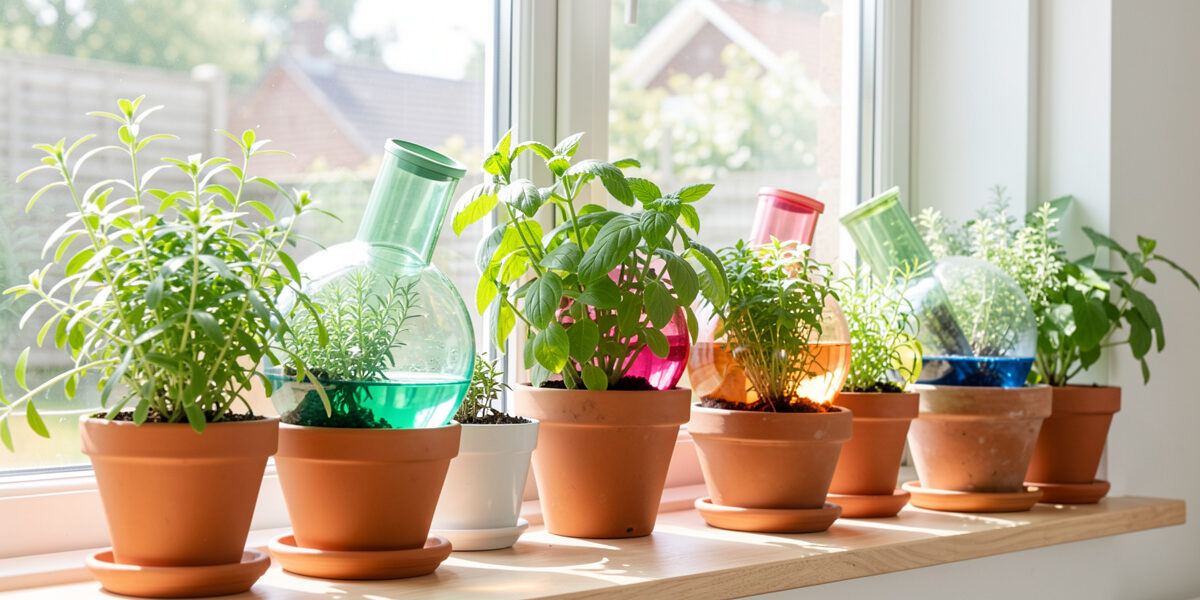
The honest answer to which are the best self-watering globes is that reservoir size and neck design matter far more than the pretty glass: a globe that holds 400 ml or more with a metered ceramic or narrow neck will carry a small pot for four to six days, while a decorative 150 ml bulb with a wide neck is a two-day top-up at best. Buy for capacity, not colour.
I have run globes on my windowsill herbs and balcony pots for years, cheap glass ones alongside the fancier borosilicate and ceramic-spike types, and the pattern never changes. The ones that actually hold a week are the exception, and most of the disappointment I hear about comes from expecting a small bulb to do a big pot’s job. Here is what separates a globe that works from one that drains in an afternoon, and how to pick the size for what you actually grow.
What a Self-Watering Globe Actually Does
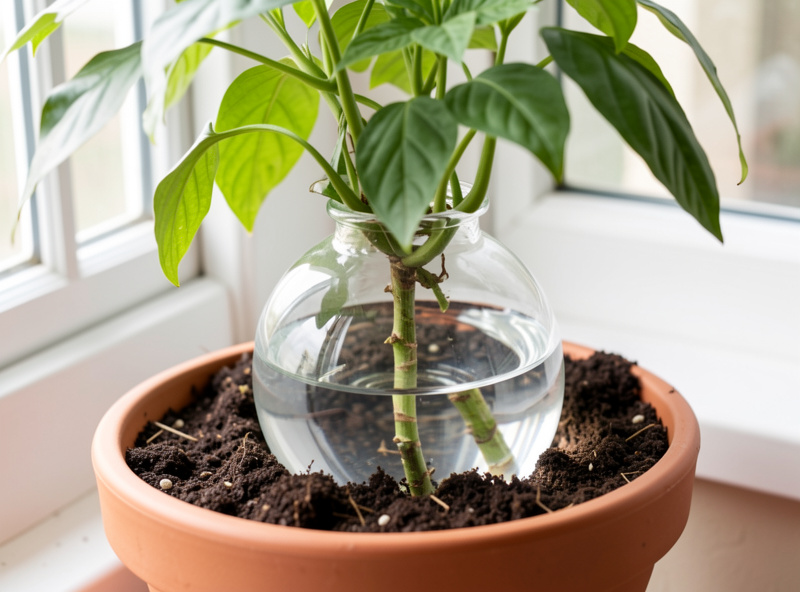
A watering globe is a sealed bulb with a long neck you push into the soil; as the soil dries it pulls water from the neck, and air bubbles back up to replace it. That is the whole mechanism, and it means a globe is a slow top-up that responds to soil dryness, not a timed or measured supply. When the soil is moist, almost nothing leaves the globe; when it dries, the flow speeds up.
This is why the same globe behaves completely differently in two pots. In a dense, water-retentive mix the soil rarely gets dry enough to pull hard, so the globe barely empties and the plant can still go thirsty at the root ball. In a loose, fast-draining peat-free mix the soil pulls constantly and the globe can dump its whole load in a day. The globe is not broken in either case; it is just doing what the soil tells it. Understanding that the soil, not the glass, sets the pace is the single thing that makes globes predictable. It also puts them firmly in the passive-reservoir family alongside the wine bottle trick and olla clay pots, which run on exactly the same physics.
Reservoir Size Is the Number That Matters
The only spec worth reading on the box is the volume, and most globes hold far less than they look. Decorative small globes hold roughly 150 to 250 ml, standard ones 300 to 500 ml, and the large “long weekend” designs 500 to 800 ml. Against a plant’s daily draw, that tells you the trip length immediately.
Do the arithmetic before you buy. A small herb in a 1-litre pot in normal indoor conditions might use 50 to 100 ml a day, so a 400 ml globe genuinely covers it for several days. A tomato or cucumber in a 10-litre pot in summer can drink close to a litre a day, so even the biggest globe is under a day of supply, which is why globes are the wrong tool for fruiting plants on a trip. The mismatch between what globes hold and what thirsty plants drink is the root of every “my globe didn’t work” complaint. If you are not sure how fast your specific plant drinks, my honest table of how long container plants last gives realistic daily figures to size against.
Glass, Plastic, or Ceramic-Spike: What Holds Up
The material changes durability and flow control more than performance. Glass globes look best and are easy to see the water level in, but they crack if knocked or if the neck freezes; plastic ones survive being dropped and travelling but scratch and cloud; ceramic-spike terracotta stakes that take a bottle or a bulb meter the flow through the clay itself, which makes them the most consistent of the lot.
My own preference has shifted over the years. Glass is what I reach for on the windowsill where they sit undisturbed and I like watching the level drop, because a clear bulb is the easiest early-warning that a globe has stopped drawing. For anything that gets handled or goes on the balcony where a stray elbow is likely, plastic earns its place by simply not shattering. The ceramic-spike types are the quiet winners for consistency: because the water passes through porous clay rather than glugging out of an open neck, the flow is slower and steadier and far less sensitive to soil density, which is exactly the failure the plain globes suffer. They cost more and are less pretty, and for a reliable week they are what I would buy. You can compare current glass and plastic watering globes and the sturdier terracotta watering spikes to see the range.
As an Amazon Associate I earn from qualifying purchases.
Self-Watering Globe Types Compared
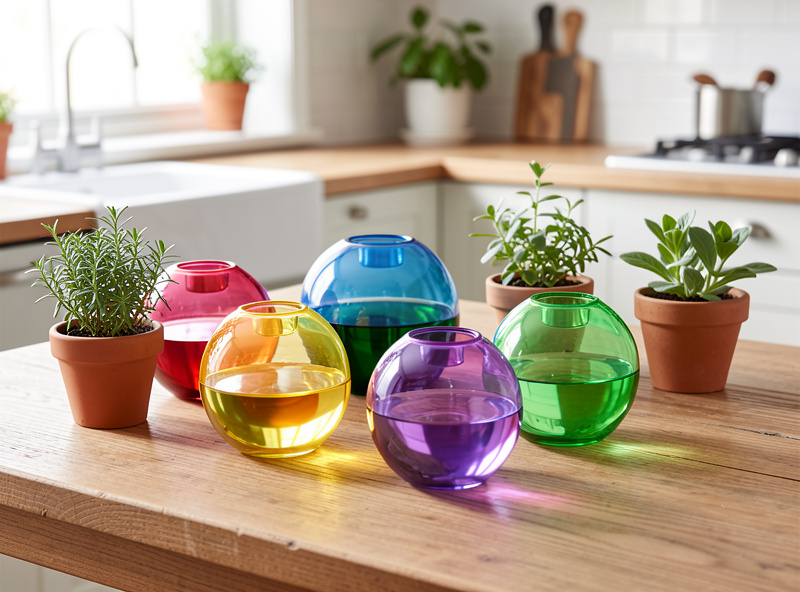
Here is how the common globe styles stack up for a small-space grower planning a trip. The “holds for” figures assume a small-to-medium pot in a normal peat-free mix with the plant pre-watered before the globe goes in.
| Type | Typical volume | Holds for | Best for | Main weakness |
|---|---|---|---|---|
| Decorative small glass | 150-250 ml | 1-2 days | Tiny herb pots, looks | Reservoir too small |
| Standard glass globe | 300-500 ml | 3-5 days | Windowsill herbs | Cracks, empties fast in loose mix |
| Large glass/plastic | 500-800 ml | 4-6 days | Medium pots, weekends | Top-heavy, can slump soil |
| Plastic globe | 300-600 ml | 3-5 days | Balcony, travel, kids | Scratches, clouds over |
| Ceramic-spike stake | varies (uses bottle) | 5-7 days | Reliable steady flow | Costs more, less decorative |
How to Set a Globe So It Actually Works
Most globe failures are setup errors, not product faults. Water the pot thoroughly first, make a pilot hole with a stick before inserting so you do not compact soil into the neck, and always run the globe at home for two days before you trust it on a trip. A globe that has not dropped its level after a day is clogged or in soil too wet to pull.
The pilot-hole step is the one people skip, and it is why globes clog: shoving a bulb straight into dry soil packs the neck solid and nothing flows. Make the hole, insert gently, and firm the soil lightly around the neck without ramming it. Watering first matters because a globe is meant to top up moist soil, not rescue a bone-dry pot; drop one into dry soil and it either glugs out everything at once or refuses to start. The two-day home test is non-negotiable for me, because a globe that drains in a day or one that never moves both look identical the moment you install them, and you only find out which you have by watching. If the neck keeps clogging, wrapping it in a scrap of the fabric from a capillary mat or a piece of fine mesh keeps soil out while still letting water pass.
How Globes Behave Through a Nordic Summer
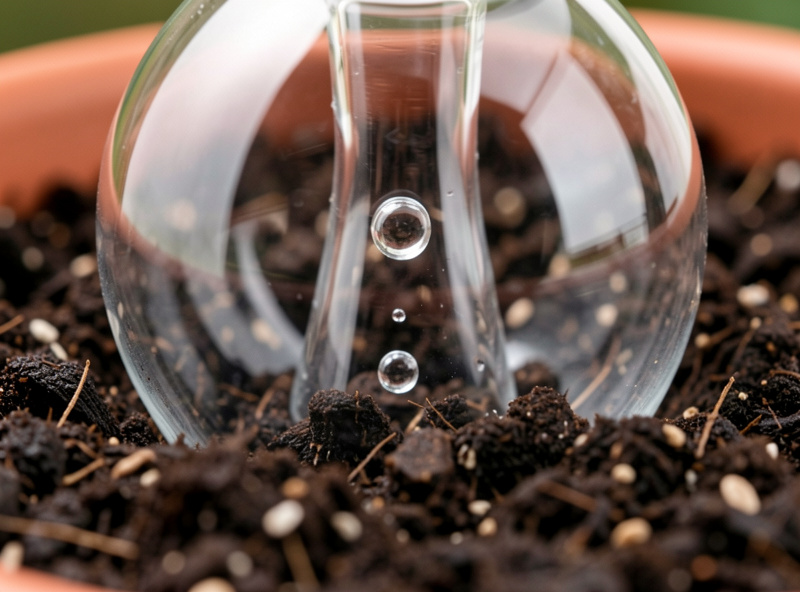
The trap up north is testing a globe in spring and trusting it for a July trip. Long midsummer daylight and warm pots push a plant’s water draw far higher than the same date further south, so a globe that comfortably held a herb for five days in April can run dry in two during a bright week in July. Always plan for the short end in high summer.
On my balcony the difference is dramatic. In April, with modest light and cool nights, a standard globe on a windowsill herb barely moves and I trust it for the better part of a week. Come the solstice, with sixteen-plus hours of daylight hammering the pots, the same globe on the same plant empties in a couple of days because the soil is pulling constantly from dawn to late evening. This is exactly why I never let a spring dry-run stand in for a summer one, and why the shade step from my away-watering guide matters so much with globes: get the pot out of direct sun and you slow the draw enough to bring a globe back into its useful range. Indoors the winter picture flips and is far kinder, since short days and low draw let a single globe hold a houseplant for many days without drama.
When to Skip Globes Entirely
Globes are the wrong choice for thirsty plants, big pots, and trips over a week, and pretending otherwise is how plants die. For a fruiting tomato, a whole balcony, or any absence beyond about six days, you want a system that adds water on a schedule rather than emptying a fixed bulb.
I love globes for what they are: a tidy, low-effort top-up for windowsill herbs and small ornamentals over a long weekend. But the moment the maths says the plant drinks more than the globe holds in a day, no globe will save it, and stacking three bulbs into one pot is just an awkward way of admitting you need a different method. For those cases I move to wick watering for a cheap week-plus fix, or an indoor watering timer and a drip kit for longer trips and bigger collections. Knowing when a globe is not enough is as useful as knowing how to use one, and the full decision map lives in my guide to watering plants while away.
Frequently Asked Questions
How long do self-watering globes last before refilling?
A standard 300-500 ml globe lasts three to five days on a small herb pot, and a large one up to six days. In a loose, fast-draining mix or on a thirsty plant it can empty in a single day, so test yours at home first.
Why is my watering globe not emptying?
The soil is too wet to pull water, or the neck is clogged with compacted soil. Water the pot, make a pilot hole before inserting, and wrap the neck in fine mesh to keep soil out while still letting water flow.
Are glass or plastic watering globes better?
Glass lets you see the water level and looks best on a windowsill, while plastic survives being dropped and is better for balconies and travel. For steady flow regardless of soil, a ceramic-spike stake beats both.
Can watering globes handle a two-week holiday?
No. Even the largest globe holds under 800 ml, which is a few days for a small plant and under a day for a thirsty one. For two weeks you need a wick system, an indoor timer, or a drip line that adds water on a schedule.
Do watering globes cause root rot?
They can if the globe over-supplies a plant in dense soil that stays saturated. Match the globe to the pot, use a well-draining mix, and never leave a globe running in soil that is already wet, which stops the roots from ever drying between top-ups.
What size watering globe do I need?
Match volume to daily draw. A small herb using 50-100 ml a day is well served by a 400 ml globe for several days, while a fruiting plant drinking closer to a litre a day needs a proper timed system instead of any globe.