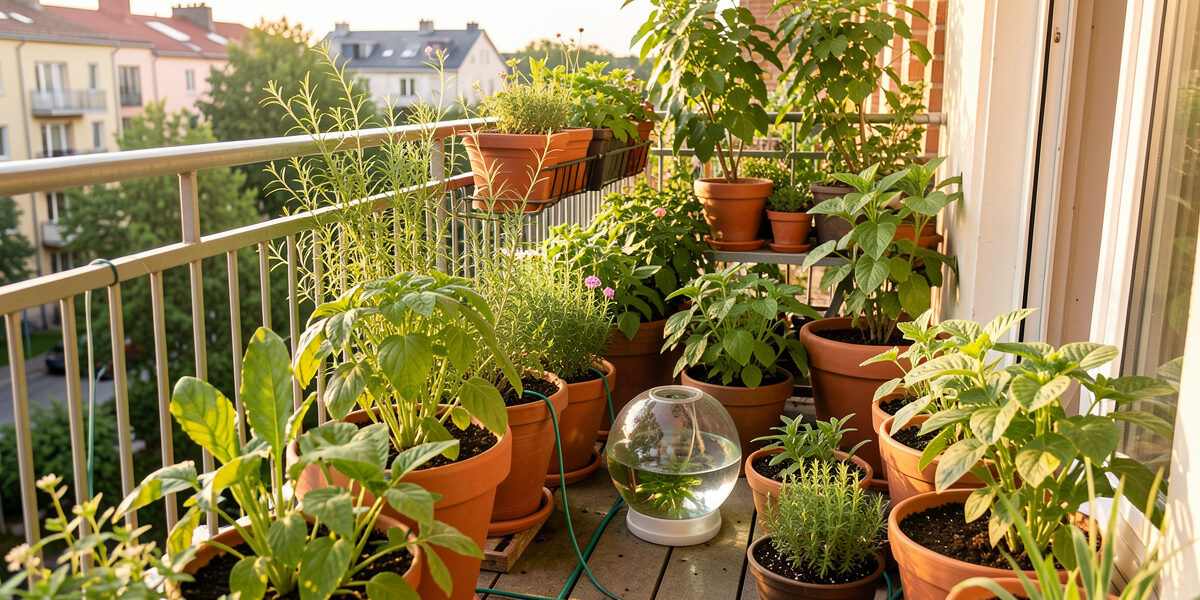
You can keep container plants alive for a one- to two-week absence without a neighbour and without spending much, and the honest answer to how to water plants while away is that you match the method to the length of the trip: wicks and globes for a long weekend, capillary matting or a self-watering reservoir for a week, and a timed drip line for anything longer than ten days. There is no single trick that covers every case.
I have left my balcony and my indoor grow shelf on their own for stretches of a Swedish summer more times than I can count, and I have come home to both thriving greens and a shrivelled disaster. The difference was never luck. It was reading the trip length correctly, prepping the plants before I left, and choosing a watering method that actually moves enough water for the pots I own. This guide is the map: what works, what quietly fails, and how to decide, with the deeper how-to for each method linked out to its own walkthrough.
Match the Method to How Long You Are Gone
The single most useful rule I can give you: a method that holds a plant for three days will not hold it for ten, and over-building for a weekend just wastes money and risks rot. For up to four days most healthy container plants need only a deep pre-watering and shade. For four to nine days you want a passive reservoir feeding the roots. For anything past ten days you need something that adds water on a schedule, not a system that only empties a fixed tank.
The reason is capacity. A wine bottle or a single globe holds a few hundred millilitres. That is a genuine top-up, not a fortnight of supply. A tomato in a 10-litre pot in July can drink close to a litre a day, so no passive gadget on earth keeps it happy for two weeks. Once you have sized the problem honestly, the method almost picks itself. I keep an honest table of how long container plants go without water so you can size your own trip before choosing anything.
The Free Prep That Does Half the Work
Before any device goes in, the prep matters more than the gadget. Water deeply until it runs from the drainage holes, move plants out of direct sun and wind, and group them together so they hold humidity as a cluster. Done right, this alone buys most plants two to three extra days, because you have slowed the rate they lose water rather than only topping up the supply.
Sun and wind are what actually empty a pot. A basil that wilts by lunchtime on a south-facing rail will sit calmly for days pushed back against a shaded north wall. Before a trip I pull everything off the balcony rail and cluster it on the floor in the shadiest corner, pots touching. Indoors I move the shelf away from the window glass and drop the grow light to a shorter photoperiod on its timer, because less light means less water drawn. Mulching the surface with a couple of centimetres of bark or leca cuts evaporation from the soil top, which on a shallow pot is a surprising share of the loss. None of this costs anything, and it is the step people skip while obsessing over which globe to buy.
Self-Watering Globes: Good for a Weekend, Oversold for a Week
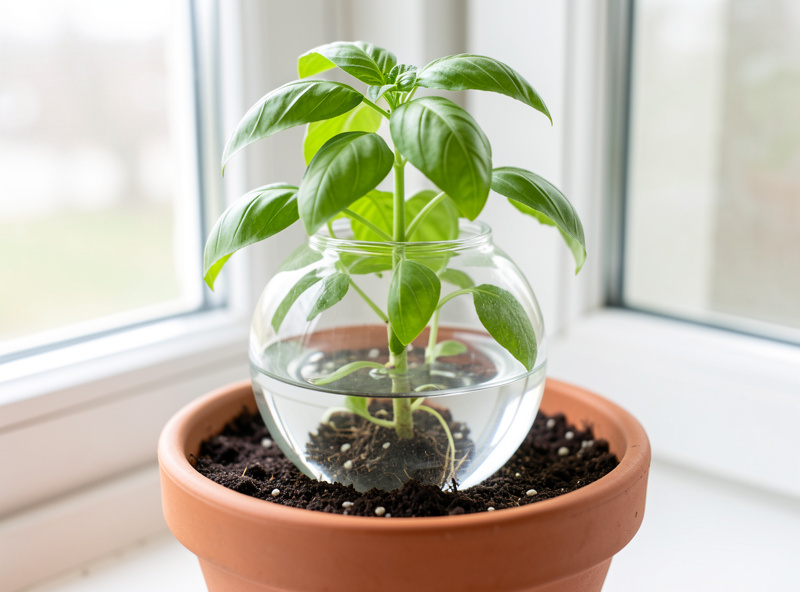
Glass or plastic globes release water as the soil dries and air bubbles back up the neck. They are the right tool for a long weekend on a small-to-medium pot, and the wrong tool for a thirsty plant over a full week. A standard globe holds roughly 200 to 400 ml, which is a few days for a herb and less than two days for a hungry tomato.
The failure mode I see most is people expecting a globe to be a two-week solution because the packaging implies it. It is not. It is a slow top-up. The other quiet problem is soil type: in a heavy, compacted mix the globe barely empties and the plant still dries at the root ball, while in a loose peat-free mix it can dump its whole load in a day. I match globe size to pot volume and always do a dry run for two days at home before I trust one on a trip. If you want the specifics on which designs actually hold their week and which drain in an afternoon, I put them head to head in my breakdown of the best self-watering globes. You can browse current self-watering globes on Amazon to see the sizes on offer.
As an Amazon Associate I earn from qualifying purchases.
Capillary Matting: The Quiet Workhorse for a Shelf of Pots
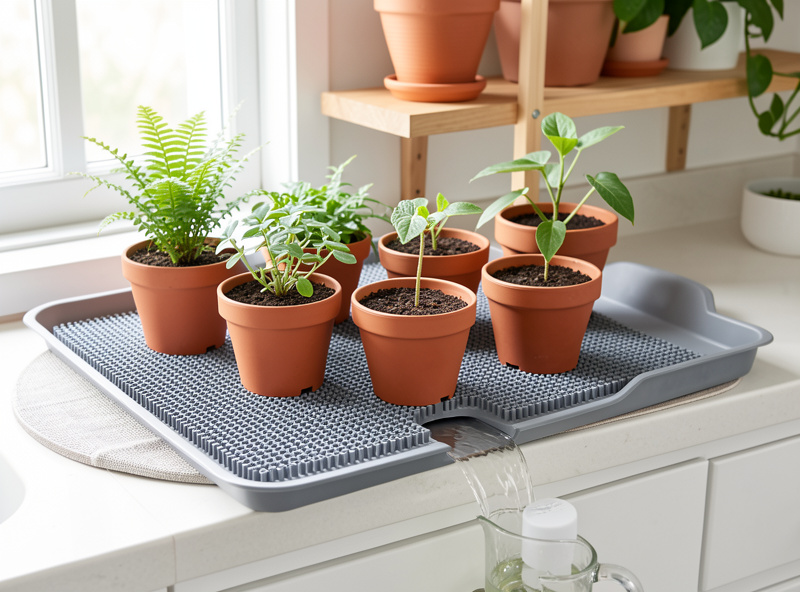
Capillary matting is a felt-like fabric that wicks water from a reservoir up into the base of pots sitting on it, watering many plants from one tank. It is the method I reach for most for an indoor shelf or a windowsill tray, because it scales to a dozen small pots at once and has nothing to clog or run out of battery. A tray of matting with one edge dipped into a water reservoir will hold a shelf of seedlings and herbs for a week without a thought.
The catch is that it only works if water can actually cross from the mat into the soil. Pots need thin plastic bases with open drainage holes; a thick terracotta pot or one sitting on a saucer will not draw. I also keep the reservoir end lower than the tray so the mat stays wet by gravity, and I pre-soak the whole mat before I leave so it starts saturated rather than dry. It is unglamorous and it just works, which is exactly why I rely on it. The full setup, including reservoir sizing and the pots it fails on, is in my capillary matting walkthrough. Ready-cut capillary matting rolls are cheap and last years.
The Wine Bottle and Other Kitchen Fixes
An inverted wine bottle filled with water and pushed neck-down into the soil is the classic zero-cost trick, and it genuinely works within its limits: it is a slow-release top-up of roughly 500 to 750 ml for a single medium pot over two to four days. It is not a myth, but it is also not a fortnight of coverage, and the results swing wildly with soil density.
I have run bottles side by side with bought globes and the physics is identical: both rely on the soil pulling water and air bubbling back in. A bottle holds more than most globes, which is its one real advantage, but the wide neck can slump the soil and empty fast in a loose mix. The fix is to bury a little gravel or a terracotta spike at the neck to meter the flow. If you want the honest verdict on whether the bottle beats a proper globe, I tested it in watering plants with a wine bottle. It sits in the same family as the low-tech olla clay-pot irrigation I use on the balcony beds.
DIY Wick Watering: The Cheapest System That Scales
Wick watering runs a length of absorbent cord from a water reservoir into the pot, and the soil draws water along the wick as it dries. It is the cheapest self-watering approach that genuinely holds for a week or more, and the whole cost is a spool of cord and a jar. Where a globe empties on a fixed schedule, a wick keeps drawing as long as there is water in the jar and the wick has not rotted.
The two things that decide success are the wick material and the height of the reservoir. Cotton and natural fibres wick beautifully but rot over a season; nylon and acrylic rope wick a touch slower but last for years without turning to slime in the jar. Keep the reservoir at or just below soil level so the wick works by capillary action rather than fighting gravity, and use more than one wick for a big pot. This is the route I trust for a week-plus indoors because there is no battery and nothing to jam. Which cords rot and which hold up is the whole point of my DIY wick watering guide. A spool of wicking rope costs almost nothing.
Automatic Timers and Drip: For Longer Trips and Thirsty Pots
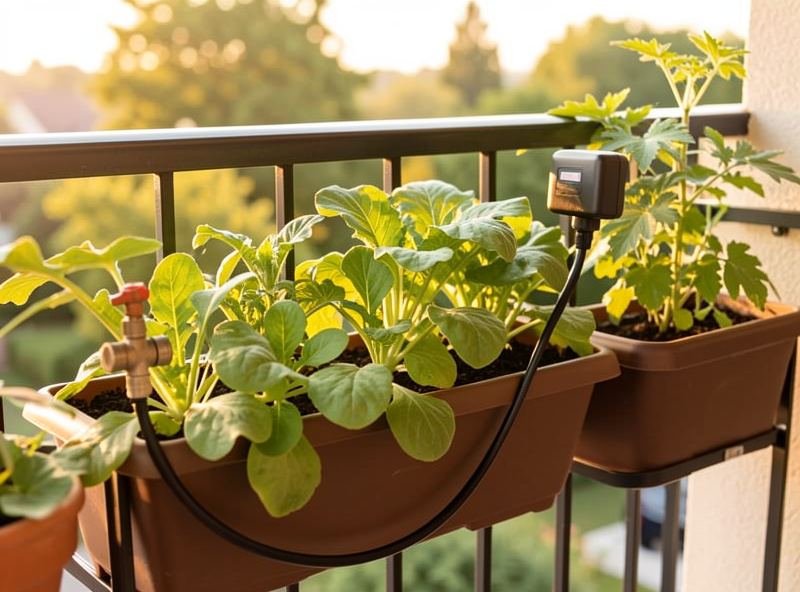
Once you are gone longer than ten days, or you are keeping a hungry tomato or a whole balcony alive, you need a system that adds water on a schedule instead of emptying a fixed tank. An indoor pump-and-timer kit or an outdoor drip line on a tap timer is the only reliable answer for a fortnight, and a small battery unit can run a shelf or a rail of containers from a bucket or the mains.
Indoors I run a little submersible pump in a bucket on a repeat-cycle timer, feeding thin tubing to each pot; the whole thing is quiet and pushes real volume. The setup and the settings that stop it flooding or starving are in setting up an indoor watering timer. Outdoors on the balcony I use a drip kit on a tap timer, which is the same principle at a bigger scale. The kits worth buying, and the ones that leak at every joint, are in my drip irrigation kit comparison for containers and balconies. If your rail gets sun all day, pairing the timer with a small panel is worth reading about in solar-powered drip irrigation, and the pre-plumbed Gardena balcony system is the plug-and-play version.
Away-Watering Methods Compared
Here is how the main options stack up for a small-space grower. The “holds for” column assumes you have done the free prep first and sized the device to the pot; a thirsty plant in full sun will always be at the short end of every range.
| Method | Best trip length | Rough cost | Pots it suits | Main weakness |
|---|---|---|---|---|
| Deep pre-water + shade | 2-4 days | Free | Any | No top-up, only slows loss |
| Wine bottle | 2-4 days | Free | 1 medium pot | Empties fast in loose mix |
| Self-watering globe | 3-6 days | Low | Small-medium pots | Small reservoir, oversold |
| Capillary matting | 5-9 days | Low | Many thin plastic pots | Fails with terracotta/saucers |
| Wick watering | 7-14 days | Very low | Small-medium pots | Natural fibre wicks rot |
| Indoor pump timer | 10+ days | Medium | Shelf of pots | Needs power and priming |
| Drip kit + tap timer | 10+ days | Medium | Balcony / many pots | Leaks at bad joints |
The Nordic Wrinkle: Summer Light Is the Enemy, Not Winter
Most away-watering advice is written for people whose plants sit in a house at a steady temperature. Up north the trap is the opposite: the trips that kill plants are the July ones, when a Swedish balcony gets sixteen-plus hours of daylight and a south-facing rail bakes. A plant that would coast through a February week can empty its pot in three days of high-summer light.
This is why I never trust a room-temperature test in spring to predict how a globe or wick performs during a midsummer trip. The light is longer, the pots are warmer, and evaporation is far higher than the same date would give further south. My rule before a summer absence is to assume every method holds for the short end of its range, move everything into shade, and shorten the indoor grow-light photoperiod so the plants simply draw less while I am gone. The winter version of the problem is the reverse and far easier: short days, low draw, and a wick or mat will hold houseplants for a fortnight without drama. If you are also running lights, the grow-light timer setup I use pairs neatly with an away week.
What I Actually Do Before a Trip
My routine is boring and it works. The day before I leave, everything gets a deep soak and moves into shade, grouped tight. For a weekend I do nothing else. For a week I set the indoor shelf on capillary matting with a full reservoir and put wicks in anything too big for the mat, while the balcony pots get globes or a bottle if the trip is short and the drip line if it is not. For anything past ten days the drip kit and timer come out and I test-run them for a full day before I go, because the only thing worse than no system is a system you discover has failed on day two.
The test run is the step nobody wants to do and the one that saves the plants. Set the method up, leave it a full day, and check that the reservoir is dropping at a sensible rate and the soil is staying evenly moist rather than flooding or staying bone dry. If you build in that dry run, away-watering stops being a gamble. For the everyday routine when you are home, the watering schedule by growth stage and the complete watering guide cover the rest, and if you tend to come home to yellow leaves, read the signs of overwatering before you blame the trip.
Read Your Pots Before You Choose Anything
The pot decides the trip as much as the plant does. A small pot in a light peat-free mix dries in a day; a deep pot in a heavy, water-retentive mix can coast for the better part of a week on its own. Before I pick a method I look at three things: pot volume, pot material, and how fast that specific pot has been drinking in the days before I leave.
Volume is the reservoir the plant already has. Ten litres of moist soil holds a lot of water; a 1-litre herb pot holds almost none, which is why the windowsill basil is always the first casualty and the balcony tomato in a big fabric bag is more forgiving than people expect. Material matters just as much. Terracotta breathes and dries fast, which is lovely for a rosemary you tend daily and a liability the moment you leave, while glazed ceramic and thick plastic hold moisture far longer. Fabric grow bags sit in between: brilliant drainage and root health, but they wick water out through their walls, so they need more supply on a trip, not less. The last thing I check is the current draw rate. If a pot has needed water every morning the week before I go, it will not suddenly slow down while I am away, and I plan for the thirsty end. If it has been fine on every second day, a passive method will stretch further. Guessing the pot’s behaviour is where most away-watering plans quietly fail before they start.
Grouping and the Humidity-Tent Trick
Clustering plants together is not just tidy; it lowers the water each one loses, because the group raises the humidity around every leaf. For a short trip you can push this further with a loose clear cover to make a temporary humidity tent, turning a shelf of pots into a slow, self-humidifying box that can hold small plants for several days on almost no top-up.
I do this indoors more than out. A few pots grouped on a tray, a clear plastic bag or a cut-down storage box propped loosely over the top so air still moves, and the moisture the plants transpire stays around them instead of escaping into a dry apartment. The one rule is that it must not be sealed and it must not sit in direct sun, or you cook the plants and invite mould. A gap for airflow at the base is enough. On the balcony I skip the tent and rely on shade and grouping alone, because outdoor air moves too much for a cover to help and wind is the bigger enemy anyway. This trick is most useful for seedlings and leafy greens, which lose water fast through soft foliage and respond dramatically to a humid pocket. It is worth pairing with the mat or wick rather than replacing them, so the reservoir handles the soil while the tent handles the leaves.
Setting Up the Passive Methods, Step by Step
The passive methods all share the same logic: fill a reservoir, connect it to the soil, and let the dry soil pull water at its own pace. The details that decide success are start-saturated soil, a reservoir at the right height, and a test run before you leave. Get those three right and every passive method behaves.
For matting, cut a piece to fit a waterproof tray, lay it so one end trails into a filled reservoir bottle or a second tray kept lower, pre-soak the whole mat until it is dripping, and stand thin-based pots directly on it with no saucers in the way. For wicks, cut cord long enough to reach from the bottom of a water jar to a good depth in the pot, wet the cord thoroughly so it starts drawing rather than sitting dry, bury one end 5 to 8 cm into the root zone, and drop the other into the jar kept at or just below soil height. For globes and bottles, water the pot normally first so the globe only tops up rather than doing all the work, then fill and invert the device into a pre-made hole so you do not compact the soil around the neck. In every case, set it up a full day before departure and watch the reservoir drop; a reservoir that has not moved by evening is not connected to the soil, and one that has half-emptied will be dry long before you are home.
A Plant-by-Plant Away Plan
Different crops fail in different ways, so I plan the shelf and the balcony plant by plant rather than blanket-covering everything with one gadget. The quick version: herbs and seedlings are thirsty and small, leafy greens wilt fast but recover, fruiting plants drink the most, and established woody herbs are the most forgiving.
Basil, coriander and other soft herbs are small-pot, high-draw plants that dry first, so they get matting or a wick, never a bare pre-water for anything past two days. Seedlings and microgreens are the same but worse, because they have shallow roots and no reserve; for those I lean on matting under a lowered light and a humidity tent. Leafy greens like lettuce, pak choi and spinach wilt dramatically but usually bounce back after a soak, so they tolerate the short end of a passive method as long as they are shaded. Fruiting plants are the real problem: a tomato, chilli or cucumber in summer can empty a big pot fast, and for a trip longer than a few days these need a drip line or a pump timer, full stop, because no passive reservoir keeps up. At the easy end, established rosemary, thyme and sage in decent pots are drought-tolerant by nature and often need nothing more than a deep soak and shade for a week. My strawberries, which fruit on the indoor rig through the dark months, sit closer to the herb end in winter with low draw, but on the summer balcony they behave like fruiting plants and get the drip. Planning per plant means the thirsty few get the real systems and you do not waste a drip kit on a rosemary that would have been fine on its own.
When Away-Watering Goes Wrong, and Why
Most failures trace back to three causes: the reservoir was too small for the trip, the water never actually reached the roots, or the plant was left in sun and simply out-drank whatever you rigged. Almost every dead-plant homecoming I have had, or been asked to diagnose, is one of those three, and all three are preventable with a test run.
A too-small reservoir is the honest-mistake failure: a single globe on a thirsty tomato, a wine bottle expected to last ten days, a mat tray that ran dry on day four. The fix is sizing, not a better gadget. The water-never-reached-the-roots failure is sneakier: a wick that dried out and stopped drawing, a mat under a terracotta pot that could not draw across, a globe clogged with soil, a drip emitter blocked at the joint. These all pass a glance and fail in practice, which is exactly why the full-day test run matters, because a disconnected system looks identical to a working one until the reservoir refuses to drop. The third failure is environmental: everything worked, but the plant sat in a south window or on a sunny rail and drank faster than the supply, or a heatwave landed while you were gone. You cannot control the weather, but you can control light exposure, so the shade-and-group step is not optional padding, it is the safety margin that covers the day the forecast is wrong. When something does come home crispy, the first question is always which of these three it was, because it tells you exactly what to change next time.
The Neighbour, the Smart Plug, and Knowing When to Ask
No rig beats a person for a long or high-stakes absence, and there is no shame in asking. For anything past two weeks, or when you are leaving something you genuinely care about, a neighbour with a two-minute watering can visit twice a week is more reliable than any device, and my honest advice is to combine the two rather than choosing.
The trick to asking well is to make it impossible to get wrong. I group everything into one spot, leave a filled watering can beside it, and write down which pots need water and which are on their own systems, so the favour is thirty seconds of pouring rather than a decision the person has to make. That way a passive method carries the daily load and the human just tops up the reservoir every few days, which is far easier to ask for than a full watering round. Where power is involved, a cheap smart plug adds a useful safety net: I can put the indoor pump timer on a plug I can toggle from my phone, and if a heatwave lands I can trigger an extra cycle or, just as important, kill a pump that a friend reports is flooding the floor. The same plug controls the grow light, so I can drop the photoperiod remotely and cut the plants’ water draw mid-trip if the weather turns. Reliable greenhouse or balcony Wi-Fi makes that possible, which is the small crossover with running decent watering routines the rest of the year. None of this replaces sizing the method correctly; it just gives you a way to react when the plan meets a forecast it was not built for.
A Simple Pre-Departure Checklist
Bringing it together, the whole thing reduces to a short routine you can run the evening before you leave. Do the free prep first, size the method to the trip and the pots, and test-run anything with a reservoir or a pump for a full day. Everything else is detail.
The night before, water every pot deeply until it drains, then move the whole collection into the shadiest spot you have and group the pots tight so they shelter each other. Decide the trip length honestly and pick from the table above: nothing extra for two or three days, a passive reservoir for up to a week, a timed system for longer. Set that method up, fill it, and leave it running for a full day while you are still home so you can watch the reservoir drop and catch a disconnected wick or a blocked emitter before it matters. Shorten any grow-light photoperiod, put a smart plug on the pump if you have one, and leave a note and a filled can for whoever might check in. Then go, and trust the prep instead of worrying about it, because the work that keeps plants alive while you are away is nearly all done before you close the door.
Frequently Asked Questions
How long can potted plants survive without water?
Most healthy container plants hold two to four days after a deep watering in shade, and a week or more with a passive reservoir like a wick or matting. Thirsty plants in summer sun are at the short end.
What is the best way to water plants while on a two-week holiday?
For two weeks you need a system that adds water on a schedule, not a fixed tank. An indoor pump timer or an outdoor drip line on a tap timer is the only reliable option; globes and bottles run dry long before then.
Do self-watering globes really work?
Yes, but only as a two-to-four-day top-up for small pots. A globe holds roughly 200 to 400 ml, which is not enough for a thirsty plant over a full week. Match the globe to the pot and test it at home first.
Can I just water deeply before I leave and skip the gadgets?
For a two- to three-day trip, yes. A deep soak plus moving plants into shade and grouping them together is enough for most healthy containers. Beyond three days in summer you need a top-up method as well.
What is the cheapest reliable way to water plants while away for a week?
DIY wick watering. A length of nylon or acrylic rope running from a water jar into the pot draws water for a week or more and costs almost nothing. Avoid cotton wicks for long trips because they rot.
Why do away-watering methods fail more in summer up north?
Long Nordic summer daylight and warm pots push evaporation far higher than the same date further south. A method that holds for a week in spring may only hold for three days during a July trip, so always assume the short end.
Related Guides
- How Long Can Container Plants Go Without Water? An Honest Table
- Best Self-Watering Globes: Which Ones Actually Hold a Week
- Capillary Matting: The Quiet Away-Watering Trick I Rely On
- Watering Plants With a Wine Bottle: Does It Really Work?
- DIY Wick Watering: Cotton, Rope, and What Won’t Rot
- Indoor Automatic Watering Timers: Setting One Up for a Plant Shelf
- Best Drip Irrigation Kits for Containers and Balconies
- DIY Self-Watering Planter: 3D-Printed Reservoir Inserts