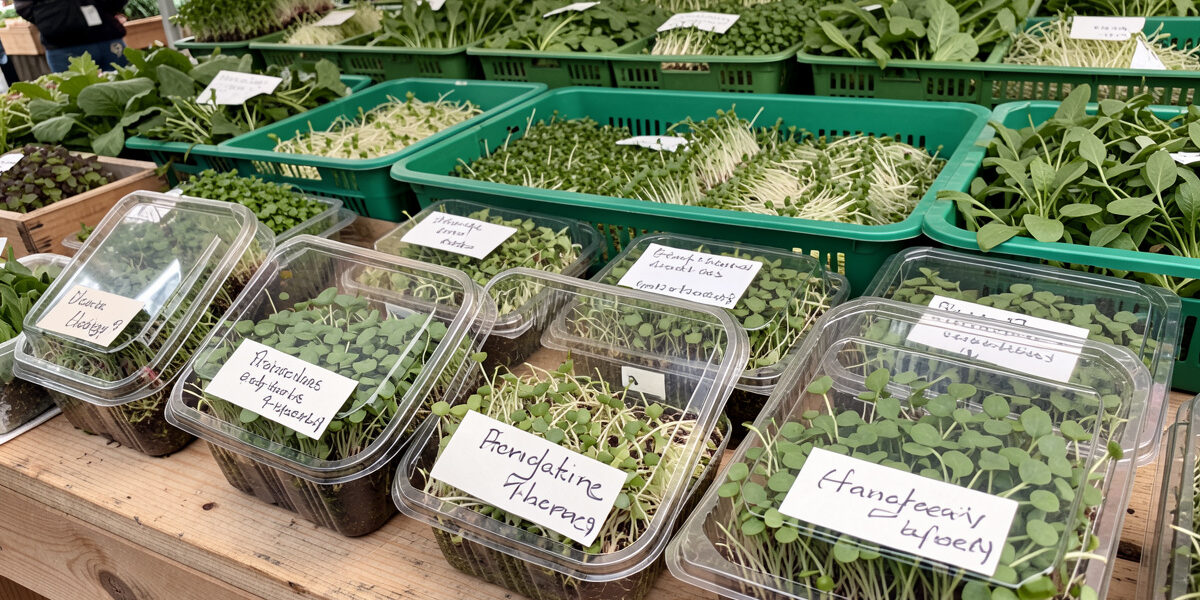
Somewhere around your fifth or sixth tray, once you are harvesting more greens than the household can eat, the thought arrives: could I sell these? It is a fair question, and microgreens genuinely are one of the few crops a small-space grower can produce to a sellable standard from a spare room or a corner of a basement. But the gap between “I grow nice trays” and “I run a microgreens business” is wide, full of unglamorous logistics, and littered with people who quit in month three. This is the honest version — what selling microgreens actually involves, who buys them, and the realities the hustle videos skip. I will not be quoting you an income figure, because anyone who does is guessing; what I can give you is a clear picture of the work.
If you are still dialling in your own growing first, that is the right order — my complete microgreens guide covers the production side that any business has to nail before it sells a single tray.
The Honest Reality First
Selling microgreens is a business of consistency, not of growing. The growing is the easy, enjoyable part you already know. The business is everything around it: producing the same quality every single week without fail, harvesting and packing to a schedule someone else depends on, delivering on time, handling food-safety expectations, and finding and keeping customers who will buy from you again next week. A chef does not care that your radish tray came up beautifully once — they care that it comes up beautifully every Thursday, indefinitely.
That shift from hobby to obligation is what catches people out. A hobby tray can fail and you shrug; a customer tray that fails is a missed order and a reputation dent. The growers who make a go of it treat reliability as the actual product. If the idea of being committed to producing fresh greens on a fixed timetable every week sounds more like a job than a joy, that is useful to know before you buy a single extra tray — and there is no shame in keeping it a hobby.
Who Actually Buys Microgreens
There are really four buyers, and they want different things. Restaurants and chefs are the classic target — they value freshness, distinctive varieties (think micro-cilantro, shiso, popcorn shoots), and reliable weekly delivery, but they negotiate hard and drop you the moment quality slips. Farmers’ markets put you face to face with home cooks who buy on appearance and a friendly chat, which suits some growers and exhausts others. A community-supported subscription, where customers prepay for a weekly box, gives you the steadiest demand but ties you to producing every week without a break. And direct-to-home or small grocery sales sit somewhere in between on effort and margin.
Each channel rewards a different strength. Chefs reward variety and reliability; markets reward presentation and personality; subscriptions reward steadiness. None of them rewards a grower who is inconsistent, and all of them require you to keep showing up. Here is how they compare in plain terms.
| Channel | What they want | Demand steadiness | Main challenge |
|---|---|---|---|
| Restaurants / chefs | Variety, freshness, reliable delivery | Steady once trusted | Hard to win; quick to drop you |
| Farmers’ markets | Appearance, friendly sale | Variable by week/weather | Time-intensive; you man the stall |
| Subscription / box | Consistent weekly supply | Steadiest | You must deliver every single week |
| Direct / small grocery | Shelf life, packaging | Moderate | Margins squeezed by the middleman |
What Sells and What Doesn’t
Not every microgreen earns its tray space commercially. The reliable sellers are the ones that look striking, taste distinctive, and grow fast and predictably: radish for its colour and bite, pea shoots for their sweetness and bulk, sunflower for crunch, and the premium specialty crops like micro-basil, amaranth, and red-vein sorrel that chefs pay a premium for precisely because they are fiddly to grow well. The fast, forgiving crops keep your throughput high; the specialty crops lift your average value. A smart range carries both.
What does not sell is anything you cannot produce consistently. A gorgeous tray of something temperamental that comes up beautifully one week and patchy the next is worse than useless commercially — it teaches your customer not to rely on you. Master a small, dependable core range before you chase exotic varieties. Presentation matters too: greens sold loose wilt and disappoint, so clean, breathable packaging that keeps them fresh to the customer’s fridge is part of the product, not an afterthought.
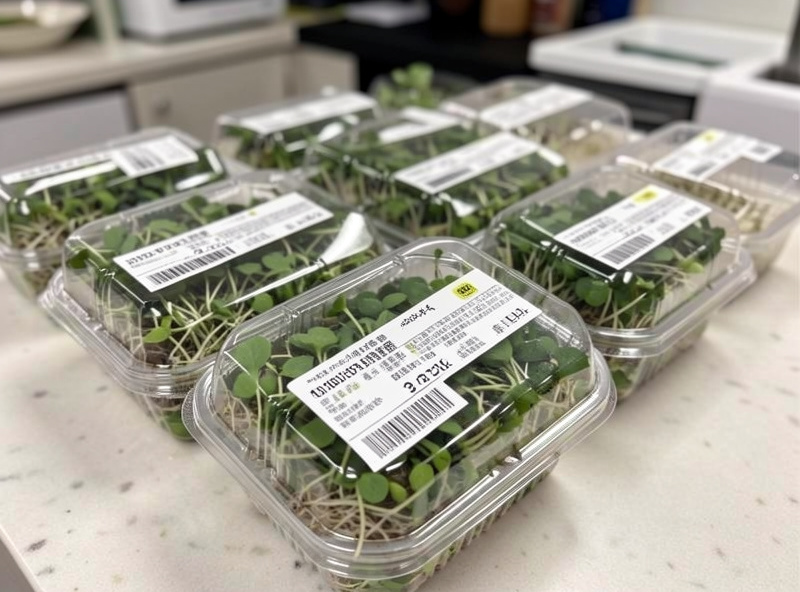
If you do go to market, decent clamshell packaging is one of the few genuine upfront costs worth getting right — limp greens in a bag will lose you a repeat customer faster than almost anything else.
Disclosure: CityRooted is reader-supported. As an Amazon Associate I earn from qualifying purchases made through links in this article, at no extra cost to you. I only point to gear I actually use or would buy for my own microgreen shelf.
Food Rules and Local Regulations
This is the part the hustle content skips entirely, and it is not optional. Selling food to the public — even microgreens, even from your kitchen — is regulated, and the rules vary enormously by country, region, and even municipality. Some places have cottage-food allowances that cover a small operation; others require a registered, inspected premises before you sell a single tub. There may be labelling requirements, food-hygiene registration, and rules about where and how you can produce. The only correct move is to find and read your own local food-business regulations before you sell anything, and to contact the relevant local authority if you are unsure. I cannot tell you what applies where you live, and neither can a generic video — treat any source that waves this away as a warning sign.
The food-safety basics travel everywhere, though: clean hands, clean trays, clean water, a clean cut, and cold-chain handling from harvest to customer. Microgreens are lower-risk than sprouts because they are grown in a drained medium and cut rather than grown in standing water, but “lower risk” is not “no responsibility.” If you are selling, you own that responsibility.
What It Actually Takes to Start
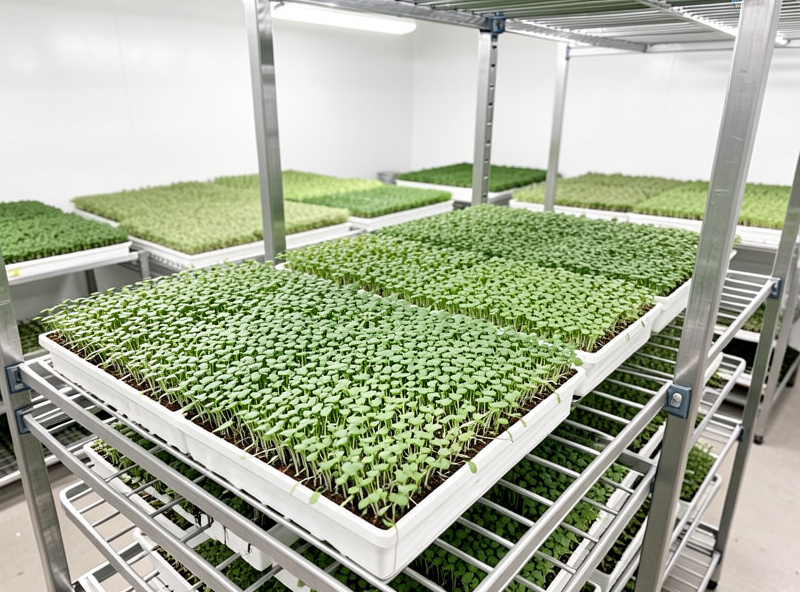
The startup picture is genuinely modest compared with most food businesses, which is part of the appeal — and part of the trap, because low barriers pull people in before they have thought it through. On the gear side you need more of what you already have: trays, medium, seed bought in volume, a reliable light setup for year-round consistency, somewhere clean and temperature-stable to grow, and packaging. None of that is exotic, and a home grower is most of the way there already. The bigger inputs are the ones that do not show up on a shopping list: a dependable weekly block of time, the discipline to grow to a schedule rather than a whim, and a tolerance for the repetitive harvest-wash-pack-deliver rhythm.
What you do not need is a fantasy budget or a warehouse. Most people who sell microgreens successfully started exactly where you are — a few trays in a spare room — and grew the operation only as fast as real, repeat demand justified. Resist the urge to kit out a full commercial rack before you have a single confirmed customer. Prove the demand with the setup you have, then invest into orders you already hold, never ahead of them.
Scaling Without Breaking
The trap that ends most small microgreens ventures is scaling faster than your space, time, or systems can carry. It is tempting, after a few good weeks, to take on three new restaurant accounts at once. Then a heatwave or a bout of damping-off wipes a batch, you cannot fill the orders, and you lose all three customers and your confidence in one week. Sustainable growth means adding one reliable account at a time, proving you can supply it consistently for several weeks, and only then taking on the next. Build buffer trays into your schedule so a single failure does not become a missed order.
The other quiet limit is you. A one-person microgreens operation is a lot of repetitive harvesting, washing, packing, and delivering, on a fixed weekly clock, on top of the growing. Be honest about how much of that you actually want in your life before you scale up the trays. Plenty of people discover the sweet spot is a handful of trays sold to one or two outlets they enjoy supplying — small, reliable, and still genuinely fun — rather than a grind they quietly resent. Whichever scale fits you, the production fundamentals stay the same, and my guides to the easiest microgreens to grow and running the 1020 tray system are the foundation any selling operation is built on.
Keep Reading
Before you sell, get the growing rock-solid: start with the complete microgreens setup guide, sort your medium with the best soil for microgreens, get even, sturdy trays using the right grow lights for microgreens, and choose your first dependable crops from the easiest microgreens to grow. Consistency in production is the only foundation a microgreens business can stand on.