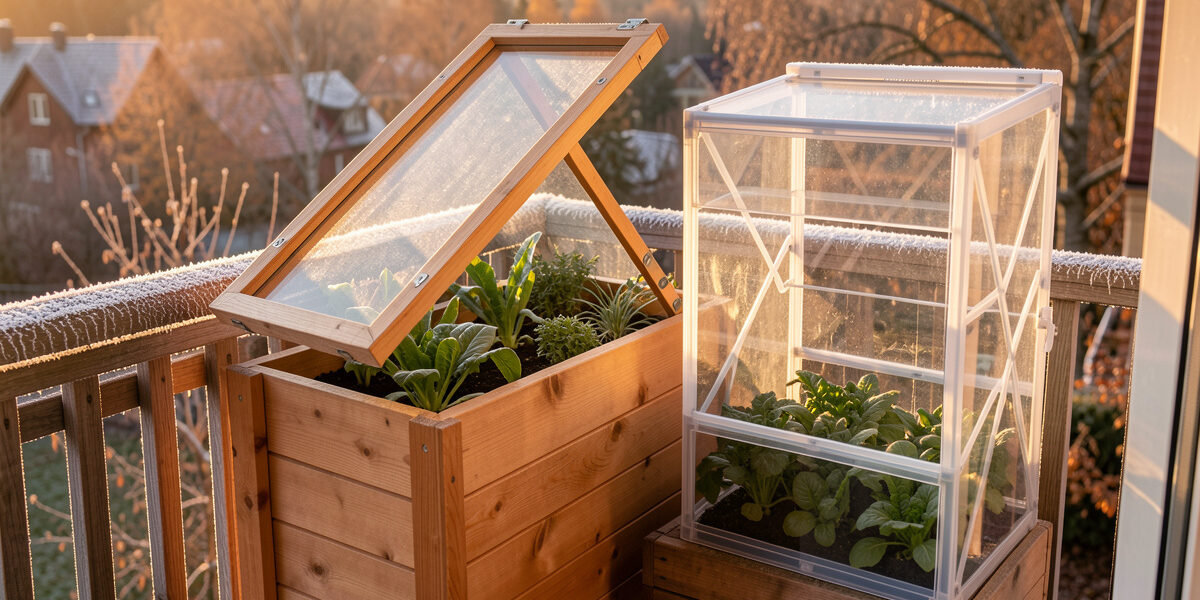
Every grower up here eventually runs into the same wall: the season is too short. I garden in a Swedish climate where the last frost can linger into late May and the first one rolls back in while the tomatoes are still green on the vine. For years I treated that window as fixed — sow in spring, harvest in summer, give up in October. Then I started building and buying the gear that stretches the season at both ends, and the whole calendar changed. Season extension is the single highest-leverage skill a cold-climate grower can learn, and almost none of the US gardening advice online is written for a frost window as tight as ours.
This is the guide I wish I’d had when I started. It covers the full toolkit — cold frames, row covers and cloches, mini greenhouses, overwintering, frost protection, and pulling a real winter harvest off a balcony or a couple of raised beds. None of it requires a heated glasshouse or a homestead’s worth of land. Everything here I’ve run in the space a Nordic apartment and balcony actually give you, through real winters where the gear either earned its keep or got pulled out.
What season extension actually means in a cold climate
Season extension is the art of buying yourself weeks — sometimes months — on either side of the frost-free window without supplemental heat. It splits into three jobs: starting earlier in spring (getting plants in the ground before the soil and air would normally allow), protecting through frost events (so a single cold night doesn’t wipe out a planting), and harvesting later or right through winter (keeping hardy crops alive and croppable when everything outdoors should be dead).
The physics is simple. Most of these tools trap heat the soil and sun give off during the day and hold it through the night, lifting the air around the plants a few degrees above ambient. A few degrees doesn’t sound like much until you realise that the difference between a killed crop and a survived one is often exactly that — the line between -1°C and +2°C. The other half of the job is wind. A bare balcony in November loses heat to wind chill far faster than a sheltered one, and most of what a cold frame or cloche does is simply stop the wind stripping warmth away from the leaves.
What season extension does not do is fight deep winter darkness. This is the part US guides skip entirely, because they’ve never gardened at 59° north. By December I’m down to roughly four usable daylight hours, and below a certain light threshold plants stop growing no matter how warm you keep them. So the honest cold-climate strategy is two-pronged: use unheated structures to stretch the shoulder seasons hard at both ends, and accept that the deepest, darkest weeks are for holding mature crops in stasis (or moving the growing indoors under a grow light for vegetables), not for new growth outside.
The frost-window math that changes everything
Before you buy a single cold frame, you need to know your actual frost dates — not the ones on a US seed packet. In my climate the practical frost-free window outdoors is roughly mid-May to late September: maybe 130 frost-free days if I’m lucky, against the 180-plus a temperate-zone grower takes for granted. Season extension is what closes that gap. A simple cold frame reliably buys me two to four weeks at each end. A row cover or cloche over a hardy crop can hold it croppable a month or more past the first frost. Stack the techniques and a 130-day window starts behaving like 200-plus for the crops that can take it.
The mistake I made early on was treating the first frost date as a deadline to harvest everything by. It isn’t. It’s the date you start protecting. Tender crops — tomatoes, peppers, cucumbers, basil — are done at first frost and there’s no fighting it; those you race to ripen and pull. But the hardy crops are just getting interesting. Kale, spinach, mâche, leeks, and most of the brassicas don’t just survive frost, many of them taste better after a hard chill converts their starches to sugar. That single realisation — that half my plants wanted the cold — is what turned autumn from an ending into a second season.
Cold frames: the workhorse of the cold-climate garden
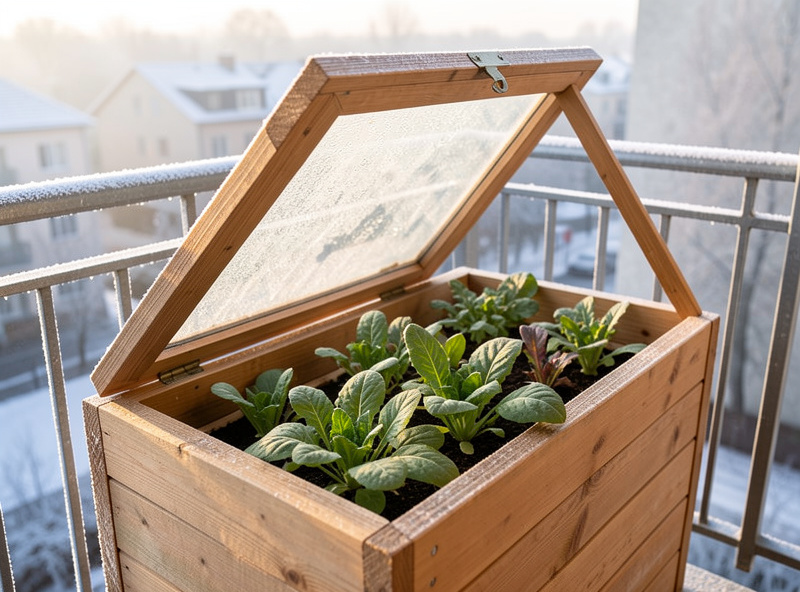
If you build or buy one thing on this list, make it a cold frame. It’s a low, lidded box with a transparent top — think a bottomless mini greenhouse you sit directly over a bed or fill with pots. The sun heats the soil and air inside through the glazing, the walls block wind, and the lid traps the warmth overnight. Mine sits on the balcony over a couple of fabric grow bags and a shallow tray of greens, and it’s the first thing I set up in late winter and the last thing I pack away.
What a cold frame buys you: a head start on spring sowings of hardy greens by three to four weeks; a safe hardening-off chamber for indoor-started seedlings (no more carrying trays in and out twice a day); and a winter holding pen for cold-hardy crops that keeps them croppable into and sometimes through the dark months. The single most important skill — and the one beginners always miss — is venting. On a sunny day, even in March, the inside of a closed frame can hit 30°C while it’s near freezing outside. Cook your seedlings once and you’ll never forget to prop the lid. I prop mine open whenever the sun’s out and the air is above a few degrees, and close it well before dusk to trap the day’s heat. A simple soil thermometer stuck in the bed inside takes all the guesswork out of it.
I cover the full build-and-use detail — glazing choices, automatic vent openers, and how to site one on a balcony for maximum sun — in my dedicated cold frame gardening guide. The short version: a cold frame is the highest return-on-effort structure in cold-climate growing, and it pairs with everything else here, from a balcony vegetable bed to a tray of indoor lettuce moved out to harden off.
Row covers and cloches: instant, cheap frost insurance
Where a cold frame is a permanent structure, row covers and cloches are the quick, flexible layer you throw over plants the night a frost is forecast. A row cover (also called floating row cover or fleece) is a sheet of lightweight spun-bonded fabric you drape directly over a bed or over low hoops. It’s feather-light, lets rain and most light through, and lifts the temperature underneath by two to four degrees — exactly the margin that saves a planting from an early autumn or late spring frost. I keep a roll of floating row cover fabric on hand from September onward and pull it over the greens the moment the forecast dips.
A cloche is the single-plant version — a clear cover (glass bell, cut plastic bottle, rigid dome) set over an individual seedling or tender plant to make a personal little greenhouse. Cloches are how I push individual transplants out a couple of weeks early in spring without committing the whole bed. The trade-off with both is ventilation again: anything clear and sealed cooks on a sunny day, so cloches come off (or get propped) once the morning warms. Fleece is more forgiving — it breathes — which is why I reach for it nine times out of ten over plastic.
The full comparison of fabric weights, hoop spacing, and when to choose a cloche over a cover is in my row covers and cloches guide. For most small balcony gardeners and small-bed growers, a single roll of mid-weight fleece is the cheapest frost insurance money can buy.
Mini greenhouses: vertical growing room in a tiny footprint
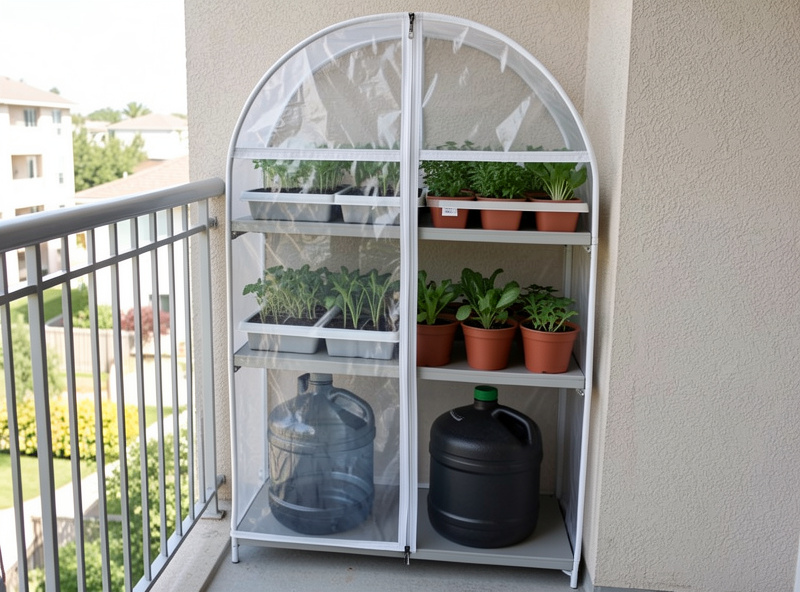
For a balcony where ground space is the hard limit, a mini greenhouse — the tiered, zip-front plastic-covered shelving kind — is how you buy growing room by going vertical. I run one against the sheltered wall of my balcony, and it does three jobs: a warm propagation space in early spring, an overflow holding area for hardened-off seedlings, and a wind-break-plus-heat-trap for cold-hardy greens deep into autumn. On a sunny spring day the inside runs warm enough to germinate things that wouldn’t budge outside.
The honest limits matter, because the marketing oversells these. A thin plastic mini greenhouse holds daytime warmth beautifully but loses it almost as fast once the sun’s gone — overnight it’s only a degree or two above ambient unless you add thermal mass (I keep a couple of dark water jugs inside to soak up day heat and release it slowly). They’re also light, so a windy balcony will fold one flat unless you anchor it hard. And like every clear structure, they bake on a sunny day if you don’t unzip the front to vent. I cover anchoring, thermal mass, and which sizes actually suit a balcony in my mini greenhouse for small spaces guide. Used with eyes open, it’s the most space-efficient extender on this list — a natural companion to vertical growing on a tight balcony.
Frost protection: reading the forecast and acting in time
Most frost damage I’ve seen — mine and other people’s — came down to not acting on a forecast, not a lack of gear. Frost protection is half equipment and half attention. The equipment is the row covers, cloches, and frames above, plus low-tech tricks: a few jugs of water tucked among the pots store daytime heat and release it overnight; moving containers tight against a south-facing wall borrows the building’s stored warmth; grouping pots together reduces the surface area losing heat. The attention is watching the forecast for that first sub-zero night and acting the evening before, while the soil still holds the day’s warmth.
One counter-intuitive point worth knowing: a clear, still, calm night is the dangerous one, not a cloudy windy one. Cloud acts like a blanket and traps ground heat; a clear sky lets it radiate straight up into space, which is why the worst frosts come on beautiful still evenings. When the forecast shows a clear calm night and temperatures near zero, that’s the night to cover up — even if the daytime was mild. I walk through the full decision tree, including how to protect plants you can’t move and what to do for an unexpected late-spring frost on tender transplants, in my frost protection methods guide. The crossover with hardening off matters here too — a seedling moved out too fast is far more frost-vulnerable, which is why I lean on the cold frame for that transition (see my notes on hardening off seedlings and on starting seeds indoors).
Overwintering: keeping plants alive through the dark months
Overwintering is the long game — keeping a plant alive through winter so it carries over instead of dying, whether to harvest from it through the cold or to get a jump on next spring. Different crops want different treatment. Hardy biennials and perennials like leeks, kale, parsley, chard, and many herbs will hold in the ground or a protected container right through a cold-climate winter with a cover and a sheltered spot. Garlic gets planted in autumn specifically to overwinter and crop the following summer. Tender perennials we treat as annuals up here — peppers and the like — can sometimes be lifted and held dormant indoors, with mixed results I’m honest about.
The container constraint is real: a plant in a pot has its roots exposed to cold from all sides, where an in-ground plant has the earth’s mass insulating it. That means an overwintering container needs extra protection — grouped against a wall, wrapped, or moved into the shelter of a cold frame or mini greenhouse — or the rootball freezes solid in a way it wouldn’t in open ground. My full crop-by-crop breakdown of what holds, what needs lifting, and how to protect roots in containers is in the overwintering vegetables guide. Done right, overwintering is how the garden produces the earliest spring harvests of all — the overwintered crop is weeks ahead of anything you sow in spring, and it pairs naturally with the hardy easy container vegetables I lean on up north.
Winter harvest: actually eating from the garden in the cold
The payoff for all this gear is the part that still feels slightly magical to me: cutting fresh greens off the balcony in the middle of a Nordic winter. It’s absolutely doable, with two caveats that the cheerful US “winter harvest” videos gloss over. First, you’re harvesting from plants that grew to size in autumn, not plants growing now — once the light drops below the threshold in deep winter, growth effectively stops, and you’re holding mature crops in cold storage on the stem. Get them to full size before the light goes, and they’ll hold for weeks of picking. Second, you harvest on the mild days. A frozen leaf is glassy and damages if you handle it; let it thaw, then cut.
The crops that make this work are the genuinely cold-hardy ones: mâche (corn salad), winter-hardy spinach, kale, claytonia, certain mustards, and leeks standing in the bed. Protected by a cold frame or a doubled row cover, several of these shrug off hard frost and keep yielding the freshest salad you’ll eat all year. The full crop list, sowing timing (you sow these in late summer, not winter), and the protection each one needs is in my winter harvest vegetables guide. Pair it with a tray of microgreens and a few sprouting jars on the counter and you can eat something fresh and home-grown straight through the darkest weeks.
A DIY hoop house for the balcony or a couple of raised beds
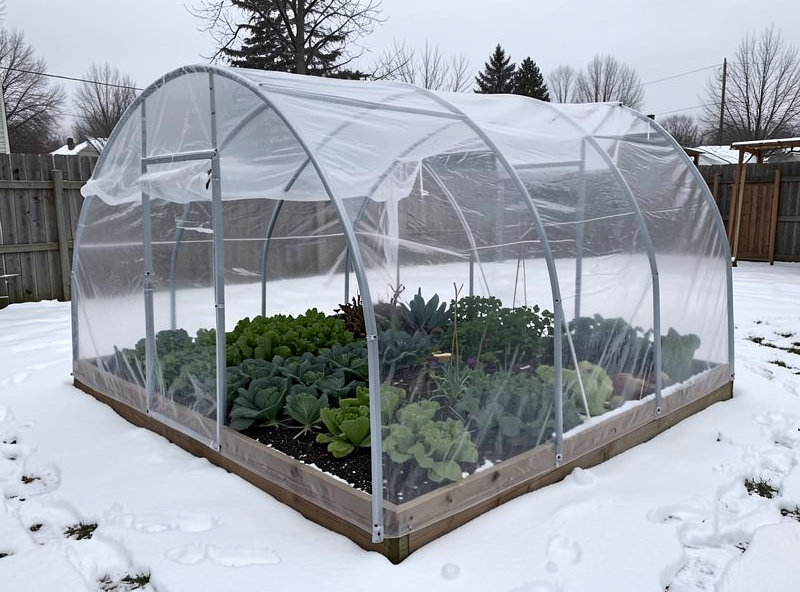
When you outgrow individual cloches and want to cover a whole bed at once, a low hoop house (a row of hoops with cover stretched over it) is the cheap, scalable answer. It’s the same idea as a row cover but tall enough to walk a watering can under and tunnel-shaped so it sheds snow. On a balcony I build a small version over a raised planter; on a couple of raised beds it scales up to cover an entire crop. Built from flexible piping and clear poly or heavy fleece, it’s the most cost-effective square-metre coverage of anything here.
The DIY build — hoop spacing, how to anchor it against wind, clipping the cover so it doesn’t blow off, and ventilation so it doesn’t cook — is in my balcony hoop house guide. It’s the natural graduation from row covers once you’re protecting more than a plant or two at a time, and it sits well over fabric grow bags or a shallow planter.
How the season-extension tools compare
| Tool | Best for | Spring head start | Frost protection | Cost & effort |
|---|---|---|---|---|
| Cold frame | Seedlings, hardening off, winter holding | 3–4 weeks | Strong (built-in) | Moderate / permanent |
| Row cover / fleece | Whole beds, quick frost cover | 1–2 weeks | 2–4°C lift | Low / instant |
| Cloche | Single transplants | 2 weeks | Good (one plant) | Low / fiddly at scale |
| Mini greenhouse | Vertical space, propagation | 3–4 weeks | Day-warm, weak overnight | Moderate / anchoring needed |
| Hoop house | Whole beds at scale | 2–4 weeks | Strong with poly | Low–moderate / DIY |
| Overwintering (in situ) | Hardy crops, earliest spring | n/a (carries over) | Crop-dependent | Low / planning needed |
There’s no single best tool — the right answer is a layered system. I start seedlings under the mini greenhouse and in the cold frame, harden them off in the frame, drop row covers over hardy beds when frost threatens, build a hoop house over the bigger plantings, and overwinter the toughest crops for a winter harvest and an early spring jump. Each tool covers a different part of the calendar, and together they roughly double the productive season for the crops that can take cold.
Where to start if you’re new to this
Don’t buy everything at once. If I were starting over with a balcony or a couple of beds, I’d do it in this order. First, a roll of mid-weight row cover — it’s cheap, it’s instant frost insurance, and it’ll save a crop the first cold night you’d otherwise have lost. Second, a cold frame — the workhorse, the thing that earns its place every single season for hardening off alone. Third, a soil thermometer so you’re working from real numbers instead of guessing. Everything after that — the mini greenhouse, the hoop house, the overwintering experiments — you add as you learn which part of your season you most want to extend.
And keep the cold-climate reality in front of you. None of this turns a Nordic balcony into a year-round California garden, and any guide that promises that is selling you something. What it does — reliably, season after season — is take a brutally short window and stretch it at both ends, so you’re eating fresh greens weeks earlier in spring, weeks later in autumn, and on the mild days right through winter. For a grower up north, that’s the whole game.
How many extra weeks can season extension really add in a cold climate?
A cold frame or hoop house reliably adds three to four weeks at each end of the season, and row covers add one to two. Layered together they can turn a 130-day frost-free window into 200-plus productive days for cold-hardy crops.
What is the single best season-extension tool for a beginner?
A roll of mid-weight floating row cover. It is cheap, instant, breathable, and lifts the temperature under it by two to four degrees, which is exactly the margin that saves a planting from a light frost. A cold frame is the best second purchase.
Can you grow vegetables outdoors through a Nordic winter?
You can harvest, but not grow. Once daylight drops below the winter threshold, plant growth effectively stops. The strategy is to grow hardy crops to full size in autumn, then hold them in stasis under cover and pick from them on mild days through winter.
Why is venting a cold frame or mini greenhouse so important?
On a sunny day even in early spring, a closed clear structure can reach 30 degrees Celsius while it is near freezing outside. Without venting it cooks the plants inside. Prop the lid or unzip the front whenever the sun is out and the air is mild.
Which vegetables actually survive frost and taste better for it?
Kale, spinach, mache, leeks, parsley, chard, and most brassicas tolerate frost, and several of them convert starch to sugar after a hard chill, so they taste sweeter. These hardy crops are the backbone of any cold-climate winter harvest.
Do containers need more winter protection than in-ground beds?
Yes. A potted plant has its roots exposed to cold on all sides, while an in-ground plant is insulated by the earth. Overwintering containers need grouping against a wall, wrapping, or moving into a cold frame so the rootball does not freeze solid.
As an Amazon Associate I earn from qualifying purchases. The gear links above point to current listings for the kit I actually use to stretch the season; buying through them supports the site at no extra cost to you.