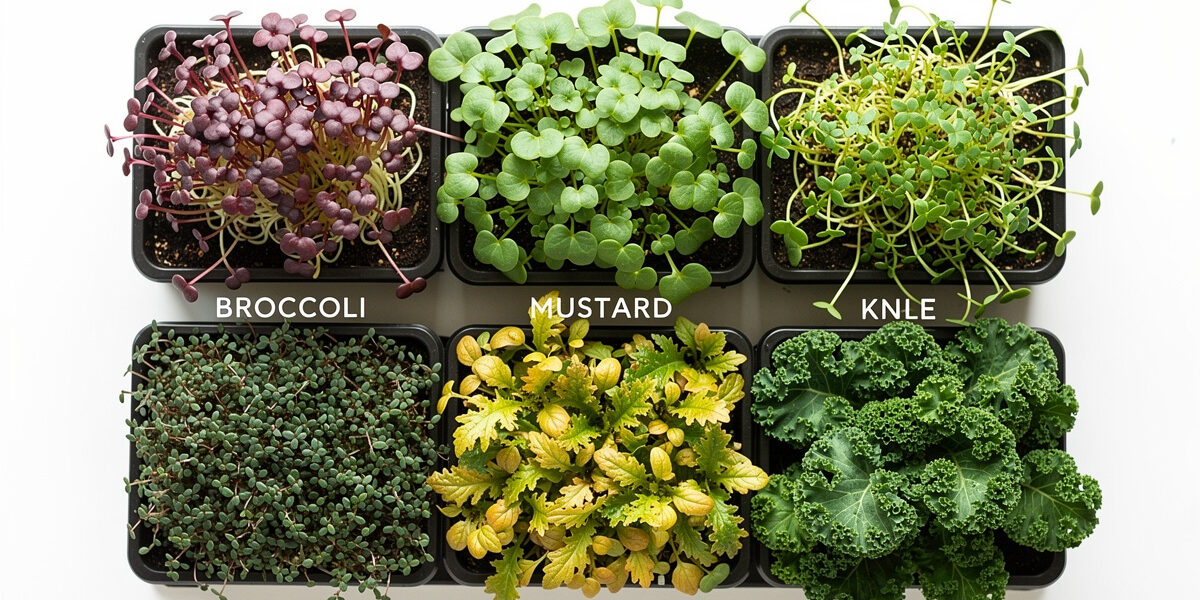
Twelve microgreen species cover 95 percent of what you will ever want to grow at home. Picking the right starter set matters: radish reaches harvest in 8 days with near-perfect germination, while cilantro takes 21 days and germinates unevenly. On my shelf, radish, sunflower, and pea shoots run every single week — the other nine rotate in and out depending on what I am cooking. As an Amazon Associate I earn from qualifying purchases. This guide ranks all 12 by speed, flavor, yield, beginner difficulty, and shopping cost — with a clear “first three trays” recommendation that wins for 9 out of 10 home growers. Once you know which species you want, the microgreens growing kit guide matches bundled starter sets to common crop choices so you can skip hunting down pieces separately.
Quick Answer: First Three Trays
Start with radish (8 days, near-foolproof, peppery), sunflower (12 days, highest yield at 12 to 18 ounces per tray, nutty crunch), and pea shoots (12 days, sweet, kid-friendly). These three teach every essential technique: small seed scatter (radish), large seed pre-soak (pea), hull removal (sunflower). After three successful cycles of those, branch to broccoli, mustard, and the slower herbs.
The 12 Best Microgreens Ranked
| Rank | Species | Days to Harvest | Yield (10×20 tray) | Difficulty | Flavor |
|---|---|---|---|---|---|
| 1 | Radish (any variety) | 8 | 8-10 oz | Easiest | Peppery |
| 2 | Sunflower (black oil) | 10-14 | 12-18 oz | Easy | Nutty, crunchy |
| 3 | Pea shoots | 10-14 | 10-14 oz | Easy | Sweet, fresh pea |
| 4 | Broccoli | 10 | 8-10 oz | Easy | Mild, slightly cabbage |
| 5 | Mustard | 8-10 | 7-9 oz | Easy | Wasabi-like heat |
| 6 | Kale | 10-12 | 6-8 oz | Moderate | Mild kale |
| 7 | Arugula | 10-12 | 6-8 oz | Moderate | Sharp, peppery |
| 8 | Cabbage (red or green) | 10-12 | 7-9 oz | Moderate | Sweet, mild |
| 9 | Beets | 15-18 | 5-7 oz | Hard | Earthy, sweet |
| 10 | Cilantro | 18-21 | 5-7 oz | Hard | Bright, citrus |
| 11 | Basil | 14-21 | 5-7 oz | Hard | Sweet basil |
| 12 | Wheatgrass | 8-10 | 10-14 oz | Easy | Grass, juicing |
Tier 1: Beginner-Proof (Top 5)
1. Radish
Radish microgreens are the single best beginner crop. Germination rates routinely hit 95 percent or higher. Cycle is 8 days from seed to harvest. Flavor is sharp and peppery — closer to mature radish but more concentrated. The leaves are vibrant green or red-tinged depending on variety (Daikon, China Rose, Ruby, Hong Vit).
Sow 1 ounce of seed per 1020 tray. No pre-soak needed. Press into pre-moistened medium, cover with humidity dome, blackout for 4 days, then uncover and light. Yield: 8 to 10 ounces.
Best variety for first-timers: Daikon radish. Crisp, mild compared to other radish microgreens, and the cheapest by weight. China Rose adds pink-red stems for visual appeal. Hong Vit is the spiciest of the radish family — fans of Korean food and sushi love it.
2. Sunflower
Sunflower (black oil seed only — never striped or confectionary) produces the highest yield per tray (12 to 18 ounces). The shoots are crunchy, nutty, and substantial enough to use as a salad base, not just a garnish. They’re also the most filling microgreen — high protein and oil content.
Pre-soak seeds 8 to 12 hours before sowing. Sow 2 to 3 ounces per tray. Cover with humidity dome and weight (5 to 10 lbs) for 4 days to force taller growth. Uncover and light for 6 to 10 more days.
The challenge: hull removal. Many sunflower seedlings retain the black hull on the cotyledons, which is unpalatable. Knock hulls off by gently rubbing with a soft brush or hand once daily during days 6 to 8. A humidity dome that maintains moisture during this period helps hulls release naturally.
3. Pea Shoots
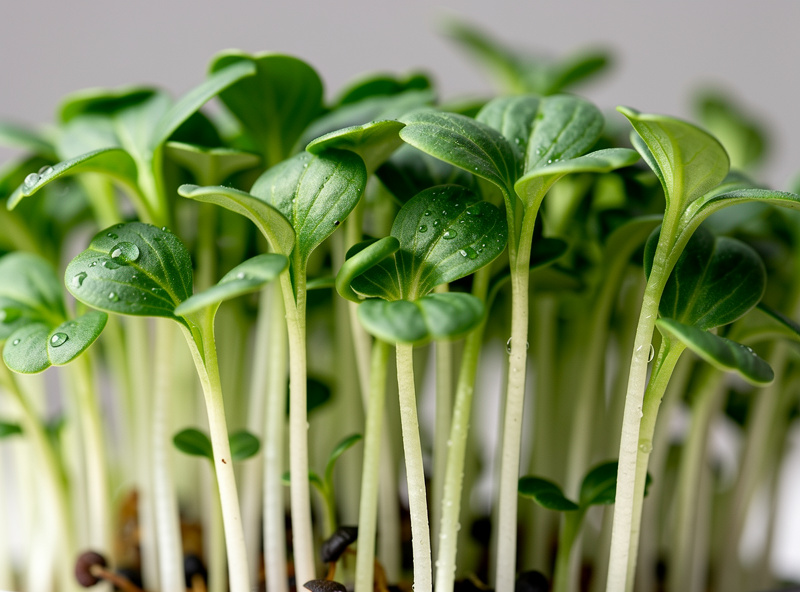
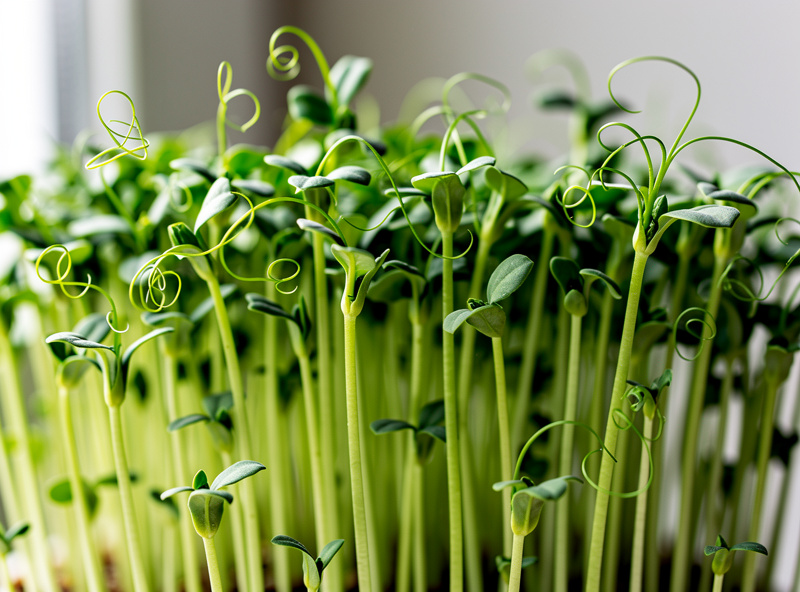
Pea shoots are the kid-friendly entry point. Sweet, tender, and substantial — they have the mouthfeel of mature snap peas. Speckled pea, Austrian winter pea, or even cheap dried green peas from a grocery store all work as seed.
Pre-soak 12 to 24 hours. Sow 3 to 4 ounces per tray (peas need heavy seeding density). Cover with dome, no weight needed. Day 4 onward: uncover and light. Harvest at 4 inches tall.
One unique feature: pea shoots may produce a smaller second cut 7 to 10 days after the first, especially if cut at 2 inches and watered consistently. Yield drops 50 to 70 percent on the second cut, but it’s still useful for low-volume kitchens.
For the harvest mechanics that apply to all three top crops, see the Microgreens Harvest guide.
4. Broccoli
Broccoli microgreens are the most versatile fast grower in the lineup. Mild, approachable flavor that works in smoothies, sandwiches, salads, and as a side garnish — nothing it clashes with. Texture is delicate but substantial enough to serve as a salad base when mixed with radish for bite.
The flavor is mild — closer to mature broccoli than to mustard or radish. Texture is delicate. Yield is moderate (8 to 10 ounces per tray) but cycle is short (10 days).
Sow 1 ounce per tray. Standard process: humidity dome days 0 to 4, light days 5 to 10. Harvest when first true leaves appear between cotyledons.
5. Mustard
Mustard microgreens deliver wasabi-like heat in a leaf-tender package. Three common varieties: Red Giant (purple-tinged leaves, sharp), Mizuna (Japanese mustard, milder), and Wasabi (most pungent of all).
Cycle is 8 to 10 days. Sow 1 ounce per tray. Same process as radish. Pair with sushi, mix into salads, or use as a sandwich topping in place of horseradish.
For complete equipment to grow these five, the Microgreens setup guide covers trays, lights, and medium. If choosing a grow light is the sticking point, the grow lights for microgreens guide breaks down T5 vs. LED options by tray count and budget.
Tier 2: Worth Trying After 5 Successful Cycles
6. Kale
Kale microgreens taste like mature kale at higher density. Tuscan (lacinato) and curly kale both work. 10 to 12 days to harvest, mild compared to broccoli or mustard. Yield 6 to 8 ounces.
7. Arugula
Sharp peppery flavor, tender leaves, fast cycle (10 to 12 days). Pairs well with pizza, sandwiches, and Italian dishes. Yield 6 to 8 ounces.
8. Cabbage
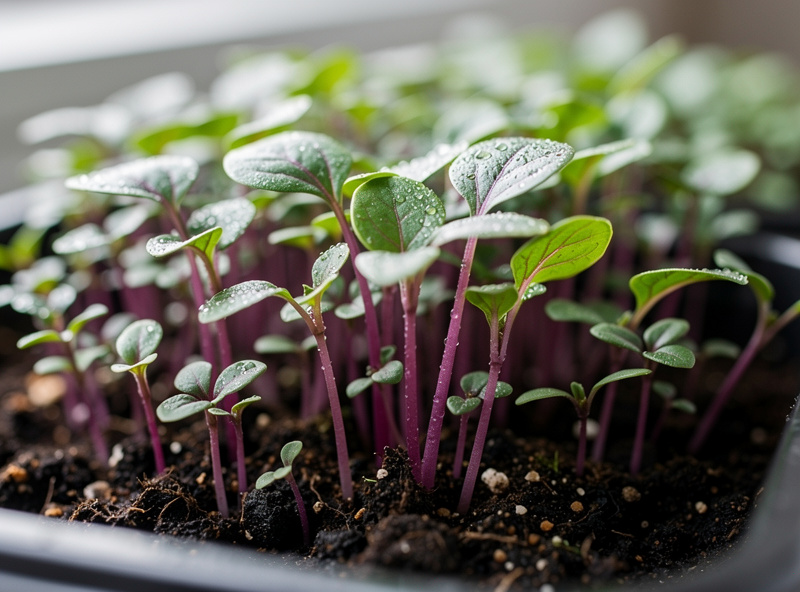
Sweet, mild, and visually striking — red cabbage microgreens have purple-tinged leaves. On my shelf they are the best-looking variety I grow, with deep purple stems against bright green cotyledons that make any plate look like it came from a restaurant kitchen. Yield 7 to 9 ounces.
Tier 3: Slow and Tricky (Skip Until Comfortable)
9. Beets
Beautiful red-purple stems and leaves. Earthy, slightly sweet flavor. The catch: 60 to 70 percent germination at best, 15 to 18 day cycle. Beets are sold as multigerm seed clusters (each “seed” is actually 2 to 5 seeds), so soak 12 to 24 hours and sow at half the density of normal small seeds. Yield 5 to 7 ounces.
10. Cilantro
Slowest popular microgreen at 18 to 21 days. Germination is uneven (some seeds sprout day 4, others day 10). Pre-soak 8 hours and lightly crush the seed coats with a rolling pin to improve germination from 50 percent to 70 to 80 percent. Worth growing only if you cook a lot of Mexican, Indian, or Thai food — store-bought cilantro spoils so fast that homegrown microgreens save real money.
11. Basil
Tender, fragrant, and beautiful — but 14 to 21 day cycle and easily moldy under humidity domes. Sow lightly, ventilate often, and accept that some trays will fail. The flavor is unmatched for caprese, pesto, and Italian dishes.
12. Wheatgrass
Not a leaf microgreen — wheatgrass is grown for juicing. Hard wheat or soft wheat berries, pre-soaked 12 hours, sown thick (1 cup per tray). Cut at 6 to 8 inches and juice. Yield 10 to 14 ounces of juiceable grass per tray. Most growers either love it (daily green juice) or skip it (no juicer at home).
Species to Avoid as a Beginner
I have tried most of these at least once and the lesson each time was the same: some crops are not worth the tray space at home scale.
Onion family (leek, scallion, chive): Slow (21+ days), prone to mold, and the seedlings are so thin they’re barely worth harvesting at home scale.
Carrot: Slow germination (15+ days), spindly seedlings, low yield. Better to grow mature carrots in containers — see the soil and growing medium guide for container techniques.
Lettuce: Lettuce micros exist but the leaf is too tender — wilts within hours of cutting. Better to grow baby lettuce at 30 to 40 days for usable salad-bowl volume.
Tomato: Toxic. The cotyledons of solanaceous crops (tomato, pepper, eggplant) contain glycoalkaloids — never eaten as microgreens.
Where to Buy Seeds
Seed quality matters more than tray quality. I buy radish and broccoli seed by the pound from True Leaf Market and restock every 4 to 5 months — a pound of radish seed runs about $30 and covers roughly 30 trays. For a research-backed overview of seed selection and growing basics, Penn State Extension’s growing microgreens guide is a solid reference. If you want to try several varieties without committing to pounds, a microgreen seed variety pack gives you 8 to 12 types in small pouches, enough for a tray each while you figure out your rotation.
Bulk specialty seed suppliers consistently outperform grocery-store seed packets:
- True Leaf Market (Salt Lake City) — bulk pricing, microgreen-specific labeling, US-based. Per-pound prices: radish $10-15, sunflower $4-7, pea shoot $6-9.
- Johnny’s Selected Seeds (Maine) — high quality, slightly higher prices, excellent germination tests.
- Sprout People (online) — broad variety, sprout-and-microgreen specialist.
- Local feed/farm stores — bulk wheat, peas, beans (oats and corn for sprouting only) for $1-3 per pound.
Avoid: garden-center seed packets coated with fungicide (clearly labeled), grocery-store dried beans for non-pea/non-mung sprouts (some treated with hot-water pasteurization that kills germination).
Cost Per Tray by Species
| Species | Seed Density | Bulk Cost (oz) | Soil Cost | Total Per Tray |
|---|---|---|---|---|
| Radish | 1 oz | $0.85 | $0.50 | $1.35 |
| Sunflower | 2.5 oz | $0.40 ea = $1.00 | $0.50 | $1.50 |
| Pea shoots | 3 oz | $0.50 ea = $1.50 | $0.50 | $2.00 |
| Broccoli | 1 oz | $1.50 | $0.50 | $2.00 |
| Cilantro | 1.5 oz | $1.20 | $0.50 | $1.70 |
Mix Trays: A Beginner Mistake
Tempting but rarely works, and I have the failed tray photos to prove it. Different species germinate at different rates and harvest at different times. A radish-broccoli-mustard mix might harvest acceptably (all 8 to 10 days), but mixing pea shoots (cycle 12) with radish (cycle 8) means harvesting half the tray early or letting the other half over-mature.
Better approach: dedicate full trays to one species and combine cut greens after harvest. For salad blends, simply harvest 2 ounces of three different single-species trays and mix in a bowl.
Frequently Asked Questions
What microgreens grow the fastest?
Radish reaches harvest in 8 days, the fastest of all common microgreens. Mustard and wheatgrass also harvest in 8 to 10 days. Most other species take 10 to 14 days. Cilantro and basil are slowest at 18 to 21 days. Pea shoots and sunflower need 10 to 14 days but are forgiving enough for first-timers.
What are the best microgreens for salads?
Sunflower shoots are the best salad microgreen — nutty, crunchy, and substantial enough to be the base, not just a garnish. Pea shoots add sweetness. Radish and arugula add peppery bite. A mix of sunflower (base), pea shoots (sweet), and radish (spicy) covers every salad profile.
Can you grow microgreens from any seed?
Most edible plant seeds work, but avoid solanaceous crops (tomato, pepper, eggplant cotyledons contain toxic glycoalkaloids). Use untreated, food-grade seeds — never garden seed packets coated with fungicide. Sunflower must be black-oil-seed type, not striped confectionary.
Which microgreen has the highest yield?
Black oil sunflower produces the most weight per tray at 12 to 18 ounces from a 10×20 tray. Pea shoots are second at 10 to 14 ounces. Wheatgrass yields 10 to 14 ounces of juiceable grass.
Are microgreens expensive to grow?
No. Most species cost $1.35 to $2.00 per tray in seed and soil. The same volume of microgreens at a grocery store costs $7 to $12. After paying off your initial setup ($35 to $200), you save $5 to $10 per tray you grow.
What microgreens taste the best?
Subjective, but consensus picks: pea shoots (sweet, kid-friendly), sunflower (nutty crunch), broccoli (mild, mainstream), and red cabbage (sweet, visually striking). Spicy preferences favor radish, mustard, and arugula.