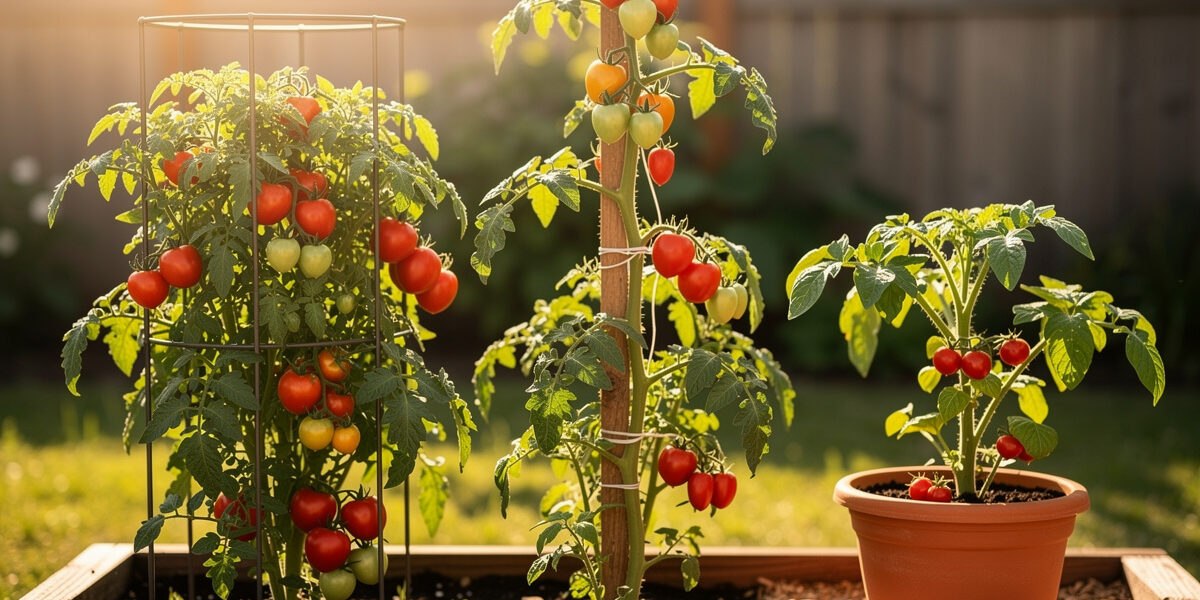
Tomato plant types fall into four growth-habit categories — determinate, indeterminate, semi-determinate, and dwarf — and picking the wrong one for your space wastes an entire season. A determinate bush in a tall-stake setup under-yields; an indeterminate vine in a patio pot collapses its support by July.
On my balcony I run determinate cherries in fabric grow bags because the compact bush habit fits a 5-gallon bag without outgrowing the rail by midsummer, and the single-flush harvest window aligns with the short Nordic season — I need fruit that ripens in July and August, not a vine still setting flowers through September. Below is each type broken down with named cultivars, exact spacing, container sizing, and the support system it actually needs, filtered through what holds up on a balcony through a Swedish summer.
The Four Tomato Growth Habits, Decoded
“Tomato plant types” can mean two different things: growth habit (how the plant grows) or fruit type (cherry, plum, slicer, beefsteak). This guide is about growth habit, because that is what dictates spacing, support, and pruning — the structural decisions you make on transplant day that you cannot undo. For a deeper look at fruit characteristics across cherry-class varieties, see Sun Gold Tomato Plants; for indeterminate-specific deep management, see Indeterminate Tomatoes: Varieties, Pruning & Yield.
Determinate Tomatoes (Bush Type)
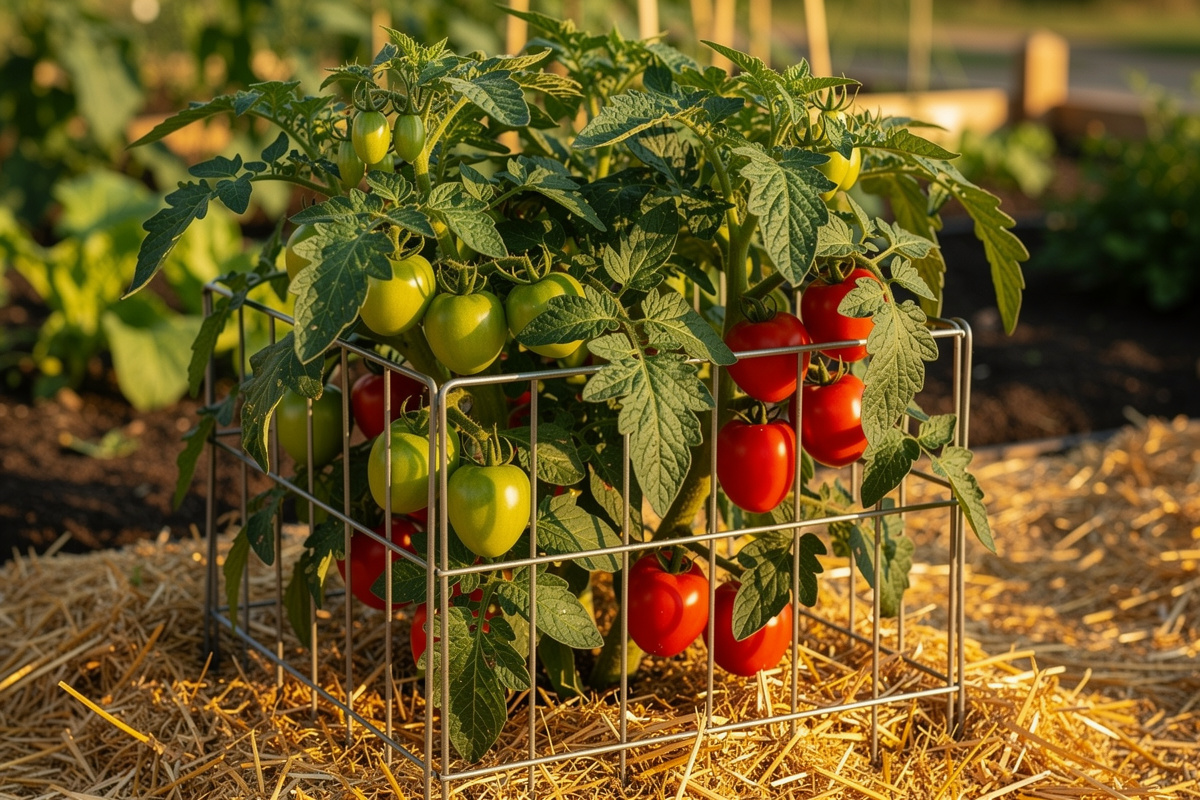
Determinate tomatoes grow to a genetically programmed height — usually 3 to 4 feet — then stop. They flower at the tips of all branches roughly simultaneously, set fruit, and ripen the entire crop within a 3 to 4 week window. After that, the plant essentially shuts down — determinate types grow to a fixed size and set most of their fruit in a short window, while indeterminate types keep growing and fruiting until frost (Iowa State University Extension).
Why this matters:
- One concentrated harvest — ideal if you want 30+ pounds of paste tomatoes ready to can in a single weekend.
- No pruning, ever. Removing suckers from a determinate cuts directly into your final yield because every leaf the plant makes is one it needs to ripen its single flush.
- Compact support requirements — a 4-foot square wire cage holds the plant for the season. Skip stakes; the bush form does not lend itself to single-stem training.
- Spacing: 24 inches between plants in row, 36 inches between rows.
Named cultivars worth growing: Roma VF, San Marzano (technically determinate types of this Italian classic exist alongside indeterminate ones — read the seed packet), Celebrity, Bush Early Girl, Patio Princess, Rutgers, Defiant PHR.
Determinates also work in 5-gallon containers, which makes them the type of choice for most balcony gardeners — I run mine in heavy-duty fabric grow bags rather than plastic pots because the fabric air-prunes roots so the plant never gets root-bound, and the bag handles make it easy to rotate plants for even sun exposure through the short Nordic season. See Container Gardening and Balcony Gardening for the relevant container sizing and watering routines.
Indeterminate Tomatoes (Vining Type)
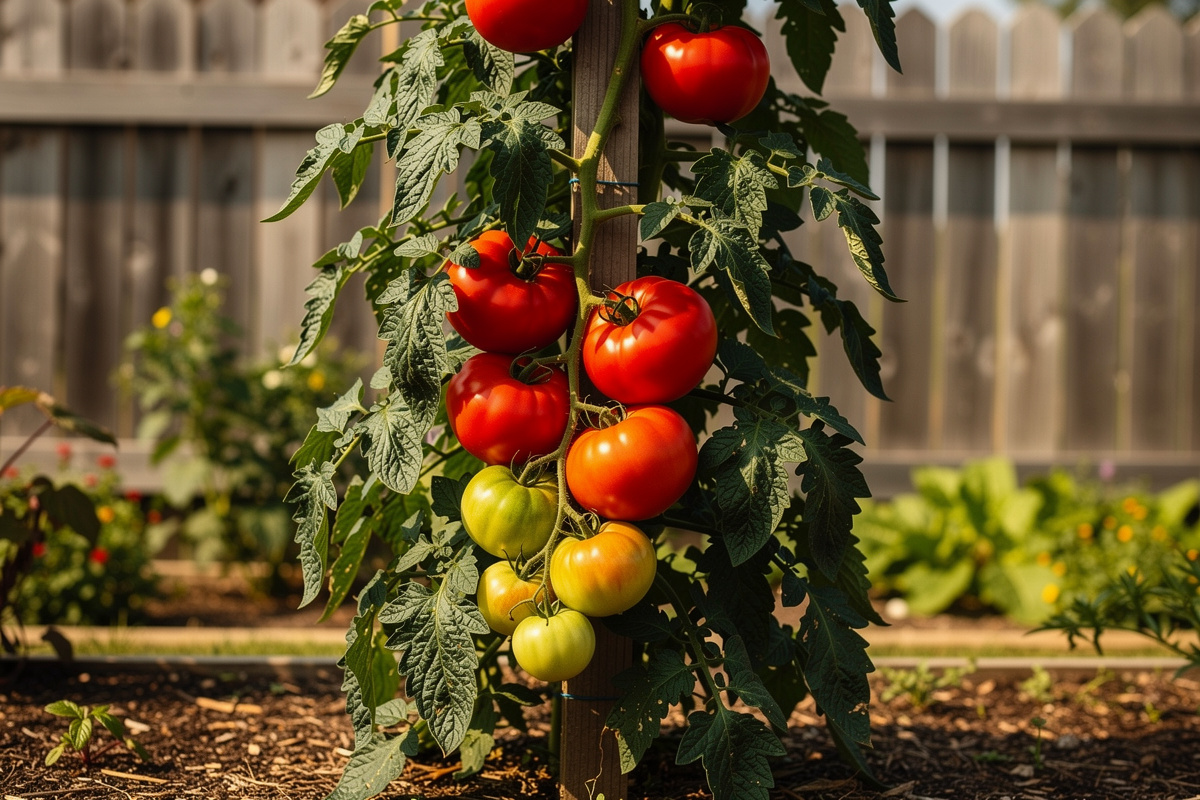
Indeterminate tomatoes have no built-in stop signal. The main stem keeps extending all season — typically reaching 6 to 10 feet by the end of summer, sometimes more in long-season climates. Flowers and fruit form continuously along the vine, which means a steady picking window from first ripe fruit through the killing frost.
What this means for management:
- Continuous harvest — perfect for fresh eating, sandwiches, salads, and gardeners who want a steady summer supply rather than one big batch.
- Weekly suckering required. Suckers (shoots that emerge in the leaf axil between the main stem and a leaf branch) become entire secondary vines if left alone. Removing them roughly doubles per-plant yield by redirecting energy from foliage to fruit.
- Tall support is non-negotiable. A 4-foot cage around an indeterminate plant fails by July. Use 6-to-8-foot stakes (full method in Staking Tomatoes) or a multi-plant trellis (see Trellis for Tomatoes).
- Spacing: 36 inches minimum between plants. Closer spacing causes mutual shading and ruins airflow, opening the door to early blight.
Named cultivars worth growing: Cherokee Purple, Brandywine, Sun Gold, Sungold (different from Sun Gold — confusingly), Sweet Million, San Marzano (indeterminate type), Big Beef, Mortgage Lifter, Kellogg’s Breakfast, Black Krim, Green Zebra, Yellow Pear.
Dwarf Tomatoes (Patio and Container Type)
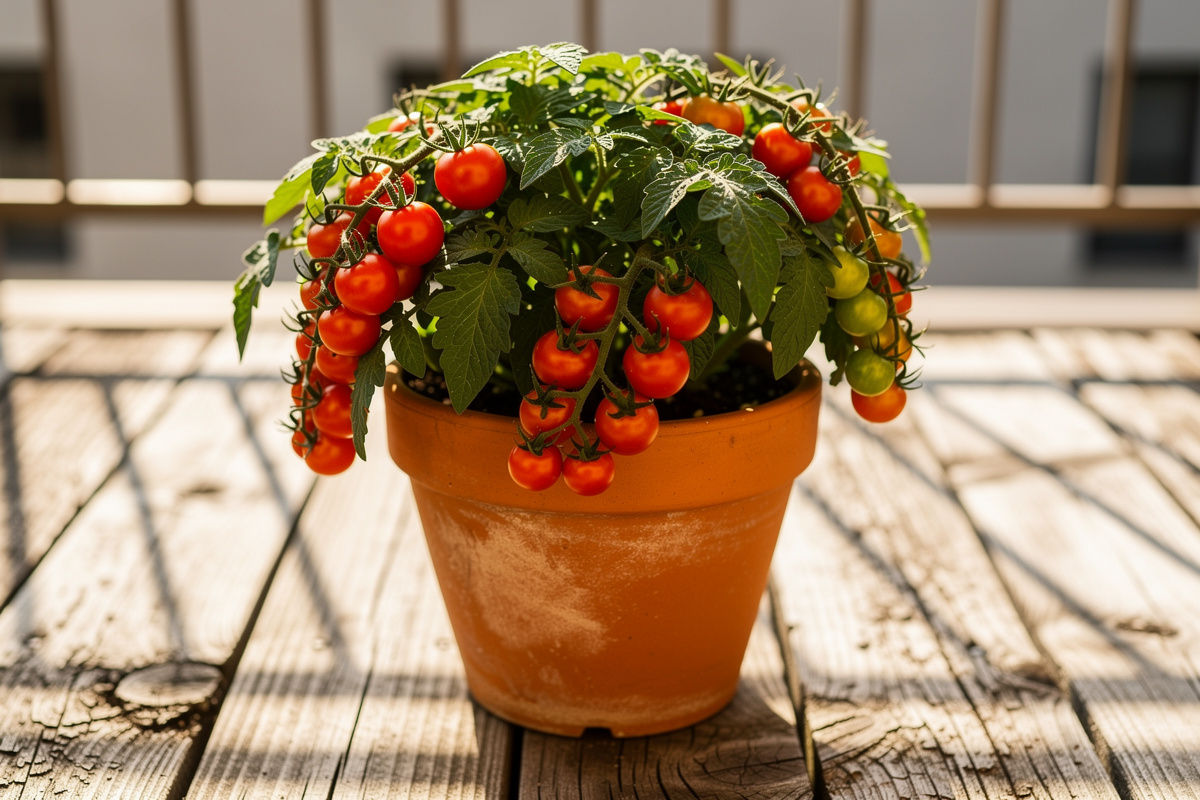
Dwarf tomatoes are a relatively new category created by the open-source Dwarf Tomato Project, distinct from determinates despite the small size. They have rugose (crinkled) thick stems, mature at 2 to 3 feet, and fruit continuously like indeterminates but on a much smaller frame. They were specifically bred for container and small-space growing.
Critical points:
- Continuous fruit on a small plant — combines the best traits of determinate (size) and indeterminate (long harvest window).
- Light suckering only. Some pruning helps keep the plant tidy and improves airflow, but unlike indeterminates, aggressive sucker removal hurts yield.
- Container minimum: 5 gallons for a dwarf, though 7 to 10 gallons produces better yields. They will survive in smaller pots but produce far less fruit.
- Spacing in-ground: 18 to 24 inches.
- Stake or short cage — even at 2 to 3 feet, dwarves carry heavy fruit loads relative to their stem, and unsupported plants will fall over once trusses fill out.
Named cultivars worth growing: Dwarf Mr. Snow, Rosella Purple Dwarf, Tasmanian Chocolate, Dwarf Wild Fred, Iditarod Red, Dwarf Beryl Beauty, Sneaky Sauce. The Dwarf Tomato Project releases new cultivars annually — Victory Seeds and TomatoFest carry the broadest selections.
Semi-Determinate Tomatoes (The Compromise)
Semi-determinate is the in-between category that gets the least attention but solves a real problem for short-season gardeners. These plants grow taller than true determinates (4 to 5 feet typically) and produce over an extended single flush — usually 4 to 6 weeks of harvest rather than the 3 weeks of a strict determinate or the continuous harvest of an indeterminate.
When to choose semi-determinate:
- You live in a short-season zone (USDA 3 to 5) where indeterminate plants run out of season before they hit peak production.
- You want extended harvest without the weekly suckering an indeterminate demands.
- You have a 5-foot tomato cage you want to actually use.
Named cultivars worth growing: Celebrity (often listed as either determinate or semi-determinate depending on source), Mountain Magic, Glacier, Stupice, Bush Goliath, Sub-Arctic Plenty.
Side-by-Side Comparison Table
| Trait | Determinate | Indeterminate | Dwarf | Semi-Determinate |
|---|---|---|---|---|
| Mature height | 3–4 ft | 6–10+ ft | 2–3 ft | 4–5 ft |
| Harvest pattern | 3–4 week single flush | Continuous, frost to frost | Continuous, smaller scale | Extended single flush, 4–6 weeks |
| Total yield per plant | 10–15 lb | 15–30 lb | 5–12 lb | 12–20 lb |
| Spacing in-ground | 24 in | 36 in | 18–24 in | 30 in |
| Container size | 5+ gal | 10+ gal | 5–10 gal (ideal) | 7+ gal |
| Support type | Square wire cage | Tall stake or trellis | Short stake or small cage | 5 ft cage |
| Suckering needed | Never | Weekly | Light only | Light, below first cluster |
| Best for | Canning, processing | Fresh eating, slicers | Patios, small spaces | Short-season gardens |
| Days to maturity | 55–75 days | 65–95 days | 60–80 days | 65–80 days |
How to Tell Which Type You Bought (When the Label Lies)
Garden center labels are notoriously unreliable. The plant tag may say “tomato” or even just give a cultivar name without the growth habit. Three quick checks:
- Search the cultivar name with “determinate” or “indeterminate” on a reputable seed company site (Johnny’s, Baker Creek, Tomato Growers Supply). The official classification is in the catalog description.
- Look at the seedling. If it’s already 12+ inches tall and starting to flop, it’s indeterminate. If it’s 6–8 inches and bushy, it could be either — the label search is the only reliable way.
- Watch the first month after transplant. Indeterminates put on 2+ inches of new growth per week and quickly outgrow their support. Determinates fill out laterally and stop gaining height around week 6.
Matching Type to Your Space
The single-question decision tree:
- Patio, balcony, no in-ground space → dwarf in a 5–10 gallon container.
- Want canning-ready batches once a season → determinate (Roma, San Marzano).
- Want fresh tomatoes from July to October → indeterminate. Plan for serious vertical support.
- Short growing season (frost-free under 100 days) → semi-determinate or fast-maturing indeterminate (Stupice, Glacier).
- Mixing both for a complete summer → 1 indeterminate per person plus 2–3 determinates for processing. This is what most home gardeners eventually settle on.
For the Nordic balcony grower, I’d add one filtering rule to the decision tree above: prioritize days-to-maturity over yield-per-plant. A 55-day determinate cherry that finishes in late July is worth more than a 90-day heirloom slicer that gets caught by the October frost. Start with a packet of fast-maturing determinate cherry seeds and you’ll have a harvest in year one while you experiment with longer-season varieties on the side.
Whichever type you choose, the rest of the season — soil prep, watering, feeding, pest management — is the same. The full season-long playbook is in the Tomato Plant: Complete Outdoor Growing Guide. For the seeding-stage work that comes 6–8 weeks before any of this, see Starting Tomato Seeds Indoors or Tomato Heirloom Seeds if you’re choosing varieties for next year.
I keep two fabric grow bags of determinate cherries and one 10-gallon bag of a semi-determinate slicer on the balcony each season — the determinates give me the reliable early flush for salads and snacking, and the semi-determinate stretches the picking window into September without the full trellis and weekly suckering an indeterminate would demand. If you’re starting from scratch, buy one packet of determinate cherry seeds, one sturdy square tomato cage, and a 5-gallon fabric grow bag — that is the minimum viable setup for a balcony tomato that actually produces. As an Amazon Associate I earn from qualifying purchases.
Frequently Asked Questions
Is a Roma tomato determinate or indeterminate?
Most Roma varieties are determinate, which is why they are the canning tomato of choice — the entire crop ripens within a 3 to 4 week window, perfect for batch processing. However, some seed companies sell indeterminate Roma types specifically bred for fresh use. Always confirm on the seed packet or seedling tag.
Can I grow an indeterminate tomato in a container?
Yes, but you need a 10 to 15 gallon container minimum and a very tall stake or balcony-mounted trellis. The plant will still produce well, but expect 30 to 40 percent lower yield than the same variety in-ground due to root volume constraints. Most container gardeners get better results with a dwarf or determinate.
Why does my dwarf tomato look so different from my determinate?
Dwarf tomatoes have a distinct trait called rugose foliage — the leaves are thick, dark green, and crinkled rather than smooth. They also have noticeably thicker, sturdier stems for their size. This is genetic, not a deficiency. Dwarves were bred from a different ancestor line than standard determinates.
Do determinate tomatoes need to be pruned at all?
No. Determinates should never have suckers removed because every leaf the plant makes is one it needs to ripen its single flush of fruit. The only acceptable pruning on a determinate is removing diseased or yellowing lower leaves for airflow — and only after the plant is well established.
Which type yields the most tomatoes?
Per plant, indeterminates win — a healthy indeterminate produces 15 to 30 pounds across the full season versus 10 to 15 pounds for a determinate. But per square foot per month, determinates can match or beat indeterminates because their compact form lets you plant more in the same bed and harvest a concentrated crop quickly.
How do I know if a tomato variety is heirloom or hybrid?
This is a separate axis from determinate/indeterminate. Heirloom means the variety is open-pollinated and at least 50 years old; hybrids are first-generation crosses bred for specific traits like disease resistance. You will find both heirloom and hybrid versions of determinate, indeterminate, and dwarf types. The packet will say either heirloom, open-pollinated, or F1 hybrid.