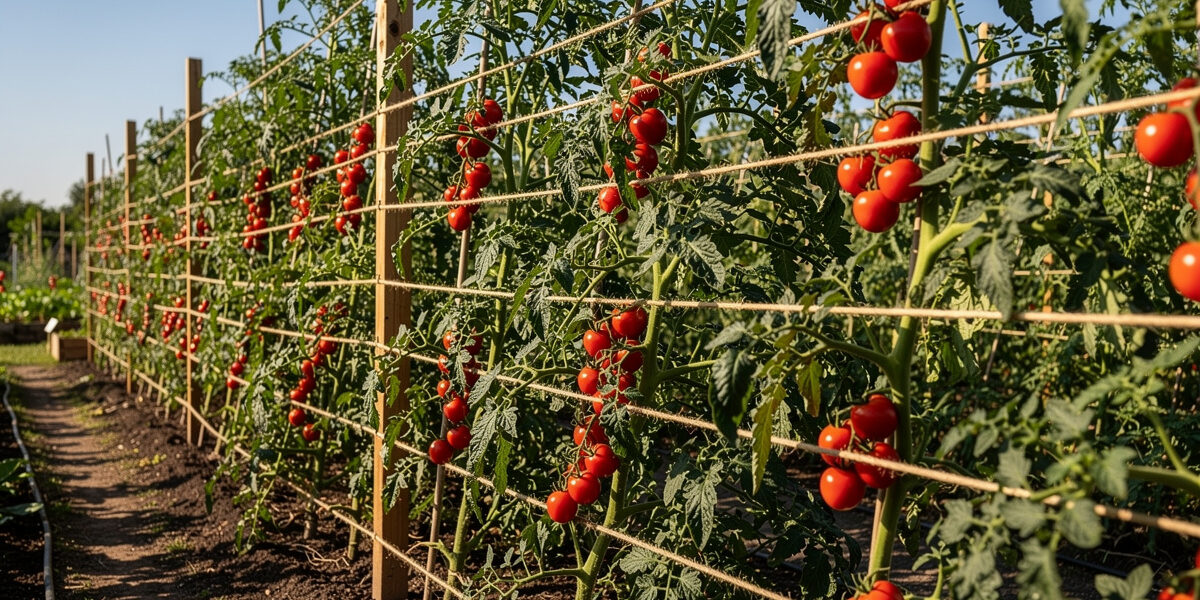
The flimsy 3-ring cone cages from big-box garden centers will collapse under a healthy tomato plant by July, and you’ll spend the rest of the season tying limp vines back up with bailing twine. Real tomato support comes in three forms — purpose-built cages from concrete reinforcing wire, A-frame structures, or the row-friendly Florida weave — and the right choice depends on your tomato type, row count, and how much you want to spend per plant. This guide compares all three multi-plant trellis methods. For single-plant single-stake training (a fourth option — and the one I use on my balcony because space constrains me to one indeterminate plant per fabric bag), see Staking Tomatoes: Single-Stake Method. The methods below are for larger setups: rows, raised beds, and in-ground gardens where you’re supporting 4+ plants at once.
Why Tomato Cages from the Garden Center Fail
The standard 33-inch tapered wire cone cage was designed for compact bush varieties popular in the 1970s. Modern indeterminate tomato vines reach 6 to 10 feet and carry 15+ pounds of fruit at peak — these cages cannot hold them. The standard failure pattern: cage tips forward in early August, spilling the entire plant onto the ground, fruit ripens in the dirt, slugs and rot finish what’s left.
For determinates, dwarves, and tomato types under 4 feet, a sturdy purpose-built cage is the simplest workable option. For indeterminates, you need either a single-stake setup or one of the multi-plant trellises below. (For type-by-type support recommendations, see Tomato Plant Types.)
Whichever system you land on, the reason to support tomatoes at all is the same: lifting the foliage and fruit off the ground improves air circulation through the canopy, keeps the fruit clean and away from soil-borne rot and slugs, and makes both spraying and picking far easier. Staked and trellised plants also dry faster after rain and dew, which is the single biggest lever against the leaf diseases that flatten unsupported tomatoes by late summer (University of Georgia Extension).
Concrete Reinforcing Wire (CRW) Cages
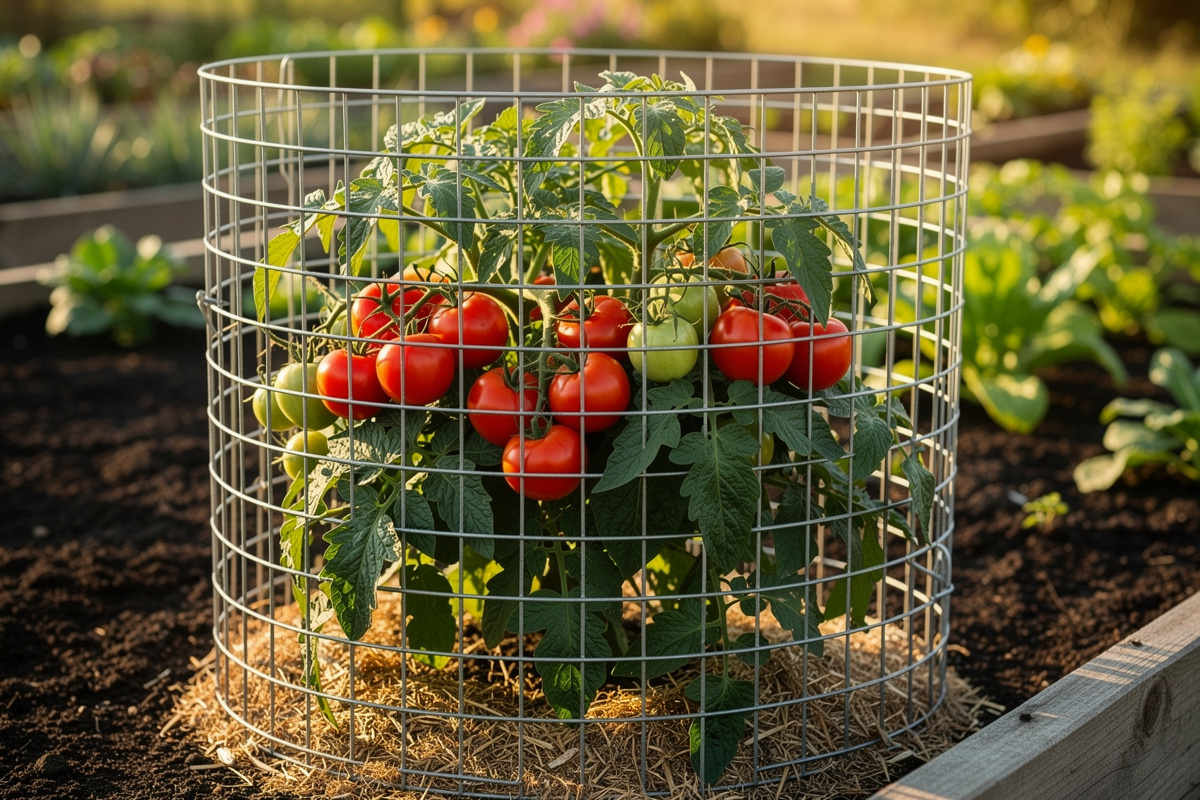
Concrete reinforcing wire — the heavy galvanized 6×6-inch mesh sold in 5-foot wide rolls at building supply stores — makes the gold-standard tomato cage. Cut a 5-foot length, roll into a cylinder roughly 18 inches in diameter, secure the seam with twist ties or zip ties.
Specs:
- Cost: $8 to $12 per cage, lifetime durability.
- Diameter: 18 inches — wide enough for a determinate to fill out without crowding.
- Height: 5 feet above ground after pushing 6 inches into soil.
- Weight capacity: 25+ pounds of fruit on a vine without bending.
- Mesh size: 6×6 inches — large enough to reach through and harvest, small enough to support the plant evenly.
Best for: Determinate and dwarf varieties, semi-determinates, and short-season indeterminates that won’t exceed 5 feet. Not tall enough for full-season indeterminates in zones 7+. On my balcony the CRW cage is the workhorse for determinate cherries — each 5-gallon fabric grow bag gets its own 18-inch diameter cage that drops right in, and in a Nordic summer where the determinate bush tops out at about 4 feet, the 5-foot cage height is more than enough. For a setup that requires zero mid-season adjustments on determinates, grab a pair of sturdy square tomato cages and install them on transplant day.
Setup tips: Drive 2 or 3 stakes around the cage and zip-tie them together for hurricane-zone wind stability. The cage itself doesn’t bend, but the whole assembly can tip in a 50 mph gust without tied-in stakes.
A-Frame Trellis
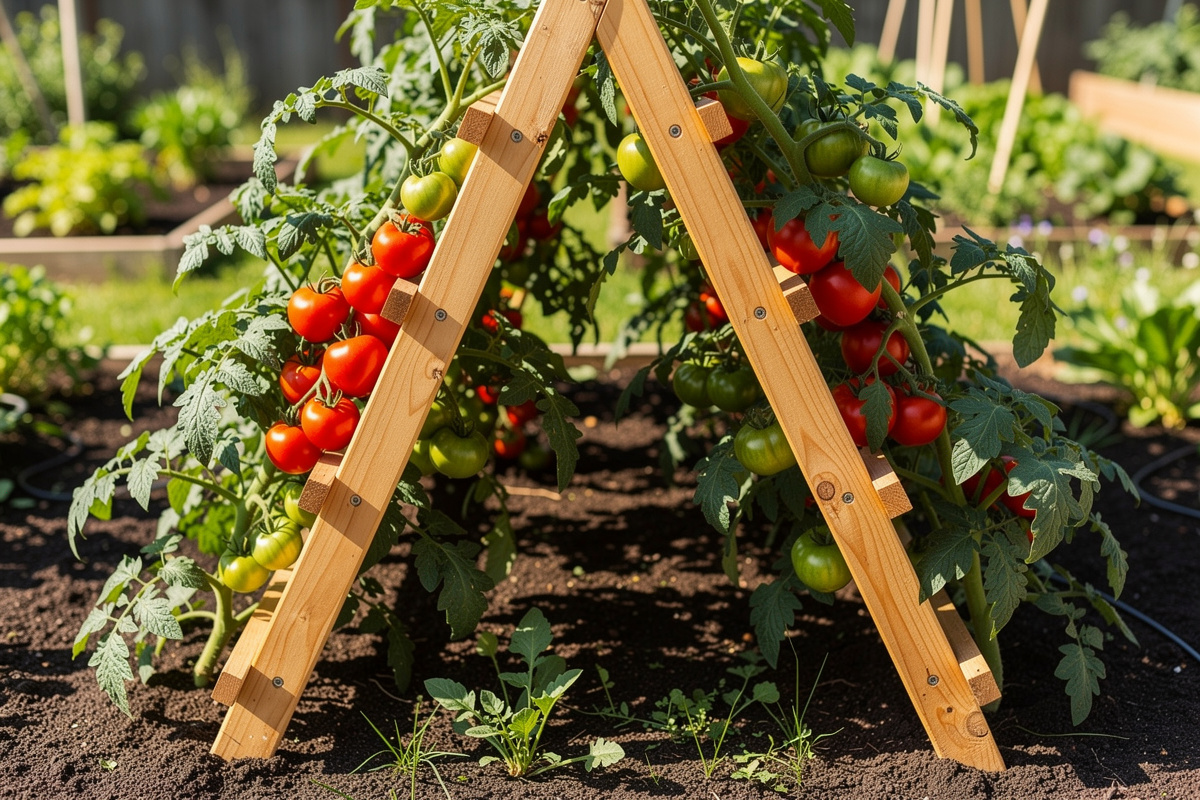
An A-frame trellis is two flat panels (wood lattice, cattle panel sections, or twine-strung 1×2 frames) connected at the top to form an inverted V over the row. Plants grow up both sides; harvest happens by reaching under or walking through.
Specs:
- Cost: $40 to $80 in materials for an 8-foot run.
- Plants per structure: 6 to 10 indeterminates (3 to 5 per side).
- Height: 6 to 8 feet at the peak.
- Width: 4 feet at the base, narrowing to 0 at the top.
Best for: Indeterminate vines in long runs. The angled growth surface naturally trains vines outward, opening the canopy for airflow and reducing disease pressure.
Disadvantages: Footprint is wider than vertical structures. Disassembly and storage between seasons is awkward. Not suitable for raised beds under 4 feet wide.
If you have limited horizontal space, look at vertical-only structures or the single-stake method instead. For broader vertical-growing strategies that work in tight urban spaces, see the Vertical Vegetable Garden and Vertical Gardening guides.
Florida Weave
The Florida weave (also called the basket weave) is the commercial-tomato-grower standard for rows of 8+ plants. Sturdy stakes (T-posts or 2×2 wooden stakes) are driven every 2 plants along the row. Twine is then woven horizontally between the stakes, in front of and behind alternating plants, holding the vines upright in a sandwich.
Specs:
- Cost: $3 to $5 per plant in materials (T-posts amortized over many seasons).
- Plants per structure: Scales linearly — 4 plants need 3 posts, 20 plants need 11 posts.
- Height: 6 feet (3 horizontal twine layers added as plants grow).
- Setup time: 30 minutes per row of 10 plants on day 1, plus 15 minutes per added twine layer through the season.
Best for: Long rows of indeterminate tomatoes, market gardens, anyone growing 10+ plants of similar varieties. Lowest per-plant cost of any reliable support method.
Method:
- Drive a 6-foot T-post or wooden stake at each end of the row, plus one between every 2 plants in the middle.
- When plants reach 12 inches tall, tie twine to the end post 8 inches above the ground. Run the twine in front of plant 1, behind plant 2, in front of plant 3, behind plant 4, all the way to the end. Tie off.
- Run twine back the same path on the opposite side, sandwiching each plant between two parallel twines.
- Add a new pair of twines every 8 to 12 inches as plants grow taller. Most rows end up with 4 or 5 twine layers by August. I use heavy-duty sisal garden twine for the weave rather than synthetic — it grips the stakes better, holds tension through rain, and composts at the end of the season so you’re not cutting plastic string out of the bed in October.
Cattle Panel Trellis (Bonus Option)
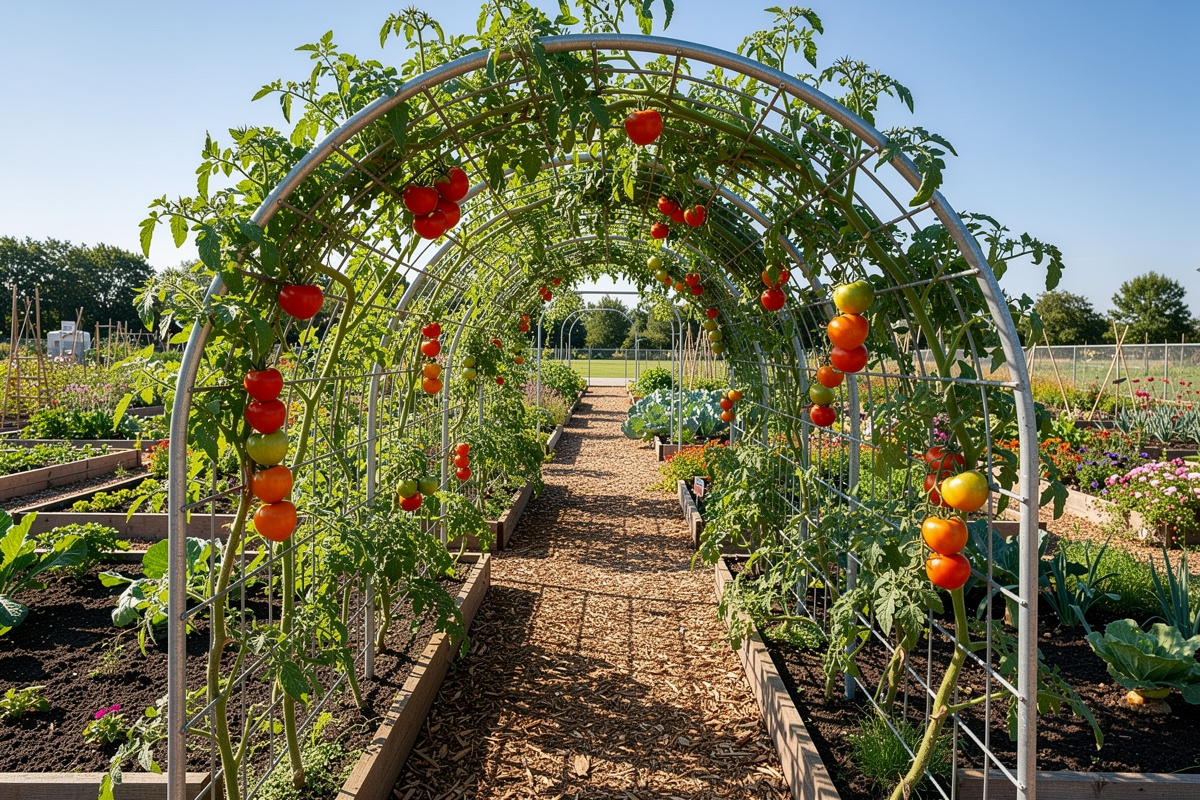
Cattle panels are 16-foot-long, 4-foot-wide galvanized steel mesh panels sold at farm stores for $25 to $35 each. Bent into an arch over a garden path or used flat against a wall, they make exceptionally durable tomato (and cucumber, and melon) trellises.
Best for: Permanent garden installations, gardeners who don’t want to disassemble support each season, growers who want walk-through harvest. The 6-inch mesh openings are perfect for reaching tomatoes through.
Disadvantage: Requires a vehicle to transport (panels don’t fit in a car) and the bending work is a 2-person job.
Comparison: Which Trellis to Choose
| System | Cost per plant | Best tomato type | Plants supported | Reusable years | Setup difficulty |
|---|---|---|---|---|---|
| CRW cage | $8–$12 | Determinate, dwarf, semi-determinate | 1 per cage | 15+ | Low |
| A-frame | $5–$10 | Indeterminate | 6–10 | 5–10 | Medium-high |
| Florida weave | $3–$5 | Indeterminate | 10+ in a row | Posts: 15+ | Low (incremental) |
| Cattle panel arch | $8–$12 | Indeterminate | 4–8 per panel | 20+ | Medium |
| Single stake | $3–$8 | Indeterminate | 1 per stake | 5–10 | Low |
Install Trellis Before Planting, Not After
Whatever system you choose, install it on transplant day or before. Driving a T-post into a 6-week-established root ball severs major roots and shocks the plant. The Florida weave especially benefits from being fully posted before plants go in — the line of stakes acts as a planting guide for spacing.
Once support is in place, the rest of the season’s care — watering, feeding, pruning, harvesting — proceeds normally. See Tomato Plant: Complete Outdoor Growing Guide for the full seasonal playbook, and Pruning Tomato Plants for the suckering routine that makes indeterminate trellis work pay off.
For the balcony grower, the trellis decision is simpler than it looks: if you’re running determinate cherries in fabric grow bags, a square wire cage per bag is the entire support system — install on transplant day, done for the season. If you’re ambitious enough to run an indeterminate vine on the balcony, you’re in single-stake territory (covered in the staking guide) or a wall-mounted heavy-duty trellis netting zip-tied to the railing — same principle as the Florida weave, just vertical and bolted to whatever structure you have. As an Amazon Associate I earn from qualifying purchases.
Trellis Durability Through a Nordic Season
On my balcony a tomato trellis needs to survive two different kinds of abuse: the weight of a loaded indeterminate plant in August and the October gales that arrive after the plants are dead but before I have had a chance to take the trellis down. I use galvanized steel stakes driven 12 inches into the fabric pot and secured with garden twine at three levels. The steel is heavy enough that a 6-foot Sungold plant in full fruit does not tip the pot in a strong wind, and the galvanised coating survives a Swedish autumn without rusting.
The Florida weave method using stakes and twine is the lightest and cheapest trellis system for a balcony, and I use it for determinate varieties that need support for only six to eight weeks. Two stakes at either end of the pot with three levels of twine woven in a figure-eight pattern support a 3-foot determinate cherry tomato; for indeterminate varieties I add a third stake and a fourth twine level to handle the extra weight and height. The whole setup costs less than ten dollars and packs flat for winter storage on a balcony where every inch is spoken for. I use UV-stable polypropylene twine rather than natural jute for this, because jute rots and snaps by August in a wet Nordic summer, dropping a fruit-laden vine onto the balcony floor at exactly the wrong moment.
Frequently Asked Questions
What is the best trellis for indeterminate tomatoes?
For 1 to 3 plants, single-stake training is simplest. For rows of 4+ plants, the Florida weave is fastest to set up and lowest cost per plant. For permanent installations, a cattle panel arch is the most durable option. Skip the standard cone cages — they cannot support indeterminate vines past mid-season.
How tall does a tomato trellis need to be?
At least 6 feet for indeterminates, 4 feet for determinates and semi-determinates, 3 feet for dwarves. Indeterminates in long-season zones (7+) regularly reach 8 to 10 feet, so build for the variety you’re growing in your specific climate.
Can I use cattle panels for tomatoes?
Yes — cattle panels make exceptional tomato trellises. Bend a 16-foot panel into an arch over a garden path, or set it flat against a wall. The 6-inch mesh openings are ideal for reaching through to harvest, and panels last 20+ years.
How do I make a Florida weave?
Drive sturdy T-posts or 2×2 wooden stakes every 2 plants along the row. When plants reach 12 inches, run twine in front of plant 1, behind plant 2, in front of plant 3, all the way to the end and back, sandwiching each plant. Add a new twine layer every 8 to 12 inches as plants grow.
When should I install the tomato trellis?
On transplant day, before the seedling is in the ground. Driving stakes or posts into established roots later in the season severs the root system and shocks the plant during peak fruit production. Plan support before planting.
Are tomato cages from the store strong enough?
The flimsy 33-inch tapered cone cages sold at most big-box stores are not strong enough for any modern tomato variety past mid-July. Make CRW cages from concrete reinforcing wire mesh, or skip cages entirely for indeterminates and use stakes or trellises.