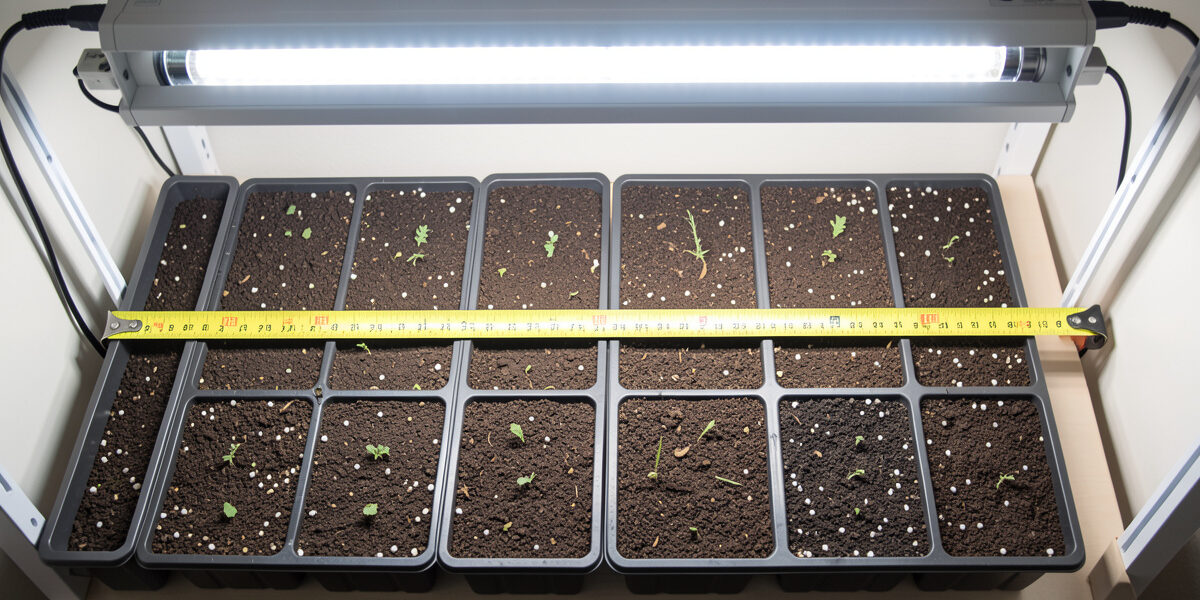
For leafy greens and herbs under modern LED, plan on roughly 20–30 actual watts per square foot; for fruiting plants that want real intensity, 30–50. The word that does the work in that sentence is actual — measured watts at the wall, not the inflated number printed on the box. Get the density right and the plants behave; get it wrong in either direction and you are either growing leggy seedlings or paying to overshoot.
Watts per square foot is the rule I reach for first when someone shows me a stretched, pale shelf and asks what went wrong. It is a blunt instrument — PPFD is the precise version — but it is the number you can work out before buying anything, and it sizes a small-space shelf correctly nine times out of ten. After years of running a microgreen and seedling shelf through dark Swedish winters, it is also the number I trust more than any marketing claim about “coverage area.”
What The Rule Actually Means
Watts per square foot is total real wattage divided by the canopy area you are lighting. If a bar pulls 60 measured watts and lights a 2 ft × 1.5 ft tray (3 square feet), that is 20 watts per square foot — bottom of the range for greens, fine for lettuce and herbs, a little light for anything fruiting. The figure tells you intensity density, which is what plants respond to, rather than raw power, which is what the bill responds to.
The reason it works as a rule of thumb is that modern white LEDs cluster within a fairly narrow efficiency band, so watts become a decent proxy for delivered light. The moment you mix in an old, inefficient panel that proxy breaks — which is exactly why the next step after this rule is to measure PPFD at home and confirm.
Target Density By Crop
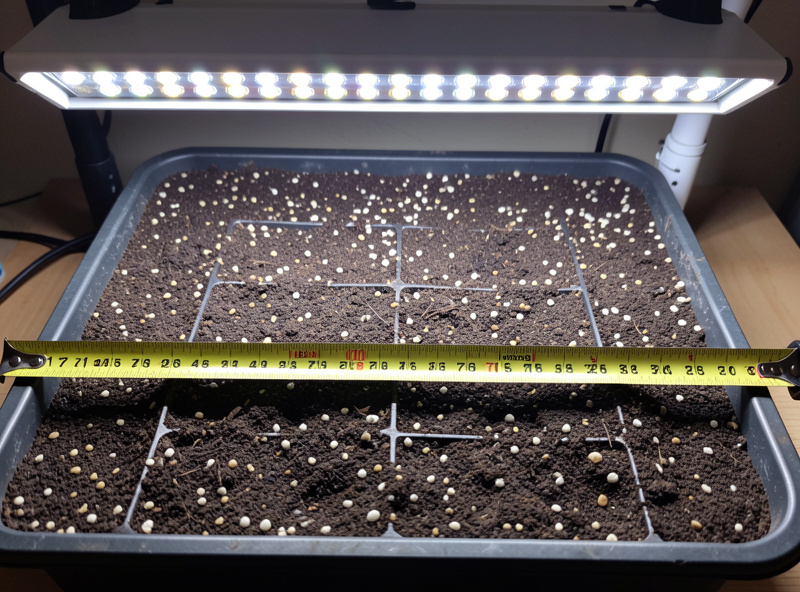
Different crops want different intensity, and the watts-per-square-foot target tracks that closely. Leafy greens and herbs are forgiving; seedlings need enough to stay compact without being blasted; fruiting plants are the hungry ones. Here is where I aim, in real measured watts of modern LED.
| Crop / stage | Actual watts / sq ft | Typical photoperiod | Notes |
|---|---|---|---|
| Sprouts (no light needed) | 0 | n/a | Grown dark on the counter |
| Microgreens | 15–25 | 14–16h | Short crop, modest intensity |
| Leafy greens / herbs | 20–30 | 14–16h | Lettuce, kale, basil, pak choi |
| Seedlings / starts | 25–35 | 14–16h | Keep close to avoid stretch |
| Fruiting (tomato, pepper, strawberry) | 30–50 | 12–14h | Highest demand for real yield |
If you are growing across categories on one shelf — greens at one end, a strawberry tower at the other — size for the hungriest crop in that zone, or split the shelf so the fruiting plants sit directly under the brightest part of the fixture.
Why The Box Wattage Wrecks The Calculation
A light sold as “150W” frequently pulls 60–110 real watts, because the headline figure is usually the theoretical diode capacity and the driver runs the chips softer. If you size a shelf using the box number, you will think you have 50 watts per square foot when you actually have 25 — and your plants will tell you so by stretching. Always meter the fixture with a plug-in energy monitor before you trust any density calculation.
As an Amazon Associate I earn from qualifying purchases. A cheap plug-in watt meter turns the box’s marketing number into a real one in about thirty seconds. That single reading is what makes the running-cost side of the equation honest, which is the whole premise of my grow light running cost calculator.
The Trap At Both Ends
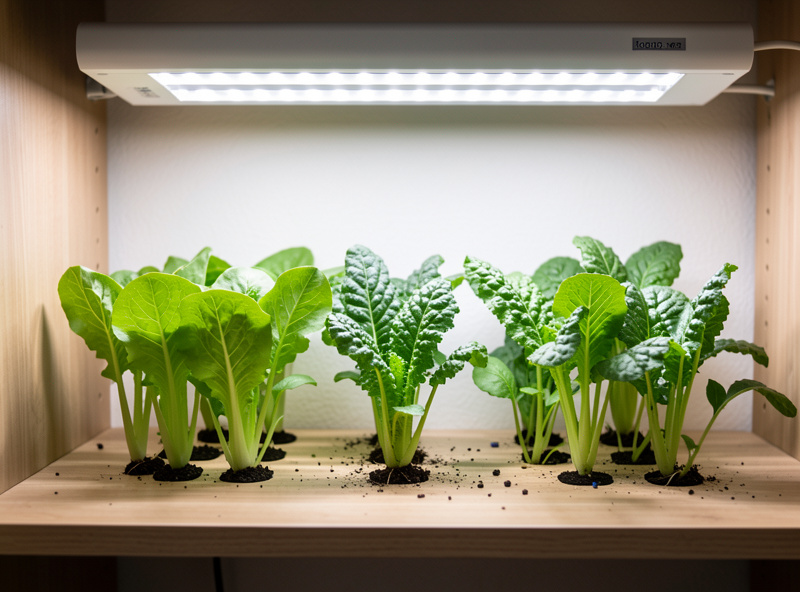
Under-lighting is the obvious failure: too few watts per square foot and seedlings stretch toward the light, internodes lengthen, and you get leggy, weak plants that flop. But over-lighting is a real and underrated waste. Once the canopy is saturated, extra watts do not buy extra growth — they just raise the bill and, with cheaper fixtures, the heat. Doubling from 30 to 60 watts per square foot on a lettuce shelf is money set on fire.
This is why I treat the rule as a target band, not a “more is better” dial. The goal is enough intensity to keep plants compact and productive, then no more. If you are at the right density and plants still stretch, the problem is usually hanging height, not wattage — the fix lives in how far a grow light should be from plants.
Watts Per Square Foot Versus PPFD
Watts per square foot is the estimate; PPFD is the measurement. The rule assumes a typical efficient LED and an average mounting height, but the actual photons hitting your canopy depend on the fixture’s efficiency, its beam spread, and how high you hang it. For sizing a purchase, the watt rule is plenty. For dialing in a shelf you already own, measure the real PPFD — even a careful phone reading beats guessing, as I cover in PAR meter apps vs real meters.
Think of it as estimate-then-confirm: use watts per square foot to buy the right fixture and size the shelf, then verify with a light reading once it is hung. That two-step is the same habit that runs through everything from grow lights for microgreens to choosing the best light for growing plants indoors.
A Worked Example From My Shelf
My seedling bar pulls about 60 watts at the wall and covers a single 1020 tray plus a little overhang — call it 3 to 3.5 square feet. That lands me around 18–20 watts per square foot, which is fine for hardening off lettuce and brassica starts but a touch light if I push tomatoes under it. When I want the bar to do fruiting-level work, I shrink the lit area — pull the trays into the bright centre and let density climb toward 30 — rather than buying a second fixture I will then have to pay to run all winter.
That is the small-space move the homestead channels never mention: you can change watts per square foot by changing the area, not just the wattage. Concentrate the plants that need intensity, spread out the ones that do not, and one honest fixture covers far more than its box claims.
Frequently Asked Questions
How many watts per square foot do grow lights need?
Around 20 to 30 actual watts of modern LED per square foot for leafy greens and herbs, and 30 to 50 for fruiting plants like tomatoes, peppers and strawberries. Use real measured watts, not the box rating.
Should I use the box wattage or the real wattage?
Always the real measured wattage. A light sold as 150W often pulls only 60 to 110 watts at the wall because the box figure is the diode capacity, not actual draw. Meter it with a plug-in energy monitor first.
Can a grow light have too many watts per square foot?
Yes. Once the canopy is saturated, extra watts add no growth and simply raise the electricity bill and heat output. For lettuce and herbs, going much above 30 watts per square foot is usually wasted money.
How do I increase watts per square foot without a bigger light?
Reduce the lit area. Pull plants into the brightest centre of the fixture so the same wattage covers a smaller canopy, raising effective intensity. Spreading plants out does the opposite.
Is watts per square foot the same as PPFD?
No. Watts per square foot is a sizing estimate that assumes a typical efficient LED; PPFD is the measured light actually reaching the canopy. Use the watt rule to buy and size, then confirm with a light reading.
What watts per square foot do seedlings need?
About 25 to 35 actual watts per square foot, kept close enough to prevent stretching. Seedlings show under-lighting fast by growing tall and leggy with long gaps between leaves.