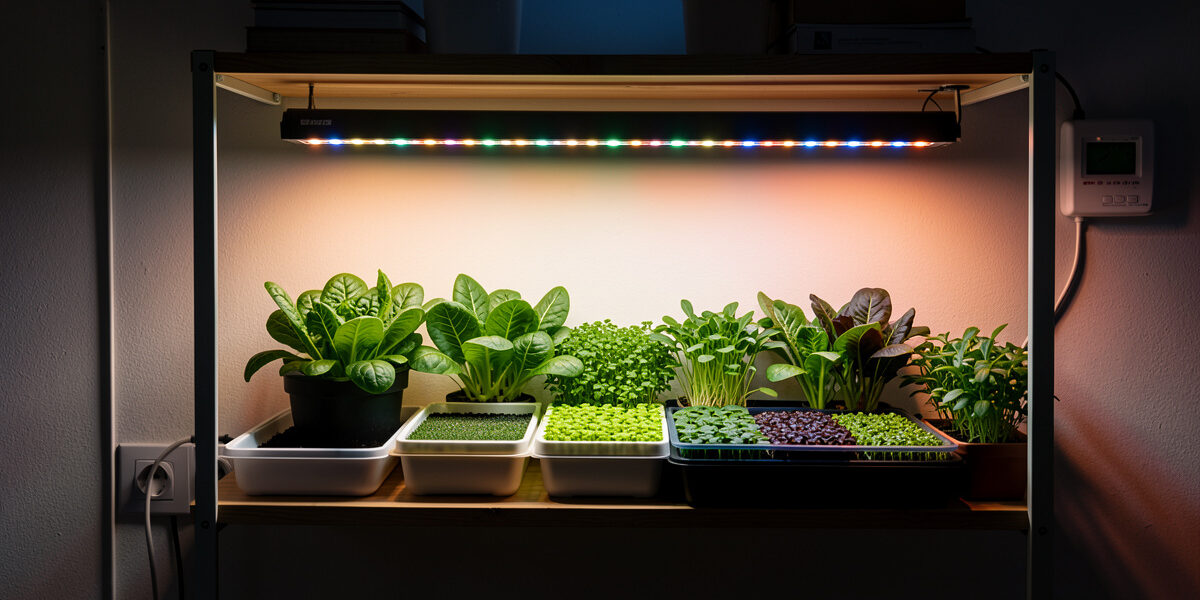
A grow light running cost calculator is just one honest line of arithmetic: watts × hours per day × days ÷ 1000 × your price per kWh. A 100‑watt bar run 14 hours a day for a 30‑day month draws about 42 kWh — somewhere between a couple of euros and a small dinner out, depending entirely on what your utility charges. Everything else on this page is about getting those four numbers right.
I run a shelf of grow lights through a Swedish winter every year, when the sun gives me maybe four usable hours of daylight and the lights are doing the actual work. Over the years I have bought, wired up, and metered enough of them — a full-spectrum LED bar over the microgreen and seedling shelf, cheap clip‑on panels, the old “blurple” boards — that I stopped trusting the wattage printed on the box and started treating the whole shelf as a system with a monthly bill attached. This hub is the calculator and the eight deeper guides that feed it, so you can work out what your shelf really costs before the bill tells you.
The Running Cost Formula (Copy This)
The entire calculation fits on the back of a seed packet. Monthly cost = (actual watts × hours per day × 30) ÷ 1000 × price per kWh. The two numbers people get wrong are “actual watts” (not the marketing number) and “price per kWh” (which in Europe includes grid fees and tax, not just the spot price). Get those honest and the rest is a calculator app.
Work it left to right. Find the real draw of your fixture — I cover how to measure that below, because the figure on the box is almost always the LED chip rating, not what the wall sees. Multiply by how many hours the timer actually runs, not how many you think it runs. Multiply by 30 for a month, divide by 1000 to turn watt‑hours into kilowatt‑hours, then multiply by whatever your last bill says you pay per kWh. That last number is the one that swings the answer from trivial to “why is my winter electricity bill like this.”
A Worked Example From My Winter Shelf
Take the bar I run over seedlings: call it 100 actual watts at the wall, on for 14 hours a day. That is 1.4 kWh a day, about 42 kWh across a 30‑day month. At a cheap off‑peak rate of roughly €0.15/kWh that is about €6.30 a month; at a painful winter rate of €0.40/kWh it is nearly €17. Same light, same hours — the bill more than doubled on price alone.
This is why I refuse to quote a single “grow lights cost X per month” figure, and why no honest calculator will either. Your rate is the dominant variable. The practical move is to pull your actual per‑kWh price off your most recent invoice (in Europe, the all‑in figure with transmission and tax, which is often double the spot price you see quoted in the news) and run the formula with that. The full breakdown of what a winter shelf adds to a real bill lives in my grow light electricity cost guide.
Finding Your Real Wattage (Not The Box Number)
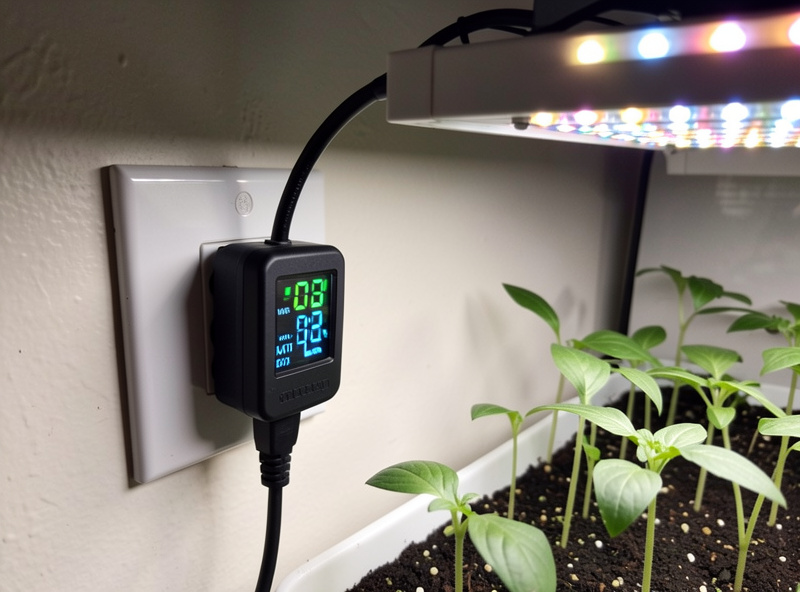
A “150W” LED grow light almost never pulls 150 watts at the wall. That figure is usually the theoretical diode capacity; the driver runs the chips softer, so real draw is frequently 60–110 watts. The only way to know is to put a cheap plug‑in energy meter between the fixture and the socket and read the live wattage — mine has paid for itself in better buying decisions several times over.
Plug the meter in, let the light warm up for a few minutes (draw settles after the driver stabilises), and read the watts. That is the number you put in the formula. If you only ever take one piece of gear advice from this hub, it is this: meter the fixture once and you will never again argue with a marketing wattage. A basic energy monitor and a PAR meter are the two tools that turn guessing into measuring.
As an Amazon Associate I earn from qualifying purchases. A plug‑in energy monitor that reads watts and kWh is the cheapest measurement upgrade you can make.
Watts Per Square Foot: The Number That Actually Sizes A Shelf
Once you know real watts, the question becomes whether you have enough of them for the area you are lighting. The working figure most small‑space growers land on is roughly 20–30 actual watts of modern LED per square foot for leafy greens and herbs, and more like 30–50 for fruiting plants that want real intensity. Under that and plants stretch; well over it and you are paying to overshoot.
That ratio is the bridge between “what does it cost” and “does it work,” because buying too much light is just as wasteful as buying too little — you pay to run wattage the canopy never uses. I walk through how to size a shelf properly, and where the rule breaks down, in watts per square foot for grow lights.
PPFD Per Watt: Efficiency Is The Hidden Cost
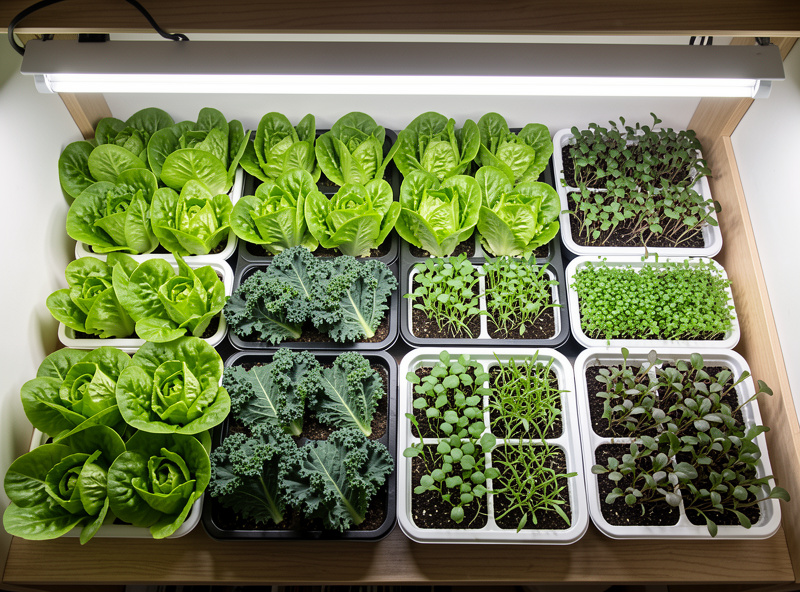
Two lights can pull the same wattage and deliver wildly different amounts of usable light to your plants. The metric that matters is PPFD — the photon flux density actually landing on the canopy — and the efficiency that matters for your bill is PPFD per watt. A good modern white LED delivers far more usable light per watt than an old blurple panel, which means a lower bill for the same plant growth.
You do not need a lab to check this. A handheld PAR meter, or even a phone app used carefully, gets you close enough to compare fixtures and set mounting heights. I cover the measurement honestly — including where the cheap methods lie — in how to measure PPFD at home, and the messy truth about phone apps in grow light PAR meter apps vs real meters.
Hanging Height And Photoperiod: Free Levers On The Bill
Two of the biggest cost levers do not cost a krona. The first is hanging height: PPFD falls off with the square of distance, so a light mounted twice as far away delivers roughly a quarter of the intensity. Hang it correctly for the growth stage and you get the light the plant needs from the wattage you are already paying for. My height‑by‑stage chart is in how far should a grow light be from plants.
The second is photoperiod — how many hours the light runs. Most leafy greens and seedlings are perfectly happy on 14–16 hours; running them 18 or 24 hours rarely buys proportional growth and just adds kWh. Matching the photoperiod to the crop is one of the cleanest ways to cut run‑cost without touching plant health, which I lay out in how many hours of grow light per day.
A Quick Cost Comparison By Shelf Size
To make the formula concrete, here is what a few common small‑space setups draw across a 30‑day month at three illustrative rates. Plug your own per‑kWh figure in to replace these — they are worked examples, not a quote.
| Setup (real watts × hours/day) | kWh / month | @ €0.15/kWh | @ €0.25/kWh | @ €0.40/kWh |
|---|---|---|---|---|
| Single clip-on, 25W × 14h | ~10.5 | ~€1.58 | ~€2.63 | ~€4.20 |
| Seedling bar, 60W × 14h | ~25.2 | ~€3.78 | ~€6.30 | ~€10.08 |
| Microgreen shelf, 100W × 16h | ~48.0 | ~€7.20 | ~€12.00 | ~€19.20 |
| Two-tier rig, 200W × 16h | ~96.0 | ~€14.40 | ~€24.00 | ~€38.40 |
| Strawberry tower, 150W × 12h | ~54.0 | ~€8.10 | ~€13.50 | ~€21.60 |
Notice the strawberry tower runs fewer hours but still costs real money, because day‑neutral strawberries through the dark months are a long‑season project — that is the rig I lean on hardest in winter, and it is documented in my growing strawberries indoors guide.
The Timer Is The Cheapest Money-Saver You Own
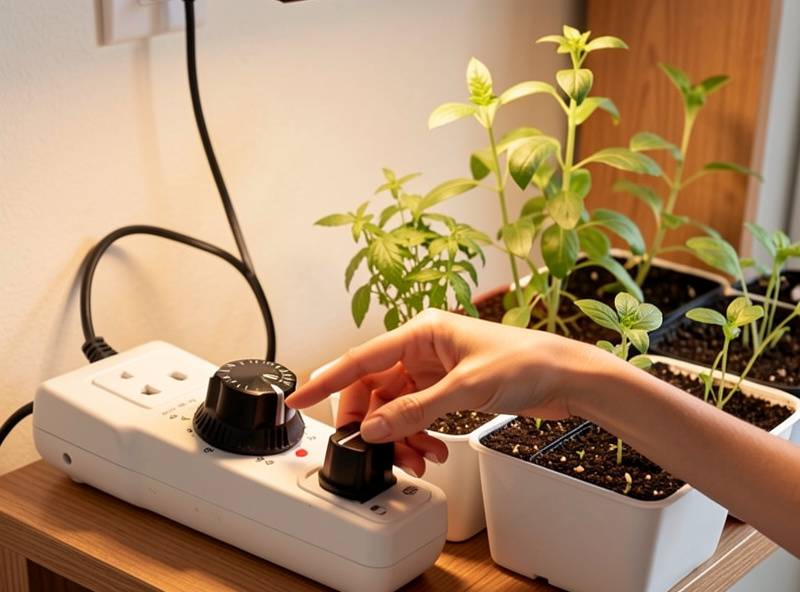
Every fixture above assumes the light is off when it should be off. A mechanical or smart timer enforces the photoperiod automatically, and a well‑set timer is the single change that cut my run‑cost the most — no more lights left on, no more guessing. A few euros of timer protects every other number in the formula. My exact setup, including the off‑peak scheduling trick, is in the grow light timer setup I use to cut run-cost in half.
As an Amazon Associate I earn from qualifying purchases. A simple grow light timer outlet pays for itself in a single winter of not leaving the bar on.
Cheap Versus Premium: Where The Money Goes
The last variable is the fixture itself. A premium LED costs more up front but often delivers more PPFD per watt, runs cooler, and lasts longer — which can mean a lower bill and fewer replacements over its life. Cheap panels can absolutely earn their place on a small shelf, but the payback maths is not obvious, and “expensive” is not automatically “better value.” I ran cheap and premium fixtures side by side and put the numbers in are expensive grow lights worth it.
If you are still choosing a fixture rather than costing one you own, my buying guides cover the selection side: best light for growing plants indoors, LED lights for growing plants indoors, and crop‑specific picks like grow lights for vegetables, grow lights for microgreens, grow lights for tomatoes, and grow lights for peppers.
Putting It All Together For A Nordic Winter
Here is the order I actually work in, every autumn before the light fails. Meter the fixture for real watts. Size the shelf at 20–30 watts per square foot for greens. Hang it at the correct height for the stage so I am not wasting intensity to distance. Set the photoperiod to the crop — 14–16 hours for greens, less for fruiting maintenance — and lock it on a timer. Then run the formula with my real per‑kWh rate so the bill is a decision, not a surprise.
That sequence is the whole philosophy of this site applied to one shelf: treat the grow light as a measured run‑cost system, not a wattage number on a box. The same instinct that makes me grow lettuce inside on metered light rather than guess, and run my microgreens and sprouts on a known schedule, is what keeps the winter shelf from quietly becoming the most expensive vegetables I have ever grown. For the broader picture of growing under artificial light, see growing plants indoors and the indoor gardening essentials setup.
Why Winter Doubles The Equation Up North
In a Nordic apartment the calculator bites hardest in the exact months you most need the light. From November to February I have maybe four usable daylight hours, so the shelf runs its full photoperiod every day — no free top‑up from a south window. At the same time, electricity prices here tend to peak in winter, when heating demand across the country is highest. So both the “hours per day” term and the “price per kWh” term climb together, and the monthly figure can quietly double against what the same shelf cost in October.
This seasonality is exactly why I plan the shelf in autumn rather than reacting in January. I decide which crops earn the winter light — greens, herbs, the strawberry tower — and which can wait for spring daylight, because every fixture I switch on is now competing for the most expensive kilowatt‑hours of the year. Treating run‑cost as a seasonal budget, not a fixed number, is the difference between enjoying a winter shelf and resenting the bill.
Reading Your Bill: Spot Price Is Not Your Real Rate
The single most common mistake I see is people running the formula with the spot price quoted in the news. Your real per‑kWh cost is the all‑in figure: the energy price plus grid transmission fees plus tax and VAT. In much of Europe that all‑in rate is roughly double the bare spot price, which means a calculation built on spot is wrong by half before you start.
Pull the number off your last invoice. Divide the total amount you paid by the kilowatt‑hours you consumed and you have your true blended rate — the one to put in the formula. If you are on a variable or hourly tariff, this is also where a timer earns its keep, by pushing the photoperiod toward the cheaper hours of the day. The full bill‑reading walkthrough lives in my grow light electricity cost guide.
Estimate First, Then Meter
You can run this whole calculation before you buy anything, using the box wattage as a worst‑case estimate. That is enough to compare two fixtures or sanity‑check whether a setup is affordable. But once the light is on your shelf, meter it for real — the actual draw is almost always lower than the box claims, so your estimate was pessimistic, and the metered figure is the one worth trusting for the rest of the fixture’s life. Estimate to decide; measure to know.
That two‑step habit — estimate before buying, measure after — is the same discipline I bring to every part of the shelf, from how often to water seedlings to which potting soil actually holds up in a container. Growing in a small space rewards people who measure and punishes people who guess.
Frequently Asked Questions
How do I calculate the running cost of a grow light?
Multiply the fixture’s actual watts by hours per day, then by the number of days, divide by 1000 to get kWh, and multiply by your price per kWh. A 100W light run 14 hours a day for 30 days uses about 42 kWh per month.
How much does it cost to run a grow light per month?
It depends almost entirely on your electricity rate. A 100W bar run 14 hours a day uses roughly 42 kWh a month, which is about 6.30 euro at 0.15/kWh or nearly 17 euro at 0.40/kWh. Always use your own per-kWh price.
Is the wattage on the grow light box the real wattage?
Usually no. The box figure is often the theoretical diode capacity, while the driver runs the chips softer, so real draw at the wall is frequently 60 to 110 watts on a light sold as 150W. Use a plug-in energy meter to find the true figure.
Does running a grow light longer grow plants faster?
Only up to a point. Most leafy greens and seedlings are satisfied with 14 to 16 hours of light; running 18 to 24 hours rarely produces proportional extra growth and simply adds kilowatt-hours to the bill.
What is the cheapest way to cut grow light running cost?
Set the correct photoperiod on a timer and hang the light at the right height. Neither costs anything to run, and together they stop you paying to overshoot intensity or leave the light on longer than the crop needs.
How many watts of grow light do I need per square foot?
Roughly 20 to 30 actual watts of modern LED per square foot for leafy greens and herbs, and 30 to 50 for fruiting plants that want higher intensity. Use real measured watts, not the marketing figure on the box.