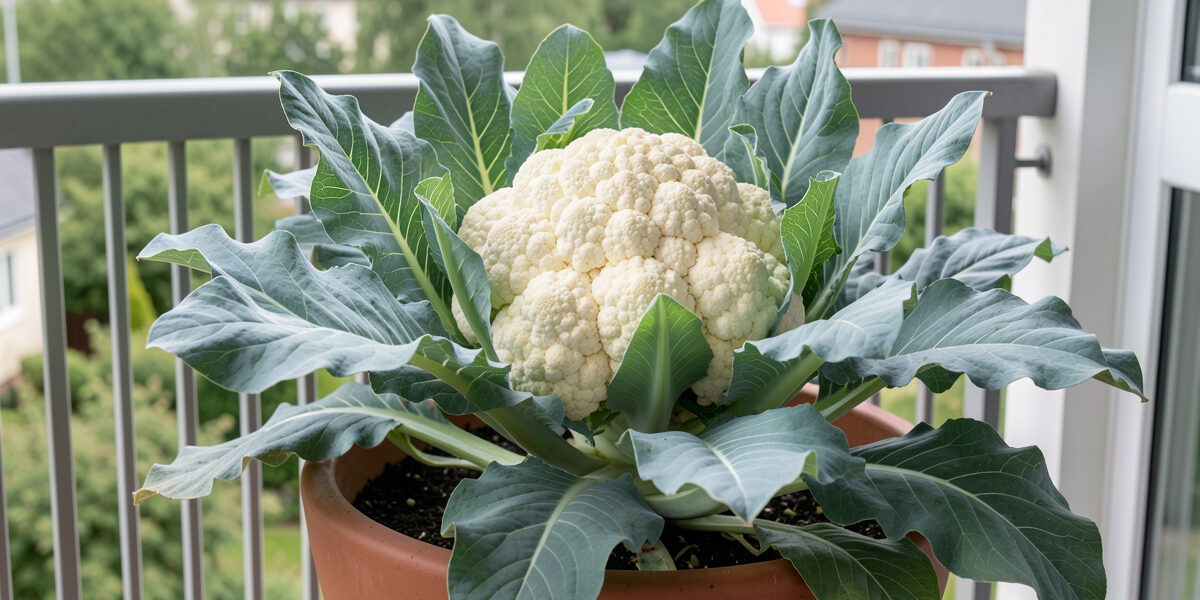
Cauliflower is the most demanding brassica to grow in a container, but it is doable on a balcony with a 12–15 litre pot at least 30 cm deep, relentlessly steady moisture, and a heavy feeding regime. Any check to growth — a dry spell, a cold snap, a feeding gap — and the plant “buttons,” making a tiny useless curd instead of a full head.
I will be honest: cauliflower is the brassica I’d grow last, after you’ve had a season’s success with kohlrabi, cabbage and broccoli in pots. It is the least forgiving of the family because the whole plant has to grow without a single interruption to make a proper curd, and a container amplifies every swing in water and temperature that a plant in open ground would shrug off. None of that means you can’t do it — it means the margin for sloppiness is zero. Get the consistency right and a balcony cauliflower is one of the most satisfying things you can grow.
Why Cauliflower Is the Fussiest Container Brassica
Cauliflower needs uninterrupted growth from seedling to harvest, and a container makes that harder because pots swing faster between wet and dry, hot and cold, than open ground. Any stress — drought, transplant shock, a hot spell, running short of nitrogen — makes the plant “button,” forming a premature golf-ball curd and stopping. That is the failure mode you are managing the whole season.
Everything about growing cauliflower in a pot is in service of removing checks to growth. The plant builds a big frame of leaves first, then converts that energy into a single dense curd; if growth stalls at any point, the plant reads it as “the season is ending” and rushes a tiny curd to seed. On a balcony the usual triggers are a fabric bag drying out in afternoon sun, a cold May night on an exposed rail, or a feeding lapse after transplant. The cold-climate angle actually helps here in one way — cauliflower hates heat, and our cool summers suit it — but the short season means you can’t afford a single wasted week to a check. This is the same heavy-feeder logic as the rest of the container brassicas, just with no slack.
Pot Size, Soil, and One Plant Per Container
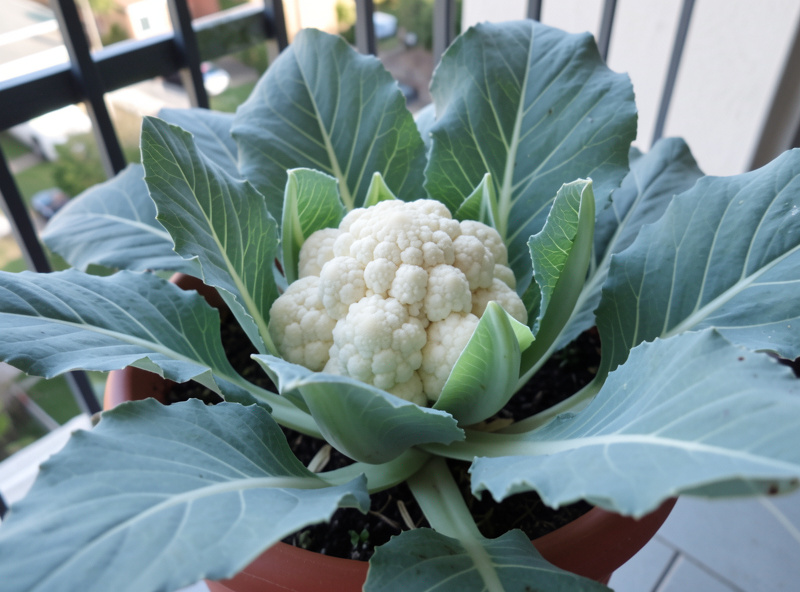
Give each cauliflower a 12–15 litre pot at least 30 cm deep, one plant per pot, in a rich free-draining mix. Cauliflower builds a large leaf frame to support the curd and needs the root run and the fertility to do it. A cramped pot or a compacted bagged “potting soil” that waterlogs is a direct route to a buttoned, stunted plant.
I grow cauliflower in 15-litre containers because the bigger soil volume buffers the moisture swings that smaller pots can’t — more mix means it dries more slowly and holds a more stable temperature, which is exactly what this plant needs. My mix is compost or coir for water-holding, worm castings for fertility, and perlite for drainage, because cauliflower wants to be damp but never sodden. One plant per pot, no compromise: cauliflower’s leaf frame is wide and two plants fighting over one container’s water and nutrients will both button. Plant slightly deep, up to the first true leaves, for stability on a windy balcony, and firm the plant in well — cauliflower dislikes a loose root run. If you only have room for a couple of pots this season, weigh whether cauliflower earns the space: each plant gives you a single curd and then it’s done, with none of the side-shoot bonus that makes broccoli such good value from the same footprint. I grow a cauliflower or two for the pleasure of it, but the workhorse pots on my balcony go to crops that crop more than once.
Watering: The Make-or-Break Factor
Consistent moisture is the single most important thing for container cauliflower — more than feeding, more than variety. The mix must stay evenly damp every day; one good dry-out while the plant is building its frame will button it. A self-watering or wicking setup that feeds moisture from below is close to essential for a balcony cauliflower.
This is why I won’t grow cauliflower in a plain pot that I have to remember to water twice a day. A fabric bag in July can go from damp to bone-dry between morning and evening, and that single swing is enough to wreck the crop. I run cauliflower on a 3D-printed self-watering insert or in a wicking bed so the root zone stays evenly moist whether or not I’m paying attention that day. If you only adopt one piece of kit for this crop, make it a reservoir-based watering system. Watch too for the opposite problem — a pot that stays waterlogged drowns the roots and stalls the plant just as surely; the signs of overwatering are yellowing lower leaves and a sour mix. Steady and damp is the target, not swampy.
Feeding a Heavy Feeder
Cauliflower is among the hungriest vegetables you can grow in a pot. Feed a balanced or nitrogen-leaning liquid feed every week to ten days through the leaf-building phase, easing back the nitrogen as the curd forms. A container empties of available nitrogen fast, and a plant that runs short stalls and buttons — the same check as drought.
I top-dress with worm castings at transplant for a slow biological base, then layer a liquid feed on top through the season because the curd is a big nutritional demand packed into a few weeks. The balance shifts as the plant matures: plenty of nitrogen while it’s building its leaf frame, then ease off so you’re not pushing soft leafy growth at the expense of a firm curd. Boron and molybdenum deficiencies show up in cauliflower as browning curds and distorted “whiptail” leaves, which is one more reason I lean on compost and castings rather than a bare synthetic feed — a living mix supplies the trace elements a salt fertiliser misses. The full schedule, including the nitrogen-to-potassium shift, is in the fertilizing brassicas guide.
Blanching the Curd and Harvesting
Most white cauliflowers need “blanching” — folding a few outer leaves over the developing curd and tucking or tying them to shade it — or sun turns the curd yellow and grainy. Start when the curd is egg-sized. Harvest while it’s still tight and smooth, before it “ricing” into separate grains, usually within a week or two of blanching.
Blanching is simply protecting the curd from light so it stays creamy white and tender; snap a couple of the large outer leaves over it and tuck them in, or loop a soft tie around them. The modern self-blanching varieties curl their own leaves over the curd and save you the job, which on a busy balcony is worth choosing for. Coloured cauliflowers — the orange, purple and green-Romanesco types — don’t need blanching at all, because the colour is the point, and they’re a genuinely easier choice for a first attempt. Whatever you grow, watch the curd closely once it forms: cauliflower goes from perfect to over-mature fast, the tight curd loosening into separating florets (“ricing”). Cut it the moment it’s full and firm, in the cool of the morning. The Almanac cauliflower guide has a clear walkthrough of blanching and the self-blanching types if you want a second reference.
Timing for a Cold Climate
Start cauliflower indoors under a light 4–6 weeks before the last frost and transplant out when nights are reliably above 5 °C. Up north, cauliflower’s hatred of heat is an advantage — our cool summers suit it — but the short season is tight, so a summer or autumn type timed to mature in the cooler shoulder months is often more reliable than a midsummer crop.
Cauliflower transplanted too early into cold soil can be checked by a chilly snap and button just as readily as one stressed by heat, so don’t rush it out before the nights settle. Harden off properly over a week — a soft seedling slammed onto an exposed balcony is a checked seedling. Because the plant needs an uninterrupted run, I aim cauliflower at the cool, stable stretch of late summer into autumn rather than gambling on it sailing through any hot spell midsummer. Row covers over the pot smooth out the early-season temperature swings and keep the first wave of pests off while the plant is establishing.
Frequently Asked Questions
Can you grow cauliflower in a container or pot?
Yes, but it is the most demanding brassica to grow in a pot. Use a 12-15 litre container at least 30 cm deep, one plant per pot, with relentlessly steady moisture and heavy feeding. Any check to growth makes it button into a tiny premature curd.
Why is my container cauliflower making a tiny curd?
That is buttoning, caused by a check to growth: drought, a cold snap, transplant shock, or running short of nitrogen. Cauliflower needs uninterrupted growth from seedling to harvest, and pots swing between wet, dry, hot and cold faster than open ground, so consistency is everything.
How often should I water container cauliflower?
The mix must stay evenly damp every single day. One good dry-out while the plant builds its frame will button it. A self-watering or wicking setup that feeds moisture from below is close to essential, because a fabric pot can go from damp to bone-dry in one hot afternoon.
Do I need to blanch cauliflower grown in a pot?
Most white cauliflowers need blanching: fold a few outer leaves over the curd and tuck or tie them to shade it from sun, which would otherwise turn it yellow and grainy. Self-blanching varieties do this themselves, and coloured or Romanesco types need no blanching at all.
Which cauliflower is easiest for a beginner in containers?
The coloured types (orange, purple) and self-blanching varieties are easiest, because they remove the blanching job and tend to be more forgiving. Choose a summer or autumn variety timed to mature in cool weather rather than gambling on one sailing through a hot midsummer spell.
Keep Building
Cauliflower is the graduation crop of the container brassica family. If it humbled you this season, drop back to the easier head-formers and build the watering and feeding rhythm first: