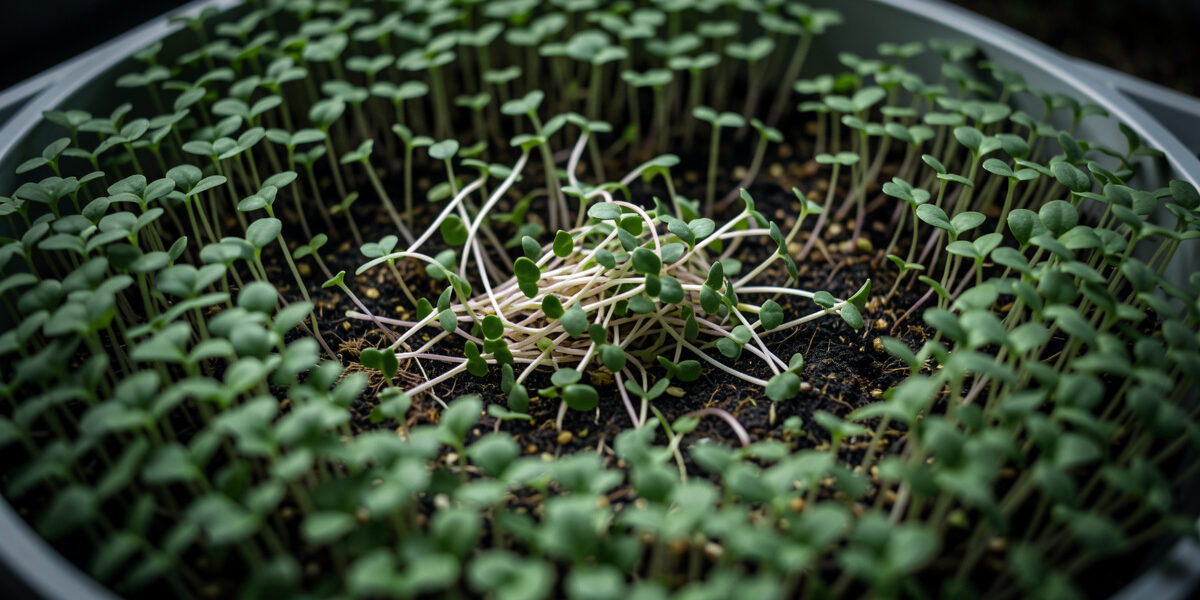
Damping off is a fungal disease that attacks microgreen seedlings at the soil line, pinching the stem until the plant topples over with a thin, water-soaked, threadlike base. Unlike surface mold, it kills, it spreads across a tray in an expanding patch, and once you see it the right call is almost always to bin that tray and sterilise everything it touched. It’s the one microgreen problem I treat as an emergency.
The reason damping off deserves its own guide, separate from mold, is that people confuse the two and make exactly the wrong call — either binning a harmless fuzzy tray or, far worse, trying to nurse a damping-off tray back and letting the infection spread to the rest of the shelf. I’ve lost a full sowing of basil to it, and the mistake was textbook: too warm, too wet, no air movement, sown thick. Once I understood the conditions it needs, it essentially disappeared from my shelf. This is the destructive end of the microgreens troubleshooting guide, and the one place I tell people to stop trying to save the tray.
What Is Damping Off in Microgreens?
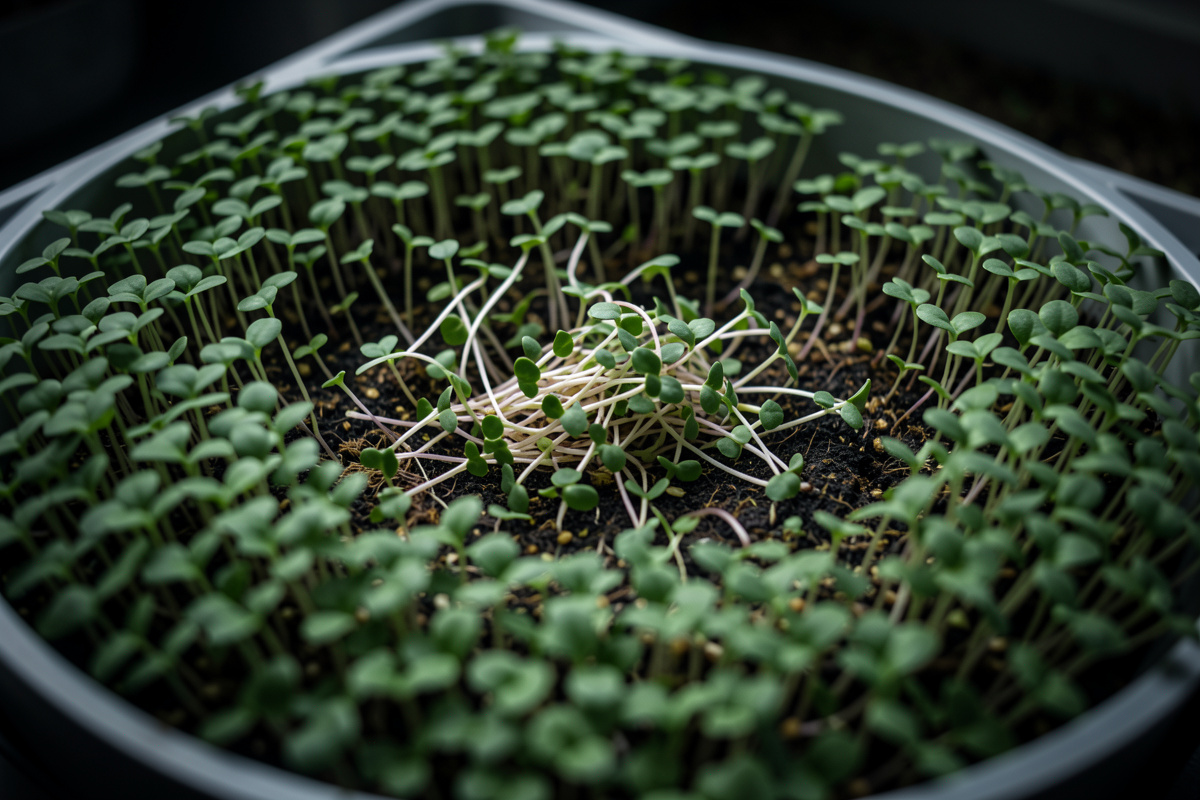
Damping off is a disease caused by soil-borne fungi and fungus-like organisms — commonly Pythium, Rhizoctonia, and Fusarium — that rot seedlings at or just below the soil line. In microgreens it shows up as seedlings that were standing fine suddenly collapsing, with a pinched, brown or translucent, water-soaked stem at the base. The pathogens thrive in the warm, wet, stagnant conditions a crowded tray creates.
These organisms live in the environment and in contaminated medium and trays, waiting for conditions to favor them. When a tray runs warm, saturated, and airless, they activate and attack the tender stem tissue at its weakest point — the soil line. The plant can’t move water past the damaged, pinched stem, so it wilts and falls, often within hours. Because the fungi spread through the wet medium, they take out neighbors next, which is why damping off appears as a patch that grows rather than random scattered losses.
It’s most dangerous at the seedling stage, which is the entire life of a microgreen crop — you never grow past the vulnerable window the way a potted plant does. That’s why microgreens, grown dense and moist and often covered, are a classic setting for it. Certain crops are notably prone: basil is the one that burned me, and it’s known to be susceptible. Understanding it as a conditions-driven disease rather than bad luck is the key to preventing it.
How Do You Tell Damping Off From Mold?
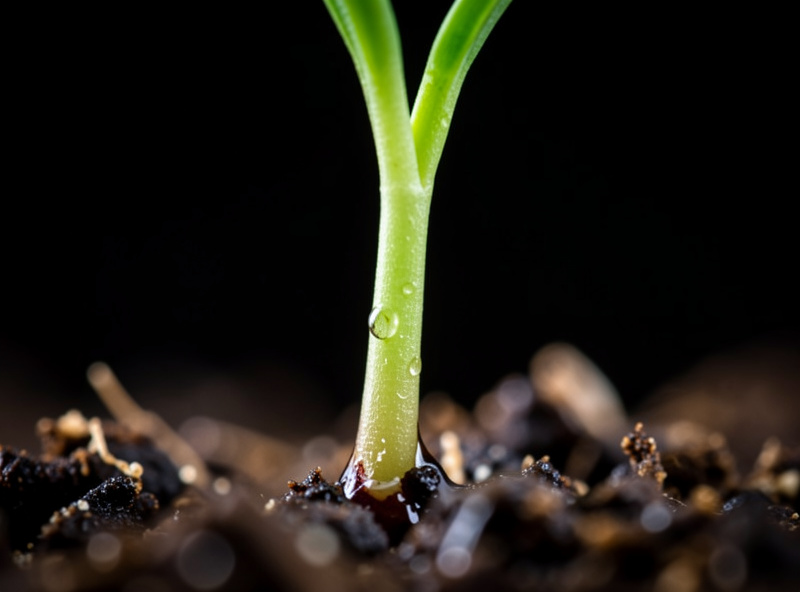
The difference is where it lives and whether it kills. Mold sits on the soil surface and on dead hulls as fuzzy, patchy growth, and the plants usually keep growing. Damping off attacks the stem itself at the soil line, pinching it thin and water-soaked so the seedling topples — the plants die. If your seedlings are collapsing with a pinched base, it’s damping off; if there’s just fuzz on the surface, it’s mold.
This distinction is worth getting right because the two demand opposite responses. Surface mold is common, usually harmless to the crop, and often fixable with airflow and bottom-watering — you frequently save the tray. Damping off is a killer that spreads, and the tray is a write-off. Confusing them either wastes a good crop or, worse, lets an infection run.
Here’s the checklist I run when a tray looks wrong:
- Are the plants dying or just fuzzy? Collapsing, toppling seedlings = damping off. Standing plants with surface fuzz = mold.
- Look at the stem base. Pinched, thin, brown or translucent, water-soaked at the soil line = damping off. No stem damage = not damping off.
- Is it spreading in a patch? An expanding circle of collapse = damping off. Scattered surface fuzz = mold.
- The mist test. Fuzz that collapses and vanishes when misted is harmless root hairs, not disease at all.
One more overlap to rule out: floppy seedlings can also just be leggy from weak light, but leggy stems stay intact and simply lean, while damping off pinches the stem through and the plant genuinely dies. Intact-but-leaning is a light problem; pinched-and-collapsed is disease.
Can You Save a Tray With Damping Off?
Almost never — and you shouldn’t try. Once damping off is established, the affected seedlings are dead and the pathogens are in the medium ready to spread to any survivors and, via spores, to your other trays. The correct move is to remove that tray from your growing area, compost or bin the medium, and sanitise the tray and anything nearby before it contaminates the rest of the shelf.
I know the instinct is to rescue — you grew it, it’s most of the way there, surely you can dry it out and save the good half. In my experience that just spreads the problem. The disease moves through the wet medium faster than you can outpace it, and every day you keep an infected tray on the shelf is a day it’s shedding spores near your healthy crops. The math is simple: microgreen seed is cheap, a clean restart takes ten days, and a shelf-wide infection can cost you weeks. Cut your losses fast.
Do not reach for a fungicide, either. This is food you’ll eat in a week, I keep everything on the shelf food-safe, and no chemistry undoes seedlings that are already dead at the stem. The only chemistry that matters here is prevention and sanitation — clean medium, clean trays, and conditions the fungi can’t exploit. Whatever’s left of the failed tray goes to my worm bin, well away from the growing shelf, and the tray goes straight to a hot wash.
How Do You Prevent Damping Off in Microgreens?
Prevent damping off by denying the fungi the warm-wet-stagnant conditions they need: use clean medium and sanitised trays, water with restraint from the bottom, run real airflow with a fan, and don’t sow so thick the canopy never dries. Prevention is the entire game — there’s no cure once it starts, so every control you put in place at sowing is what keeps it away.
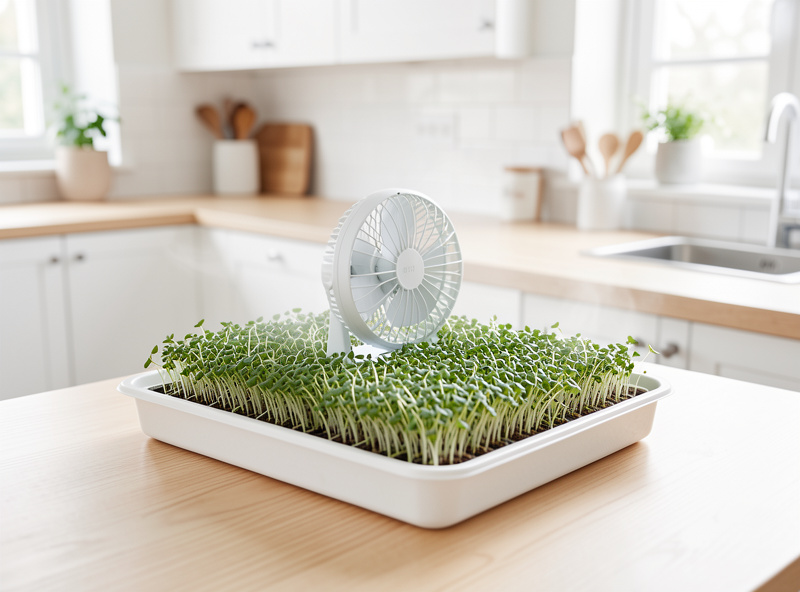
Airflow. A small fan on the shelf is the single best preventive. Moving air dries the seedling stems and the surface, breaking up the stagnant humid layer the fungi need. The same fan that fights mold and thickens leggy stems is your first line against damping off. I didn’t run one when I lost that basil tray; I haven’t had damping off since I added one.
Water discipline. Saturated medium is the fungi’s ideal habitat. Water from the bottom, let the medium wick what it needs, and drain the rest so the crop is never sitting in water. Keep the surface and stems on the drier side of healthy — the same restraint I describe for the signs of overwatering applies exactly. Take humidity domes off promptly once germination is underway; a domed, warm, wet tray is a damping-off incubator.
Clean inputs and sensible density. Fresh, clean medium — my best soil for microgreens notes favor mixes that drain well rather than staying swampy — plus sanitised trays remove the pathogen reservoir. And don’t sow wall-to-wall: a jammed canopy never dries and gives the disease its microclimate. Even, moderate seeding, the kind that also gives even germination, keeps air moving through the stand.
Warmth without stagnation. The fungi like warm and wet together. You still want room-warm for good germination, but pair the warmth with airflow and restrained watering so warmth alone doesn’t tip into their favor. Warm-and-dry-ish is fine; warm-and-swampy-and-still is the danger zone.
Do those consistently and damping off becomes a non-event. The through-line with everything else on the troubleshooting list is the same: airflow, water discipline, clean trays, sensible density. Master those four and you’ve solved not just damping off but most of the mold, yellowing, and legginess that plague home trays. For a solid non-commercial reference on seedling diseases, university extension services publish good material — the University of Minnesota Extension microgreens growing guide covers medium and moisture, and Johnny’s Selected Seeds keeps crop-by-crop notes in its guide to growing microgreens.
What does damping off look like in microgreens?
Seedlings that were standing fine suddenly topple over, with a thin, pinched, water-soaked stem right at the soil line. It usually appears as an expanding patch of collapse rather than scattered losses, because the fungi spread through the wet medium to neighboring plants.
How is damping off different from mold on microgreens?
Mold is fuzzy growth on the soil surface and hulls, and the plants usually keep growing. Damping off attacks the stem at the soil line, pinching it so the seedling collapses and dies. Dying, toppling plants mean damping off; surface fuzz on standing plants means mold.
Can you save microgreens with damping off?
Almost never. The affected seedlings are already dead and the pathogens are in the medium ready to spread. Remove the tray from your growing area, compost the medium, and sanitize the tray and surroundings before it infects your other trays. A clean restart is faster than a rescue.
What causes damping off in microgreens?
Soil-borne fungi like Pythium, Rhizoctonia, and Fusarium that thrive in warm, wet, stagnant conditions. Saturated medium, no airflow, dense sowing, contaminated trays, and leaving humidity domes on too long all create the environment these pathogens need to attack seedlings.
How do I prevent damping off in microgreens?
Deny the fungi warm, wet, stagnant conditions. Use clean medium and sanitized trays, water from the bottom with restraint, run a small fan for airflow, remove humidity domes after germination, and avoid sowing so densely that the canopy never dries. There is no cure, so prevention is everything.