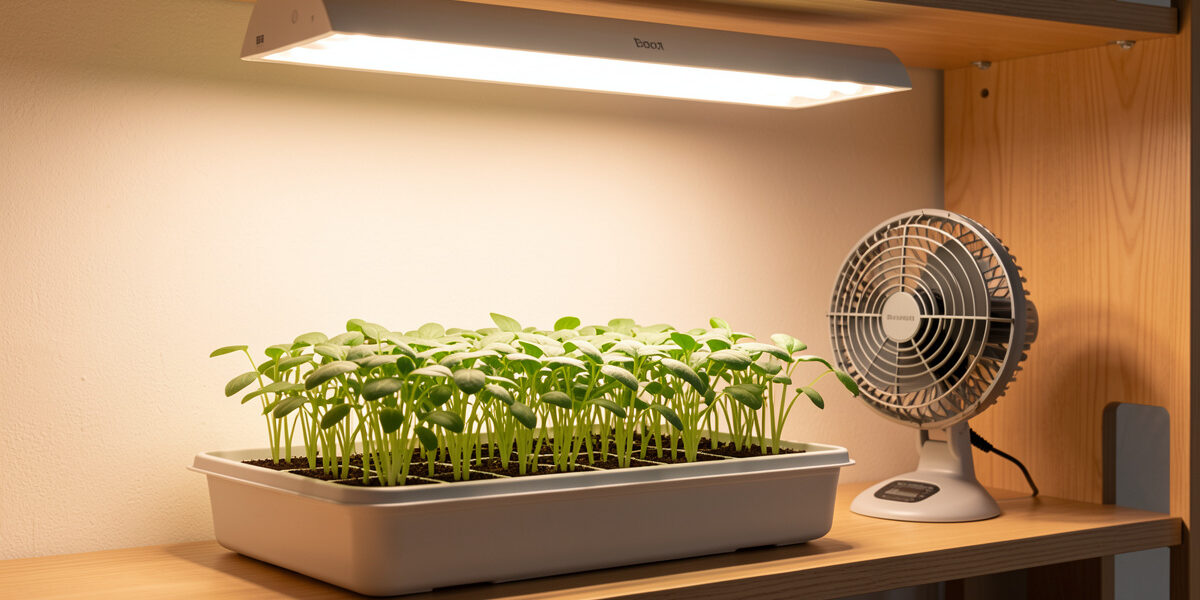
Damping off is a soil-borne fungal disease — usually Pythium or Rhizoctonia — that pinches a seedling’s stem right at the soil line and topples it overnight. By the time you see the slump, the stem is already rotted through, which is why prevention is the only reliable cure: an infected seedling almost never recovers, and the best you can do is keep the rest of the tray from going the same way.
This is the failure that ends seed-starting runs in a single morning. You check the shelf, and a cell that had a sturdy little tomato yesterday is now lying flat, its stem constricted to a wet thread where it meets the mix. The instinct is to water it and prop it up. Both moves make it worse. What follows is the diagnosis and the prevention routine I run on my own shelf — the one I arrived at after killing a flat of tomatoes to this exact thing — because damping off is almost entirely a problem of environment, and the environment is something you control.
What Does Damping Off Look Like?
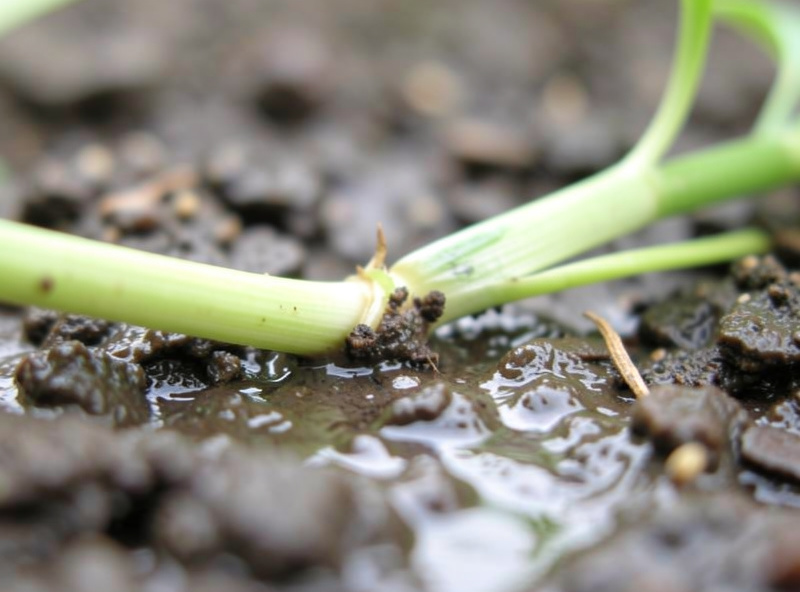
Damping off has two faces, and recognising either one early is the whole game. In post-emergence damping off — the kind you see after seedlings are up — the seedling topples at the soil line, and the stem at ground level is pinched, water-soaked, and visibly thinner than the stem above it. Pick the seedling up and the top comes free while a bit of rotted base stays in the mix. In pre-emergence damping off, the seed rots in the soil before it ever breaks the surface, and you just see a gap where a seedling should be. Both are the same fungi working at different stages.
The signature is the constriction at the soil line. The stem has a damp, threadlike pinch you can feel between thumb and finger — healthy tissue meets a soft, water-soaked neck that gives way under the lightest pressure. Sometimes you will also see fine white fungal threads across the wet surface of the mix, though that white fuzz can also be harmless saprophytic mold; the difference matters and is worth learning. A seedling that simply dried out wilts from the top down and the stem stays firm; a damped-off seedling is wet at the base and the top falls over first. The University of Minnesota Extension’s seedling-disease guidance describes the same pinched-stem collapse as the diagnostic sign, and it is the one I look for every morning.
What Causes Damping Off in Seedlings?
Three conditions, always together: wet media, cool temperatures, and still air, in trays that were not clean. Pythium and Rhizoctonia are the fungi most often responsible, and they are everywhere — in unwashed reused trays, in garden soil brought indoors, in old bagged mix that got damp in storage, even in dust. They are not a sign that you did something uniquely wrong; they are the default decomposers of wet, organic matter, and a seedling with a soft stem sitting in saturated mix is exactly the food they are built for.
A seedling is vulnerable because its stem is soft and its roots are shallow. The stem at the soil line is the junction between the wet surface layer and the air above, and it stays damp longest. Add a humidity dome clamped down tight over saturated media and you have built the perfect chamber for the fungus. Cool temperatures slow the seedling’s growth, so it sits in that vulnerable soft-stem stage for longer, while the fungus is perfectly happy in the cold. This is why damping off hits hardest in early-sown trays in a Nordic spring, when the windowsill is cold, the light is weak, and the dome is still on.
How Do I Prevent Damping Off Before Sowing?
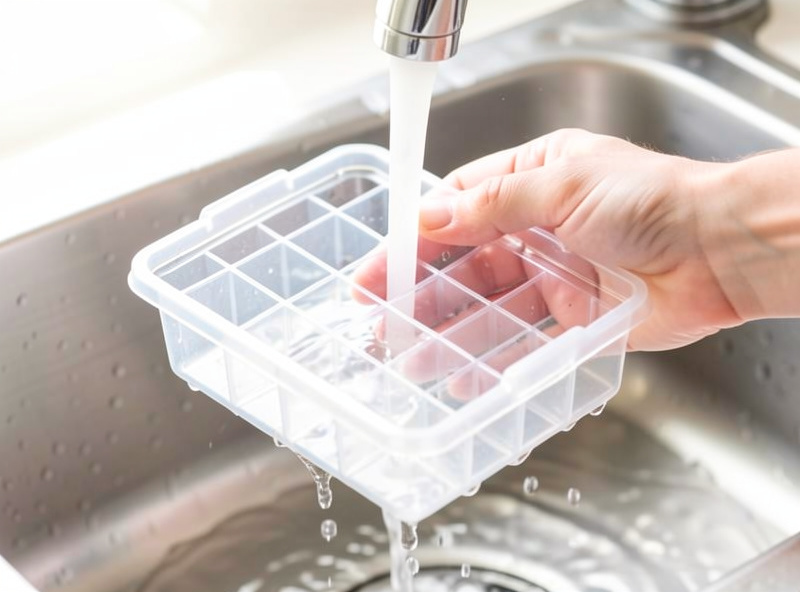
Prevention starts before the seed goes in, with clean media and clean trays. I use a fresh, sterile, fine seed-starting mix — my own blend of coir, perlite, and a little worm casting — never garden soil and never old bagged mix that has gone damp. I sterilise my Bootstrap Farmer 1020 trays and cells between uses, because a tray that held a damped-off crop last season carries the spores into this one. A scrub in hot soapy water, a rinse, and a soak in a weak bleach solution or a hot run is cheap insurance against re-introducing the fungus you already fought.
Drainage is the second pillar. A tray that holds water around the cells is a tray that grows fungus, so every cell needs a real drainage hole and the tray needs to sit on a mesh or slatted surface that lets excess water escape. I bottom-water for fifteen or twenty minutes and then tip out what the mix has not taken, so the cells never stand in puddles. The surface of the mix should dry between waterings — a wet surface at the soil line is the single biggest risk factor, because that is exactly where the stem gets pinched. The full kit I trust is on the seed-starting equipment list, and the ready-made kit decisions cover the store-bought options.
Sowing density matters too. Seedlings crammed shoulder to shoulder hold moisture and a layer of dead-still air between them, and that damp microclimate right at the soil line is exactly where the fungus gets its first hold. I sow two or three seeds per cell and thin to one once the first true leaves appear, rather than a thick carpet of seedlings that never dries at the base. A sparse, airy tray is a hostile environment for Pythium in a way a crowded one never is.
Why Does Airflow Matter So Much?
Still, humid air over wet media is the condition damping-off fungi need to thrive, and a small fan fixed to the shelf breaks that condition more reliably than anything else I own. Moving air does three things at once: it dries the surface layer of the mix where the stem is pinched, it keeps the boundary layer of humid air off the seedling’s stem, and it strengthens the stem itself by making the seedling sway. I run a clip-on USB fan on its lowest setting, pointed across the top of the tray rather than straight at the seedlings — enough to gently move the leaves, not enough to dry the mix out. The fan runs whenever the lights are on.
I came to the fan the hard way. Last spring I bottom-watered a flat of tomato cells that had no drainage, left the humidity dome clamped down, and went to bed; by morning half the flat had toppled, the stems soft and pinched at the soil line. The mix was saturated, the air under the dome was still and wet, and the fungus had the perfect eight hours to work. A fan and a drained tray would have saved every one of them. Penn State Extension’s seed-starting advice puts good air circulation right alongside sterile media at the top of its prevention list, and that matches what my shelf tells me. If you are setting up a shelf, a small clip-on fan for the grow shelf is the single purchase I would make first.
As an Amazon Associate I earn from qualifying purchases.
Should I Use a Fungicide, Cinnamon, or Chamomile?
Honestly, the home remedies get more credit than they earn. Cinnamon does have mild antifungal properties, and chamomile tea has a reputation as a gentle antifungal drench, but neither is reliable enough to rescue a tray that is already damping off, and neither is a substitute for the environmental fixes. I have sprinkled cinnamon on a suspect surface and felt virtuous about it; the tray damped off anyway, because the mix was still saturated and the air was still still. Use them as a backup if you like, not as the plan.
A real fungicide drench can work on trays that keep failing despite good culture, but for a home seed-starting shelf the cost, the handling, and the fact that resistance builds mean I do not reach for one. The honest answer is that damping off is prevented, not treated. Get the media sterile, the trays drained, the surface dry, and the air moving, and you will prevent more damping off than any drench ever cures. The remedies are the last one percent, not the first ninety-nine.
Can You Save a Seedling Once It Pinches?
Almost never. Once the stem is constricted and water-soaked at the soil line, the tissue that carries water up the plant is gone, and the seedling will not regrow it. The top may stay green for a day, propped on a rotted base, but it is already dead in functional terms. The move is to pull the affected seedling immediately — do not leave it as a source of spores — and protect the rest of the tray by drying the surface, lifting any dome, and getting the fan running harder. Then start that cell over in fresh, clean media if there is time in the season.
The one judgement call is how many have gone. A single toppled seedling in an otherwise healthy, dry, airy tray is contained — pull it, watch the rest. Three or four toppling across a wet tray means the environment is wrong for the whole flat, and you are better off restarting the lot in clean conditions than nursing the survivors through a losing battle. I would rather lose a week restarting a flat than spend three weeks watching it collapse two cells at a time.
What I’d Do Starting Today
If a seedling toppled this morning, pull it now, before the fungus spreads through the wet media to its neighbours. Then fix the environment: tip out any standing water, let the surface of the mix dry until it is barely damp to the touch, lift the humidity dome off for good, and point a fan across the tray. Those four moves, done today, save more of the remaining seedlings than anything you can buy.
For the next flat, build the prevention in from the start — sterile mix, clean and drained trays, bottom-watering with the runoff tipped out, a dome that comes off the moment the first seedlings emerge, and a fan running whenever the lights are on. Damping off stops being a recurring crisis the day those six things become routine, and the rest of the seedling-failure picture — the leggy stretch, the stalled growth, the yellowing — is covered from the main seedling-diagnosis hub. If you grow microgreens rather than tray seedlings, the same fungi behave a little differently; understanding when a dome helps and when it hurts is the crossover skill that ties it together.
Related Articles
- Why Are My Seedlings Dying? A Diagnostic Guide
- Choosing Seed-Starting Trays: Drainage, Cell Size, Reuse
- Humidity Domes for Seed Starting: When to Use One
- Best Seed-Starting Kits: Buy a Bundle or Build Your Own?
- Seed-Starting Equipment List: What You Actually Need
Can damping off spread to other seedlings?
Yes. The fungi move through wet media and splash on water, so remove the affected seedling immediately and dry the tray out to protect the rest.
Does cinnamon stop damping off?
Cinnamon has mild antifungal properties but is unreliable as a standalone cure. Use it as a backup to dry media and airflow, not a replacement for them.
Is damping off the same as root rot?
Related but different. Damping off attacks the stem at the soil line in young seedlings; root rot attacks older roots below ground. Both come from soggy, oxygen-poor media.
Can I reuse soil after damping off?
Not for seed starting. The media is contaminated with spores, so compost it or sterilize it and start fresh in clean, sterilized trays.
Does a humidity dome cause damping off?
It can, if left on too long. Domes are for germination only; remove them once seedlings emerge and get air moving across the tray.