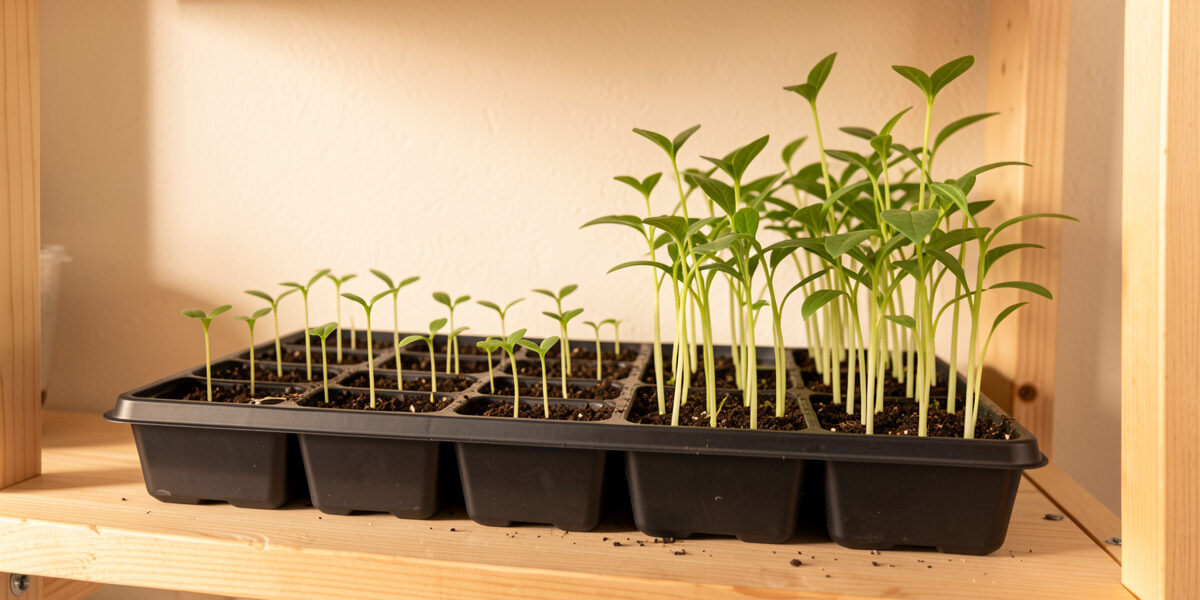
Seedlings that sprout fine then stall are usually sitting in the wrong temperature, the wrong-size cell, or a medium that has gone compacted and oxygen-starved. Growth pauses because the roots cannot expand, not because the plant is finished, and the fix is almost always a bigger container and a warmer, better-lit spot. A stalled seedling is rarely a sick seedling — it is a seedling whose roots have run out of somewhere to go.
This is the quiet failure, the one without the drama of damping off or the obvious color of purple leaves. The seedling simply sits there, alive, green, and exactly the size it was a week ago, while the seedlings next to it pull ahead. People read it as disease and reach for fertilizer, when what the plant is asking for is root room and warmth. I have stalled more seedlings than I care to count by leaving them in cells that were too small for too long, and the pattern is always the same: the top stops growing because the bottom has nowhere to grow into. What follows is how I read a stalled seedling, the three things I check first, and the move that usually restarts growth within a week.
Why Do Seedlings Stop Growing After Germination?
A seedling stops growing when one of its limiting factors runs out, and for indoor seedlings the usual suspects are root space, root temperature, light, and oxygen in the root zone. The seedling germinated on the energy packed into its seed, and for the first couple of weeks it draws on that reserve while building its first true leaves and a working root system. Once the reserve is spent, the plant has to earn every bit of new growth from its leaves and roots — and if the roots have hit a wall, or the root zone is too cold to take up nutrients, or the light is too dim to drive photosynthesis, growth simply stops. The plant is not dying; it is parked, waiting for a limiting factor to ease.
The reason this reads as mysterious is that the seedling looks fine. The leaves are green, the stem is firm, there is no mold and no obvious disease — it is just not getting bigger. That is actually the diagnostic: a stalled seedling in good color with firm tissue is almost never diseased. Disease looks like collapse, yellowing, or lesions; stalling in an otherwise healthy-looking plant points at the environment, specifically the root environment. So before you assume something is wrong with the plant, lift it out of its cell and look at the roots, because that is where the answer almost always is.
Root restriction works the way a too-small pot works on any plant: once the roots fill the available volume, the plant stops extending its top growth in proportion. Penn State Extension’s container-grown plant guidance treats root restriction as one of the first things to check when a container plant stalls, and a seedling in a cell is just an extreme case of the same principle — a very small container, reached very quickly. The other hidden factor is oxygen in the root zone. Roots need air as much as water, and a fine seed-starting mix that has compacted down, or a cell that stays saturated, squeezes the air out and the roots suffocate even when there is physical room. A stalled seedling in a compacted, wet mix can be stalled by lack of oxygen as much as by lack of space, which is why loosening the media and letting it dry between waterings is part of the fix, not just giving it a bigger pot.
Is My Seedling Root-Bound Already?
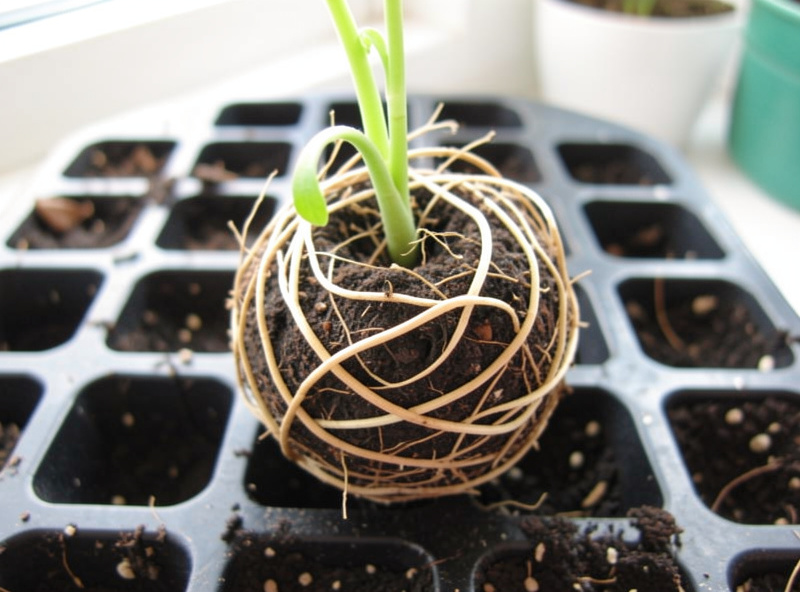
A seedling can be root-bound far faster than people expect, because the roots grow before the top does. In a small cell — the one-inch cells common in starter trays — a vigorous seedling can fill the root ball in two to three weeks, at which point the roots hit the cell walls and start circling, with nowhere left to go. Once the roots are circling, the top stops putting on new growth, because the plant cannot support more leaf area than its root system can feed. The seedling sits at the same size, green and firm, and the cause is hidden in the cell.
The test is to lift the root ball. Pop the seedling out of its cell and look at the outside of the root ball: if you see roots circling the perimeter, poking out the drainage hole, or forming a dense mat on the outside, the seedling is root-bound and that is your stall. The root ball slides out as a tight, pale brick, roots wound around the outside like thread on a spool, with no fresh white root tips pushing into new media. A seedling in this state is not going to grow until it is given more root room, and the longer it sits root-bound, the harder it is to restart — badly circling roots can stay circling even after potting on, girdling the plant. The cell-size and drainage choices I make are aimed squarely at buying enough root room before this happens.
How Does Cell Size Stall a Seedling?
Cell size is the most underrated lever in seed starting, because it sets a hard ceiling on how big a seedling can get before it stalls. A one-inch cell grows a seedling to a certain size and then stops it, because the root ball fills the cell and the top cannot outgrow the bottom. A two-inch cell buys you weeks more growth before the same thing happens. The mistake I made for years was starting everything in the smallest cells to save shelf space, then being surprised when the seedlings parked at three weeks — they had simply filled their cells and run out of root room, and no amount of fertilizer or light was going to fix a root-bound plant in a one-inch cell.
The fix is to match the cell size to how long the seedling will live in it. Quick crops that go out fast — lettuce, brassicas for transplanting in a few weeks — are fine in small cells. Slow crops that live indoors for two months — peppers, tomatoes, eggplants — need a bigger cell from the start, or a plan to pot them on at least once before they go out. I start my tomatoes in small cells for germination and move them up to a larger pot within three weeks, before the roots ever circle. The principle is simple: a seedling stalls when its roots fill its container, so either start it in a container big enough for its whole indoor life, or plan to move it up before the roots run out of room.
The practical version of this on my shelf is a two-stage system: I germinate everything in small cells, because they are easy to keep evenly moist and they warm quickly on the mat, and then I move the slow crops up to a larger pot at the first sign of roots reaching the cell wall. That first move is the one that matters most. A tomato moved up at three weeks recovers in days and grows on strongly; the same tomato left until five weeks, with a dense circling root ball, spends its recovery fighting its own roots and sometimes never quite catches up. The discipline is checking the roots early and moving up early, before the stall ever sets in — because once a seedling has parked, you are restarting it, and that is always slower than never letting it stop.
Can Cold Soil Pause Seedling Growth?
Yes, and it is the second most common cause of stalling after root-binding, especially up here. A root zone that sits below the range the plant wants — below about 15 degrees for most vegetables — slows root growth to a crawl, which slows top growth to a crawl, because the plant cannot take up water and nutrients faster than the roots can absorb them. The seedling parks, not because it is root-bound but because its roots are too cold to work. This pairs with the purple leaves I described in the cold-root phosphorus lockout guide: cold roots both stall growth and flush leaves purple, and the fix for both is the same warmth.
A heat mat under the trays, held to a setpoint by a thermostat, keeps the root zone in the 18 to 24 degree band where roots actually grow, and stalled cold seedlings resume growth within days of being warmed. The detail on the temperatures I set by crop covers the numbers; the principle is that root temperature, not air temperature, governs how fast a seedling grows. A room that feels warm to you can still leave roots cold if the tray sits on a chilly sill, which is why I lift trays off cold surfaces and run a mat under anything that is not growing. Light matters too — a seedling under a dim light has no reason to grow even if its roots are fine — and the question of whether the light is enough is worth asking of any stalled tray.
The link between root temperature and growth rate is well established, and it is steeper than people assume. The Royal Horticultural Society’s propagation and growing advice treats bottom heat as a basic tool for keeping young plants growing, because root activity drives top growth. Below their preferred range, roots absorb water and nutrients slowly, the plant’s metabolism slows, and the seedling parks. The effect is most visible on heat-loving crops — a pepper seedling in a cold root zone simply will not grow, while a lettuce seedling in the same conditions trundles on — which is why I am quicker to put peppers and tomatoes on a heat mat than the hardy greens. If a stalled seedling is a heat-lover sitting in a cool room, the root zone is the first place I look.
When Does Stalling Mean It’s Time to Pot On?
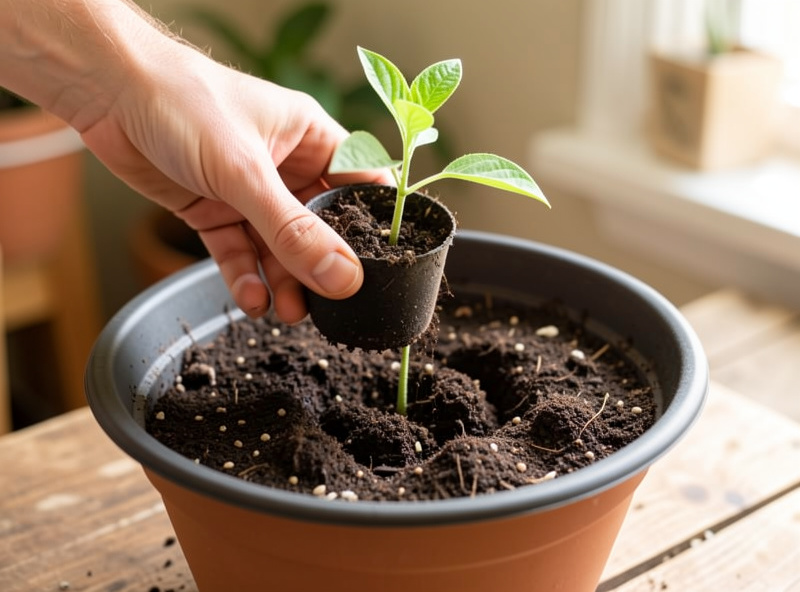
Stalling is the signal to pot on, more often than not. If a seedling is healthy in color and firm in tissue but has stopped growing, and the roots are circling the cell, the next size up is the fix — not fertilizer, not a heat mat, not more light, though warmth and light help the recovery. Potting on means moving the seedling into a larger container with fresh mix around the root ball, giving the roots a new volume of media to grow into. The fresh mix also brings fresh air and a gentle nutrient charge, and the act of moving up often restarts growth within a week. I move seedlings up a cell size the moment I see roots circling, not when they are dense and desperate, because early potting on recovers cleanly and late potting on sometimes does not.
When you pot on, tease out the bottom of the root ball gently if it is a tight mat, to encourage the roots to grow out into the new media rather than continuing to circle. Set the seedling slightly deeper than it was, firm the fresh mix around it, and water it in. A seedling that was stalled by root-binding will visibly restart within a few days of the move — new leaves, a flush of fresh white root tips at the edge of the new mix, the plant clearly growing again. If it does not restart after potting on, then the cause was not root-binding, and you look to temperature and light next. The full kit for the shelf — cells, mat, light, mix — is on the seed-starting equipment list.
What I’d Do Starting Today
If a seedling has stalled, the first thing I do is lift it out of its cell and look at the roots. If they are circling, pot it on today into a larger container with fresh mix — that alone restarts most stalled seedlings within a week. If the roots are not root-bound, check the root-zone temperature with a probe; if it is below about 15 degrees, put the tray on a heat mat. If the roots are fine and the root zone is warm, ask whether the light is close and bright enough, because a dim light parks a seedling as surely as a cold root. Work through root space, then temperature, then light, in that order.
The habit that prevents stalling is potting on early and often — moving seedlings up a cell size before the roots ever circle, rather than after. Match the cell size to how long the crop lives indoors, keep the root zone warm, and keep the light close, and stalling stops being a recurring surprise. The rest of the seedling-failure picture — the damping off that follows wet, crowded trays, the leggy stretch from low light, the white mold that warns of the same wet conditions — is laid out from the main seedling-diagnosis hub.