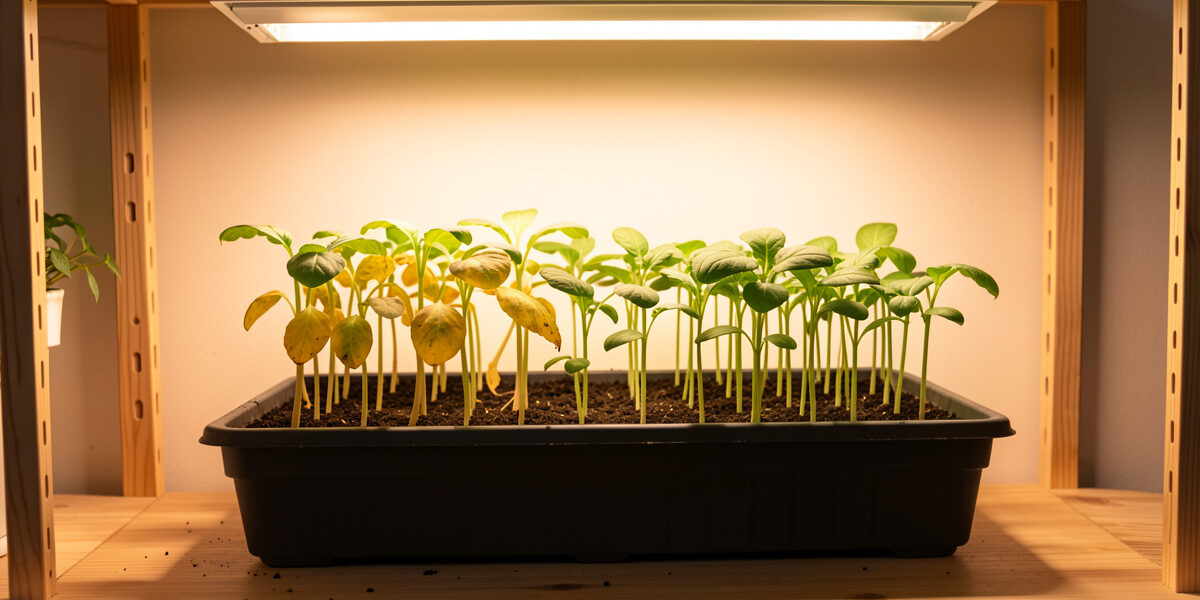
Yellow seedling leaves mean one of three things: the seedling has spent its stored nutrients, the root zone is too wet or too dry, or the light is wrong. Where the yellow starts tells you which — yellow on the oldest leaves means something different from yellow at the growing tip, and reading that location correctly is the whole diagnosis. Most yellowing is fixable, and almost none of it is a disease.
This is the symptom that sends people to the fertilizer bottle first, and that is often the wrong move. A seedling’s first leaves are designed to yellow and drop once the plant is up and feeding itself, so a bit of yellowing at the base is sometimes the plant working exactly as intended. The skill is telling that normal transition apart from the yellowing that signals a real problem — a drowning root zone, a dim light, a genuine nutrient shortfall — and the location of the color is the code that breaks the tie. What follows is how I read yellow on my own shelf, the three causes behind it, and the order in which I act before I ever reach for feed.
Why Are My Seedling Leaves Turning Yellow?
Leaves turn yellow — chlorosis, in the textbooks — when they stop producing enough chlorophyll, and in a seedling that happens for three main reasons. The plant has run out of the nutrients it packed into the seed and needs to start feeding itself. The roots are in trouble, usually from too much or too little water, and cannot take up what the leaves need. Or the light is wrong, either too dim for the leaf to justify its chlorophyll or so strong it bleaches the pigment out. The pattern of the yellow maps onto the cause, which is why the table below is the first thing I consult.
The University of Minnesota Extension’s nutrient-disorder guidance makes the same point that growers use in practice: the position of the chlorosis on the plant is the single most useful clue, because nutrients move within the plant in predictable ways. Mobile nutrients like nitrogen are pulled out of the oldest leaves and sent to the growing tip when the plant is short, so a nitrogen shortfall yellows the oldest leaves first. Immobile nutrients like iron stay put, so a shortage shows up on the newest growth. Read the location, and you have read the cause.
| Where the yellow is | Likely cause | Check first | First thing to do |
|---|---|---|---|
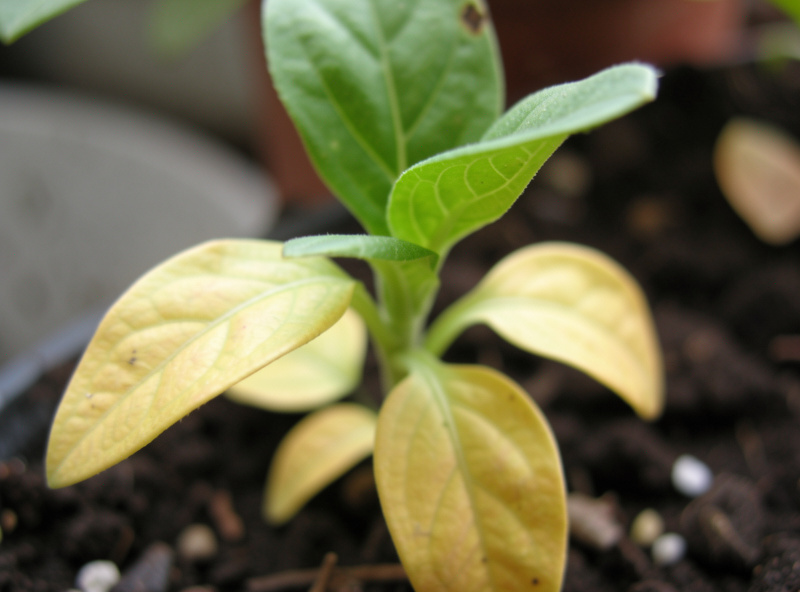
| Lowest leaves (cotyledons) yellowing, top still green | Spent seed reserves, normal transition | Whether true leaves are present and growing | Feed weakly once true leaves are working |
| Whole plant pale yellow-green, slow growth | Low light, or a general nitrogen shortfall | Light distance and run-time | More light; weak feed only if light is already enough |
| Leaves yellow and limp or wilted together | Overwatering, roots suffocating | How wet the media is | Dry the media out; check drainage |
| Leaves yellow with dry, crispy edges | Underwatering or fertilizer salt burn | Media dryness and recent feeding | Water evenly; flush the media if over-fed |
| Yellow between the veins, veins stay green | A specific nutrient such as magnesium or iron | Media pH and feed history | Check pH; feed a balanced weak mix |
| New growth yellow at the growing tip | Iron or a micro-nutrient, often pH-linked | Media pH | Adjust pH toward neutral; feed weakly with micronutrients |
Is It Normal for Cotyledons to Yellow?
Yes, and recognising this saves more seedlings than any other distinction in this guide. The cotyledons — the first two seed leaves that emerged from the soil — are packed with stored energy to launch the seedling. Once the first true leaves are up and photosynthesising, the plant begins drawing down the cotyledons’ reserves, and they yellow, wither, and eventually drop off. That is the seedling transitioning from running on its seed to feeding itself, and it is a sign of healthy progress, not decline.
The trap is reading this natural fade as a deficiency and fertilizing too early. I did exactly that one season: the cotyledons on a flat of tiny tomatoes started to yellow, I assumed the plants were hungry, and I gave them a half-strength feed that burned the tips of the true leaves white within a day. The cotyledons were yellowing because they were supposed to; the seedlings did not need feeding yet, and the fertilizer I added sat in a small root zone and scorched the tissue. The rule I follow now is to wait until the true leaves are clearly working and the cotyledons are visibly fading before any feed, and even then to go weak — weaker than the bottle suggests, because a small root zone concentrates salts fast.
Does Yellow Mean My Seedling Needs Fertilizer?
Sometimes, but only sometimes, and only after the true leaves are working. A seedling carries enough nutrients in its seed to get through the first couple of weeks, so early yellowing is almost never a feed problem — it is a light or water problem. Once the cotyledons start to fade and the plant is relying on its roots and leaves, a very weak feed can help, particularly for seedlings that have been in the same cell for a while and have used up what the media offered. The key word is weak: a quarter to a half of the strength on the bottle is plenty for a seedling, and full strength will burn it.
The feed I reach for is a weak liquid feed — a dilute seaweed or balanced fertilizer cut well below the label rate — applied to moist media, never to dry roots, so it does not shock them. If you want a ready-made option, the liquid seaweed fertilizer search is the kind of gentle feed I use on seedlings. But before you feed, rule out the other causes: a seedling yellowing because its roots are drowning will not be fixed by fertilizer, and a seedling yellowing because the light is too dim needs light, not nutrients. Feed is the last lever, not the first.
As an Amazon Associate I earn from qualifying purchases.
Can Overwatering or Underwatering Cause Yellow Leaves?
Both can, and the look of the yellow tells them apart. Overwatering is the more common, and it yellows the oldest leaves while making the whole plant look limp and wilted even though the media is wet — the classic “wet and wilted” combination that means the roots are drowning. Saturated media pushes the oxygen out of the root zone, the roots suffocate and begin to rot, and the plant cannot take up water even though it is sitting in it, so the leaves yellow and go soft. The fix is to dry the media out, fix the drainage, and let the surface dry between waterings.
Underwatering shows up differently: the leaves yellow with dry, crispy edges that crumble between your fingers, and the media is dry and pulled away from the cell walls. The plant is sacrificing its oldest leaves to hold the growing tip alive on limited water. The fix is simply to water evenly and consistently, and to bottom-water so the whole root ball gets wet rather than just the surface. Either way, the watering routine matters more than the fertilizer, and the capillary matting I rely on for even moisture is the tool that keeps the root zone neither flooded nor bone-dry. A yellowing seedling in wet media is not hungry; it is drowning.
The definitive test is in the media, not the leaves. Push a finger a centimetre into the mix: if it is sodden and heavy and water squeezes out, the yellowing is from overwatering and the fix is to stop watering and improve drainage; if it is dry and dusty and the cell feels light when you lift it, the yellowing is from underwatering and the fix is a thorough, even watering. The leaves can look similar from a distance, but the root zone never lies, and a five-second finger test resolves the question that a guess at the leaves cannot. Once you know which it is, the fix is obvious — and neither fix involves fertilizer, which is why I check the media before I ever reach for a bottle.
How Does Light Affect Leaf Color?
Light drives leaf color in both directions, and getting it wrong yellows seedlings from opposite ends. Too little light and the plant produces less chlorophyll than it needs, so the whole seedling goes a pale, weak yellow-green as it stretches for brightness — this is the same low-light condition that causes the leggy stretch I describe separately, and the fix is the same: more light, closer, for more hours. A pale, stretched, yellow-green seedling is almost always light-starved, and feeding it will not help because the problem is energy, not nutrients.
Too much light yellowing is the opposite mistake and the easier one to miss. A light that is too close or too intense can bleach the top leaves — the ones nearest the lamp — to a pale yellow or almost white, as the intense light destroys chlorophyll faster than the plant can replace it. If the yellowing is concentrated on the uppermost leaves and the lower leaves are fine, the light is too close; raise it a few centimetres and the color recovers. The Royal Horticultural Society’s growing advice treats light as the first thing to check in a pale seedling, before nutrients, and my shelf agrees. The lighting choices I have measured and the timer setup I run are covered elsewhere if you are building the lighting side.
What I’d Do Starting Today
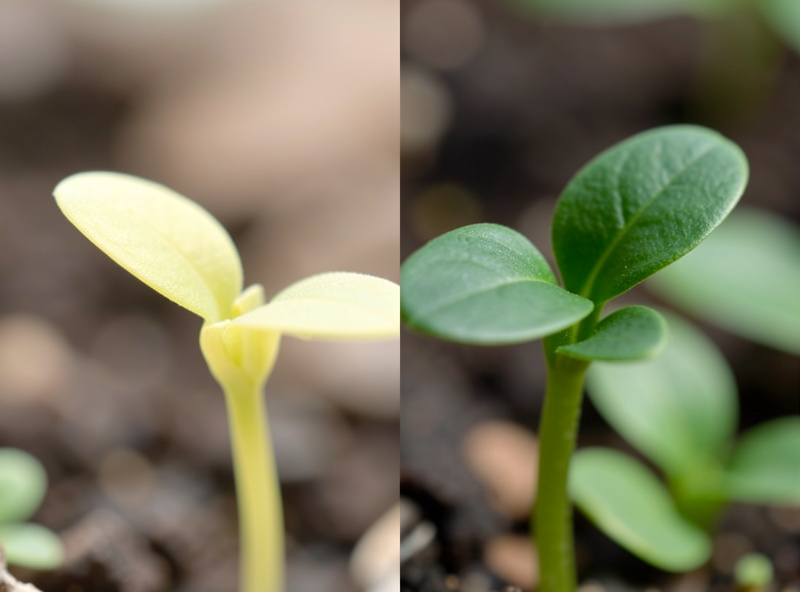
If a seedling is yellowing, read the location before you do anything else. Yellow on the lowest leaves while the top is green and growing is often the normal cotyledon fade — leave it alone, or give a very weak feed only once the true leaves are clearly working. A whole pale plant is usually low light; move the light closer and longer. Yellow and limp in wet media is overwatering; dry it out. Yellow with crispy edges is underwatering or salt burn; water evenly and flush if you over-fed. Yellow at the growing tip or between veins is a nutrient or pH issue; check pH before reaching for more fertilizer.
The discipline is to fix light and water first and feed last, because feeding a seedling that is yellow for any other reason makes it worse. Get the light right, the watering even, and the root zone healthy, and most yellowing resolves on its own — the cotyledons drop when they are meant to, and the true leaves stay green. The rest of the seedling-failure picture — the stalling that comes from root-bound cells, the purple leaves that mean cold roots, the damping off that follows wet media — is laid out from the main seedling-diagnosis hub, and if you grow microgreens the yellow shows up there too, covered in the microgreens yellowing guide. The full shelf kit is on the seed-starting equipment list.
Dig Deeper
- Why Are My Seedlings Dying? A Diagnostic Guide
- Seedlings That Stall and Stop Growing: The Usual Causes
- Leggy Seedlings: Why They Stretch and How to Fix
- Are Expensive Grow Lights Worth It? Cheap vs Premium, Measured Side by Side
- Capillary Matting: The Quiet Away-Watering Trick I Rely On
Why are my seedling leaves turning yellow?
Yellow leaves on seedlings usually mean spent seed reserves, a watering problem, or wrong light. Where the yellow starts (oldest leaves, whole plant, or growing tip) tells you which one it is.
Should I fertilize yellowing seedlings?
Only once the true leaves are working and the cotyledons are fading. Feed very weakly, weaker than the bottle says, because over-fertilizing burns seedlings far faster than under-feeding.
Can overwatering cause yellow seedling leaves?
Yes. Saturated media starves roots of oxygen, the oldest leaves yellow and go limp, and the plant looks both wet and wilted. Dry the media and fix the drainage.
Is it normal for the first seed leaves to turn yellow?
Yes. The cotyledons yellow and drop as the seedling shifts to feeding itself through its true leaves. It is a normal transition, not a disease, once true leaves are present.
Can too much light turn seedling leaves yellow?
Yes. A light too close or too intense can bleach the top leaves pale yellow to white. Raise the light a little if the yellowing is on the uppermost leaves closest to the lamp.
What does yellow between green veins mean?
Interveinal chlorosis usually points to a specific nutrient such as magnesium or iron, often tied to pH. Check the media pH before adding more fertilizer.