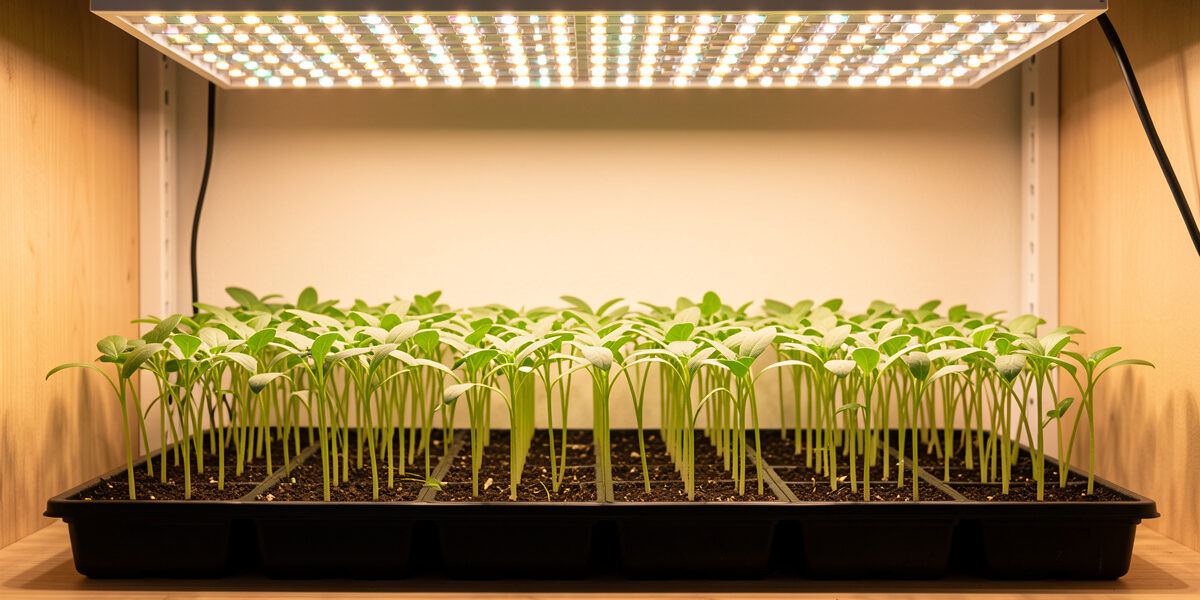
Leggy seedlings stretch because they are starved for light. The stem elongates reaching for a source that is too dim or too far away, and the cells grow long, pale, and weak instead of short, green, and sturdy. In a Nordic window in late winter, even a south-facing sill is too dark the day a seedling emerges, so stretching is the default outcome unless you add a lamp.
This is the most common seedling problem I see up here, and the one most people misread. A tall, thin, pale seedling looks sick, so the instinct is to feed it or repot it, when what it actually needs is photons. The seedling is not failing to grow; it is growing exactly as a plant grows in shade — putting every bit of energy into reaching the light rather than building a thick stem and true leaves. What follows is why that happens, how I measure and fix it on my own shelf, and the honest answer to whether a badly stretched seedling is worth saving.
Why Do Seedlings Get Leggy?
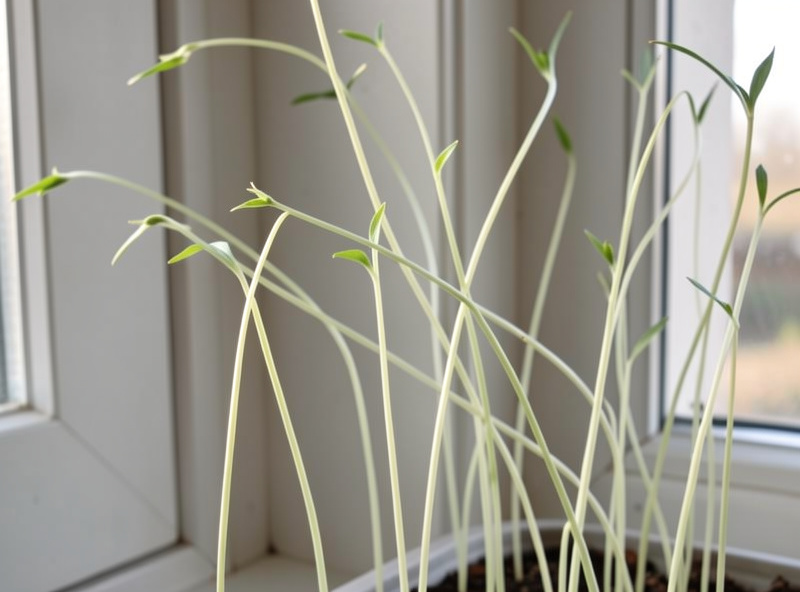
A seedling stretches when the light it receives is weaker than the energy it wants to spend growing. The hormone auxin accumulates on the shaded side of the stem and causes those cells to elongate, which bends the stem toward the light source — useful in nature, where a seedling shaded by a rock leans toward the gap. In a dim room the whole stem elongates, because every side is the shaded side, and you get a tall, pale, floppy plant with a long gap between leaves instead of a compact, sturdy one. The process is called etiolation, and it is the plant’s emergency response to darkness.
The reason it happens so fast is that a germinating seedling is programmed to reach light before its stored energy runs out. It is running a race against its own seed reserves, and in low light it gambles everything on height. Within days of emergence, a seedling under a dim window has doubled its stem length while barely growing leaves, and the stem is too thin to hold itself up. The Royal Horticultural Society’s seedling and growing advice describes the same pale, drawn-up growth as the signature of insufficient light, and it is the first thing I look for each morning.
Is a Windowsill Enough Light for Seedlings?
In a Nordic winter, no, and that is the hard truth that breaks most indoor seed-starting attempts up here. A south-facing window in summer throws enough light to grow sturdy seedlings; the same window in January gives roughly six hours of low-angle daylight — SMHI’s daylight figures put Stockholm around that mark in midwinter — that has already lost strength passing through double glazing. A seedling wants fourteen to sixteen hours of usable light at a useful intensity, and a winter sill delivers neither the duration nor the intensity. Put a tray of tomato seedlings on a January sill and they will stretch, every time, because the light is below the threshold where the plant can build strong cells.
I learned this by measuring. The light at my south sill in midwinter reads a fraction of what my grow bar delivers at the shelf, and the difference is not subtle — it is the difference between a compact, deep-green seedling and a pale thread. This is why I treat a grow light as the default, not the upgrade, for winter seed starting, and why the question of whether the expensive lights are worth it has a different answer when your alternative is a dark window. Measuring the actual light, rather than guessing, is the skill that fixed this for me; my notes on using a PAR meter versus a phone app cover how to do it cheaply. If you are growing microgreens rather than tray seedlings, the same low-light stretch shows up there too, and the microgreens leggy-stretch fix is the crossover page.
How Close Should a Grow Light Be to Seedlings?
Closer than you think, and that single adjustment fixes more leggy seedlings than any other. Light intensity falls off with the square of distance, so a lamp twice as far away delivers a quarter of the light to the leaf — which means a light that is fine at fifteen centimetres is starving the seedling at forty. I run my full-spectrum LED bar about twenty centimetres above the shelf, which puts roughly 250 micromoles per square metre per second at the seedlings’ top leaves, in the range young seedlings want. Move that same bar to fifty centimetres and the reading collapses, and the seedlings stretch within days.
The fix is to start the light low and watch the seedlings rather than the clock. If they are compact and deep green, the height is right; if they start to lean or stretch, lower the light an inch or two. I run mine for fourteen hours a day on a timer — the timer setup that cut my run-cost is written up separately — because consistent duration matters as much as intensity. The table below is the rough height and duration I use by fixture type, as a starting point to dial in by watching your own seedlings.
| Light type | Height above seedlings | Hours per day | Best for |
|---|---|---|---|
| Full-spectrum LED bar | About 15 to 25 cm | 14 to 16 | Even coverage over a shelf of trays |
| Quantum board or panel | About 30 to 45 cm | 14 to 16 | Larger footprint, higher output |
| Clip-on gooseneck LED | About 15 to 20 cm | 14 to 16 | A single tray in a tight space |
| Blurple panel | About 30 to 40 cm | 14 to 16 | Cheap but harsh spectrum; verify the PPFD |
| South-facing windowsill | Fixed at the glass | Daylight only | Summer only; too dim in a Nordic winter |
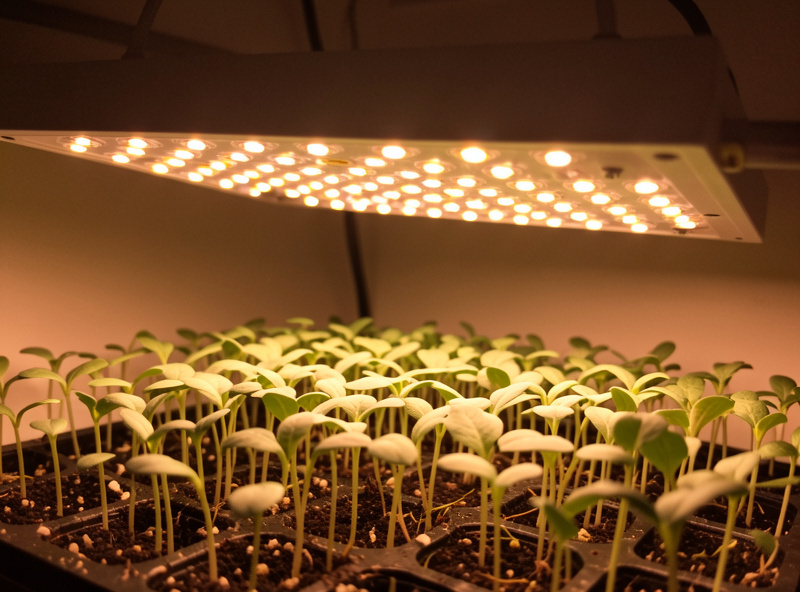
The reason distance matters so much is the inverse-square law: double the distance and you get a quarter of the light at the leaf, not half. This is why a light that seems bright to your eye can still be starving a seedling — the human eye adjusts to the brightness, but the plant is stuck with the photons that actually arrive at its leaves. I check the shelf each morning with a glance at the canopy: compact, deep-green seedlings with short gaps between leaves mean the height is right, and any seedling leaning or reaching is a signal to drop the light a notch. A cheap PAR meter or even a reasonably calibrated phone app takes the guesswork out, and the reading at the leaf surface is the number that actually predicts whether a seedling will stretch.
Can You Fix Leggy Seedlings, or Do You Restart?
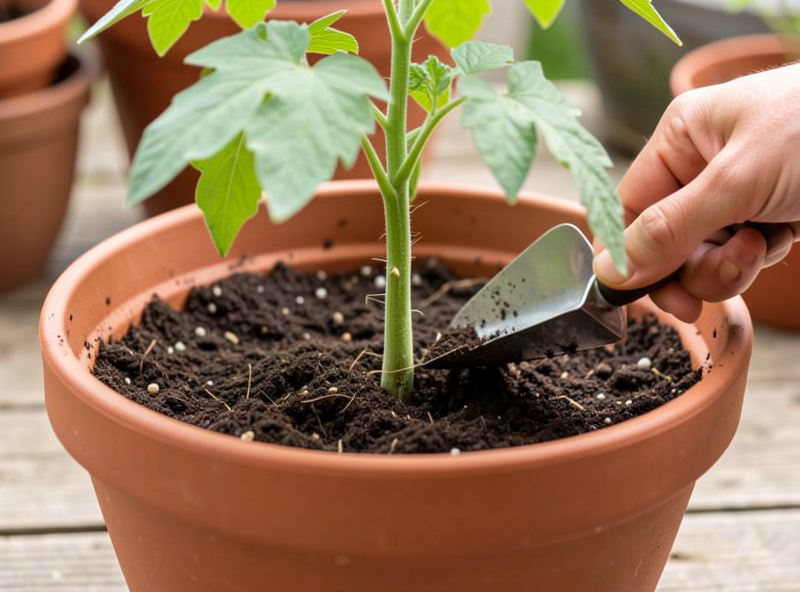
A leggy seedling stops stretching the moment you give it enough light, but the weak stem that already grew stays weak — you cannot shrink it back to a sturdy stalk. So the fix is two-part: move the seedling under proper light immediately to stop the stretch, then decide whether the existing stem is salvageable. A seedling that stretched for a few days and is still slightly firm can usually be saved by burying its stem deeper when you pot it on. One that grew into a pale, falling-over thread is often better composted and restarted, because the stem will never support the plant properly and it is a rot risk sitting wet against the soil.
The bury-deeper trick works because some crops grow adventitious roots along a buried stem. Tomatoes are the classic case — you can strip the lower leaves and pot a leggy tomato deep, and the buried stem roots into a far sturdier plant. I have rescued February-stretched tomatoes this way and ended up with fine plants. The catch is that not every crop does this; the trick that saves a tomato can rot a pepper or a brassica whose stem does not root readily. For most stretched seedlings the honest call is to prevent it next time and restart the worst cases now.
There is one more trick for a seedling that is only slightly soft, and it borrows from the outdoors. In nature, wind stresses a seedling and the plant responds by thickening its stem, which is why outdoor-grown plants are stockier than indoor ones. You can mimic this with a small fan blowing gently across the tray — the same fan that prevents damping off by drying the surface — or by lightly brushing your hand over the seedlings once a day. The mechanical stress triggers the plant to invest in a sturdier stem. It will not rescue a badly etiolated seedling, but for a borderline one that has been moved back under good light, it helps the new growth come in stockier than it otherwise would.
Does Pinching or Cutting Back Help Leggy Seedlings?
It depends on the crop, and getting this wrong sets you back two weeks. Pinching the growing tip off a leggy seedling forces the plant to branch from lower nodes, which can turn a single thin stem into a bushier plant — but only for crops that branch naturally from a cut. Tomatoes and basil take to it well; pinch a leggy tomato above a pair of leaves and it will throw two new growing shoots. Pinching a pepper, which you usually want as a single strong stem, just removes the growing tip and stunts it. Pinch a brassica or lettuce seedling and you may have just killed the part you wanted to eat.
The rule I follow is to fix the light first and pinch only as a shaping tool once the seedling is sturdy again under good light. Pinching a stretched, light-starved seedling does not fix the stretch; it just redirects a struggling plant’s energy into recovery it can ill afford. Get the light right, let the seedling firm up, and then pinch for shape if the crop calls for it. If you want a ready-made lighting setup rather than building your own, the full-spectrum LED bar search is where I would look, and the rest of the gear is on the seed-starting equipment list.
As an Amazon Associate I earn from qualifying purchases.
What I’d Do Starting Today
If your seedlings are stretching right now, lower the light today — not next week. Move it to within fifteen or twenty centimetres of the top leaves, set it on a fourteen-hour timer, and watch the new growth over the next three days. If the new leaves come in compact and green and the stem stops elongating, the light was the problem and you have caught it in time. If the existing stem is already a pale thread, restart the worst ones and save the rest by burying deeper at potting-on, but only for crops like tomatoes that root from the stem.
For the next batch, start under the light from day one — the moment a seedling emerges it wants full intensity, and a few days of dim light at emergence is enough to set the stretch in motion. Do not trust a winter window, measure the light if you can, and keep the lamp close. Leggy seedlings are a light problem with a light fix, and the rest of the seedling-failure picture — the damping off that follows a crowded, stretched tray, the stalling, the yellowing — is laid out from the main seedling-diagnosis hub.
Further Reading
- Why Are My Seedlings Dying? A Diagnostic Guide
- Damping Off: Stop Seedlings Toppling at the Soil Line
- Are Expensive Grow Lights Worth It? Cheap vs Premium, Measured Side by Side
- The Grow Light Timer Setup I Use to Cut Run-Cost in Half
- Grow Light PAR Meter Apps vs Real Meters: What You Can Trust
Can leggy seedlings recover?
Partly. Move them under stronger light immediately and the stretching stops, but the weak stem that already grew stays weak. Bury it deeper at potting on, or restart if it is badly stretched.
How many hours of light do seedlings need?
Fourteen to sixteen hours a day is standard. More than eighteen does no good and can stress the plant, and a dark rest period actually matters for growth.
Will a sunny window stop seedlings going leggy?
In summer, often yes; in a Nordic winter, no. Winter window light is too low-angle and brief, so most seedlings stretch on the sill and need a lamp.
Should I pinch the top off a leggy seedling?
Only for crops that branch from a cut, like tomatoes and basil. Pinching a single-stem crop like a pepper just removes the growing tip and stunts it.
Can I bury a leggy seedling deeper when potting on?
Yes for tomatoes, which root along a buried stem. For most other crops, bury only to the first leaves or the stem can rot.
Why are only some seedlings in the tray leggy?
Usually because they are furthest from the light or shaded by taller neighbours. Light falls off fast with distance, so the edges of a tray stretch first.