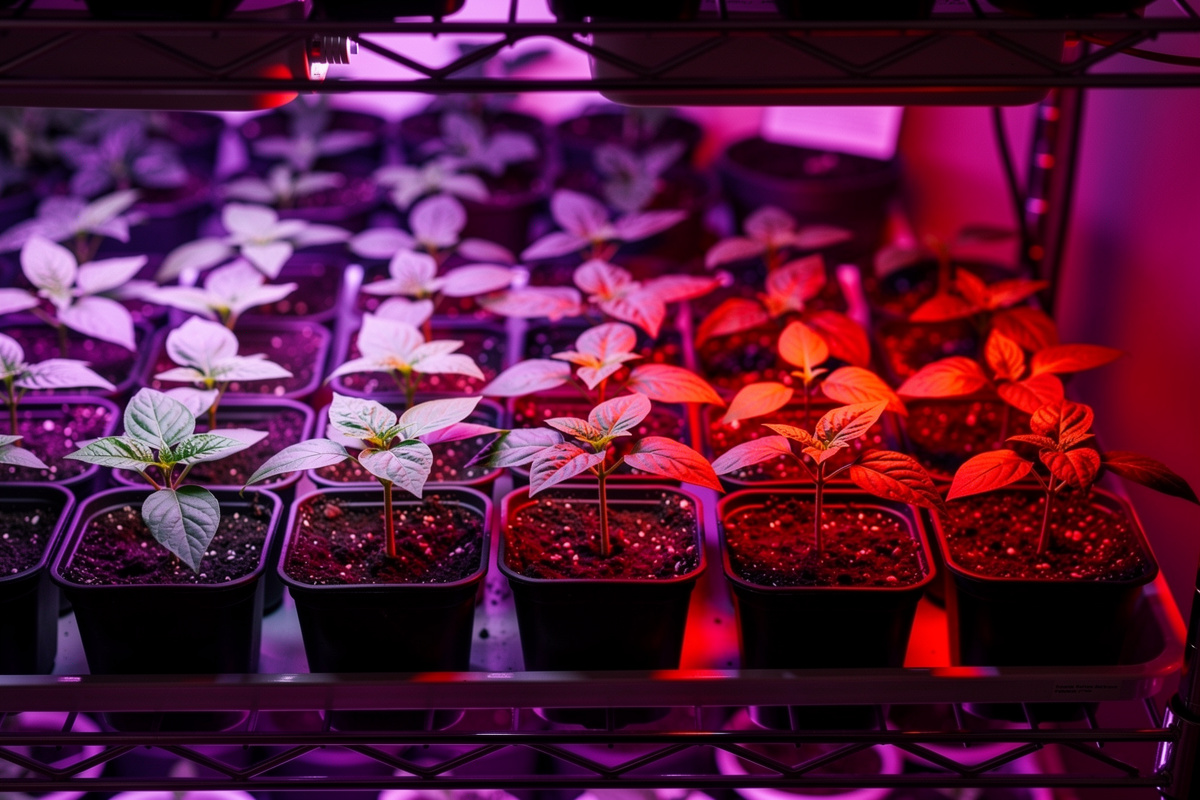
Pepper plants are light-hungry — that is the single biggest thing I have learned running them on my indoor shelf through a Swedish winter. Outdoors they soak up 8-10 hours of direct sun without breaking a sweat; indoors, even my best south-facing window delivers only a fraction of that intensity, and only for a few months of the year. Grow lights close the gap, and the right setup is the difference between a pepper plant that just survives the dark months and one that fruits through them.
For a complete overview of all indoor growing methods and crops, see my LED lights for growing plants indoors guide for light specifics and my complete indoor growing guide.
This guide covers light spectrum, intensity, fixture types, hanging distance, photoperiod, and stage-by-stage recommendations so you can match the right light to your indoor pepper growing goals.
As an Amazon Associate I earn from qualifying purchases.
Why Peppers Need Serious Light
For the complete tomato grow light guide, see grow lights for tomatoes.
Peppers evolved in sunny, tropical environments. They need intense light not just for photosynthesis, but specifically to trigger flowering and fruit development. Without enough light, a pepper plant will grow tall and leggy, produce few flowers, and drop the ones it does make.
The key metric is PPFD (Photosynthetic Photon Flux Density), measured in micromoles per square meter per second (µmol/m²/s). This tells you how much usable light actually reaches the plant canopy. Here is what peppers need at each stage:
| Growth Stage | PPFD Required | Hours Per Day | DLI Target |
|---|---|---|---|
| Seedling (weeks 1-4) | 100-200 µmol/m²/s | 14-16 hours | 5-12 mol/m²/day |
| Vegetative (weeks 4-8) | 200-400 µmol/m²/s | 16 hours | 12-20 mol/m²/day |
| Flowering/Fruiting | 300-600 µmol/m²/s | 14-16 hours | 15-30 mol/m²/day |
DLI (Daily Light Integral) is the total amount of photosynthetically active light a plant receives in a day. For reference, a sunny outdoor summer day delivers 40-60 mol/m²/day. Peppers need a DLI of at least 15 to fruit well — most windowsills deliver 3-8. Purdue Extension’s greenhouse guide is the clearest plain-language explainer of how DLI is measured and why it matters more than raw wattage (Measuring Daily Light Integral in a Greenhouse), and an e-gro bulletin on managing DLI for vegetable transplants shows why seedlings run on a lower DLI target than fruiting plants (Managing DLI for transplant quality).
Light Spectrum: What Colors Matter
Not all light wavelengths are equally useful for peppers. The two most important ranges are:
- Blue light (400-500nm) — Drives vegetative growth, leaf development, and compact plant structure. Important during the seedling and vegetative stages. Plants grown without enough blue light stretch toward the light source and become leggy.
- Red light (600-700nm) — Triggers flowering, fruit set, and ripening. Critical during the flowering and fruiting stages. This is the primary driver of pepper production.
Full Spectrum vs Red/Blue (Blurple) Lights
Older-generation LED grow lights used targeted red and blue diodes, producing a purple (“blurple”) glow. These work, but modern full-spectrum white LEDs are better for several reasons:
- They include green and far-red wavelengths that penetrate deeper into the canopy, reaching lower leaves and branches.
- Plants look natural under white light, making it easy to spot pest damage, nutrient deficiencies, and ripeness.
- Some full-spectrum LEDs add small amounts of far-red and UV output, which research suggests can nudge stress-compound production in hot peppers (the same pathway behind capsaicin). It is a real but modest effect — not a reason to pick a fixture on its own.
For indoor pepper growing, choose full-spectrum LED panels — the full-spectrum LED grow light I run over my own pepper shelf is exactly this class of fixture. The marginal efficiency gains of blurple lights do not outweigh the visibility and quality advantages of white LEDs.
Types of Grow Lights for Peppers
Learn about grow lights for all vegetables in our comprehensive guide.
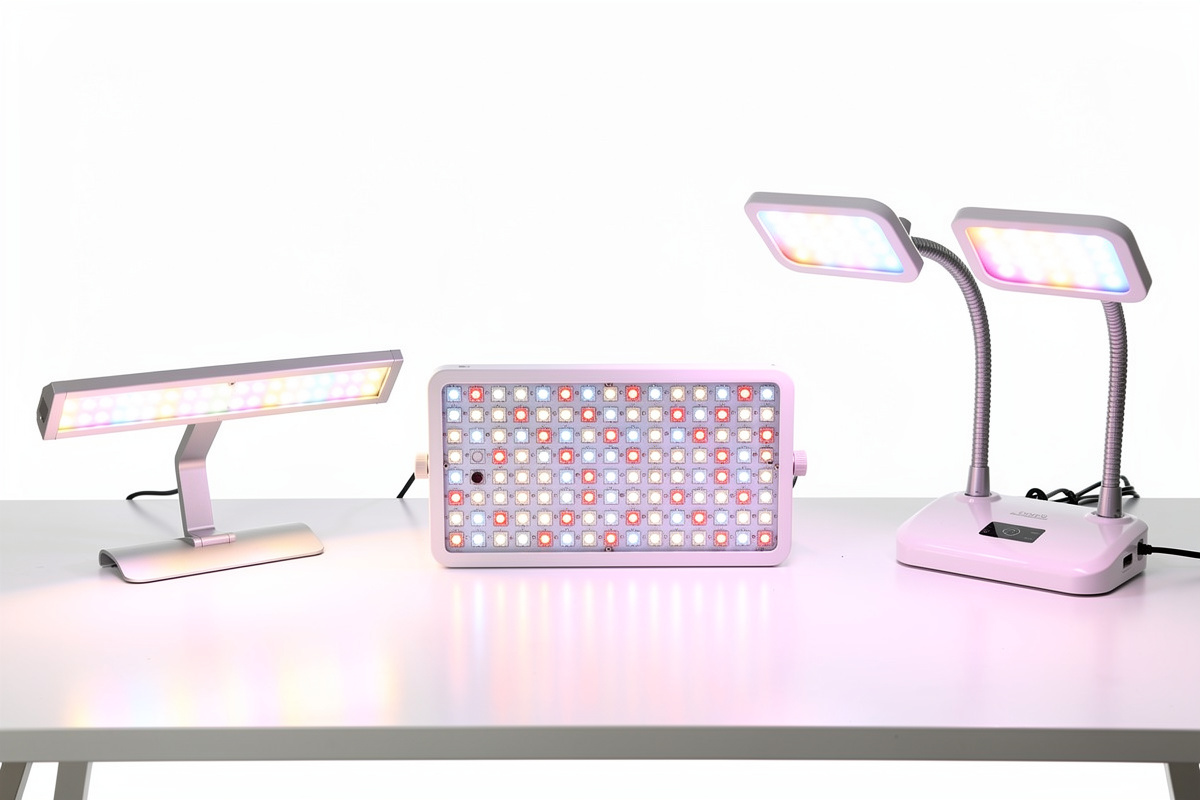
The grow light market is crowded. Here is a practical breakdown of the main types and which ones work best for peppers.
LED Panels (Best Overall)
Full-spectrum LED panels are the top choice for indoor pepper growers. They produce high PPFD at low wattage, generate minimal heat, and last 50,000+ hours. A quality 100W LED panel covers a 2×2 foot area — enough for 2-4 pepper plants — and costs $60-$120.
Best for: Dedicated pepper growing shelves, closet grows, anyone serious about consistent harvests.
LED Light Bars
Strip-style LEDs mount under shelves and work well for multi-tier growing setups. They provide even light distribution across a shelf but typically lower PPFD than panels. Best suited for seedlings and compact varieties.
Best for: Wire shelf setups, seed starting, supplementing window light.
Gooseneck/Clip-On LED Lights
Small, adjustable lights that clip onto a shelf edge or pot rim. Affordable ($15-$30) and easy to position, but they cover a small area and typically provide low PPFD (50-150 µmol/m²/s). Adequate for a single small plant or seed starting, but not powerful enough for fruiting peppers.
Best for: Single-plant windowsill setups, seed germination, supplementing natural light for one plant.
T5/T8 Fluorescent Tubes
Fluorescent tubes were the standard before LED technology matured. They still work — T5 high-output tubes produce decent light intensity — but they run hotter, use more electricity, and need bulb replacement every 12-18 months. LEDs have surpassed them in every metric except initial cost for very basic setups.
Best for: Growers who already own fluorescent fixtures and do not want to replace them yet.
HID (HPS/MH) Lights
High-intensity discharge lights produce excellent PPFD but generate significant heat, consume 3-5x more electricity than LEDs for the same output, and require ballasts and reflectors. Overkill for home pepper growing.
Best for: Commercial greenhouses. Not recommended for home indoor growing.
| Light Type | PPFD (typical) | Coverage | Wattage | Lifespan | Cost | Pepper Rating |
|---|---|---|---|---|---|---|
| LED Panel (100W) | 300-600 µmol | 2×2 ft | 100W | 50,000 hrs | $60-$120 | ★★★★★ |
| LED Light Bar | 150-300 µmol | 2×1 ft | 20-40W | 50,000 hrs | $25-$60 | ★★★★☆ |
| Gooseneck LED | 50-150 µmol | 1 plant | 10-25W | 25,000 hrs | $15-$30 | ★★☆☆☆ |
| T5 Fluorescent | 150-300 µmol | 2×1 ft | 54W/tube | 20,000 hrs | $30-$80 | ★★★☆☆ |
| HPS/MH (250W) | 400-800 µmol | 3×3 ft | 250W+ | 10,000 hrs | $100-$200 | ★★☆☆☆ |
Hanging Distance and Light Positioning
For indoor pepper growing tips, check growing peppers indoors.
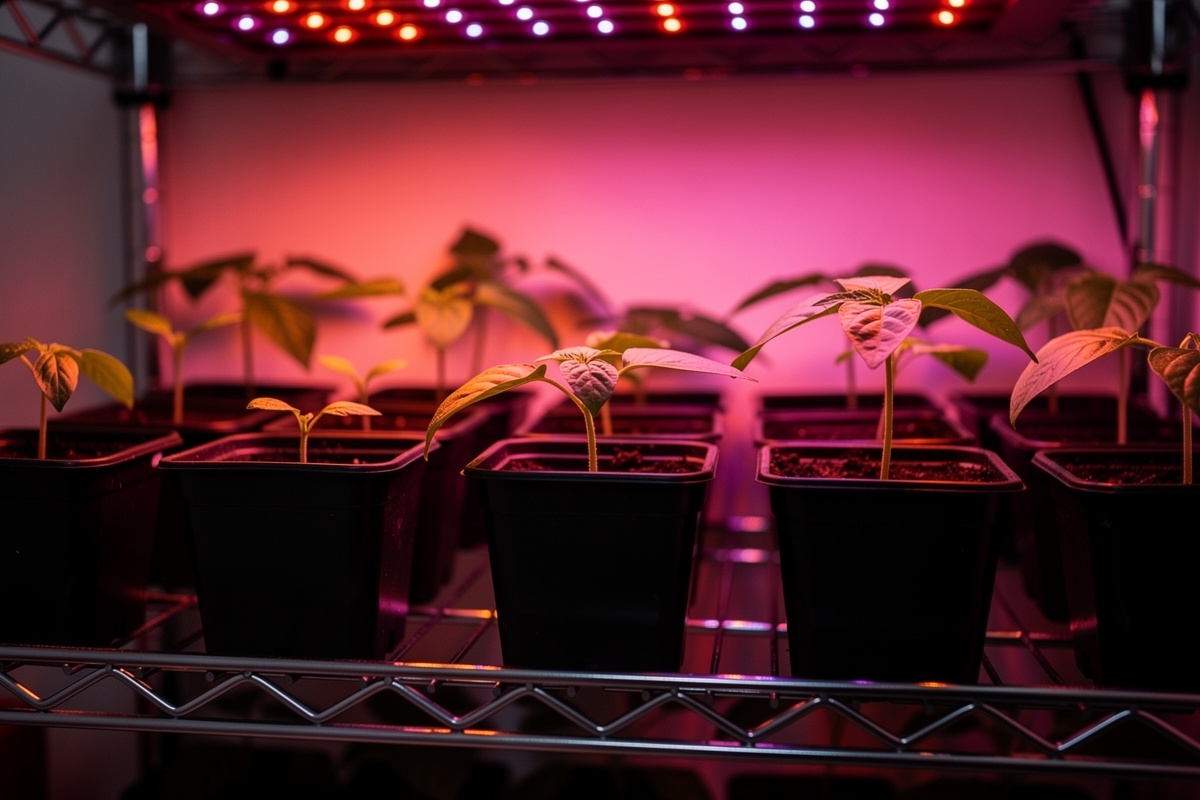
The distance between your grow light and the pepper plant canopy directly affects how much PPFD reaches the leaves. Too close causes light burn (bleached or crispy leaf tips). Too far wastes light energy and produces leggy, stretched growth.
Recommended Distances by Growth Stage
| Growth Stage | LED Panel Distance | LED Bar Distance | Fluorescent Distance |
|---|---|---|---|
| Seedlings | 24-30 inches | 12-18 inches | 4-6 inches |
| Vegetative | 18-24 inches | 8-12 inches | 4-6 inches |
| Flowering/Fruiting | 12-18 inches | 6-10 inches | 3-5 inches |
These are starting points. Your specific fixture may vary — check the manufacturer specifications for recommended hanging height. If you see leaf tips curling up or developing white/yellow patches, raise the light. If stems are stretching between leaf nodes, lower the light.
Adjustability Is Essential
Pepper plants grow from a 2-inch seedling to a 24-inch bush over their life. You need to raise the light as the plant grows. Use adjustable hangers (ratchet rope hangers are cheap and work well) or a height-adjustable shelf system. Fixed-distance lights require you to raise or lower the plant pot instead, which is less convenient but workable.
Photoperiod: How Many Hours of Light
Avoid common urban gardening mistakes with your light setup.
Peppers are day-neutral plants, meaning they do not rely on specific day length to trigger flowering (unlike cannabis or poinsettias). However, total light hours still matter because more hours of light means more total photosynthesis and faster growth.
Recommended Photoperiod by Stage
- Seedlings: 16 hours on / 8 hours off — maximizes early growth
- Vegetative: 16 hours on / 8 hours off — builds strong stems and foliage
- Flowering/Fruiting: 14 hours on / 10 hours off — some growers reduce to 12 hours, but 14 provides a better balance between light energy and rest
Always use a timer. Consistent light/dark cycles matter more than the exact number of hours. Irregular schedules stress the plant and can cause blossom drop. A simple $8 mechanical timer or a smart plug works fine.
Dark Period Matters
Plants need darkness to metabolize and transport sugars produced during photosynthesis. Running lights 24/7 does not help — research shows that peppers grown with a proper dark period outperform those under continuous light. Stick to 14-16 hours maximum.
Setting Up a Pepper Grow Light Station
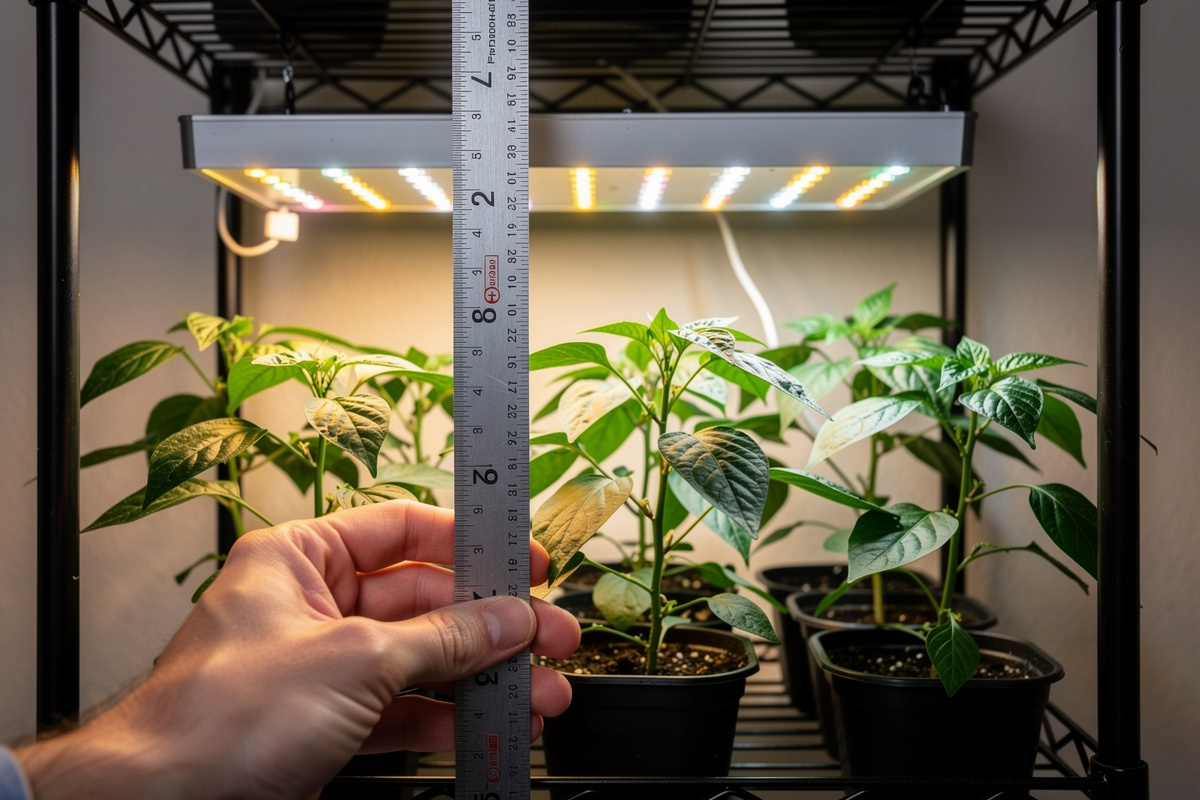
Here is a practical, budget-friendly setup for growing 4-8 pepper plants indoors with grow lights. This same configuration works for indoor tomatoes and other fruiting crops.
Basic Setup (2-4 Plants)
- Light: One 100W full-spectrum LED panel
- Coverage: 2×2 foot area
- Structure: Wire shelving unit (one shelf dedicated to peppers)
- Timer: Mechanical or smart plug timer
- Hangers: Ratchet rope hangers to adjust height
- Cost: $80-$150 total
Expanded Setup (6-8 Plants)
- Light: Two 100W LED panels, or one 200W panel
- Coverage: 2×4 or 4×4 foot area
- Structure: 4-tier wire shelving with two grow shelves
- Timer: Smart power strip with individual outlet timers
- Extras: Small oscillating fan for airflow and pollination assist
- Cost: $150-$300 total
Setup Steps
- Assemble the wire shelf unit in a room with stable temperature (70-85°F) — if your growing space runs cooler than that, a seedling heat mat under the trays keeps the root zone in range while pepper seeds germinate.
- Attach ratchet hangers to the shelf above your growing level.
- Hang the LED panel so it sits 24 inches above the shelf surface (for seedlings).
- Place a drip tray or waterproof mat on the growing shelf.
- Plug the light into a timer set to 16 hours on / 8 hours off.
- Position a small fan to blow gently across the canopy — this strengthens stems and aids pollination.
- Lower the light to 12-18 inches as plants enter the flowering stage.
Electricity Cost: What Will It Cost to Run?
Grow lights run 14-16 hours a day. That is a real electricity cost. Here is what to expect:
| Setup | Wattage | Hours/Day | Monthly kWh | Monthly Cost (at $0.15/kWh) |
|---|---|---|---|---|
| One 100W LED panel | 100W | 16 | 48 kWh | $7.20 |
| Two 100W LED panels | 200W | 16 | 96 kWh | $14.40 |
| One 200W LED panel | 200W | 16 | 96 kWh | $14.40 |
| Two T5 4-tube fixtures | 432W | 16 | 207 kWh | $31.10 |
| One 250W HPS | 295W (with ballast) | 16 | 142 kWh | $21.24 |
LED panels cost roughly $7-$15 per month to run — less than a single bag of store-bought organic peppers. The same lights work for tomatoes, herbs, and other indoor crops, spreading the cost across multiple harvests.
Troubleshooting Light Problems
| Symptom | Likely Cause | Fix |
|---|---|---|
| Leggy, stretched stems with long internodes | Light too far away or too weak | Lower the light or upgrade to a higher-PPFD fixture |
| Bleached or white leaf tips | Light too close (light burn) | Raise the light 2-4 inches |
| Leaves curling upward | Light stress or heat from fixture | Raise light, check temperature at canopy level |
| Lots of foliage but no flowers | Too much blue light, not enough red | Switch to full-spectrum panel or add red supplementation |
| Flowers form but drop before fruiting | Light intensity too low at flowering stage | Target 300+ PPFD at canopy, lower light to 12-18 inches |
| Uneven growth (one side taller) | Uneven light distribution | Rotate pots 90° every 2-3 days, center plants under light |
| Slow overall growth | Photoperiod too short | Increase to 16 hours for vegetative, 14 for flowering |
Combining Grow Lights with Window Light
If your pepper plants sit near a window, you can use a smaller grow light to supplement rather than replace natural light. Run the grow light during morning and evening hours to extend the total photoperiod to 14-16 hours. This hybrid approach reduces electricity cost while still giving peppers the DLI they need.
A 40W LED light bar running 6-8 supplemental hours costs under $3/month in electricity and can push a window-grown pepper plant from barely surviving to actively producing fruit. If your indoor garden also includes lower-light crops like lettuce or herbs, they can share the window light while peppers get the supplemental LED.
Checking Your PPFD With a Smartphone
You do not need a lab-grade quantum PAR meter to get a rough read on your setup. Smartphone light-meter apps (Photone on iOS is the one I keep on my phone; there are Android equivalents) use the front camera and a cheap paper diffuser over the lens to estimate PPFD. They are not lab-accurate, and they will not replace a real quantum sensor for serious work — but for a home grower trying to tell whether a panel at 16 inches is delivering roughly 350 PPFD or closer to 150, they take the guesswork out of hanging height. If the reading comes in well under where your target stage needs, lower the light or add a second panel.
For anything that rides on a precise number — a side-by-side fixture test, a published grow log — borrow or buy a real PAR meter. For dialing in a home pepper shelf, the phone app is the practical tool.
Related Articles
- Growing Peppers Indoors: Complete Container Guide — full pepper growing guide covering varieties, soil, watering, and care
- Grow Lights for Tomatoes: Indoor Growing Guide — similar light requirements, overlapping setup
- Growing Tomatoes Inside — companion fruiting crop with shared light needs
- How to Grow Lettuce Inside — lower-light crop for mixed indoor gardens
- Indoor vs Outdoor Urban Gardening — comparing growing methods and environments
- Hydroponic Peppers vs Soil Grown — compare soil vs hydroponic pepper growing on SmartHydroLab
How many hours of light do indoor pepper plants need?
Indoor pepper plants need 14-16 hours of light per day. During the seedling and vegetative stages, 16 hours produces the fastest growth. During flowering and fruiting, 14 hours is sufficient. Always use a timer for consistent light/dark cycles — irregular schedules stress the plant and cause blossom drop.
What PPFD do peppers need to produce fruit?
Pepper plants need a minimum of 200 PPFD at the canopy to grow well, and 300-600 PPFD for strong flowering and fruit production. Seedlings can start at 100-200 PPFD. A 100W full-spectrum LED panel positioned 12-18 inches above the canopy typically delivers 300-500 PPFD.
Can I use a regular LED bulb as a grow light for peppers?
Regular household LED bulbs produce light but at very low intensity compared to purpose-built grow lights. A standard 10W LED bulb delivers roughly 20-40 PPFD at 12 inches — far below the 300+ PPFD peppers need for fruiting. You would need 10-15 regular bulbs to match one 100W grow light panel.
How far should grow lights be from pepper plants?
For LED panels, start at 24-30 inches for seedlings, 18-24 inches for vegetative growth, and 12-18 inches for flowering and fruiting. LED light bars should be closer: 12-18 inches for seedlings, 6-10 inches for fruiting. If leaf tips turn white or curl upward, the light is too close.
How much does it cost to run grow lights for peppers?
A single 100W LED grow light panel running 16 hours per day uses about 48 kWh per month, costing approximately $7.20 at average US electricity rates. Two panels double that to about $14.40/month. LED panels are 3-4 times more energy efficient than fluorescent or HPS alternatives.