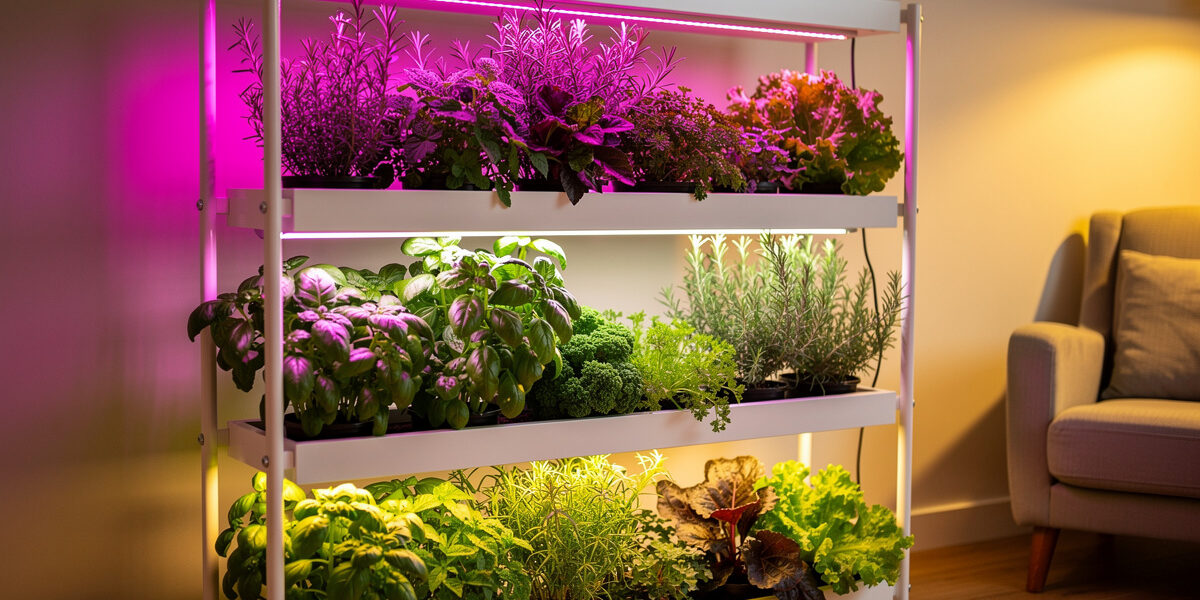
For most of the year my windowsill is decorative — a Swedish winter gives me a handful of weak daylight hours when most crops want ten or more. LED grow lights are what made indoor food growing actually work for me, and they are what make it work for anyone whose apartment does not face the right way. Unlike the fluorescent and HID rigs I used to mess with, today’s LEDs run cool, sip electricity, and last for years. Whether you are starting herbs on the kitchen counter or running a full seedling shelf, the right LED setup is the difference between leggy, pale plants and compact, healthy growth.
Why LED Lights Work for Indoor Plants
Plants need light in specific wavelengths to photosynthesize. The two most important ranges are blue light (400–500 nm) for vegetative growth and leaf development, and red light (600–700 nm) for flowering and fruiting. LED grow lights are engineered to emit exactly these wavelengths, which means almost no energy is wasted producing light that plants cannot use. Iowa State Extension makes the underlying point plainly: light is the most limiting growth factor indoors, and supplemental lighting is what removes that ceiling (important considerations for supplemental light).
Compared to a south-facing window, even a modest LED panel delivers consistent, controllable light regardless of season, weather, or apartment orientation. This consistency is what allows indoor growers to produce lettuce, peppers, and herbs year-round without depending on natural sunlight.
LED vs Fluorescent vs HID: Quick Comparison
| Feature | LED | Fluorescent (T5/CFL) | HID (HPS/MH) |
|---|---|---|---|
| Energy efficiency | Very high (2.5–3.0 µmol/J) | Moderate (1.2–1.7 µmol/J) | Moderate (1.0–1.7 µmol/J) |
| Heat output | Low | Moderate | High |
| Lifespan | 50,000+ hours | 10,000–20,000 hours | 10,000–24,000 hours |
| Spectrum control | Full spectrum tunable | Limited | Single spectrum per bulb |
| Upfront cost | $$–$$$ | $ | $$ |
| Running cost (monthly) | $3–$8 | $5–$15 | $15–$40 |
| Best for | All stages | Seedlings, herbs | Large fruiting plants |
For most home growers, LEDs are the clear winner. The upfront cost has dropped significantly since 2020, and the electricity savings pay for themselves within a few months.
Types of LED Grow Lights
Panel LEDs
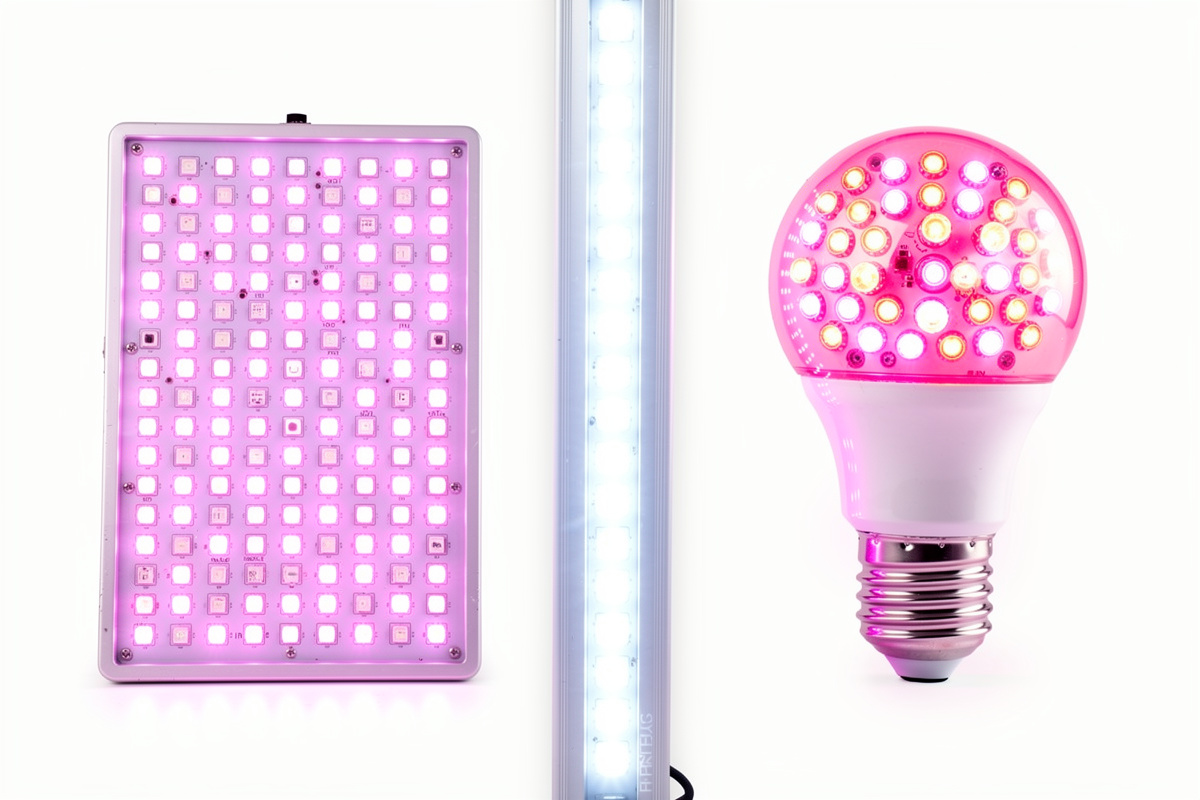
Panel grow lights are flat, rectangular fixtures that hang above your plants. They offer even light distribution across a wider area, making them ideal for shelving units or grow tents. Entry-level panels covering a 2×2 foot area start around $40–$60 and draw 100–150 watts. These are the most popular choice for indoor vegetable growers because they cover the most canopy area per dollar.
Strip and Bar LEDs
LED light bars are slim, linear fixtures that mount under shelves or along rack edges. They work well for tiered growing setups where vertical space is limited. Most strip lights are daisy-chainable, so you can connect multiple bars to a single power source. A two-bar setup is enough for a standard 4-foot shelf of herbs or leafy greens.
Bulb-Style LEDs
Screw-in LED grow bulbs fit standard E26/E27 lamp sockets. They are the cheapest entry point — a single 15-watt bulb costs $10–$15 and provides enough light for one or two small pots. The drawback is limited coverage area. Bulb-style LEDs are best for supplementing window light on individual plants rather than running an entire indoor garden.
Ring and Gooseneck LEDs
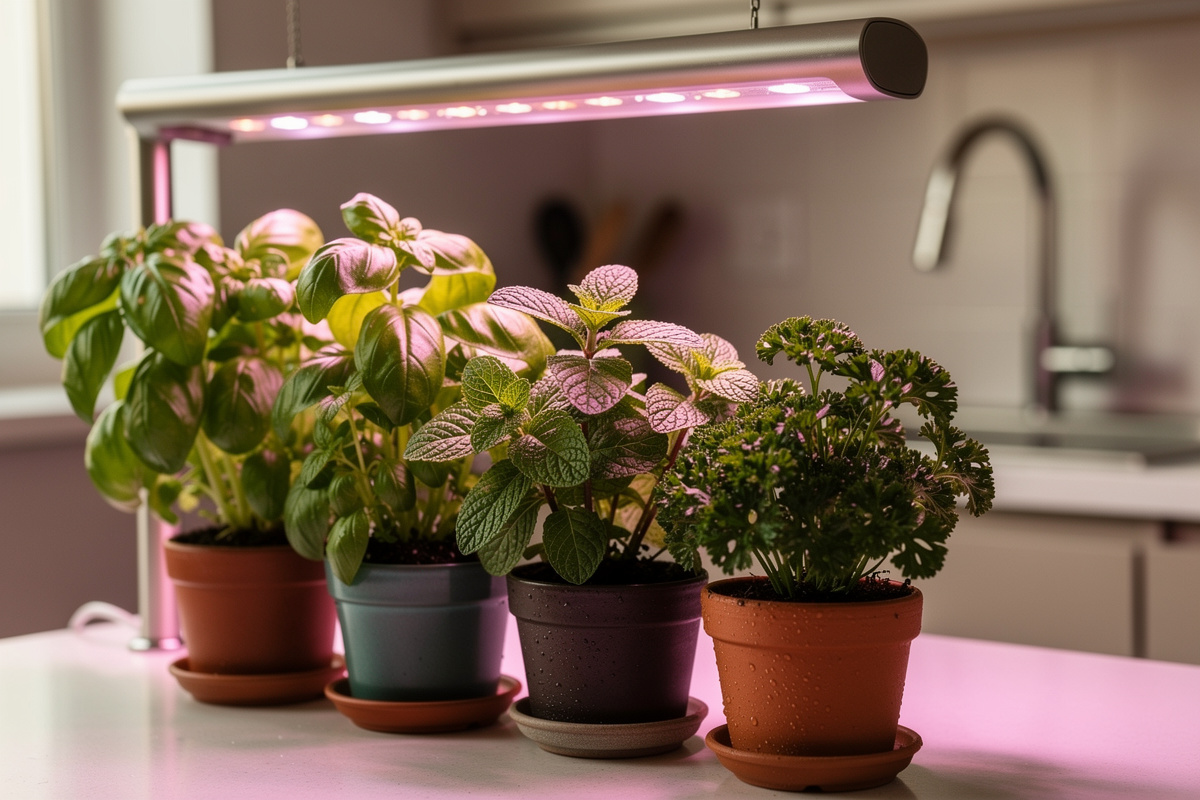
Clip-on gooseneck lights with circular LED heads are popular for desk-sized setups. They are adjustable, inexpensive, and draw very little power (10–20 watts). While they lack the intensity for fruiting vegetables, they are perfectly adequate for herbs, sprouting, and small foliage plants.
Understanding Light Spectrum for Plants
Modern LED grow lights come in three main spectrum options:
Full Spectrum (White Light)
Full spectrum LEDs emit a balanced white light that mimics natural sunlight. They typically combine blue, red, and green diodes to produce light across the entire visible range. Full spectrum lights are the most versatile option because they support all growth stages — from seedling to harvest. They also look natural in living spaces, which matters if your grow setup is in a kitchen or living room.
Red/Blue (Blurple) Lights
The distinctive purple glow of red/blue LED panels comes from combining red and blue diodes without any white or green. These lights are energy-efficient because they only produce the wavelengths plants use most. However, the purple light makes it difficult to visually inspect plants for pests or nutrient deficiency. Many growers have moved away from blurple lights in favor of full spectrum models.
Supplemental Red or Far-Red
Some advanced panels include far-red diodes (700–750 nm) that trigger the Emerson enhancement effect, boosting photosynthetic efficiency by up to 30%. This matters most for fruiting crops like tomatoes and peppers that need strong flowering signals.
How Much Light Do Indoor Plants Need?
Light intensity for plants is measured in PPFD (Photosynthetic Photon Flux Density), expressed in µmol/m²/s. Different plant types need different levels:
| Plant Type | PPFD Needed | Daily Light Hours | DLI Target |
|---|---|---|---|
| Herbs (basil, mint, cilantro) | 100–200 µmol/m²/s | 12–14 hours | 8–12 mol/m²/day |
| Leafy greens (lettuce, spinach) | 150–250 µmol/m²/s | 12–16 hours | 10–14 mol/m²/day |
| Seedlings and sprouts | 100–200 µmol/m²/s | 14–16 hours | 8–12 mol/m²/day |
| Fruiting vegetables (tomatoes, peppers) | 300–600 µmol/m²/s | 14–16 hours | 20–30 mol/m²/day |
| Houseplants (low light) | 50–100 µmol/m²/s | 10–12 hours | 4–6 mol/m²/day |
DLI (Daily Light Integral) is the total amount of photosynthetically active light received over a full day. Think of PPFD as the flow rate and DLI as the total volume. A lower-intensity light running for longer hours can achieve the same DLI as a brighter light running fewer hours. Purdue Extension’s greenhouse guide is the clearest plain-language walkthrough of how DLI is measured and why it predicts indoor growth better than wattage ever does (Measuring Daily Light Integral in a Greenhouse).
Choosing the Right LED Grow Light
Selecting the right light depends on three factors: what you are growing, how much space you need to cover, and your budget.
Coverage Area
Every grow light has a recommended coverage area at a specific hanging height. A 100-watt panel typically covers a 2×2 foot area at 18 inches above the canopy. If you double the hanging height, the intensity drops by roughly 75% (inverse square law). Always check the manufacturer’s PPFD map rather than relying on wattage alone — two 100-watt lights from different brands can have vastly different output.
Wattage Guidelines
As a general rule for LED grow lights:
- Herbs and leafy greens: 20–30 watts per square foot of growing area
- Fruiting vegetables: 30–50 watts per square foot
- Seedlings: 15–25 watts per square foot
A standard 2×4 foot shelf growing lettuce needs about 160–240 watts of LED power. For a single pot of basil on a counter, a 15-watt bulb is enough.
Budget Recommendations
Entry-level panels ($30–$60) work well for herbs and leafy greens. Mid-range panels ($60–$150) with Samsung LM301 diodes offer better efficiency and are suitable for starting seeds through to harvest. Premium panels ($150–$300+) make sense for serious vegetable growers who want maximum yield per watt.
Setting Up Your LED Grow Light
Hanging Height
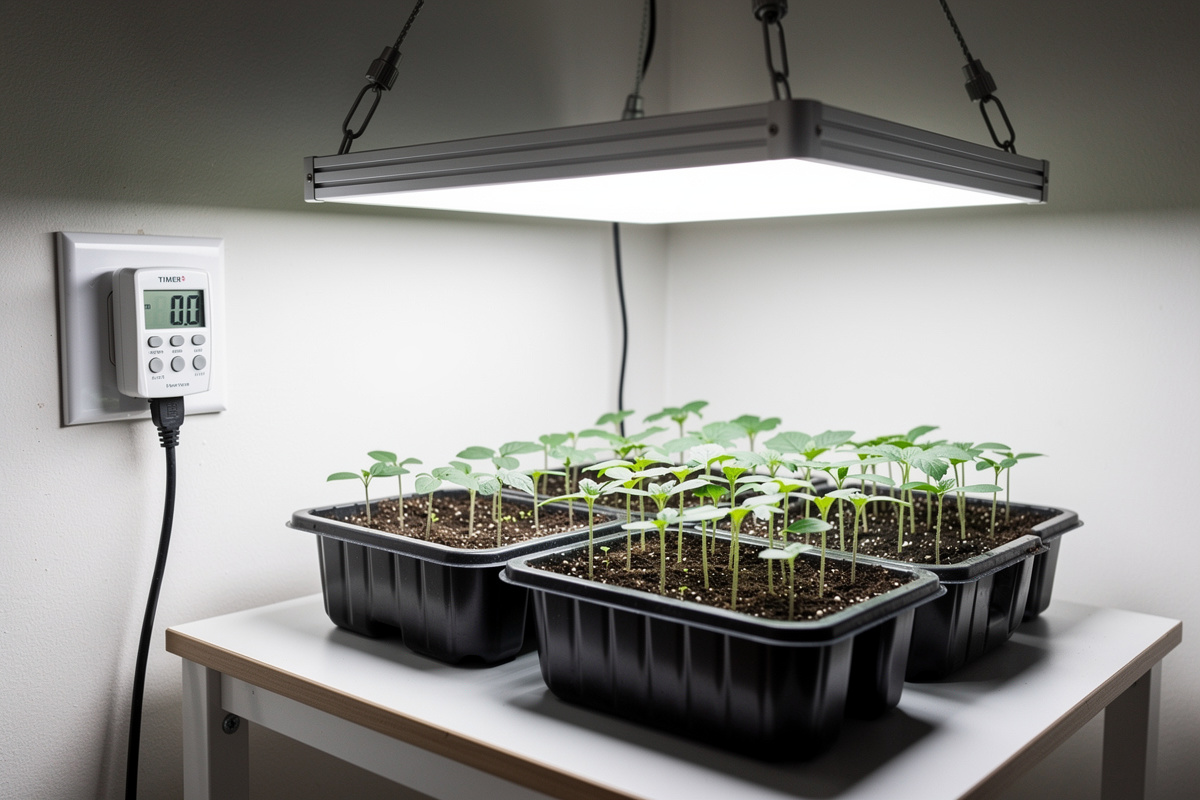
Start with the manufacturer’s recommended height and adjust based on plant response. Signs the light is too close include leaf curling, bleaching (white spots), or brown edges. Signs it is too far include leggy stems and pale, stretched growth. Most LED panels work best at 12–24 inches above the plant canopy.
Light Schedule and Timers
A mechanical or digital timer is essential. Running lights manually leads to inconsistent schedules that stress plants. Set your timer for 14–16 hours on and 8–10 hours off. The dark period matters — plants use darkness for respiration and growth hormone production. Never run grow lights 24/7 unless you are germinating seeds (which can handle continuous light for the first few days).
Reflective Surfaces
White walls, aluminum foil (matte side out), or mylar reflective sheets bounce stray light back toward your plants. This can increase effective light intensity by 10–25% without any additional electricity cost. Even placing your grow setup in a corner with two white walls makes a noticeable difference.
Common LED Grow Light Mistakes
Running Lights Too Close
LED panels produce less heat than HID lights, so new growers assume they can place them inches from the canopy. While LEDs will not burn leaves with heat, excessive light intensity causes photoinhibition — the plant shuts down photosynthesis to protect itself. Maintain at least 12 inches between the light and the top of your tallest plant.
Ignoring Light Uniformity
A single point-source light creates a hot spot in the center and weak coverage at the edges. Plants on the perimeter grow leggy while center plants get burned. Using two smaller panels instead of one large one, or adding reflective walls, evens out the light distribution.
Choosing by Wattage Alone
A cheaply made 300-watt panel with inefficient diodes may produce less usable light than a quality 150-watt panel with Samsung or Osram LEDs. Look for the actual PPFD measurements at your target hanging height, not the advertised wattage. Efficiency (µmol/J) is the number that matters most.
Skipping the Timer
Inconsistent light schedules confuse plant hormones and stunt growth. A $5 mechanical timer eliminates this problem entirely. If you are growing fruiting crops, even one hour of unexpected darkness during the light period can disrupt flowering.
Energy Cost and Efficiency
One advantage of LEDs is their low running cost. A 100-watt panel running 14 hours per day consumes about 1.4 kWh daily. At the US average electricity rate of $0.16/kWh, that is $0.22 per day or roughly $6.70 per month. Compare that to a 400-watt HPS light at the same schedule: $0.90/day or $27/month.
Where I live the lights run harder and longer — through the dark months a single 100W panel over my microgreen and seedling shelf is on 14-16 hours a day from roughly October to April, and the electricity cost still lands around the numbers above. The point worth internalizing is that running cost is almost never the reason to skimp on light; the reason plants fail indoors is too little of it, not too much on the bill. Size the setup to the canopy you actually want to cover, then let the timer and the electricity rate do the math.
| Setup | Wattage | Daily Hours | Monthly Cost (US avg) |
|---|---|---|---|
| Single bulb (herbs) | 15W | 14 | $1.00 |
| Two-bar strip (shelf) | 40W | 14 | $2.70 |
| Panel (2×2 ft area) | 100W | 14 | $6.70 |
| Panel (4×2 ft area) | 200W | 14 | $13.40 |
| Dual panel (4×4 ft area) | 400W | 14 | $26.90 |
Best Plants to Grow Under LED Lights
Almost any plant grows under LEDs, but some respond better than others to artificial light. The easiest wins for beginners:
- Basil — Thrives under 12–14 hours of LED light, produces continuously with regular harvesting
- Lettuce and salad greens — Fast 30-day harvests, low light needs, perfect for beginners (complete lettuce guide)
- Mint — Nearly indestructible under grow lights, aggressive grower
- Chives — Compact, low-maintenance, tolerates varied light levels
- Microgreens and sprouts — Harvestable in 7–14 days, need only modest light (sprouting without soil)
- Cherry tomatoes — Need higher intensity but reward with year-round harvests (indoor tomato guide)
- Hot peppers — Compact varieties like Thai chili do well under 200+ PPFD panels
Troubleshooting LED Grow Light Problems
| Symptom | Likely Cause | Fix |
|---|---|---|
| Leggy, stretched stems | Light too far away or too weak | Lower light to 12–18 inches; increase wattage |
| Pale or yellow leaves | Insufficient light intensity | Add a second light or move closer |
| Brown leaf tips or white spots | Light too close (light burn) | Raise light 4–6 inches higher |
| Curling leaves | Heat stress or light stress | Check temperature; raise light |
| No flowering | Wrong spectrum or photoperiod | Use full spectrum; ensure 8+ hours dark |
| Slow growth despite light | Other factors (nutrients, water, temp) | Check pH, watering, and room temperature |
How many hours a day should LED grow lights be on for indoor plants?
Most indoor plants need 12–16 hours of LED light per day, depending on the species. Herbs and leafy greens do well with 12–14 hours, while fruiting vegetables like tomatoes and peppers need 14–16 hours. Always provide at least 8 hours of darkness for proper plant respiration.
Can any LED light be used as a grow light?
Regular household LED bulbs emit light in the visible spectrum that plants can partially use, but they are far less efficient than dedicated grow LEDs. Grow lights are engineered to emit higher proportions of blue and red wavelengths that drive photosynthesis.
Do LED grow lights use a lot of electricity?
LED grow lights are the most energy-efficient option available. A 100-watt panel running 14 hours daily costs about $6–$7 per month at average US electricity rates. This is roughly 60–70% less than equivalent HID lighting systems.
How far should LED grow lights be from plants?
Most LED grow lights should be positioned 12–24 inches above the plant canopy. Seedlings benefit from slightly higher positioning (18–24 inches), while mature plants can handle closer distances (12–18 inches). Always check for signs of light burn and adjust accordingly.
Are purple or white LED grow lights better for plants?
Both can grow healthy plants, but full spectrum (white) LED lights have become the preferred choice for most home growers. They provide a natural appearance, make it easy to inspect plants for problems, and support all growth stages.
Related Articles
- Grow Lights for Tomatoes: Indoor Growing Guide — Specific lighting requirements for indoor tomato production
- Grow Lights for Peppers: Indoor Lighting Guide — LED recommendations for indoor pepper growing
- Growing Plants from Seed Indoors: Complete Starter Guide — How to use grow lights for seed starting
- How to Grow Lettuce Inside: Container Guide — Lettuce under LED lights from seed to harvest
- Indoor vs Outdoor Urban Gardening — Comparing grow light setups with natural sunlight options