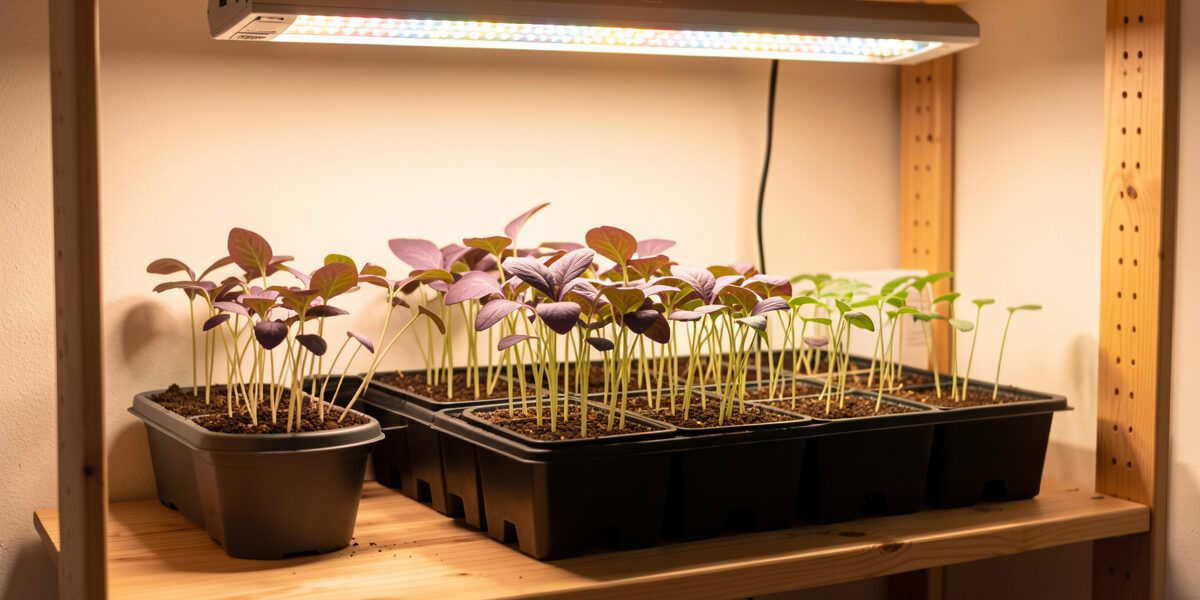
Purple seedling leaves usually mean cold roots have locked out phosphorus. The nutrient is right there in the soil, but a root zone that is too cold cannot absorb it, so the leaves build up anthocyanin pigment and flush purple or reddish, usually on the undersides and the older leaves first. It is a temperature problem dressed up as a nutrient problem, and the fix is almost always to warm the roots, not to feed.
This is the seedling problem most often solved with the wrong bottle. A grower sees purple, assumes phosphorus deficiency, and reaches for a bloom fertilizer high in P — and the leaves stay purple, because the cold roots never took up the nutrient that was poured on them, and now the seedling is sitting in salty media as well. The purple is the plant telling you its roots are cold, and once you read it that way the fix is quick and cheap. What follows is how I read the color on my own shelf, what causes it, and the order in which I act — warmth first, feed last, and only if the color says so.
Why Do Seedling Leaves Turn Purple?
The purple comes from anthocyanin, a pigment the plant produces as a stress response, and the stress that triggers it most often in seedlings is a root zone too cold to take up phosphorus. Phosphorus is the nutrient a seedling uses to build new tissue and transfer energy, and it is also the one most sensitive to cold soil: below a certain root-zone temperature, the roots physically cannot absorb it, no matter how much is sitting in the mix. The plant, still trying to grow, pushes sugars into the leaves where they back up and form anthocyanin, and the leaf flushes purple. The color is the visible end of a hidden problem underground.
The pattern of the purple tells you it is this lockout rather than something else. It shows first on the older leaves — the plant moves its limited phosphorus to the growing tip and sacrifices the oldest leaves — and it shows strongest on the undersides and the leaf stems, where the pigment concentrates. The leaves take on a dusty, bluish-purple cast on the undersides, like a bruise spreading under the leaf, while the newest growth at the top may still look green. The University of Minnesota Extension’s nutrient-deficiency guidance describes exactly this older-leaf, purpling pattern for phosphorus, and it is the signature I look for before I touch a thermostat.
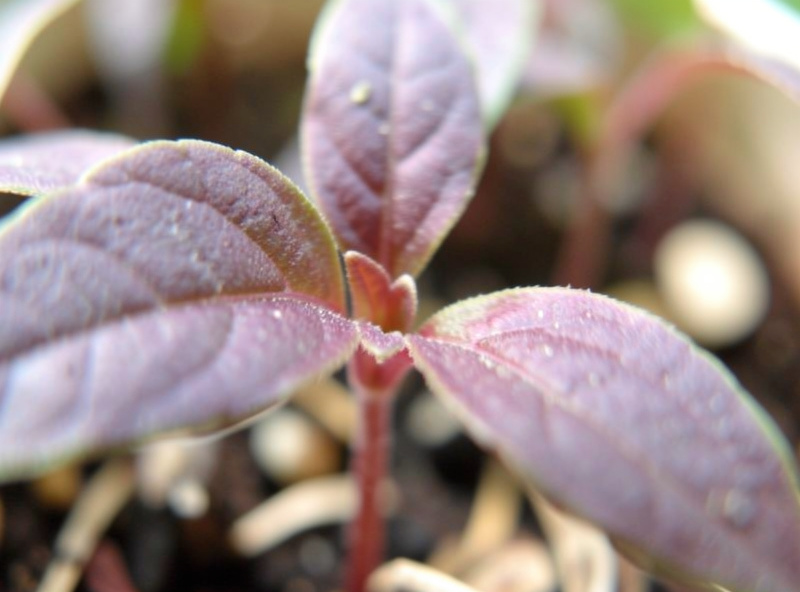
Is Purple Always a Phosphorus Deficiency?
No, and this is where the easy diagnosis leads people astray. Purple can mean genuine phosphorus shortage in a genuinely warm root zone, but in an indoor seed-starting tray that is rare — most seed-starting mixes carry enough phosphorus to start a seedling. Far more often the phosphorus is present and locked out by cold. Before you assume deficiency, ask whether the root zone is warm enough, because adding phosphorus to cold roots is the move that fixes nothing and risks burning the seedling with excess salts.
The way to tell cold lockout from a genuine deficiency is to check the temperature before you check the nutrients. If the root zone reads cold — below that 15-degree threshold where uptake stalls — the purple is lockout, and warming fixes it without any feed. If the root zone is already warm and the purple is still there, then you are looking at a real shortage, and even then it is more likely a pH problem tying up phosphorus than a lack of phosphorus in the mix. Phosphorus becomes less available to roots in both cold soil and in soil that has drifted too acid or too alkaline, so a warm root zone with persistent purple is a reason to check pH, not just to pour on more P. The diagnostic order — temperature, then pH, then nutrient — saves you from treating the wrong layer of the problem.
Purple can also come from two other sources that are not deficiencies at all. A grow light heavy in the blue part of the spectrum can intensify anthocyanin and give leaves a purple tint, particularly on young growth close to the lamp; this is usually minor and vanishes when the light is raised or the spectrum broadens. And some cultivars are simply purple by genetics — purple basil, red-leaf lettuce, certain brassicas produce anthocyanin as a matter of course, and their color is normal, not a distress signal. The Royal Horticultural Society’s plant-nutrition notes separate these natural pigmentations from the stress purpling, and it is a distinction worth holding in your head before you diagnose.
How Cold Is Too Cold for Seedling Roots?
Most vegetable seedlings want a root zone somewhere in the range of 18 to 24 degrees Celsius, with the heat-lovers — peppers, tomatoes, eggplants — toward the warmer end of that band. Below about 13 to 15 degrees, phosphorus uptake stalls sharply, and the leaves begin to purple within days. The catch is that the air in your room can feel perfectly warm while the root zone is cold, because a tray sitting on a windowsill or a stone shelf is cooled from below by the surface it rests on. In a Nordic apartment in late winter, a sill that catches the sun in the afternoon can still be conducting cold from the wall all night, and the roots sit at twelve degrees while you are comfortable in a jumper.
The gap between air temperature and root temperature is the part that catches people out, and it is larger than you would guess. A room that holds 20 degrees can still leave a tray on a windowsill with roots at 12, because the sill is cooled by the glass and the wall behind it, and the thin plastic of a cell tray does almost nothing to insulate the root ball from the cold surface beneath. Lifting the tray off the sill with a layer of cardboard, a cork mat, or a scrap of foam insulation underneath can buy several degrees of root warmth for nothing, before you ever plug in a heat mat. I measure the root zone with a cheap probe thermometer pushed under the tray, because guessing from the air temperature is exactly how I ended up with purple seedlings in a room I thought was warm.
This is why a heat mat fixes more seedling trouble than any single other piece of gear I own. On my shelf a Hydrofarm heat mat under the trays, held to a setpoint by a thermostat, keeps the root zone in the right band — around 21 degrees for lettuce and spinach, a touch warmer for peppers and tomatoes — and the purple fades within days as phosphorus uptake resumes. The probe sits under the tray measuring the root zone, not the air, because the root temperature is the number that matters. The detail on the exact temperatures I set by crop and the question of whether you need a mat at all are covered separately; up here, in a cold room in March, the answer is almost always yes.
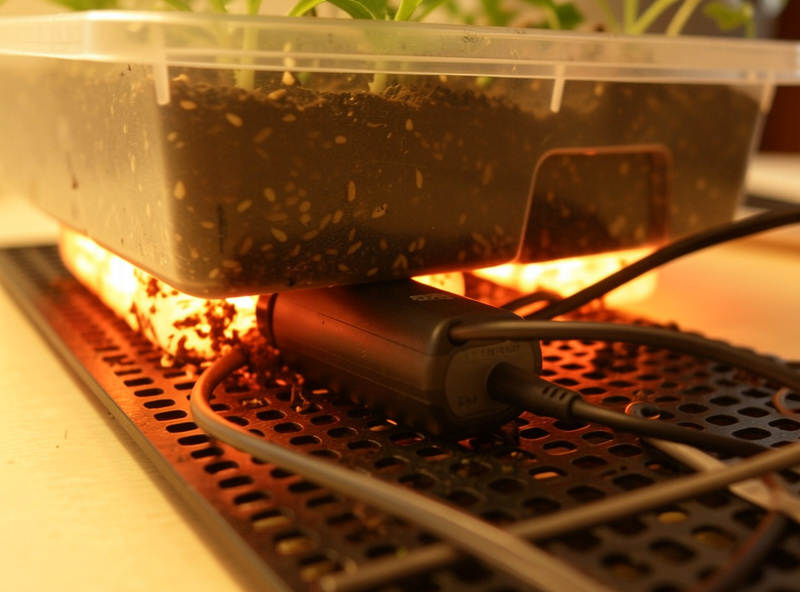
Should I Add Fertilizer When Leaves Go Purple?
Usually no, not as the first move, and this is the mistake I made myself. Last spring I read purple on a flat of tomato seedlings as a straight phosphorus deficiency and dosed them with a weak bloom feed high in P. The leaves stayed purple for a week, because the roots were cold and took up almost none of what I had poured on, and then the excess salts began to crisp the leaf edges — I had fertilized a problem I should have warmed. The seedlings recovered once I put them on a heat mat and flushed the media with plain water, but I lost ten days and stressed the plants for nothing.
The correct order is warmth, then patience, then feed only if the color persists. Put the tray on a heat mat, hold the root zone in the right range, and watch the new growth over the next several days. If the new leaves come in green and the purple on the older leaves begins to fade, the cause was cold and you are done — no fertilizer needed. If the roots are warm and the purple is still spreading, then you have a genuine nutrient issue and a very weak feed is appropriate. Seedlings need remarkably little feed early on, and the cotyledons carry enough reserve for the first true leaves; over-fertilizing does far more damage than under-fertilizing at this stage. When you do feed, go weaker than the bottle suggests.
When Is Purple Actually Normal?
Sometimes purple is just the plant, and learning to tell the difference saves a lot of unnecessary intervention. A seedling of a naturally purple cultivar — purple basil, red mustard, certain kohlrabi and brassicas — is supposed to be that color, and you will see the anthocyanin from the first true leaves regardless of temperature or feed. These seedlings purple up evenly and consistently, in line with their genetics, rather than showing the older-leaf, underside-heavy pattern of cold lockout. If you sowed a purple variety, expect purple leaves and do not chase a deficiency that is not there.
The other harmless case is a brief flush of color on very young seedlings of crops that are not naturally purple, often tomatoes and brassicas, when they first meet cool air or strong light. A faint purple on the undersides of young tomato leaves in a cool room is common and usually resolves as the plant grows and the roots warm. The signal to act is persistent, deepening purple that spreads across the plant and pairs with slow growth — that is the lockout pattern, and that is when you warm the root zone. A moment of color on an otherwise vigorous seedling is usually nothing to fix.
What I’d Do Starting Today
If your seedling leaves are purple right now, before you reach for any fertilizer, check the root-zone temperature. Feel the underside of the tray, or better, put a thermometer probe under it — if the roots are sitting below about 15 degrees, that is almost certainly your cause, and a heat mat will turn the color around in days. Warm the roots, hold them in the 18 to 24 degree band, and give the new growth three or four days to come in green. Resist the urge to feed until you have done that, because feeding cold roots is the move that fixes nothing and risks salt burn.
For the next batch, build the warmth in from the start — a heat mat with a thermostat under the trays is the single purchase that prevents this and a cluster of other cold-root problems, and the heat-mat buying notes cover what to look for. Keep trays off cold sills and stone shelves, or set them on an insulating layer if you must. The rest of the seedling-failure picture — the leggy stretch that comes from low light, the damping off that follows cold, wet media — is laid out from the main seedling-diagnosis hub, and the full kit is on the seed-starting equipment list.
Read These Next
- Why Are My Seedlings Dying? A Diagnostic Guide
- Damping Off: Stop Seedlings Toppling at the Soil Line
- Leggy Seedlings: Why They Stretch and How to Fix
- Seedling Heat Mat Temperatures by Crop: The Numbers I Set
- Do You Need a Heat Mat for Seeds? When It Earns Its Keep
Are purple seedling leaves a phosphorus deficiency?
Often, but usually an induced one. Cold roots lock out phosphorus, so the fix is warmth, not fertilizer. Warm the root zone and the purple fades within days.
Will fertilizer fix purple seedling leaves?
Not if the cause is cold. Roots cannot absorb phosphorus from a cold root zone, and excess fertilizer can burn the seedling. Warm first, feed only if the color persists.
Can a grow light turn seedling leaves purple?
A light heavy in blue spectrum can intensify anthocyanin and add a purple tint, but it is usually minor compared to cold. Suspect the spectrum only if the roots are warm and the light is adequate.
Is it normal for tomato seedling leaves to be purple underneath?
Some purple on the undersides of young tomato leaves is common and often harmless, especially in cool conditions. Persistent deep purple across the plant is the signal to warm the roots.
What temperature should seedling roots be?
Roughly 18 to 24 degrees Celsius for most vegetables, warmer for heat-lovers like peppers and tomatoes. Below about 15 degrees, phosphorus uptake stalls and leaves purple.