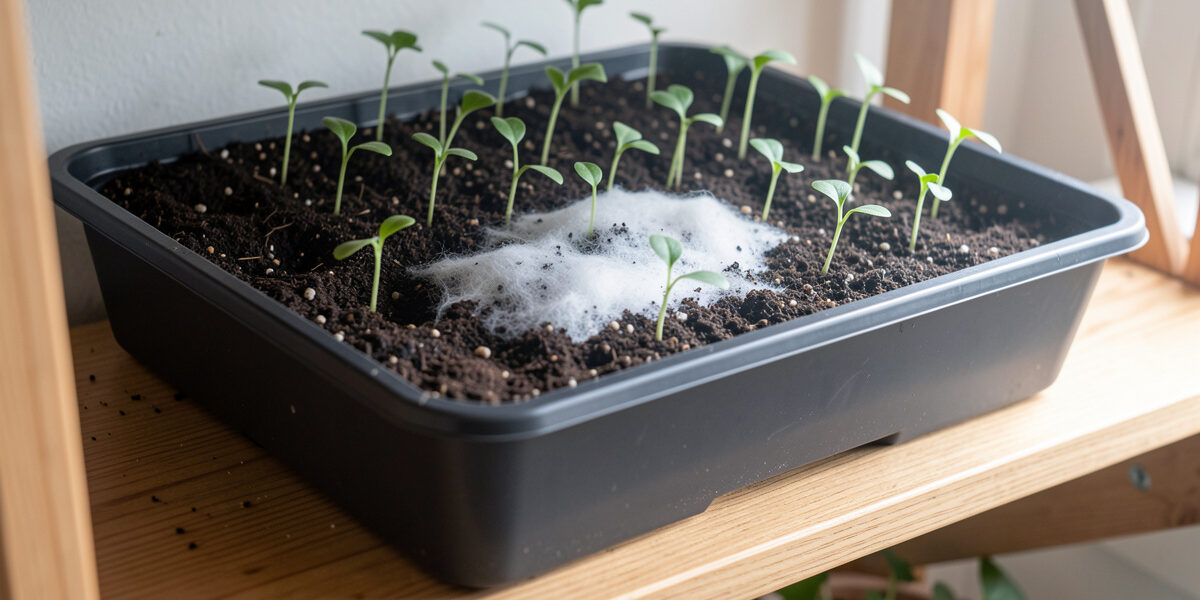
White fuzz on seed-starting soil is usually harmless mold, not a disease. It is a saprophytic fungus feeding on dead organic matter in a too-wet, too-still tray, and it is not attacking your seedlings. But it is a warning: the same wet, still conditions that grow this mold also grow the damping-off fungi that kill seedlings, so you fix the moisture and the air, not just the mold on top.
This is the one that makes people throw away trays they should have kept, and I have done it myself. You lift the humidity dome, see a soft white cobweb spread across the dark mix, and assume the tray is diseased and done for. It usually is not. The mold is a messenger, telling you the surface of the mix has stayed wet and still for too long, and the correct response is to change the environment so it dries — not to panic, and not to reach for a fungicide. What follows is how to tell the harmless fuzz from the mold that actually threatens seedlings, why it appears, and the routine I use to make it go away on its own.
What Is the White Fuzz on My Seed-Starting Mix?
The white fuzz is the visible mycelium of a saprophytic fungus — a mould that lives on dead organic matter rather than on living plants. In a seed-starting tray it is feeding on fragments of the coir, peat, or compost in your mix, on the seed coats of seeds that did not germinate, and on any trace of organic matter sitting on the wet surface. It is doing the same job compost fungi do in a leaf pile: breaking down dead material. The mould itself is not parasitising your seedlings, which is why a tray can be covered in white fuzz and still hold perfectly healthy, green, upright seedlings growing right through it.
The most common culprits are fast-growing moulds in genera like Trichoderma and Mucor, which specialise in colonising fresh dead organic matter and are present in essentially every bag of mix and every cubic metre of indoor air. Trichoderma, in fact, is sometimes sold as a beneficial soil additive because it can outcompete pathogenic fungi — so a tray with a little of it is not only harmless, it is arguably a sign of a biologically active medium. The mould you see is the visible tip of a decomposition process happening invisibly in every healthy pot of soil. It only becomes visible when the surface stays wet and still long enough for the mycelium to mass into fuzz you can actually see.
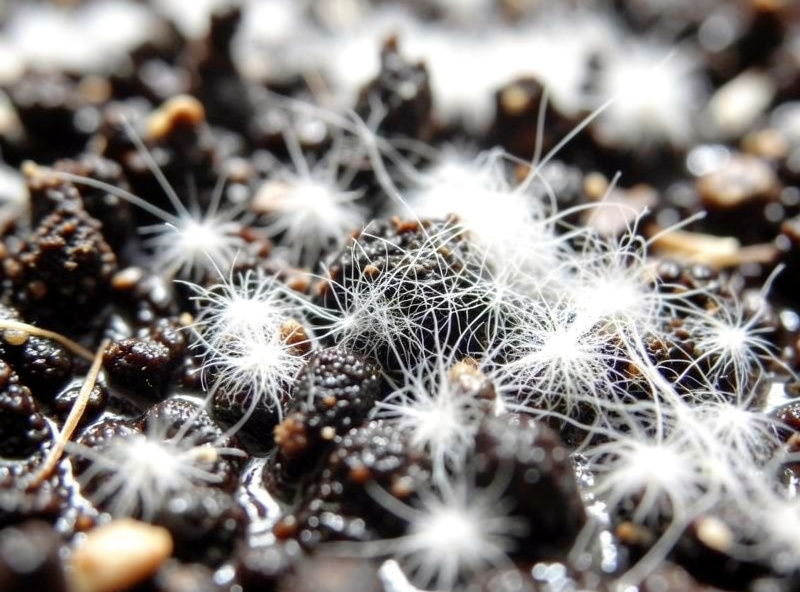
The texture is the giveaway. Saprophytic mould sits on top of the mix as a fine, dry fuzz like a thread of cobweb pressed flat against the wet surface, barely attached, that lifts when you breathe on it. It grows across the surface in patches rather than around individual stems, and it stays white or pale grey. The moulds that attack seedlings behave differently — they work at the soil line on the stem itself, and the seedling topples. The University of Minnesota Extension’s seedling-disease guidance keeps these two cleanly separate, and holding that separation in your head is the difference between composting a good tray and saving a bad one.
Is White Mold the Same as Damping Off?
No, and confusing the two is the mistake that costs trays. White saprophytic mould on the surface is generally harmless to the seedlings; damping off is a disease that kills them. Damping-off fungi — Pythium and Rhizoctonia, the same ones I describe in the damping-off guide — attack the soft stem right at the soil line, constrict it to a wet thread, and topple the seedling. The mould you see on top of the soil is a different organism doing a different job, and a seedling standing upright through a patch of white fuzz is almost certainly fine.
A practical test, if you are unsure which you are looking at: look at the stem, not the soil. If the white growth is only on the surface of the mix and the seedlings stand firm and green with clean stems at the soil line, it is saprophytic mould and the seedlings are fine. If a seedling’s stem is soft, pinched, or marked with a water-soaked band right where it meets the soil, that is damping off working on the plant itself, and that seedling is in trouble regardless of what is on the surface. The location of the growth — on dead media versus on the living stem — is the whole diagnosis.
The two are linked, though, and this is the important part: the conditions that grow harmless surface mould are the same conditions that invite damping off. Both love a wet surface, still air, and organic media. So while the white fuzz itself is not killing your seedlings, it is a clear signal that the tray is too wet and too poorly ventilated — and if you leave that environment in place, damping off is the next thing that arrives. Treat the mould as an early warning and fix the environment, and you prevent the disease that would actually matter. If you are growing microgreens rather than tray seedlings, the surface-mould question has its own wrinkles, and the microgreens mould-versus-root-hair guide covers those.
Why Does Mold Grow on Seed-Starting Soil?
Four things together: a wet surface, an organic medium, still air, and low light at the surface. Seed-starting mix is deliberately high in fine organic material — coir, peat, compost — because that is what holds water and gives a soft bed for a root to push through. That same organic matter is food for saprophytic fungi, and when it stays wet and sits in still air under a humidity dome, the mould spores that are everywhere in the air land on it and germinate. The surface of the mix is the perfect nursery because it is wet, organic, and exposed.
A humidity dome makes it worse, because it traps the moisture evaporating from the mix and holds a layer of saturated, still air right against the surface. I use domes for germination, when the seeds need constant moisture to sprout, but the dome comes off the moment the first seedlings emerge — after that, the dome is solving a problem you no longer have and creating one you do. The other contributor is top-watering, which keeps the surface wet; bottom-watering pulls moisture up from below and leaves the surface drier, which is why I bottom-water and tip out the runoff. A wet surface under still air under a dome is the recipe for white fuzz, and breaking any one of those three breaks the mould.
The freshness of your media plays a part too. A bag of seed-starting mix that has been sitting open and damp in a shed has already been colonised by mould spores, and you are essentially sowing into a ready-made mould culture. I keep my mix dry and sealed between uses, and I wet only what I need for a sowing rather than damping a big batch that sits around. Coir, which I use as the base of my own mix, is less prone to surface mould than peat because it rewets cleanly and holds air, but any organic medium will grow fuzz if you keep its surface wet and still. The mould is not a sign of a bad mix; it is a sign of a wet surface on a good one.
How Do I Get Rid of White Mold on Seedling Soil?
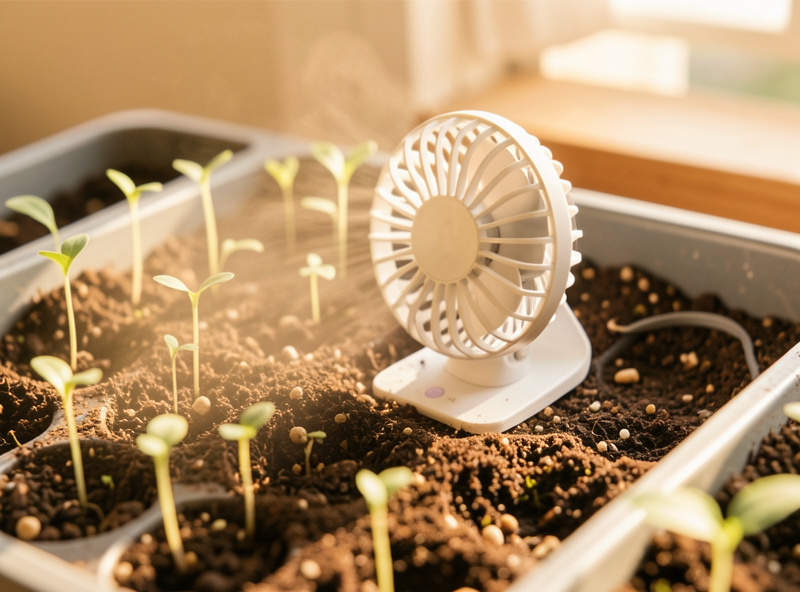
Fix the environment and the mould retreats on its own; scraping it off treats the symptom, not the cause. The first move is airflow — a small clip-on fan running on low across the tray dries the surface and breaks the still, saturated air the mould needs, and it is the same fan I use to prevent damping off. The second is to water less and from below, so the surface of the mix is allowed to dry between waterings rather than staying perpetually wet. The third is to remove the dome if it is still on, and to thin any crowded seedlings that are trapping moist air between them. Within a few days of those changes the white fuzz usually shrinks back and disappears.
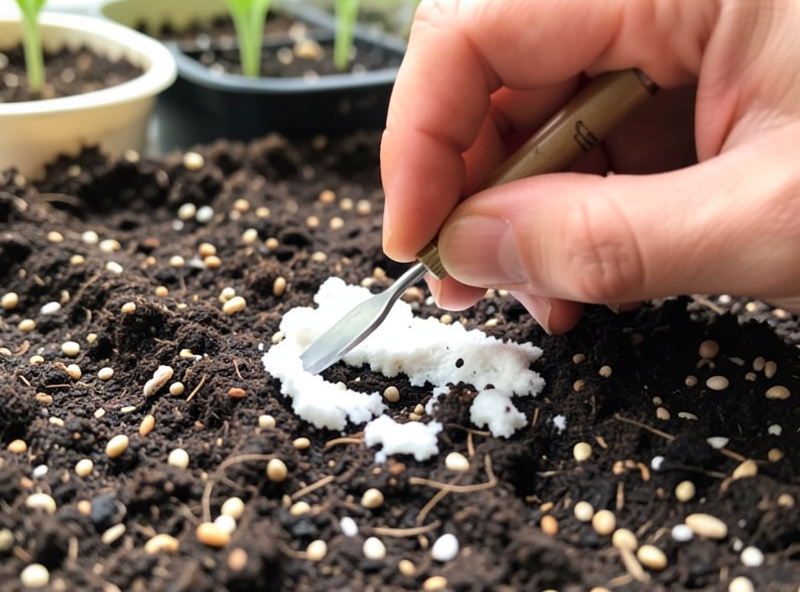
If a thick mat of mould is sitting on the surface, you can scrape it off gently with a tool or a spoon — the drained trays I use make this easy because the surface is accessible and not waterlogged — but understand that the mould will return if the surface stays wet. Sprinkling cinnamon on the surface is a popular home remedy, and cinnamon does have mild antifungal properties, but in my experience it is unreliable as a cure and no substitute for drying the tray out. I have sprinkled cinnamon on a mouldy surface and felt virtuous about it; the mould came back in three days because the mix was still saturated. Fix the moisture first, and the mould largely takes care of itself.
For a stubborn patch that will not retreat with drying alone, a light spray of diluted hydrogen peroxide — ordinary pharmacy peroxide cut with several parts water — knocks the surface mould back without harming the seedlings, and it breaks down to water and oxygen so there is no residue to worry about. I reach for it only after I have already fixed the airflow and the watering, because it is a stopgap rather than a cure; spray the mould, and it still comes back if the surface stays wet. Used sparingly on a tray you have already dried out, it is a useful nudge. Used as a substitute for fixing the environment, it is a waste of time.
Is the Mold Harmful to Touch or Breathe?
For most people, no, not in the amounts you meet on a seedling tray. Saprophytic moulds of this kind are not pathogens, and handling the tray or scraping the surface is low risk for a healthy adult. The sensible cautions are the ones you would take with any mould: wash your hands afterwards, avoid getting a face full of it, and do the scraping gently rather than flicking dry spores into the air. If you have a mould allergy, asthma, or a sensitivity to fungal spores, wear a mask for the cleanup and let someone else do it if it bothers you — caution here is reasonable without being alarmist.
The one thing I would not do is leave a heavily mouldy tray sitting in a living space you spend a lot of time in, especially a bedroom, simply because you do not need the spore load. A tray with a little surface fuzz on a well-ventilated shelf is nothing to fear; a tray that has gone to a thick, coloured, wet mould — green, black, pink — is a different conversation, and that one I would empty and clean up promptly. The common white fuzz on wet seed-starting mix is in the harmless category, and the Royal Horticultural Society’s mould and disease advice treats it as a cultural problem to dry out rather than a hazard. The fan that dries the surface also keeps the air moving past your face, which is another point in its favour.
What I’d Do Starting Today
If you see white fuzz on your seed-starting soil this morning, first check the seedlings themselves. If they are upright, green, and firm at the soil line, the mould is harmless and the tray is fine — you have a moisture problem, not a disease. Lift the humidity dome off for good, get a fan moving gently across the surface, and switch to bottom-watering so the top of the mix can dry. The fuzz will shrink back within days, and the seedlings will be healthier for the drier air regardless.
Then keep the conditions that prevent it coming back: a dome only until germination, bottom-watering with the runoff tipped out, a fan running whenever the lights are on, and seedlings thinned enough that air moves between them. Build those in and the white fuzz stops appearing, and so does most of the damping off it was warning you about. The wider seedling-failure picture — the purple leaves that mean cold roots, the leggy stretch from low light, the trays that stall for other reasons — is laid out from the main diagnosis hub, and the capillary watering I rely on is the trick that keeps the surface dry even when I am away.