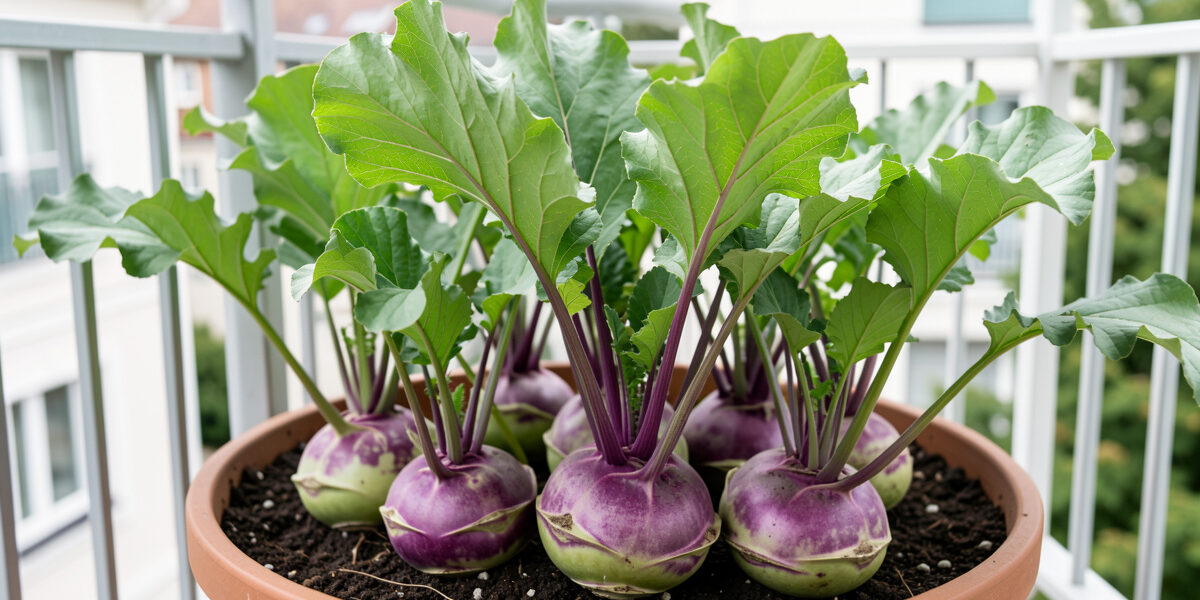
Kohlrabi is the easiest and fastest brassica to grow in pots, cropping in around 55–60 days from a swollen stem that sits above the soil — which is why it thrives in a small 7–10 litre container where a cabbage or cauliflower would be cramped. Harvest it young, around tennis-ball size, and it’s crisp, mild and sweet; leave it too long and it turns woody.
If you’ve never grown a head-forming brassica in a container, start here. Kohlrabi sidesteps the two things that make the rest of the family demanding: you’re not waiting for a big head to form, and you’re not feeding a giant leaf frame, so a missed watering or a small pot doesn’t end the crop. It’s the gateway brassica — quick, forgiving, and genuinely good raw straight off the plant. I keep a couple of pots of it in succession all season precisely because it asks so little and turns around so fast.
Why Kohlrabi Suits Small Pots
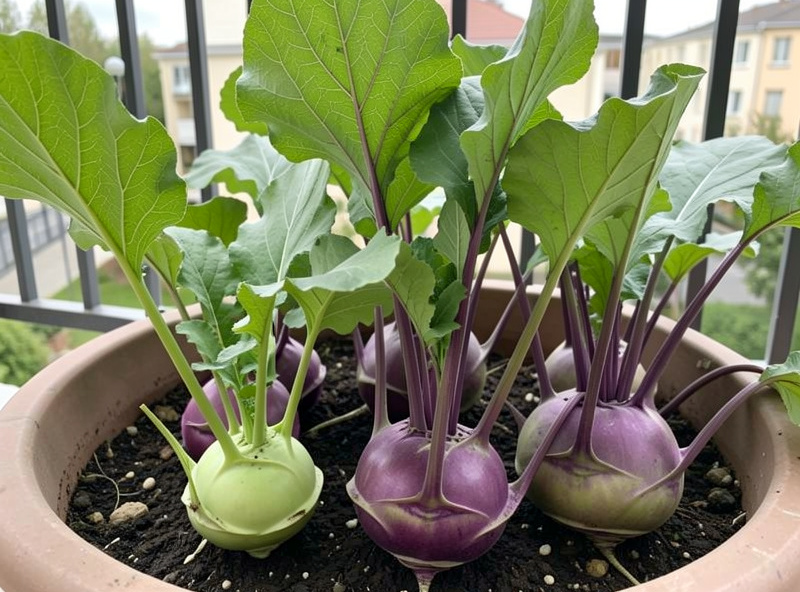
Kohlrabi is grown for a swollen stem that develops at soil level, not a deep root or a big head, so it needs far less container depth than other brassicas — a 7–10 litre pot around 20 cm deep is plenty for two or three plants. That shallow-pot tolerance makes it the obvious choice for a small balcony or a windowsill box where depth is the constraint.
The edible part is the bulbous base of the stem, sitting on top of the mix like a little spaceship with leaves coming off it, so the roots underneath are modest. That’s the whole reason it works where the deep-rooting members of the family struggle. I grow it in shallow troughs and in the gaps around bigger plants, two or three to a 10-litre pot, and it bulks up happily as long as the mix stays damp. It’s less of a heavy feeder than a cabbage too — the standard rich free-draining container mix from the brassicas hub guide with some worm castings worked in carries a kohlrabi crop without much extra fuss.
Sowing, Spacing, and Succession
Sow kohlrabi every 3–4 weeks from spring through late summer for a continuous supply, spacing plants about 15 cm apart. Because it crops so fast — under nine weeks — succession sowing is the way to grow it: a steady trickle of tender young bulbs beats one big batch that all turns woody at once while you’re still eating the first few.
This succession habit is what makes kohlrabi so useful in a small space. A pot that finishes in July goes straight back into production with a fresh sow, and I keep a rolling supply from late spring right up until the autumn cold slows growth. You can direct-sow it into the pot once the weather warms, or start it under a light like the rest of the brassicas for the earliest crop — kohlrabi transplants fine if you move it young, before the stem starts swelling. Don’t sow it all at once: a glut of kohlrabi is a glut of woody kohlrabi, because they don’t hold their tender window for long once they hit size.
Harvest Young or It Turns Woody
Harvest kohlrabi when the swollen stem is 5–8 cm across — roughly tennis-ball size — for crisp, sweet, tender flesh. Past about that size, especially on the older green varieties, it gets fibrous and woody at the core. Cut it at the base, trim the leaves (they’re edible too, like a mild kale), and use it fresh.
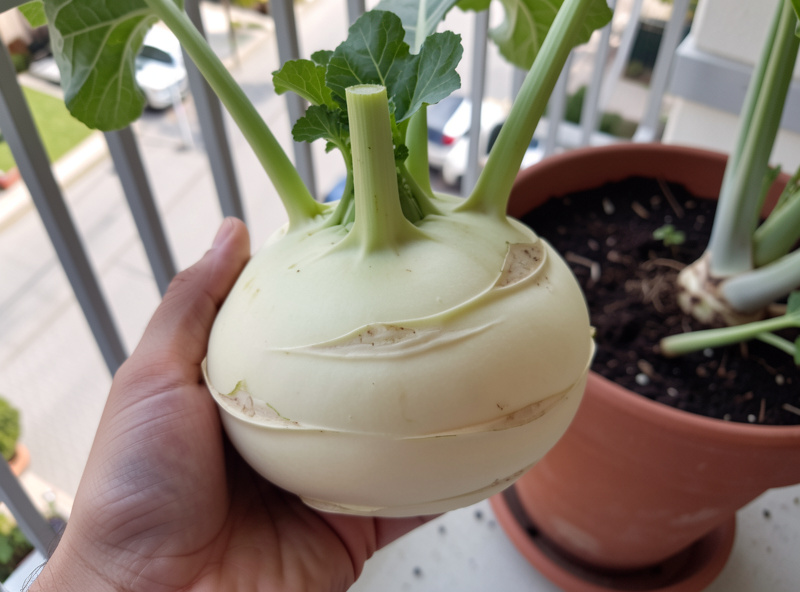
The single mistake everyone makes with kohlrabi is leaving it on the plant to get bigger, the way you would a cabbage. Resist it — bigger kohlrabi is worse kohlrabi. The young bulb is crunchy and mild, somewhere between an apple and a broccoli stem, lovely raw in slices or grated into a slaw; the over-grown one is tough and needs cooking to be palatable. The modern varieties bred to “stand” hold their tender texture at a larger size much better than the old types, so if you tend to forget a harvest, grow one of those. Don’t waste the leaves, either — the young foliage cooks down like a mild kale, so a single plant gives you both the crunchy bulb and a handful of greens, which is good value from a small pot. I tend to peel the bulb thinly, since the outer skin can be a little tough even on a young one, and the pale flesh underneath is the best part raw. Steady moisture matters here too: a kohlrabi that dries out and then drinks can split its bulb, the same way a cabbage splits its head, so keep the mix evenly damp with a self-watering setup or just consistent watering.
Green, Purple, and Giant Varieties
Kohlrabi comes in green (pale white-green) and purple-skinned types, plus large “stands-without-going-woody” varieties bred to hold their tender texture at size. The flesh is creamy white inside all of them; the purple skin is just skin-deep colour. For containers, the fast green types are the quickest, the purple ones are a touch hardier and prettier, and the giant types suit a forgetful harvester.
I grow both colours for the look of a mixed pot — pale and deep purple stems side by side is genuinely handsome on a balcony — but flavour-wise there’s little between them when picked young. The one variety distinction that matters in practice is the modern “giant” kohlrabi: unlike the old green types that go woody the moment they pass tennis-ball size, these are bred to stay crisp and sweet even when they reach the size of a grapefruit or bigger. If you know you’ll forget a harvest or two, those are the safer bet, because they remove the narrow tender window that catches people out. The faster small types are better for tight succession sowing where you’re cropping young anyway. Either way, kohlrabi seed is cheap and germinates fast, so it’s a low-stakes crop to experiment with. The RHS kohl rabi guide is a solid reference for sowing times and spacing if you want to cross-check the basics.
Common Kohlrabi Problems in Pots
Kohlrabi has few problems, but the handful that crop up in containers are all preventable: woody bulbs from harvesting late, split bulbs from inconsistent watering, a plant that bolts to flower instead of swelling, and leaf damage from flea beetle. None of them are serious if you catch the cause, and most trace back to either timing or moisture.
Bolting — the plant sending up a flower stalk instead of swelling its stem — happens when a young plant gets checked by cold after transplanting or by a hot dry spell, the same stress response you see across the brassica family. Move plants out only once the weather has settled, and keep them growing steadily without a check. A bulb that fails to swell at all usually means the plant is too crowded or starved of light, so thin to the right spacing and give it a bright spot. The watering rule is the same one that governs every brassica in a pot: even moisture, never a swing from bone-dry to flooded, which is what splits a bulb or toughens the flesh. Because kohlrabi grows so fast, a deficiency rarely has time to develop in a decent compost-and-castings mix, which is part of why it’s such a beginner-friendly crop.
Cold Tolerance and Fewer Pests
Kohlrabi is hardy and handles cold well, so it works at both ends of a short Nordic season — an early spring crop under cover and a late autumn one that takes light frost. It also draws slightly less pest pressure than the leafy, heading brassicas, though cabbage whites and flea beetle will still find it, so the same netting rules apply.
I’ll often run kohlrabi as my first and last brassica of the year because it shrugs off the cool shoulder weather that bookends our season, and a touch of frost on a late crop does it no harm. It’s not pest-proof, though — flea beetle pepper the leaves with little shot-holes in warm spells, and cabbage whites will lay on it like any brassica — so I still net the pots. Because there’s no dense head for caterpillars to bore into, the damage tends to be cosmetic leaf-munching rather than crop-ruining, but the container pest routine is worth following to keep plants growing cleanly. A row cover doubles as both pest exclusion and a few degrees of frost protection for the early and late sowings.
Where to Go Next
Once kohlrabi has shown you how easy a container brassica can be, the rest of the family is the natural next step — and the feeding, watering and pest logic all carry straight over. A forgiving container cabbage is the obvious follow-on, broccoli in a balcony pot rewards you with weeks of side shoots, and when you’re ready for the challenge, cauliflower is the family’s graduation crop. For the feeding side of all of them, see the fertilizing brassicas guide, and the whole system ties together in the container brassicas hub.