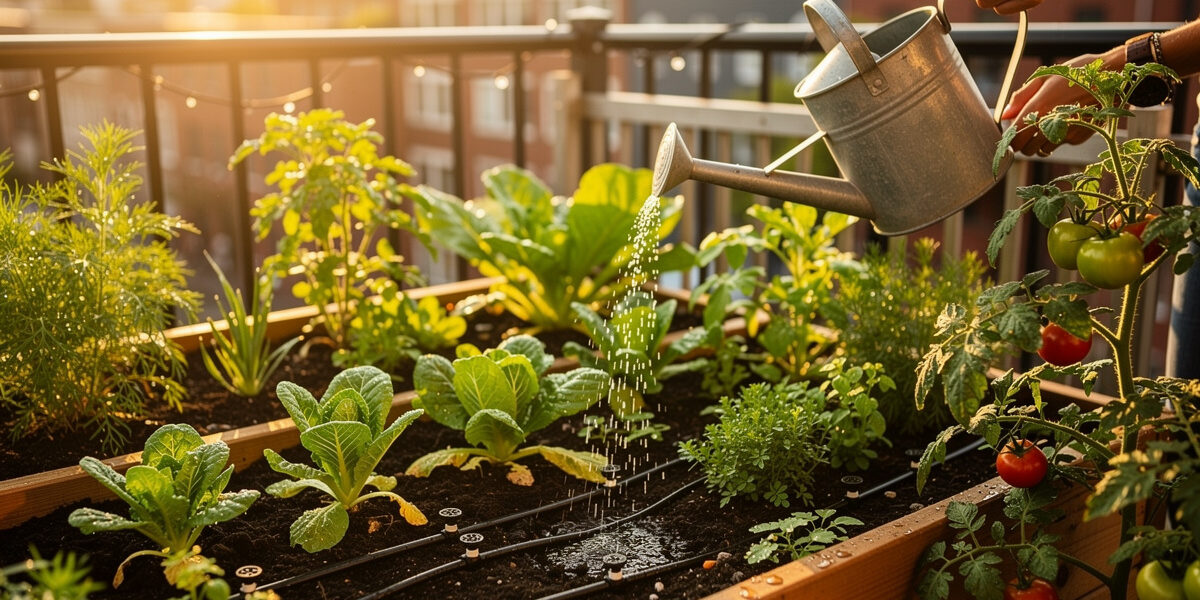
To water a garden well, water deeply but less often: soak the root zone until it is wet 15–20 cm down, then wait until the top 3–4 cm dries before you water again. For most containers in summer that is every 1–2 days; for raised beds, every 3–4 days. Frequency is the wrong question — depth and timing are what keep roots alive.
That single habit — deep, infrequent soaks instead of a daily splash — fixes more sick plants than any gadget I have ever bought. I have grown food on a Swedish balcony and a couple of raised beds for years now, killing plenty along the way, and watering is where most of those deaths actually happened: not too little water, but the wrong rhythm. This guide is the whole system I use, from reading soil moisture by hand to choosing between a drip line, an self-watering insert, and a clay olla — and the cold-climate quirks the US gardening internet never mentions.
How Often Should You Water a Garden?
There is no universal schedule — a fabric pot in August dries out four times faster than the same plant in a deep raised bed in May. The honest answer: water when the top 3–4 cm of soil is dry, not on a fixed calendar. In peak Nordic summer that lands at roughly every 1–2 days for containers and every 3–4 days for beds, but a cool cloudy week can stretch that to once a week.
The mistake almost everyone makes is watering on autopilot — a little every morning regardless of weather. Shallow daily sips keep the surface damp and the deeper soil bone dry, so roots stay near the top where they cook in the first heatwave. What you want is the opposite: a thorough soak that drives roots downward, then a drying period that pulls air back into the soil. Roots need oxygen as much as water; permanently wet soil drowns them. Your watering can is really an air pump as much as a water source.
How to Tell When Plants Actually Need Water
Skip the schedule and read the soil directly. The finger test is the most reliable free tool you own: push a finger in to the second knuckle (about 4 cm). If it comes out with cool, damp soil clinging to it, wait. If it is dry and crumbly that deep, water now. I check three or four pots this way every evening in summer and it takes under a minute.
Two more reads I trust more than any app. Pot weight: lift a container right after watering and again two days later — a dry pot is dramatically lighter, and after a week you can tell hydration by heft alone. A cheap moisture meter settles arguments in deep beds where your finger can’t reach the root zone; I treat the reading as a second opinion, not gospel, because compacted or salty soil throws them off. Wilting is a last-resort signal, and a misleading one — squash and big-leaf plants flop in midday heat even with wet roots and recover by evening, so never water on midday wilt alone. Check the soil first.
How Much Water Plants Need: Beyond the “Inch a Week” Rule
The classic advice is “2.5 cm (one inch) of water per week.” It is a fine starting point for open ground but it falls apart in containers, which is exactly where small-space growers live. A pot has no surrounding soil to wick from and a huge surface area relative to its volume, so it can need that “weekly inch” every single day in a heatwave.
The number that actually matters is reaching the bottom of the root zone. Water until it runs freely from the drainage holes — that tells you the whole column is wet, not just the top. Then let it dry down. Underneath this table sits the only rule that travels: match the volume to the container depth and the weather, not to a calendar.
| Setup | Typical summer frequency | How much per watering | Watch-out |
|---|---|---|---|
| Small pots (under 5 L) | Daily, sometimes twice | Until it drains out the bottom | Dry out fastest; worst for heat stress |
| Large containers (15–40 L) | Every 1–2 days | 2–4 L until runoff | Check weight; surface can mislead |
| Fabric grow bags | Every 1–2 days | Generous — sides evaporate too | Faster drying than plastic |
| Raised beds (30 cm+ deep) | Every 3–4 days | Long slow soak, 10–15 min | Deep, infrequent beats daily sips |
| Self-watering / wicking | Refill reservoir every 4–7 days | Top up reservoir only | Still flush from the top monthly |
| Seedlings / trays | Daily, lightly | Mist or bottom-water | Never let the surface fully dry |
For the full treatment of pot choice, depth, and drainage that drives all of this, my container gardening guide and the raised beds and planters guide are the companion pieces.
The Best Time of Day to Water
Early morning is best, full stop. Watering between roughly 5 and 9 a.m. gives plants a full reservoir before the heat of the day, lets foliage dry quickly (wet leaves overnight invite fungal disease), and loses the least to evaporation. A morning soak can be 20–30% more efficient than the same water applied at midday.
If mornings are impossible, early evening is the acceptable backup — but aim the water at the soil, not the leaves, so foliage isn’t sitting wet through a cool Nordic night. Midday watering isn’t the “scorched droplet lens” myth people repeat (that’s largely nonsense); the real problem is that you lose a big fraction to evaporation before it ever soaks in. The one exception: a plant in genuine acute wilt at noon should be watered immediately — a slightly less efficient drink beats heat death.
Watering Containers, Raised Beds, and Balcony Pots Differently
The single biggest variable in how you water is what the plant is growing in. Containers are the hardest mode and where small-space growers spend most of their time, so they deserve the most attention. The smaller and shallower the pot, the more often you’ll be out there with the can.
On a balcony the constraints stack up: pots heat from all sides (including the rail and the wall behind them reflecting sun), there’s often no rain reaching them under a balcony above, and weight limits cap how much soil — and therefore water buffer — you can carry. The fix is bigger pots wherever the structure allows, grouping containers so they shade each other’s sides, and a mulch layer on top to cut surface evaporation. My balcony gardening guide and the focused balcony vegetable garden walkthrough cover the structural side; here we’re just on water. Fabric grow bags deserve a special note — their breathable walls give fantastic root health but evaporate from the sides as well as the top, so they’re the thirstiest container of all.
Watering Methods Compared: Hand, Drip, Soaker, Olla, Self-Watering
Once you’re past a handful of pots, hand-watering every day becomes the thing that quietly kills your enthusiasm. The right delivery system isn’t about luxury — it’s what keeps plants evenly watered when life gets busy and what makes a week away possible. I’ve run all of these side by side on the same balcony, and each earns its place in a different situation.
The table below is the honest verdict. There’s no single winner: hand-watering wins for attentiveness and seedlings, drip wins for a busy summer, ollas win for unpowered set-and-forget, and self-watering containers win for the balcony grower who travels.
| Method | Best for | Effort after setup | Cost | Watering interval |
|---|---|---|---|---|
| Hand-watering (can/wand) | Few pots, seedlings, attentive growers | High — daily in summer | Low | Daily |
| Drip irrigation + timer | Many containers or a bed, busy weeks | Very low | Medium | Automated, 1–2×/day |
| Soaker hose | Rows in a raised bed | Low | Low–medium | Every 2–3 days |
| Olla (buried clay pot) | Beds and large pots, no power | Very low | Low | Refill every 3–7 days |
| Self-watering container | Balconies, travel, thirsty crops | Very low | Medium | Refill reservoir weekly |
| Wicking bed | Larger raised beds, water efficiency | Very low | Medium (build) | Refill reservoir weekly |
If you want automation without plumbing the whole balcony, a timer-driven drip kit is the highest-leverage upgrade you can make — I cover the off-grid version in my solar-powered drip irrigation build and the plug-and-play route in the Gardena balcony watering setup guide. For the no-power, no-gadget approaches, ollas and wicking beds are covered in their own spoke guides linked at the bottom.
How to Water Seedlings and Transplants
Seedlings play by different rules: their roots are shallow and tiny, so the surface must never fully dry out, but a heavy stream will flatten them and a soggy tray invites damping-off — the fungal collapse that fells seedlings overnight. The answer is gentle, frequent, and from below. Bottom-watering (sitting the tray in 1–2 cm of water for 20 minutes) draws moisture up to the roots without battering the stems or wetting the foliage.
As seedlings establish and you pot them on, start stretching the interval to encourage roots to chase water downward — this is how you build a sturdy plant instead of a leggy one. Newly transplanted seedlings get one thorough watering-in to settle soil around the roots, then a slightly drier regime so the roots explore. My tomato seedling guide and the microgreens walkthrough both go deeper on tray watering for those specific crops.
Signs of Overwatering vs Underwatering
The cruel irony is that overwatering and underwatering look almost identical — both produce wilting, yellow leaves, and a sad-looking plant — because both end in roots that can’t take up water. Underwatered soil is dry and pulled away from the pot’s edge; overwatered soil is wet, often smells sour, and the roots have started to rot, so the plant droops in soaking-wet soil. Always check the soil before you reach for the can.
Overwatering kills more container plants than drought does, especially indoors and in pots without drainage holes. Yellow lower leaves, a mushroom-y smell, fungus gnats hovering, and mould on the soil surface all point to too much water, not too little. The fix is almost never “water more” — it’s better drainage, a more open soil mix, and letting the pot dry down properly between waterings. The separate overwatering spoke linked below is the full diagnostic.
Keeping a Garden Watered While You’re Away
A week’s holiday is where unwatered containers go to die — a small pot in July can’t survive three days unattended. The reliable solutions, in order of how much I trust them: a timer-driven drip system (set it before you leave and test it for two days first), self-watering containers with full reservoirs, and buried ollas for beds. Wick systems and water-bottle spikes are fine as a backup for a single weekend but won’t carry thirsty plants through a hot week.
Before any trip, move pots out of direct afternoon sun and group them tightly so they shade each other and trap humidity, then mulch every surface. Halving a plant’s sun exposure roughly halves its water demand, which can turn “dead in three days” into “fine for a week.” Whatever automated system you use, run it for 48 hours before you leave — a kinked drip line you discover from the airport is worse than no system at all.
Mulch: The Cheapest Way to Water Half as Often
If you do only one thing to cut your watering workload, mulch the surface of every pot and bed. A 3–5 cm layer of mulch shades the soil, slashes evaporation from the surface, and can reduce how often you need to water by a third to a half. Bare soil in a sunny pot loses water from the top all day; covered soil holds it where the roots are.
For containers I use whatever is cheap and to hand — wood chips, bark, leaf mould, even a layer of gravel on the most ornamental pots. In beds, straw and shredded leaves work well and break down into the soil over the season, which is a quiet bonus for soil structure. Keep the mulch a couple of centimetres clear of plant stems so they don’t sit damp and rot. The one caveat for seedlings: don’t heavily mulch a freshly sown tray, because the surface needs to stay reachable and you don’t want to bury the emerging shoots. Mulch goes on once plants are established and standing tall.
Water Quality and Temperature
Most plants are far less fussy about water than the internet suggests — ordinary tap water is fine for nearly everything you’ll grow in containers. The one habit worth keeping is letting a watering can stand for an hour or two so the water comes to room temperature; ice-cold water straight from the tap shocks warm-soil roots, especially on heat-loving crops like tomatoes and peppers. In a Nordic apartment that tap water can be genuinely cold, so I keep a full can resting indoors between waterings.
Rainwater is better still where you can collect it — it’s soft, free, and at ambient temperature, which is why a small rain barrel pays for itself fast on a balcony or terrace. If your tap water is very hard, the white crust you see on pot rims and soil is mineral build-up, and flushing the pot thoroughly once a month (watering until plenty runs out the bottom) leaches those salts back out before they stress the roots. That monthly flush matters most for self-watering and wicking setups, where salts otherwise accumulate in the reservoir-fed soil.
Cold-Climate and Low-Light Watering Notes
Most watering advice online is written for long, hot, dry growing seasons — and up north it can actively mislead you. In a Nordic spring, soil is cold and plants are barely transpiring, so the same pot that needs daily water in July might need water once a week in May. Cold wet soil plus a tender transplant equals rot, not growth. I water far less in shoulder season than the calendars suggest, and I let cold beds dry more between soaks.
Indoors under grow lights the rules flip again: heated apartment air is dry and pulls moisture from pots quickly, but short winter days mean slow growth and low water uptake, so it’s easy to overwater a plant that simply isn’t drinking much. Check the soil, not the schedule. And anything overwintering — herbs on a windowsill, dormant containers — wants to stay barely moist, never wet, or the roots sit cold and sodden until they rot. The cold-climate, low-light lens is the part the warm-region channels skip, and it’s the part that actually keeps Nordic plants alive.
Good watering also starts with good soil. A mix that holds moisture without going waterlogged is half the battle — see best potting soil for vegetables and best soil for raised beds for the blends I actually use, and feeding the soil with home compost improves water retention more than any product on a shelf. For the indoor crops, growing lettuce inside and the indoor herb garden guides cover their specific watering quirks, and fertilizing tomatoes ties watering to feeding for the thirstiest crop on the balcony.
Frequently Asked Questions
How often should I water my garden?
Water when the top 3-4 cm of soil is dry, not on a fixed schedule. In peak summer that is roughly daily for small pots, every 1-2 days for large containers, and every 3-4 days for raised beds. Cool weather can stretch it to once a week.
Is it better to water in the morning or evening?
Early morning, between 5 and 9 a.m., is best. Plants get a full reservoir before the heat, foliage dries quickly to avoid disease, and you lose the least water to evaporation. Evening is an acceptable backup if you water the soil, not the leaves.
How do I know if I am overwatering?
Overwatered plants wilt in soil that is still wet, often with a sour smell, yellow lower leaves, mould on the surface, and fungus gnats. Always check the soil before watering: if it is wet and the plant is drooping, the problem is too much water, not too little.
How much water do container plants need?
Water until it runs freely from the drainage holes, which means the whole root zone is wet, then let the top few centimetres dry before watering again. Small pots may need this daily in summer; large containers every 1-2 days.
How can I keep my garden watered while on holiday?
A timer-driven drip system is the most reliable, followed by self-watering containers and buried ollas. Test any system for 48 hours first, move pots out of direct sun, group them together, and mulch the surface to roughly halve water demand.
Should I water seedlings from the top or bottom?
Bottom-water seedlings by sitting the tray in 1-2 cm of water for about 20 minutes. This draws moisture to the roots without battering the fragile stems or wetting foliage, which prevents damping-off, the fungal collapse that kills seedlings overnight.
Why are my plant’s leaves yellow even though I water it?
Yellow leaves with wet soil usually mean overwatering and the start of root rot, not thirst. Roots need oxygen, and constantly soggy soil suffocates them. Improve drainage, use a more open soil mix, and let the pot dry down between waterings.
Related Guides
- Vegetable Garden Watering Schedule by Growth Stage
- Olla Irrigation: Clay Pot Watering for Containers
- DIY Wicking Bed: Self-Watering Raised Bed Build
- Small-Space Rainwater Harvesting for Balconies
- Signs of Overwatering Plants and How to Fix It
- How Often to Water Seedlings Indoors
- Solar-Powered Drip Irrigation: Panel and Battery Sizing
- DIY Self-Watering Planter: 3D-Printed Reservoir Inserts
- Gardena Balcony Watering System — Setup Guide
- Container Gardening: The Complete Guide
- Raised Beds & Planters Guide